
Artemisinin: From Ancient Chinese Medicine to Modern Cancer Research |
The Nobel Prize-winning compound that selectively destroys cancer cells through a mechanism the pharmaceutical industry wishes they'd discovered |
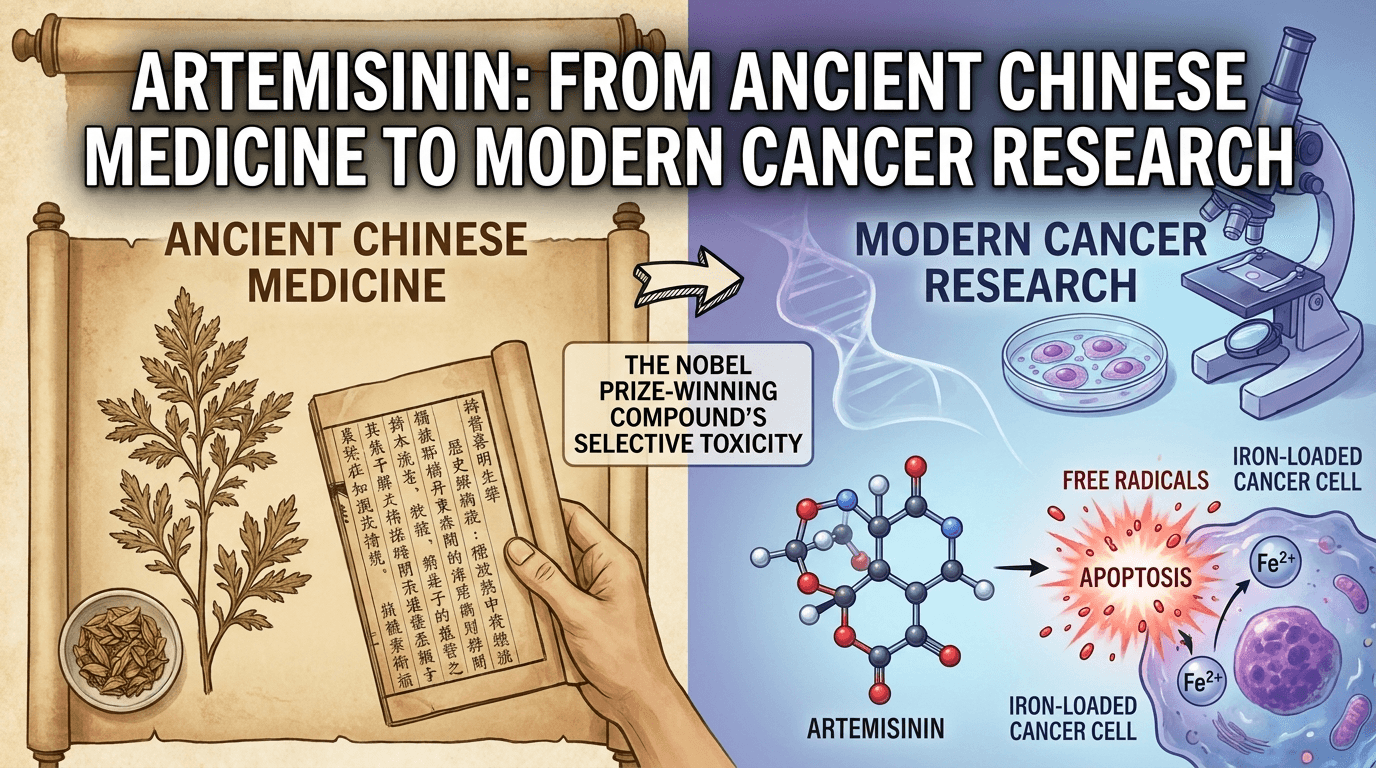
In the annals of medical suppression, few stories illustrate the criminal disconnect between effective treatment and pharmaceutical profit quite like artemisinin. Here is a compound with demonstrated selective toxicity to cancer cells, derived from a plant used successfully for thousands of years, validated by modern Nobel Prize-winning research - and yet virtually ignored by the cancer industry that continues to push their poison of choice: chemotherapy.
The story begins not in a pharmaceutical laboratory but in ancient Chinese medical texts. Artemisinin, extracted from sweet wormwood (Artemisia annua), was documented as a fever treatment over 2,000 years ago. While Western medicine was still bleeding patients with leeches and poisoning them with mercury, Chinese physicians were using this plant to treat malaria with remarkable success. The compound sat in dusty archives, another victim of medical colonialism that dismissed non-Western knowledge as primitive superstition.
Enter Dr. Youyou Tu, a researcher in Maoist China's Project 523, tasked with finding malaria treatments for North Vietnamese soldiers. Operating with limited resources and drawing from traditional Chinese medical literature, Tu and her team identified artemisinin as the active compound in sweet wormwood. By 1972, they had isolated it. By the 1980s, its effectiveness against malaria was undeniable. In 2015, Tu received the Nobel Prize in Physiology or Medicine - recognition that came decades late, after millions of malaria deaths that artemisinin could have prevented if the medical establishment hadn't been so committed to its synthetic drug pipelines.
But the malaria story, remarkable as it is, may be the least interesting application of this compound. What the pharmaceutical industry doesn't advertise - what they actively suppress in their funded research - is artemisinin's extraordinary mechanism of action against cancer cells. And it all comes down to iron.
Cancer cells are iron addicts. They require massive amounts of iron to fuel their rapid division, and they express far more transferrin receptors on their surface than healthy cells - up to 1000% more in some cancers. This iron hunger is their Achilles' heel. Artemisinin contains an endoperoxide bridge that reacts specifically with ferrous iron (Fe2+), breaking down and releasing a cascade of free radicals that destroy everything in their path. In healthy cells with normal iron levels, this reaction barely happens. In iron-loaded cancer cells, it's devastating.
The oxidative burst that follows is selective carnage. Artemisinin and its derivatives create a flood of reactive oxygen species inside cancer cells while leaving healthy tissue largely untouched. Studies have demonstrated this effect across multiple cancer types - breast, prostate, lung, leukemia, colon. The compound induces apoptosis (programmed cell death), inhibits angiogenesis (the blood supply tumors need to grow), and even appears to target cancer stem cells - the population responsible for recurrence and metastasis that conventional treatment seems to neglect, is this intentional?
Compare this to chemotherapy, the medieval poison still pushed as first-line treatment. Chemotherapy targets rapidly dividing cells indiscriminately - cancer cells, yes, but also hair follicles, gut lining, bone marrow, immune cells. The 'side effects' aren't side effects at all; they're direct toxic effects on healthy tissue. The therapeutic window - the difference between effective dose and lethal dose - is narrow and terrifying. Artemisinin, by contrast, exploits a biological difference between cancer and normal cells, creating a dramatically wider therapeutic window and far less collateral damage.
So why isn't artemisinin standard of care for cancer? Why do oncologists reach for compounds that destroy quality of life when a plant-derived molecule with millennia of safety data sits on the shelf? The answer is as depressing as it is predictable: you can't patent a plant. You can't charge $10,000 per treatment for something people can grow in their gardens. The pharmaceutical business model requires proprietary molecules, synthetic compounds they can exclusively manufacture and price-gouge. A natural compound with superior efficacy but inferior profit potential gets buried.
The research suppression is systematic. Studies showing artemisinin's anti-cancer effects get minimal funding. Positive results languish in obscure journals while pharmaceutical-funded research dominates medical education. Doctors graduate knowing dozens of chemotherapy protocols but never hearing about the compound that won a Nobel Prize for its life-saving properties.
There are strategies to enhance artemisinin's effectiveness. Combining it with iron supplements or hyperthermia treatments that increase cellular iron uptake. Using it with butyrate, a short-chain fatty acid that further sensitizes cancer cells. The iron-mediated mechanism suggests why bloodletting - ridiculed by modern medicine - might have had genuine therapeutic effects in iron-overloaded conditions. The ancients weren't always wrong; they just lacked the biochemical vocabulary to explain what they observed.
Youyou Tu's Nobel Prize should have triggered a revolution in cancer treatment. Instead, it was a footnote - a brief acknowledgment before the pharmaceutical machine continued its relentless promotion of profitable poisons over effective plants. The criminal negligence of suppressing effective treatments while pushing toxic ones represents one of the great moral failures of modern medicine.
Dr. Henry Lai and Dr. Narendra Singh at the University of Washington demonstrated artemisinin's selective toxicity to cancer cells in a series of groundbreaking studies beginning in 1995. Their research showed that artemisinin could kill cancer cells while leaving healthy cells relatively unharmed - due to that same iron-dependent mechanism that makes it effective against malaria. Cancer cells require 3-15 times more iron than normal cells for DNA synthesis, cellular division, mitochondrial function, and metabolic activity. Artemisinin exploits this metabolic difference with lethal precision, killing iron-rich cancer cells while sparing iron-poor normal tissue.
Subsequent research by Dr. Thomas Efferth's group at the German Cancer Research Center in Heidelberg identified artemisinin's activity against a broad spectrum of cancer cell lines - leukemia, colon cancer, melanoma, breast cancer, prostate cancer, ovarian cancer, lung cancer, and others. As previously mentioned the compound triggers apoptosis (programmed cell death) through multiple pathways, inhibits angiogenesis (preventing tumors from developing the blood supplies they need to grow), and shows remarkable synergy with conventional chemotherapy agents, potentially allowing dose reduction of toxic drugs while maintaining or improving efficacy.
The mechanism extends far beyond simple free radical generation. Artemisinin disrupts mitochondrial function in cancer cells specifically, increases intracellular calcium leading to cell death pathways, inhibits nuclear factor-kappa B (NF-κB) signaling that promotes cancer cell survival and proliferation, interferes with multiple growth factor pathways that cancer cells depend upon, and induces DNA damage that triggers cellular suicide mechanisms. Again this proves artemisinin's iron-dependent activation provides a degree of selectivity that spares normal tissues.
While the pharmaceutical industry has focused on developing synthetic analogs like artesunate, artemether, and dihydroartemisinin that can be patented and sold at high profit margins, the natural compound retains significant bioactivity and is far less expensive. The World Health Organization has restricted artemisinin monotherapy for malaria to prevent resistance development - but this restriction doesn't apply to cancer research, where combination approaches show the most promise and where resistance mechanisms differ fundamentally from those in malaria parasites.
Clinical trials using artemisinin and its derivatives for cancer treatment have shown promising results in early-phase studies. A pilot study by Dr. Singh's group found that oral artemisinin combined with iron supplements produced partial responses in patients with advanced, treatment-resistant cancer. European studies using intravenous artesunate have documented tumor regression in various cancer types including colon cancer and lung cancer. While large-scale randomized controlled trials are still needed, the preclinical evidence and early clinical findings support further investigation and integration into integrative oncology protocols.
Personally I think the problem with these studies is that they are always focused on one intervention, when simply adding an artemisinin extract to an ongoing natural therapy regimen may be the best way forward but don't take that as medical advice, please consult a professional.
The ancient Chinese physicians who used Artemisia annua for fever and ague didn't know about endoperoxide bridges, Fenton reactions, iron metabolism, or free radical chemistry. But they carefully documented clinical efficacy, preparation methods, optimal timing, and dosing through centuries of empirical observation and refinement. Modern pharmacology has validated what traditional medicine knew through experience: this plant contains something special, something that selectively targets iron-rich cells while sparing healthy tissue, something that can cure malaria and potentially offers hope in the fight against cancer.
Youyou Tu's Nobel Prize recognized not just a drug discovery, but the validation of traditional medicine as a legitimate source of modern therapeutics. In her acceptance lecture in Stockholm, she emphasized the importance of integrating traditional knowledge with modern scientific methods, of respecting empirical wisdom while applying rigorous scientific testing. The artemisinin story represents a bridge between two medical paradigms - one ancient, empirical, and holistic; the other modern, reductionist, and mechanistic. Both were necessary to unlock the compound's full potential and bring it to the millions who needed it.
Current research continues to explore artemisinin's potential applications against various diseases beyond malaria and cancer. Antiviral activity against cytomegalovirus, hepatitis B and C, and other pathogens shows promise. Anti-inflammatory effects for autoimmune conditions including rheumatoid arthritis and lupus are being investigated. Possible applications in treating certain parasitic infections beyond malaria, including schistosomiasis, offer hope for the developing world. The compound that saved millions from malaria may yet prove valuable across an even broader therapeutic landscape.
Artemisinin proves that nature solved problems long before laboratories existed. It demonstrates that selective toxicity - targeting cancer while sparing health - is possible without synthetic chemical warfare. And it exposes the cancer industry for what it truly is: not a search for cures, but a profit engine that treats patients as revenue sources and effective treatments as threats to be neutralized.
References1. Tu Y. (2011). The discovery of artemisinin (qinghaosu) and gifts from Chinese medicine. Nature Medicine. PMID: 21989013 2. Lai H & Singh NP. (1995). Selective cancer cell cytotoxicity from exposure to dihydroartemisinin and holotransferrin. Cancer Letters. PMID: 7567284 3. Meshnick SR. (2002). Artemisinin: mechanisms of action, resistance and toxicity. International Journal for Parasitology. PMID: 12359192 4. Efferth T. (2006). Molecular pharmacology and pharmacogenomics of artemisinin and its derivatives in cancer cells. Current Drug Targets. PMID: 16611029 5. Krishna S et al. (2008). Potentiation of the antimalarial activity of artesunate and amodiaquine by inhibitors of glutathione synthesis. Antimicrobial Agents and Chemotherapy. PMID: 18752857
|



0 Comments
Join the conversation
Be the first to comment
Share your thoughts above.