
Beyond Red Light: Why Multi-Wavelength Photobiomodulation Changes Everything |
The science behind 9-wavelength systems and why targeting multiple cellular pathways simultaneously amplifies healing potential |
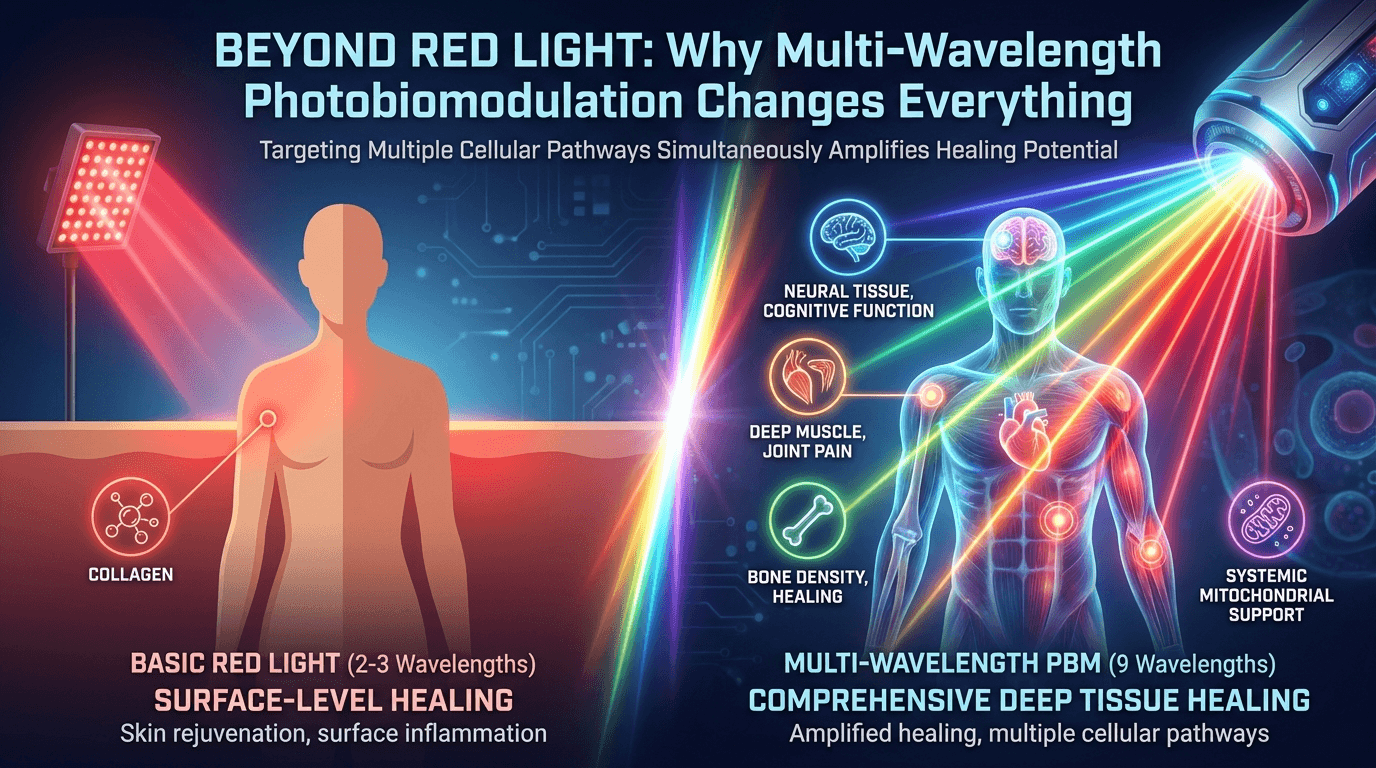
Most people think red light therapy is simple: turn on the red LEDs, sit in front of them for 10-20 minutes, and you're done. And to be fair, even basic 2-3 wavelength devices provide real benefits. But the science of photobiomodulation reveals why targeting multiple cellular pathways simultaneously with 9 distinct wavelengths changes everything.
After all, your body isn't operating on just one wavelength. Different tissues absorb different frequencies of light at different depths. One-size-fits-all might work for basic skin rejuvenation, but if you're serious about deep tissue healing, brain health, or systemic cellular support, you need a broader spectrum approach.
The Penetration Depth Problem
Here's the rub: visible red light (630-660nm) penetrates skin beautifully - 1-3mm deep, perfect for collagen synthesis and surface-level healing. But it doesn't reach deeper tissues. Near-infrared (NIR) wavelengths (810-1060nm) penetrate 5-20mm or more, reaching muscle, bone, and even crossing the blood-brain barrier to affect neural tissue.
The thing is, you need both shallow and deep penetration for comprehensive healing. Skin aging, hair loss, and surface inflammation respond to visible red. Deep tissue injuries, joint pain, cognitive function, and systemic mitochondrial support require NIR wavelengths that can reach subcutaneous structures.
A 9-wavelength system addresses this by spanning the entire therapeutic range from 480nm (blue) to 1060nm (deep NIR). Each wavelength targets specific chromophores - molecules that absorb light - at specific depths.
The 9-Wavelength Breakdown
480nm Blue Light - Surface antimicrobial action. Blue light in this range excites porphyrins in bacteria (particularly P. acnes), generating reactive oxygen species that destroy bacterial cells. Effective for acne, surface infections, and skin inflammation. Penetration: less than 1mm.
590nm Amber Light - Pigmentation and redness reduction. This wavelength specifically targets melanin and hemoglobin chromophores in the skin, making it effective for age spots, sun damage, and vascular lesions. Penetration: 1-2mm.
630nm Red Light - Collagen synthesis and skin aging. Red light at 630nm is absorbed by mitochondrial chromophores in fibroblasts, stimulating collagen and elastin production. NASA's original LED research used wavelengths in this range for wound healing in space. Penetration: 2-3mm.
660nm Deep Red Light - Hair growth and skin rejuvenation. This wavelength has been extensively studied for androgenetic alopecia (pattern hair loss) and deeper dermal healing. It penetrates slightly deeper than 630nm and is preferentially absorbed by cytochrome c oxidase in hair follicle mitochondria. Penetration: 3-4mm.
670nm Red/NIR Boundary - Retinal health and age-related macular degeneration (AMD). Research shows 670nm red light improves mitochondrial function in retinal cells, slowing or reversing dry AMD progression. The eye is uniquely accessible to light therapy since it's designed to absorb photons. Penetration (in retinal tissue): high absorption.
810nm Near-Infrared - Stroke recovery and deep brain penetration. The NEST-1 trial (Lampl et al., 2007) demonstrated that 810nm NIR light applied to the scalp within 24 hours of ischemic stroke improved outcomes at 90 days by enhancing neuronal mitochondrial function. This wavelength is at the peak absorption for cytochrome c oxidase, the key enzyme in mitochondrial ATP production. Penetration: 10-15mm (crosses skull bone).
830nm Near-Infrared - Deep tissue and systemic mitochondrial support. This wavelength penetrates even deeper than 810nm and has been studied for traumatic brain injury, muscle recovery, and joint pain. It's particularly effective for systemic inflammation reduction. Penetration: 15-20mm.
850nm Near-Infrared - Cognitive function and deep structural healing. Research shows 850nm NIR improves cerebral blood flow, reduces neuroinflammation, and supports neural repair mechanisms. Also highly effective for deep muscle and fascia healing. Penetration: 15-20mm.
1060nm Deep Near-Infrared - Deepest penetration, whole-body systemic effects. Water absorption is minimal at this wavelength (compared to 980nm, where water absorption spikes), allowing maximum tissue penetration. Effective for deep organ support, lymphatic drainage, and whole-body anti-inflammatory effects. Penetration: 20mm+.
Why Chromophore Targeting Matters
Keep in mind, different wavelengths don't just penetrate to different depths - they're absorbed by different molecular targets. The primary chromophores in photobiomodulation are:
Cytochrome c oxidase (CCO) - The terminal enzyme in the mitochondrial electron transport chain. Peak absorption: 810-830nm. When NIR light is absorbed by CCO, it enhances electron transport efficiency, increasing ATP production by up to 150% in some studies. This is the primary mechanism behind photobiomodulation's cellular energy boost.
Water - Broad absorption across the spectrum, with a major spike at 980nm (which is why we avoid that wavelength - too much heat, too little penetration). At therapeutic wavelengths (630-1060nm), water absorption is low enough to allow deep penetration while still providing some thermal stimulation of circulation.
Melanin - Absorbs strongly in the visible range (400-700nm), particularly blue and amber wavelengths. This makes 480nm and 590nm effective for pigmentation disorders but less effective for deep tissue healing.
Hemoglobin - Absorbs visible red light (630-660nm), which is why red light therapy improves circulation and why people with vascular lesions respond well to 590-630nm treatment.
Porphyrins (in bacteria) - Absorb blue light (400-480nm), leading to bacterial photodestruction. This is why blue light is antimicrobial while red and NIR are not.
The Synergistic Effect: Why 9 > 1
Of course, you could use a single wavelength device and get results. A quality 660nm panel will absolutely improve skin health. An 810nm device will help with deep tissue healing. But here's what they don't tell you: multi-wavelength systems aren't just additive - they're synergistic.
When you combine 630nm (surface collagen synthesis) with 810nm (deep mitochondrial activation) and 1060nm (systemic anti-inflammatory effects), you're not just treating three separate layers - you're triggering cascading cellular responses that amplify healing at every level.
Surface healing improves because deeper circulation is enhanced. Deep tissue healing accelerates because surface inflammation is reduced. Systemic energy production increases because multiple mitochondrial populations across tissue depths are simultaneously activated.
A 2013 study by Avci et al. published in Seminars in Cutaneous Medicine and Surgery (cited over 850 times) demonstrated that combining multiple wavelengths produced superior outcomes compared to single wavelengths in wound healing and collagen synthesis. The researchers proposed that multi-wavelength approaches activate complementary cellular pathways - nitric oxide release, growth factor upregulation, and reactive oxygen species modulation - that single wavelengths address incompletely.
The Clinical Evidence
Photobiomodulation isn't fringe science anymore. Over 4,000 peer-reviewed studies have been published on red and near-infrared light therapy, with clinical applications ranging from wound healing to traumatic brain injury to age-related cognitive decline.
NASA pioneered the research in the 1990s when they discovered that 670nm LED arrays accelerated plant growth in space and then healed wounds faster in astronauts. The military adopted the technology for battlefield wound treatment. And now mainstream medicine is catching up - slowly, because light therapy can't be patented and doesn't generate pharmaceutical profits.
But they don't tell you the full story. Most clinical research uses single wavelengths because that's easier to study and control for variables. Multi-wavelength research is harder to design and fund. So the absence of large-scale multi-wavelength RCTs doesn't mean the approach is invalid - it means it doesn't fit the conventional research funding model.
Practical Application
For general wellness and skin health, a 2-3 wavelength system (usually 660nm + 850nm) provides solid benefits. If that's your starting point, you'll see results. But for more complex situations - chronic pain, cognitive decline, deep tissue injuries, systemic inflammation - the broader spectrum matters.
The depth of support you need determines the wavelengths you should prioritize. Shallow concerns (skin aging, hair loss) respond to visible red (630-670nm). Deep concerns (joint pain, muscle recovery) need NIR (810-850nm). Systemic whole-body concerns benefit from the deepest penetration (1060nm).
A 9-wavelength system gives you the full toolkit. You're not locked into one therapeutic depth or one cellular target. You're addressing the full spectrum of photobiomodulation mechanisms simultaneously—and that's when the real magic happens.
Visit https://HealthHarmonic.com/redlight to learn about our latest generation wide spectrum nine-wavelength light panels and visit https://RedLightResearch.com to get our full report on light therapy research with many more research citations.
References
1. Lampl Y, et al. (2007). Infrared laser therapy for ischemic stroke: the NeuroThera Effectiveness and Safety Trial-1 (NEST-1). Stroke, 38(6), 1843-1849. https://pubmed.ncbi.nlm.nih.gov/17463313/
2. Avci P, et al. (2013). Low-level laser (light) therapy (LLLT) in skin: stimulating, healing, restoring. Seminars in Cutaneous Medicine and Surgery, 32(1), 41-52. https://pubmed.ncbi.nlm.nih.gov/24049929/
3. Hamblin MR (2018). Mechanisms and Mitochondrial Redox Signaling in Photobiomodulation. Photochemistry and Photobiology, 94(2), 199-212. https://pubmed.ncbi.nlm.nih.gov/29164625/
4. Whelan HT, et al. (2001). Effect of NASA light-emitting diode irradiation on wound healing. Journal of Clinical Laser Medicine & Surgery, 19(6), 305-314. https://pubmed.ncbi.nlm.nih.gov/11776448/
Note: This article is for educational purposes and does not constitute medical advice. Consult qualified healthcare providers before beginning any new therapy. |


0 Comments
Join the conversation
Be the first to comment
Share your thoughts above.