
Royal Rife: The Microscope That Saw Too Much |
How a brilliant optical engineer claimed to see living viruses and develop frequency-based medicine—and why the medical establishment allegedly destroyed his work |
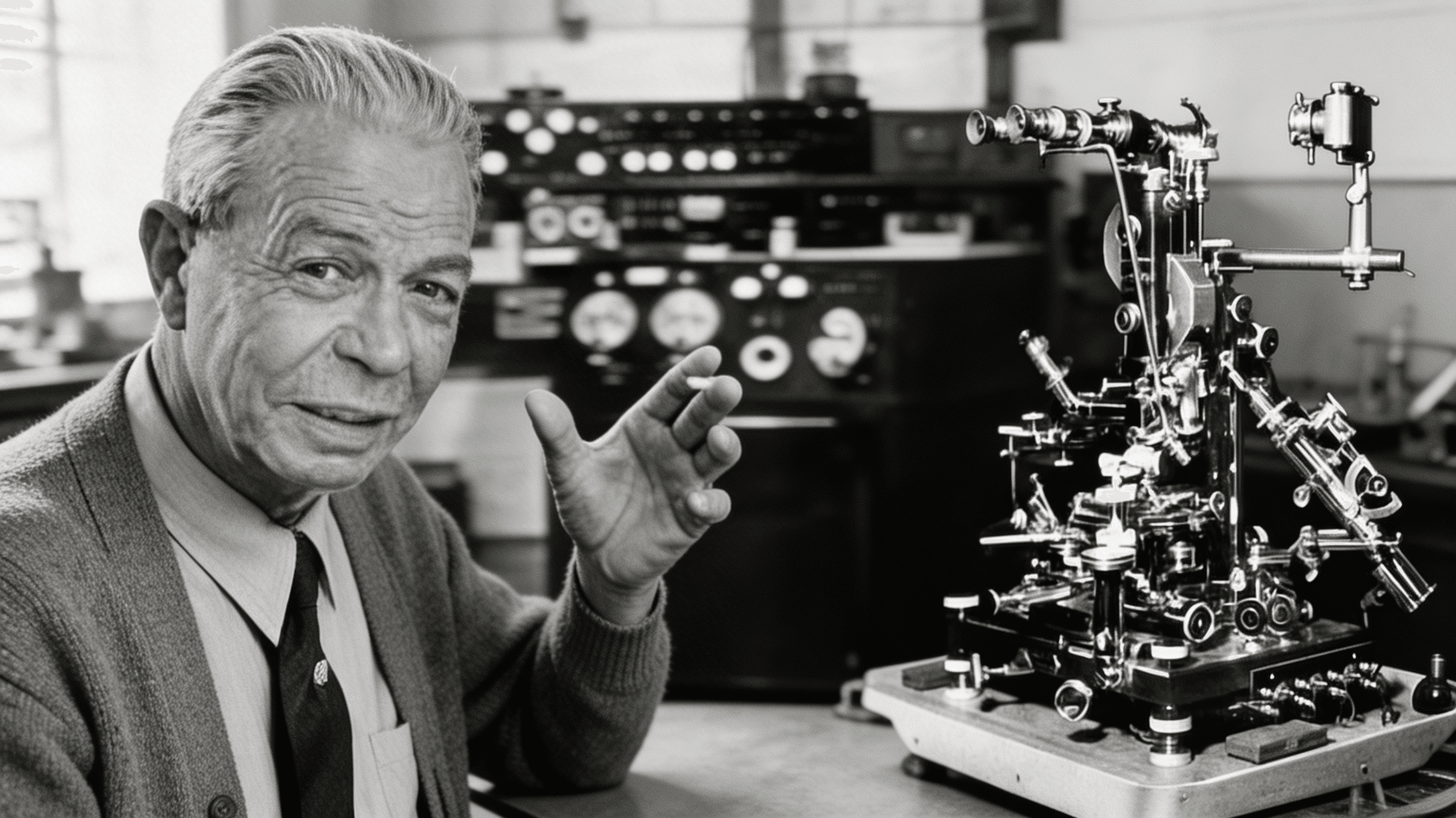
In the annals of medical history, few stories provoke such intense controversy as that of Royal Raymond Rife (1888-1971). A brilliant optical engineer and inventor, Rife claimed to have built microscopes capable of magnifying objects up to 60,000 times - far beyond the theoretical limits of conventional light microscopy. More astonishingly, he asserted that his Universal Microscope allowed him to observe living viruses in their natural state, something modern electron microscopy cannot accomplish without killing the specimen.
But Rife did not stop at observation. He developed what he called the Mortal Oscillatory Rate (MOR) theory—the idea that every pathogenic organism has a specific resonant frequency at which it can be destroyed through vibration, much as an opera singer shatters glass with the right note. Using his frequency-generating Beam Ray Machine, Rife claimed to have successfully treated terminal cancer patients in a 1934 clinical trial that allegedly achieved recovery in 16 out of 16 cases.
These claims, if true, would have revolutionized medicine. So why have most people never heard of Royal Rife? According to researchers like Barry Lynes, author of "The Cancer Cure That Worked," Rife's work was systematically suppressed by powerful medical interests who saw his non-patentable, inexpensive frequency therapy as a threat to profitable pharmaceutical treatments.
The Universal Microscope: An Optical Marvel
Rife's Universal Microscope represented a radical departure from conventional optical design. While standard microscopes of the era were limited to magnifications of about 2,000 times due to the wavelength of visible light, Rife employed a complex system of quartz prisms and monochromatic light sources to achieve unprecedented resolution.
The key innovation was Rife's use of specialized optics that reportedly allowed him to observe living microorganisms without the staining and fixation processes that kill specimens in traditional microscopy. His microscope supposedly used specific wavelengths of light to illuminate samples in ways that revealed structures invisible to conventional instruments.
Independent witnesses, including prominent physicians and researchers of the 1930s, reportedly viewed live demonstrations of the Universal Microscope. Dr. Arthur Kendall, a bacteriologist from Northwestern University Medical School, and Dr. Edward Rosenow of the Mayo Clinic were among those who allegedly observed Rife's work with fascination. But attempts to independently verify Rife's claims have been hampered by the fact that his original microscopes were reportedly destroyed or disappeared.
The 1934 Cancer Trial: Claims of a Medical Miracle
According to historical accounts compiled by researchers like Lynes, Rife conducted what would become his most controversial experiment in 1934. A group of 16 terminal cancer patients, given weeks to live by their physicians, were reportedly treated at the University of Southern California using Rife's frequency technology.
The treatment protocol involved exposing patients to specific electromagnetic frequencies while Rife monitored their blood samples using his Universal Microscope. After approximately 90 days of treatment, 14 of the 16 patients were allegedly pronounced completely free of cancer. The remaining two required additional treatment but reportedly recovered as well.
These results, if accurate, would represent one of the most significant medical achievements in history. Yet no peer-reviewed documentation of this trial exists in conventional medical archives. Supporters claim the records were destroyed or suppressed; skeptics argue the trial never occurred as described or was poorly documented from the start.
Mortal Oscillatory Rates: The Science of Frequency DestructionCentral to Rife's theory was the concept of Mortal Oscillatory Rates - specific frequencies that could shatter or disable pathogenic organisms through resonant vibration. Rife reportedly catalogued thousands of these frequencies, each corresponding to a specific microbe.
His original method used high RF frequencies ranging from 139,200 Hz to 1,607,450 Hz, delivered through a 3.1-3.8 MHz carrier wave using the Beam Rays Machine. This approach created specific sideband frequencies that supposedly matched the resonant frequencies of target pathogens. The theory was that when a pathogen's natural resonant frequency was applied, the organism would vibrate itself apart or become unable to reproduce.
Modern frequency devices often use audio frequencies derived from the work of John Crane, Rife's assistant in the 1950s. While these frequencies differ from Rife's original high RF method, many users report positive results through bioelectrical entrainment and cellular resonance mechanisms that may work differently than Rife originally proposed.
The Suppression Narrative: AMA, Morris Fishbein, and the Pharmaceutical Industry
According to researchers who have investigated Rife's history, his troubles began when Morris Fishbein, then-editor of the Journal of the American Medical Association (AMA), allegedly attempted to buy into Rife's technology. When Rife refused, Fishbein supposedly used his considerable influence to discredit Rife's work and destroy his reputation.
The narrative continues that the AMA and pharmaceutical interests saw Rife's frequency therapy as an existential threat. Unlike drugs, which could be patented and sold at high margins, frequency therapy required only a machine that could theoretically be built by anyone with technical knowledge. Furthermore, if diseases could be addressed through electromagnetic frequencies, the entire pharmaceutical model of symptom management would be undermined.
Rife's laboratory was reportedly broken into, his equipment vandalized or stolen, and key research notes destroyed. Colleagues who had supported him were allegedly threatened or bribed into silence. By the 1950s, Rife was reportedly an alcoholic recluse, his work largely forgotten by the medical establishment.
Modern Perspectives and Ongoing Research
Today, Rife's legacy lives on in the frequency medicine community, where thousands of practitioners and researchers continue to explore electromagnetic approaches to wellness. Modern "Rife machines" have proliferated, though most use audio frequencies rather than Rife's original high RF method.
Skeptics point out that no rigorous, peer-reviewed studies have validated Rife's specific claims about cancer treatment or the effectiveness of his particular frequencies. The shortage of surviving original equipment makes independent verification difficult. Mainstream medicine generally views Rife's work as historical curiosity at best, medical fraud at worst, but then again mainstream medicine is largely corrupted by financial interest.
Yet the broader concept of frequency medicine continues to gain traction. Photobiomodulation (red and near-infrared light therapy) has demonstrated biological effects through electromagnetic stimulation. Research into bioelectrical medicine, including vagal nerve stimulation and targeted electromagnetic therapies, is actively pursued by major institutions. The idea that biological systems respond to specific electromagnetic frequencies is no longer fringe science - it is increasingly mainstream.
Whether you believe Royal Rife was a misunderstood genius whose work was suppressed by powerful interests, or a well-intentioned inventor whose claims exceeded his achievements, his legacy remains one of medical history's most contentious debates. What is certain is that his story raises profound questions about how medical innovation is evaluated, who controls access to therapeutic technologies, and what happens when potentially disruptive discoveries threaten established economic interests.
At HealthHarmonic.com, we believe in exploring all avenues of wellness, including frequency-based approaches that honor the body's natural bioelectrical nature. While we make no claims about treating disease, we remain committed to sharing information about electromagnetic wellness approaches that empower individuals to take charge of their own health journey.
References1. Lynes, B. (1987). The Cancer Cure That Worked: Fifty Years of Suppression. Marcus Books. ISBN: 0-9618505-1-1. Available at: https://www.amazon.com/Cancer-Cure-That-Worked-Suppression/dp/0961850511
2. RifeVideos.com. (2022). The Rife Machine Report: An Analysis of Three Original Rife Machines. Available at: https://www.rifevideos.com
3. Rife Energy Medicine. (n.d.). Rife Frequency Research and Historical Documentation. Available at: https://rifeenergymedicine.com
4. RifeList.com. (n.d.). Rife Frequency Database and Equipment Information. Available at: https://www.rifelist.com
Note: This article is for educational purposes and does not constitute medical advice. The claims discussed represent historical accounts and alternative perspectives that have not been validated by conventional medical research. |




0 Comments
Join the conversation
Be the first to comment
Share your thoughts above.