
Subscribe
The Surveillance State Inside Your Body: Biosensors, Smart Dust, and Injectable Trackers
An investigation into DARPA's biosensor programs, hydrogel implants, and the emerging infrastructure of internal biological surveillance
Introduction: The Invisible Watchers
In 2021, the Pentagon's research arm announced a breakthrough that sounded like science fiction: a biosensor capable of detecting infection in the human body before symptoms appeared. Developed by DARPA and manufactured by Profusa, this hydrogel-based implant represented merely the visible tip of a technological iceberg - one that promises to revolutionize healthcare while simultaneously enabling unprecedented surveillance of human biology.
What we're witnessing is not simply medical innovation. It is the emergence of a new paradigm where the boundary between human body and monitoring network dissolves. Biosensors, smart dust, and injectable trackers are being developed by governments, corporations, and military agencies worldwide. The question is no longer whether these technologies will be deployed, but who will control them and what safeguards - if any - will protect individual autonomy.
This investigation examines the documented development of internal biosurveillance technologies, their stated medical applications, their potential for misuse, and the critical privacy and autonomy questions that remain largely unanswered.
The Biosensor RevolutionWhat Are Biosensors?
Biosensors are analytical devices that combine a biological component with a physicochemical detector to measure specific substances. In medical applications, they can monitor glucose, oxygen, lactate, biomarkers for disease, and even emotional states through biochemical signatures.
The global biosensors market is projected to reach $49.3 billion by 2030, driven by demand for continuous health monitoring, personalized medicine, and point-of-care diagnostics.
Continuous Glucose Monitors: The Gateway Technology
Continuous Glucose Monitors (CGMs) represent the most widely deployed biosensor technology. Devices from Dexcom and Abbott use subcutaneous sensors to provide real-time glucose data for diabetes management.
CGMs have demonstrated the viability and market acceptance of implantable biosensors. They have also normalized the concept of continuous biological monitoring, paving the way for more invasive and comprehensive surveillance technologies.
DARPA's Hydrogel Biosensor
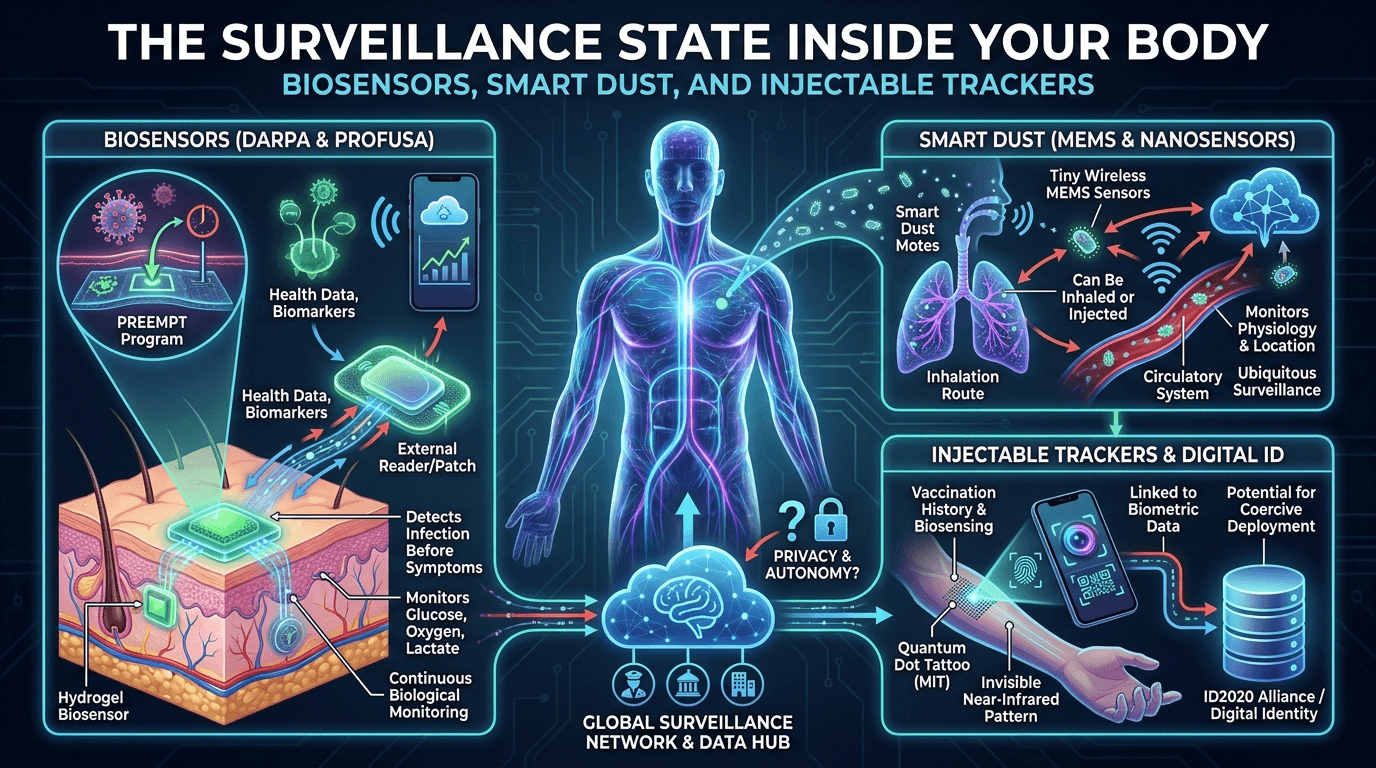
In 2016, DARPA awarded $7.5 million to Profusa for development of the Lumee Oxygen Platform. This implantable biosensor uses a hydrogel scaffold approximately the size of a grain of rice that can be injected under the skin.
The sensor works through: Hydrogel matrix: A porous polymer scaffold that integrates with surrounding tissue; Fluorescent biosensors: Molecules that change optical properties in response to target analytes; External reader: A handheld device or patch that optically interrogates the sensor through the skin.
Profusa's technology can continuously measure oxygen levels in tissue - a critical indicator of healing, infection, and vascular health. The company has also developed sensors for glucose, lactate, and other biomarkers.
The PREEMPT Program
DARPA's PREEMPT (Preventing Emerging Pathogenic Threats) program takes biosurveillance to another level. Announced in 2018, PREEMPT aims to develop technologies to 'detect and respond to infectious disease threats before they spread.'
Key components include: Predictive models of viral evolution; Methods to prevent spillover from animals to humans; Biosensors for early detection of infection. The program explicitly targets 'human populations' for monitoring, raising questions about consent, data ownership, and the potential for coercive deployment during health emergencies.
Smart Dust: The Ultimate Surveillance ParticleOrigins and Concept
The term 'smart dust' was coined by Kristofer Pister at UC Berkeley in the 1990s. The concept involves networks of tiny wireless microelectromechanical systems (MEMS) sensors that can detect light, temperature, vibration, magnetism, or chemicals.
A single smart dust mote might be as small as a grain of sand - small enough to remain suspended in air, float in liquids, or settle on surfaces undetected. When networked, these devices could create comprehensive surveillance blankets covering entire regions.
Military Development
DARPA has funded smart dust research through multiple programs: SHM (Structural Health Monitoring): Using embedded sensors to monitor aircraft, bridges, and buildings; NEMS (Nanoelectromechanical Systems): Developing sensors at the nanometer scale; Microbots and swarm robotics: Coordinated networks of tiny devices.
A 2018 RAND Corporation report on emerging technologies noted that smart dust could enable 'ubiquitous surveillance' with applications for both military and civilian monitoring.
The Dust in Your Lungs
The most concerning aspect of smart dust technology is the potential for inhalation or injection. Particles small enough to remain airborne can be breathed in, entering the lungs and potentially crossing into the bloodstream. Once inside the body, they could: Monitor physiological parameters from within; Track location through unique identifiers; Deliver drugs or biological agents; Potentially interfere with cellular processes.
A 2015 Nature Nanotechnology study demonstrated that nanoparticles can be designed to penetrate the blood-brain barrier, opening possibilities for both therapeutic and surveillance applications.
Injectable Trackers and Digital IdentityThe ID2020 Alliance
The ID2020 Alliance is a public-private partnership launched in 2016 with the stated goal of providing digital identity for the '1 billion people who lack any form of recognized identification.' Partners include Microsoft, Accenture, Gavi (the Vaccine Alliance), and the Rockefeller Foundation.
While ID2020 emphasizes privacy and user control, critics have raised concerns about: The potential for biometric surveillance; Data security and ownership; The convergence of health data with identity systems; Coercive implementation in vulnerable populations.
MIT's Quantum Dot Tattoo
In December 2019, researchers at MIT published a study in Science Translational Medicine describing a novel method for recording vaccination history: a quantum dot tattoo.
The technology uses: Microneedle patches for painless vaccine delivery; Quantum dots (nanocrystals) that emit near-infrared light; Patterns detectable by smartphone cameras but invisible to the naked eye.
The researchers explicitly stated that the technology could 'enable decentralized data storage and biosensing.' While developed for medical records, the same technology could encode any information - including identity, location history, or behavioral data.
DARPA's 'Under the Skin' Surveillance
In April 2020, DARPA issued a press release titled 'DARPA Looking to Develop 'Under the Skin' Surveillance Technology to Track Pandemics'. The program sought to develop 'predictive, preemptive, and personalized' approaches to infectious disease through continuous biomonitoring.
The technology would use 'biodata' to identify infection before symptoms appear, enabling isolation and contact tracing. While framed as pandemic response, the same infrastructure could monitor: Drug and alcohol use; Stress and emotional states; Pregnancy; Genetic predispositions; Political or ideological arousal (through stress biomarkers).
The Data DilemmaWho Owns Your Biological Data?
Biosensor data represents the most intimate form of personal information - continuous streams of data about your body's internal state. Yet ownership and control of this data remain unclear: Medical device companies typically claim data rights through user agreements; Health insurers increasingly demand access to monitoring data; Employers may require biosensor use for workplace safety or health insurance discounts; Governments can subpoena or mandate data collection.
A 2021 Nature Biotechnology article warned that 'the commercialization of continuous health monitoring raises profound questions about data ownership, privacy, and the potential for discrimination.'
Life and health insurance companies are already using biosensor data to adjust premiums. John Hancock, a major life insurer, requires policyholders to use fitness trackers and share data through its Vitality program.
As biosensors become more sophisticated, insurers could: Deny coverage based on genetic predispositions; Adjust premiums in real-time based on behavior; Require monitoring as a condition of coverage; Share data with affiliates and partners.
The Genetic Information Nondiscrimination Act (GINA) prohibits genetic discrimination in health insurance and employment, but it does not cover epigenetic changes, biomarker patterns, or continuous monitoring data.
Employer Surveillance
Workplace biosurveillance is expanding rapidly: Amazon has patented wearable devices that track worker movements and vibrate to direct behavior; Mining and construction companies use fatigue monitoring systems; Healthcare workers may be required to use infection-detection biosensors; Military personnel face the most comprehensive biological monitoring.
A 2020 European Parliament report on artificial intelligence and surveillance warned that 'biometric monitoring in the workplace represents a fundamental threat to human dignity and autonomy.'
The Military-Pharmaceutical ComplexOperation Warp Speed and Beyond
The U.S. government's Operation Warp Speed demonstrated the power of military-pharmaceutical collaboration. The program brought together: Department of Defense logistics and planning; Pharmaceutical company manufacturing; Advanced biomedical research; Surveillance and tracking systems.
While successful in accelerating vaccine development, the operation also established infrastructure and precedents for rapid deployment of medical countermeasures - including potential biosensor technologies. The Biomedical Advanced Research and Development Authority (BARDA)
BARDA, part of the U.S. Department of Health and Human Services, partners with private industry to develop medical countermeasures for national security threats. BARDA has funded development of: Rapid diagnostic platforms; Vaccine delivery systems; Therapeutic monitoring devices; 'Digital health' infrastructure.
BARDA's partnerships with companies like Profusa and Philips have advanced biosensor capabilities while blurring lines between civilian healthcare and military applications.
The Pandemic as Catalyst
COVID-19 accelerated acceptance of biological surveillance: Contact tracing apps normalized location and proximity monitoring; Vaccine passports established precedents for health-based access control; Remote monitoring expanded for quarantine enforcement; Public health surveillance gained broad acceptance.
A 2021 Brookings Institution report noted that 'the pandemic has fundamentally altered public attitudes toward health surveillance, creating opportunities for expanded monitoring that would have been politically impossible before 2020.'
Ethical and Human Rights ImplicationsInformed Consent in an Emergency
Emergency powers during health crises can override normal consent requirements. During COVID-19, governments worldwide implemented: Mandatory testing; Quarantine enforcement; Vaccine mandates; Contact tracing.
If biosensors are deemed essential for pandemic response, could they be mandated? The precedent exists in Jacobson v. Massachusetts (1905), which upheld compulsory vaccination during smallpox outbreaks but that case has been blown out of proportion considering all he had to do was pay a fine to avoid the vaccination.
Bodily Autonomy Under Threat
The right to bodily integrity is a fundamental human right recognized in international law. Yet biosensor technologies challenge this right by: Creating pressure to accept implantation for employment, insurance, or access; Normalizing continuous external monitoring of internal states; Establishing precedents for coerced medical interventions; Enabling new forms of biological control.
The Universal Declaration of Human Rights and the International Covenant on Civil and Political Rights protect against arbitrary interference with privacy, but these frameworks were developed before continuous biosurveillance was technically possible.
The Digital Divide Becomes Biological
As biosensor technologies proliferate, new forms of inequality emerge: Access: Who can afford advanced monitoring and personalized interventions? Data literacy: Who understands and can control their biological data? Discrimination: Who is excluded based on biomarker profiles? Enhancement: Who can afford biological upgrades?
A 2022 World Economic Forum report warned that 'the convergence of biotechnology and digital surveillance threatens to create a biological underclass excluded from the benefits of personalized medicine.'
The Future: Integration and ResistanceThe Internet of Bodies
The Internet of Bodies (IoB) refers to the network of human bodies connected through internet-enabled devices. RAND Corporation's 2020 report identified IoB as an emerging domain with significant implications for: Healthcare delivery; National security; Privacy and civil liberties; Human enhancement.
The report warned that 'the Internet of Bodies represents a new frontier in surveillance, with implications that are only beginning to be understood.'
Neural Interfaces and Brain Monitoring
Beyond peripheral biosensors, companies like Neuralink, Kernel, and Synchron are developing brain-computer interfaces (BCIs). These technologies could: Restore function to paralyzed individuals; Treat neurological disorders; Enhance cognitive capabilities; Read and potentially influence thoughts and emotions.
Nothing nefarious could be done with that technology, right?
The U.S. Food and Drug Administration has established an Emerging Sciences Working Group to address the unique challenges of neural interfaces, but regulatory frameworks remain in development.
Technological Countermeasures
As surveillance technologies advance, so do countermeasures: Faraday cages and shielding to block wireless signals; Detection equipment to identify implanted devices; Signal jamming to disrupt data transmission; Legal challenges to mandate transparency and consent.
Privacy advocates are calling for: Strict regulations on biological data collection; Mandatory disclosure of all implanted devices; Right to removal and data deletion; Prohibition on coerced implantation.
Conclusion: The Body as Battlefield
The human body is becoming the final frontier of surveillance. Biosensors, smart dust, and injectable trackers promise remarkable medical benefits - but they also enable unprecedented monitoring and control. The technologies described in this investigation are not speculative; they are documented, funded, and in many cases already deployed.
The critical questions we face are not technical but political and ethical: Will biological surveillance be voluntary or coerced? Who controls the data generated by our bodies? What limits - if any - will be placed on biological monitoring? How do we prevent the emergence of a biological caste system?
The surveillance state is no longer something that watches from outside. It is becoming something that lives within us - monitoring, recording, and potentially controlling the most intimate aspects of human existence. The time to establish boundaries is now, before these technologies become so normalized that resistance becomes impossible.
Your body is the last private space. Defend it while you still can!
References1. RAND Corporation - Internet of Bodies - https://www.rand.org/pubs/research_reports/RR3226.html
2. Wikipedia: Internet of things - https://en.wikipedia.org/wiki/Internet_of_things
9. Wikipedia: Biometrics - https://en.wikipedia.org/wiki/Biometrics
|
Stay up to date!
Get the latest news delivered to your inbox.