
The Terrain vs. The Germ: Why Béchamp Was Right All Along |
How modern microbiome science is vindicating Antoine Béchamp's pleomorphic theory and challenging the Pasteurian paradigm that dominates modern medicine |
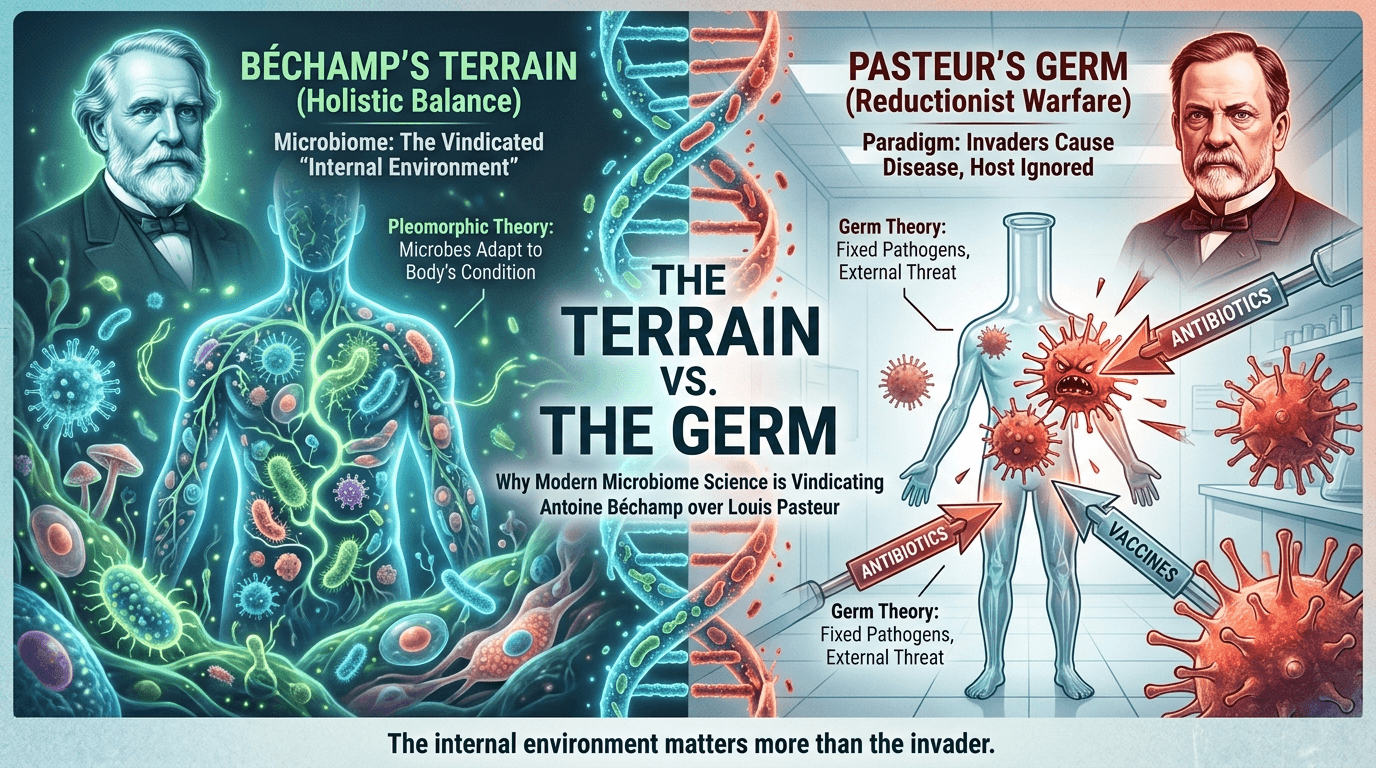
For over a century, the germ theory of disease has reigned supreme in Western medicine. Louis Pasteur's assertion that invading microorganisms cause disease, regardless of the host's condition, has shaped everything from vaccination strategies to antibiotic use. But what if Pasteur was wrong? What if his rival, Antoine Béchamp (1816-1908), correctly understood that the terrain - the internal environment of the body - matters more than the germ itself?
The irony is striking: modern science, particularly the revolutionary discoveries in microbiome research, is increasingly validating Béchamp's terrain theory while exposing fundamental limitations in the Pasteurian paradigm. The question is no longer whether Béchamp was right, but why medicine remains so invested in a model that ignores the complexity of human biology.
The Historical Conflict: Two Competing Visions
The intellectual battle between Pasteur and Béchamp represents one of science's most consequential rivalries. Pasteur, a chemist by training, viewed microorganisms as fixed, hostile invaders that caused disease through their mere presence. His approach was fundamentally reductionist: identify the pathogen, kill the pathogen, cure the disease.
Béchamp, a physician, chemist, and microscopist, saw a far more complex picture. Through his development of the microscope and decades of careful observation, he proposed that microorganisms were pleomorphic - capable of changing form based on their environment. More radically, he suggested that bacteria could arise from within microscopic sub-units he had discovered which he called "microzymas" when conditions favored their development.
Béchamp's theory was not that germs don't exist or never cause disease. Rather, he argued that the same microorganism could be harmless or pathogenic depending on the terrain in which it found itself. A healthy, well-nourished body with balanced chemistry would maintain microbes in benign forms; a toxic, acidic, nutrient-deficient environment would trigger their transformation into disease-causing forms.
Pleomorphism: The Shape-Shifting Microbe
Central to Béchamp's theory was pleomorphism - the ability of microorganisms to change their form and function based on environmental conditions. This directly contradicted Pasteur's monomorphism, which held that each microbe had a fixed, immutable nature.
Béchamp observed what he called microzymas - tiny, indestructible granules present in all living matter - that could transform into bacteria when the surrounding environment became favorable for their proliferation. In healthy tissue, these microzymas remained dormant; in diseased or dying tissue, they became active, multiplying and potentially causing further pathology.
This concept was not unique to Béchamp. Dr. Günther Enderlein (1872-1968) later developed similar theories about the cyclical development of microorganisms, documenting what he called the "life cycle of the Endobiont." Gaston Naessens (1924-2018) observed similar phenomena with his somatoscope, documenting what he termed "somatids" - fundamental biological particles that could transform based on terrain conditions.
The Pasteurian Victory: Politics Over Science?
History records Pasteur as the victor in this scientific dispute, but the manner of his victory raises questions. Pasteur was a master of self-promotion and political connections, while Béchamp was a reserved academic who refused to compromise his principles for recognition.
On his deathbed, Pasteur allegedly recanted his germ theory position, reportedly saying, "Le germe n'est rien, c'est le terrain qui est tout" (The germ is nothing, the terrain is everything). Whether this quote is apocryphal or genuine remains debated, but the sentiment aligns with discoveries that would take another century to fully emerge.
The Pasteurian model won not necessarily because it was more accurate, but because it was more profitable. The germ theory lent itself to patentable interventions - vaccines, antibiotics, antivirals - that could be manufactured and sold. The terrain theory, emphasizing diet, environment, and lifestyle, offered no such commercial opportunities. This economic reality shaped medical education, research funding, and pharmaceutical development for generations.
Modern Microbiome Science: Vindicating Béchamp
The explosion of microbiome research over the past two decades has fundamentally challenged germ theory assumptions while supporting terrain-based perspectives. We now know that the human body contains roughly as many bacterial cells as human cells, with microbial genes outnumbering human genes by 100 to 1. These microbes are not invaders - they are essential partners in health.
Research has revealed that the same bacterial species can be beneficial or harmful depending on context. Escherichia coli, often demonized as a pathogen, is a normal and necessary inhabitant of the healthy human gut. It becomes problematic only when the intestinal environment deteriorates - through antibiotic use, poor diet, stress, or other factors that disrupt the microbial ecosystem.
Studies on Clostridium difficile infection provide a stark example. C. difficile is present in many healthy individuals without causing disease. It becomes pathogenic primarily after antibiotic treatment disrupts the normal gut flora - the terrain - creating conditions that allow C. difficile to overgrow and produce toxins. The solution is not more antibiotics (which worsen the terrain) but restoration of healthy microbiota through fecal transplants or targeted probiotics.
The Biofilm Revelation
One of the most significant challenges to germ theory orthodoxy comes from biofilm research. Biofilms are communities of microorganisms that attach to surfaces and encase themselves in protective extracellular matrices. Within biofilms, bacteria display remarkable plasticity, changing their gene expression, metabolism, and even morphology based on environmental conditions.
This is pleomorphism in action - exactly what Béchamp described. The same bacterial species behaves completely differently as a planktonic (free-floating) cell versus a biofilm-embedded community. Its pathogenic potential, antibiotic susceptibility, and immune system interactions all change based on its environment. The germ is not the sole determinant of disease; the context in which it exists matters profoundly.
Chronic infections often involve biofilm formation, explaining why these conditions resist standard antibiotic treatment. The bacteria aren't inherently resistant - their biofilm mode of existence makes them so. Addressing biofilm infections requires terrain-based approaches that disrupt the protective matrix and restore conditions that favor healthy microbial balance.
Epigenetics and Cellular Environment
The field of epigenetics provides another powerful validation of terrain theory. We now understand that gene expression is not fixed but dynamically regulated by environmental factors - diet, stress, toxins, and yes, microbial interactions. The same genome produces different cellular outcomes based on the terrain in which cells find themselves.
Cancer research has been particularly transformed by this understanding. The somatic mutation theory of cancer, which mirrors germ theory's reductionism, has failed to deliver the cures promised decades ago. Meanwhile, researchers like Dr. Thomas Seyfried have demonstrated that cancer is fundamentally a metabolic disease - an issue of cellular terrain, specifically mitochondrial dysfunction, that drives genetic instability rather than the reverse.
This metabolic perspective aligns perfectly with terrain theory. Cancer cells don't arise randomly or solely from genetic accidents; they emerge when cellular metabolism is disrupted by toxic exposures, nutrient deficiencies, chronic inflammation, and other terrain imbalances. Addressing these root causes offers a fundamentally different approach than trying to kill cancer cells while ignoring the environment that created them. These concepts are explored in great detail in the free online course at https://ForbiddenFood.tv
Implications for Medicine and Health
The terrain theory's vindication has profound implications for how we approach health and disease. Rather than focusing exclusively on killing germs, terrain-based medicine asks: What conditions allowed these microorganisms to become problematic? What environmental factors need to be addressed to restore balance?
This shift changes everything about prevention and treatment. Instead of relying solely on vaccines and antibiotics, terrain medicine emphasizes:
Of course, this doesn't mean abandoning all Pasteurian interventions. Antibiotics save lives when used appropriately. But an exclusive focus on germ-killing while ignoring terrain maintenance has created the modern epidemic of chronic disease, antibiotic resistance, and autoimmune conditions.
The Paradigm Shift Continues
Thomas Kuhn's concept of paradigm shifts describes how scientific revolutions occur - not through gradual accumulation of evidence, but through fundamental changes in how problems are conceptualized. The transition from germ theory to terrain theory represents exactly such a paradigm shift.
The evidence for terrain-based approaches continues to accumulate. Functional medicine, integrative health, and personalized nutrition all represent applications of terrain theory principles. The recognition that one-size-fits-all pharmaceutical approaches cannot address the complexity of human biology is growing, even within mainstream medicine.
Béchamp's insight that "the germ is nothing, the terrain is everything" was ahead of its time. Modern science is finally catching up to what he observed through his microscope over a century ago. The question facing medicine now is whether it can overcome a century of institutional investment in the Pasteurian model to embrace a more holistic, terrain-based understanding of health and disease.
For those seeking true wellness, the implications are clear: focus on cultivating a healthy internal terrain through proper nutrition, detoxification, stress management, and lifestyle choices. The microbes will take care of themselves when the environment supports health.
For terrain-based natural wellness products visit https://HealthHarmonic.com
References1. Béchamp, A. (1912). The Blood and Its Third Anatomical Element. Montague R. Leverson (Trans.). Available at: https://www.amazon.com/Blood-Its-Third-Element/dp/1541159357
2. Sender, R., Fuchs, S., & Milo, R. (2016). Revised estimates for the number of human and bacteria cells in the body. PLoS Biology, 14(8), e1002533. https://pubmed.ncbi.nlm.nih.gov/27541692/
3. Qin, J., Li, R., et al. (2010). A human gut microbial gene catalogue established by metagenomic sequencing. Nature, 464(7285), 59-65. https://pubmed.ncbi.nlm.nih.gov/20203603/
4. Seyfried, T.N. (2012). Cancer as a Metabolic Disease: On the Origin, Management, and Prevention of Cancer. Wiley. ISBN: 978-0470584927.
5. Hall-Stoodley, L., Costerton, J.W., & Stoodley, P. (2004). Bacterial biofilms: from the natural environment to infectious diseases. Nature Reviews Microbiology, 2(2), 95-108. https://pubmed.ncbi.nlm.nih.gov/15040259/
Note: This article is for educational purposes and does not constitute medical advice. The historical perspectives presented represent alternative viewpoints to mainstream medical theory. |


0 Comments
Join the conversation
Be the first to comment
Share your thoughts above.