The medical establishment wants you to believe that germs are your enemy. But what if the real battle isn't against invisible invaders - but against the toxic burden your body carries every single day?
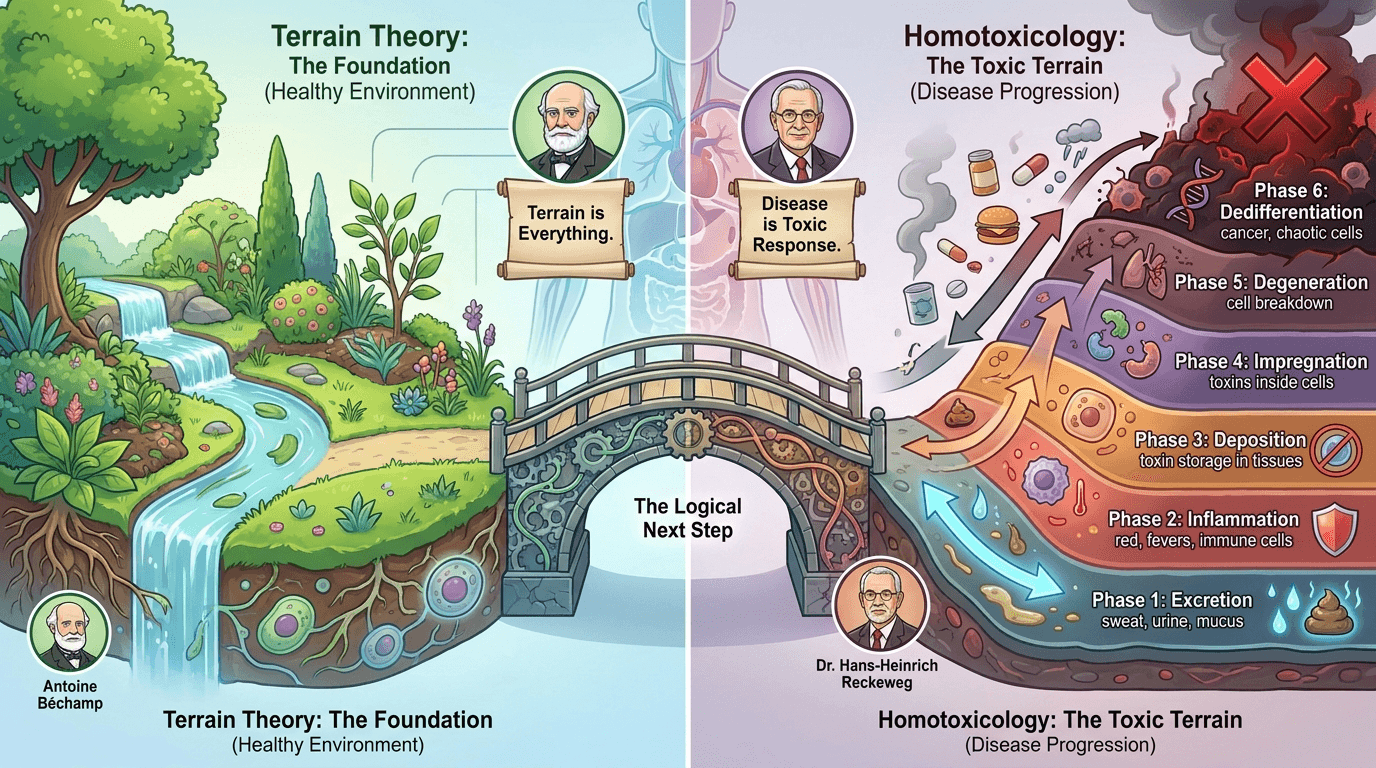
For over a century, two paradigm-shifting ideas have challenged the germ theory orthodoxy that dominates modern medicine. Terrain theory, pioneered by Antoine Béchamp in the 1800s, proposed that disease arises not from external microbes but from the internal environment of the body. Decades later, German physician Hans-Heinrich Reckeweg took this concept further with homotoxicology - a comprehensive framework explaining how toxic accumulation drives disease and how detoxification restores health.
Here's the rub: these two concepts aren't separate philosophies. Homotoxicology is the natural, logical corollary to terrain theory. Together, they form a unified understanding of health that the pharmaceutical industry has every reason to ignore.
The Foundation: Terrain Theory Explained
Antoine Béchamp, a contemporary and rival of Louis Pasteur, observed something remarkable under his microscope. He discovered that microorganisms change form - a phenomenon called pleomorphism - depending on the environment they inhabited. Béchamp proposed that the "terrain" (the internal biological environment) determined whether disease would develop, not the presence of germs alone.
Keep in mind, this was revolutionary. While Pasteur's germ theory said "kill the bug, cure the disease" and "one bug = one disease," Béchamp argued that a healthy terrain would naturally resist disease. The microbe, he famously stated, "is nothing; the terrain is everything."
Günther Enderlein, a German microbiologist, expanded on this work in the 20th century. He demonstrated that microorganisms living in our blood could transform from harmless to pathogenic forms depending on the pH and toxicity of our cellular environment. His research on pleomorphism showed that what we call "infection" is often the body's response to an already-compromised terrain.
After all, if germs were the only cause of disease, why don't all exposed individuals get sick? The answer lies in the terrain.
Enter Homotoxicology: The Toxic Terrain
In the 1950s, Dr. Hans-Heinrich Reckeweg synthesized decades of observations into a comprehensive medical framework he called homotoxicology - literally, "the study of human toxins." His central thesis was elegant: disease is the body's biological response to toxic substances (homotoxins), and healing occurs when these toxins are neutralized and eliminated.
Reckeweg identified homotoxins as any substance that burdens cellular function: environmental pollutants, heavy metals, processed foods, pharmaceutical residues, metabolic waste products, and even emotional stress. When the body's detoxification systems - the liver, kidneys, lymphatic system, and cellular elimination pathways - become overwhelmed, toxins accumulate in the tissues.
This is where homotoxicology becomes the logical extension of terrain theory. If the terrain determines disease susceptibility, then toxic load is the primary determinant of terrain quality.
The Six-Phase Table: Mapping Disease Progression
Reckeweg's most important contribution was his Six-Phase Table of Homotoxicology, which maps how disease progresses as toxins accumulate:
Phase 1: Excretion – The body attempts to eliminate toxins through normal channels (sweat, urine, mucus, feces). This is acute detoxification.
Phase 2: Inflammation – When excretion fails, inflammation recruits immune cells to neutralize and remove toxins. Think fevers, rashes, acute infections.
Phase 3: Deposition – Chronic exposure leads to toxin storage in connective tissue, fat, and organs. Symptoms become chronic but reversible.
Phase 4: Impregnation – Toxins penetrate cellular structures, disrupting enzyme function and metabolism. Damage deepens but may still be reversible.
Phase 5: Degeneration – Cellular structures break down. Chronic diseases like autoimmune conditions, organ failure, and neurodegeneration emerge.
Phase 6: Dedifferentiation – Cells lose their specialized function entirely. This is the cancer phase—uncontrolled, chaotic cellular behavior.
Notice the pattern? Disease isn't random. It's a predictable response to toxic burden. And here's what they don't tell you: most chronic diseases are simply advanced phases of toxin accumulation that conventional medicine tries to suppress with pharmaceuticals - which only add to the toxic load.
Cellular Terrain and Elimination Pathways
Both terrain theory and homotoxicology emphasize that cellular health is non-negotiable. Your cells operate in an extracellular fluid environment - the "matrix" or "mesenchyme" as Reckeweg called it. This matrix must maintain proper pH, oxygen levels, nutrient availability, and low toxin concentration for cells to function optimally.
When this cellular terrain becomes acidic, oxygen-deprived, and toxin-saturated, cells shift into survival mode. Mitochondrial function declines. Cellular respiration becomes inefficient. Waste products accumulate. This is the fertile ground for chronic disease.
The body has multiple elimination pathways designed to clear toxins:
- Liver detoxification – Phase I and Phase II enzyme systems neutralize toxins for excretion
- Kidney filtration – Removes water-soluble waste from blood
- Lymphatic drainage – Clears extracellular toxins and immune debris
- Intestinal elimination – Bile, fiber, and microbiome facilitate toxin removal
- Skin and lungs – Secondary routes for volatile and fat-soluble toxins
When these pathways become congested - due to chronic toxic exposure, nutrient deficiencies, or genetic variants affecting detoxification enzymes - the terrain degrades rapidly. Homotoxicology provides the roadmap for understanding which phase of toxicity the body is experiencing and how to reverse it.
Challenging the Germ Theory Orthodoxy
Both Béchamp and Reckeweg were marginalized by the medical establishment. Why? Because their models challenge the entire pharmaceutical paradigm. If disease is primarily a function of toxic terrain rather than infectious agents, then the solution isn't patented drugs - it's detoxification, nutrition, and environmental medicine.
Keep in mind, germ theory served industrial interests perfectly. It created a lucrative model: identify a pathogen, develop a drug, treat symptoms indefinitely. It also provided a perfect scapegoat for environmental polluters. Terrain theory and homotoxicology, by contrast, empower individuals to address root causes - something that doesn't generate recurring revenue for pharmaceutical companies.
But the evidence keeps mounting. Modern research on the microbiome, environmental toxins, and mitochondrial dysfunction consistently validates what Béchamp and Reckeweg understood over a century ago: the internal environment determines health outcomes.
The Paradigm Shift Underway
Today, functional medicine practitioners, integrative doctors, and biological medicine clinics across Europe routinely apply homotoxicological principles. They use detoxification protocols, drainage remedies, and matrix support to restore cellular terrain.
After all, once you understand that disease is the body's intelligent response to toxicity - not a random attack by germs - everything changes. You stop suppressing symptoms and start supporting elimination. You stop fearing microbes and start optimizing your terrain.
This is the awakening that terrain theory and homotoxicology offer: a return to biological common sense. Your body isn't broken. It's burdened. And when you remove the burden, healing becomes inevitable.
Scientific References
1. Béchamp, A. (1912). The Blood and Its Third Element. London: John Ouseley Ltd.
2. Enderlein, G. (1925). Bacteria Cyclogeny. Berlin: Walter de Gruyter.
3. Reckeweg, H.-H. (2000). Homotoxicology: Illness and Healing Through Anti-Homotoxic Therapy. Aurelia-Verlag GmbH. https://www.heel.com/
4. Heine, H. (2008). "The Extracellular Matrix and Regulation of Cell Function: From Molecular Aspects to Cell Differentiation." Biological Medicine, 37(2): 123-129.
5. Pischinger, A. (2007). The Extracellular Matrix and Ground Regulation: Basis for a Holistic Biological Medicine. North Atlantic Books. https://www.northatlanticbooks.com/
6. Ferrara P, et al. (2008). "Homotoxicological remedies versus desmopressin versus placebo in the treatment of enuresis: a randomised, double-blind, controlled trial." Pediatric Nephrology, 23(2):269-274.
https://pubmed.ncbi.nlm.nih.gov/17310359/
7. Valentiner U, et al. (2003). "The effect of homeopathic plant extract solutions on the cell proliferation of human cutaneous fibroblasts in vitro." Forschende Komplementärmedizin und Klassische Naturheilkunde, 10(3):122-127.
https://pubmed.ncbi.nlm.nih.gov/12853718/
8. Ernst E, et al. (2004). "Homotoxicology--a review of randomised clinical trials." European Journal of Clinical Pharmacology, 60(5):299-306.
https://pubmed.ncbi.nlm.nih.gov/15197516/
9. Grant DM. (1991). "Detoxification pathways in the liver." Journal of Inherited Metabolic Disease, 14(4):421-430.
https://pubmed.ncbi.nlm.nih.gov/1749210/
10. Smit A, et al. (2010). "Disease development." Alternative Therapies in Health and Medicine, 16(3):20-6.
https://pubmed.ncbi.nlm.nih.gov/20486621/





0 Comments
Join the conversation
Be the first to comment
Share your thoughts above.