
Trivia Question❓Known as nature's antibiotic, this pungent compound found in crushed garlic cloves - formed when alliin meets the enzyme alliinase - is responsible for most of garlic's antimicrobial properties, but what is the name of this sulfur-containing compound? Answer at the bottom of the newsletter |
Royal Rife's Universal Microscope Likely in More Detail Than What You've Seen... |
|
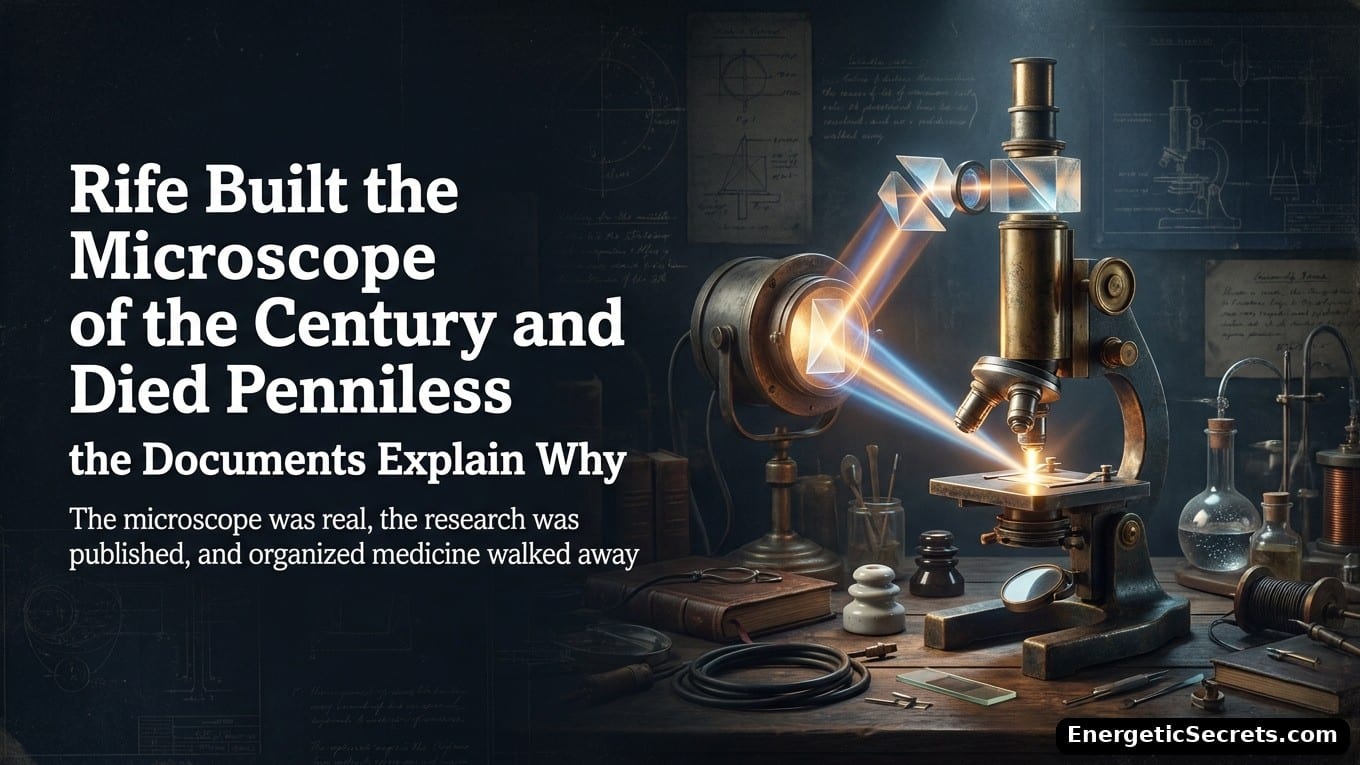
Royal Raymond Rife has spent seventy years being argued about by people who never touched his equipment. I have spent a good part of my adult life in this corner of medical history, along with the EMF and frequency research that grew out of it, and the argument almost always starts in the wrong place. It starts with whether Rife was right. It should start with what he actually built.
Because what he built is not in dispute. It is in the Smithsonian. In its 1944 annual report, the Smithsonian Institution published a survey article called "The New Microscopes," written by R. E. Seidel and M. Elizabeth Winter. The report contains a section headed "The Universal Microscope," and it describes Rife's instrument in the kind of technical detail you only get from examining a thing that exists (nobody writes down 100 threads to the inch about a rumor). Rife's microscopes, the authors write, "far surpass the theoretical limitations of the ordinary variety of instrument." The largest of them, developed in 1933, "consists of 5,682 parts."
That is a real instrument, described by real people, in a government publication. And once you read how it worked, the whole shape of this story changes.
The prism was the invention
Most retellings of Rife mention the microscope and move on. Nobody explains it. So let me explain it, because the Smithsonian text walks you through the mechanism and the mechanism is the whole point.
The entire optical system of the universal microscope was made of block-crystal quartz, chosen because quartz transmits ultraviolet light well. The illuminating unit alone contained 14 lenses and prisms: three in the high-intensity incandescent lamp, four in a Risley prism, and seven in an achromatic condenser with a numerical aperture of 1.40.
Then comes the part that made it work. Between the light source and the specimen sat two circular, wedge-shaped block-crystal quartz prisms, which polarized the light passing through. Those prisms could be rotated with vernier control through 360 degrees. Rotating them in opposite directions bent the transmitted light at variable angles and projected a slice of spectrum up into the axis of the microscope. By working that spectrum back and forth, you could walk the illumination from the infrared end all the way to the ultraviolet.
Here is why that mattered. When the portion of the spectrum reached the point where the organism and the color band "vibrate in exact accord," the organism itself emitted a characteristic spectrum. Each organism responded to its own specific wavelength. The filter-passing form of typhoid bacillus, for example, emitted a blue spectrum and deviated the plane of polarization by plus 4.8 degrees. The operator would then reset the prisms to minus 4.8 degrees and send a monochromatic beam through the specimen, illuminating the organism in its true chemical color.
What that meant in practice was that you could see a living organism without killing it and without staining it. That is not a small thing. Staining kills the specimen (you destroy the very thing you are trying to look at). Rife's prism system, if it worked as described, let you watch living organisms in their own light, distinguish them by species, and do it with a resolution the Smithsonian authors called a surpassing of the ordinary limits.
There was a second prism trick further up the tube. Normally a microscope's light rays run parallel, then start to converge, and eventually cross, arriving at the ocular spread apart. In the universal microscope, a specially designed quartz prism was inserted at each point where the rays were about to cross, pulling them parallel again. Those prisms sat in tracks of magnelium (a metal with an expansion coefficient close to quartz), aligned by micrometer screws of 100 threads to the inch and spaced only 30 millimeters apart. The result was that light traveled 449 millimeters through a tube whose physical length was only 229 millimeters, zigzagging the whole way. So when someone tells you Rife's microscope is folklore, you can point them at the mechanism.
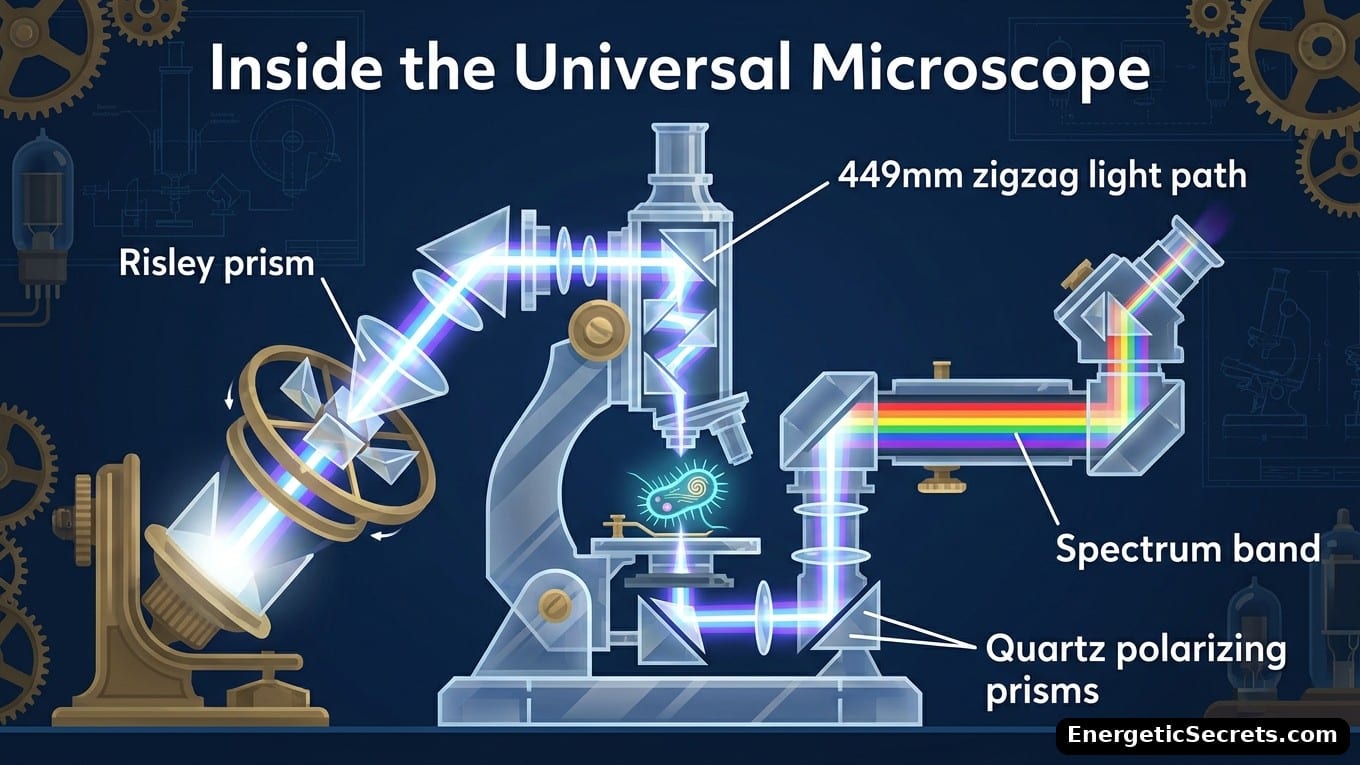
The quartz prism train is not a legend. It is written down, with spacing and thread counts, in the 1944 Smithsonian report. Of course, a description is a description: the Smithsonian was reprinting a survey from the Journal of the Franklin Institute, and it certified nothing. But describing an instrument's prism geometry in that much detail is not how you describe something that never existed. Read More... |

| ★★★★★ |
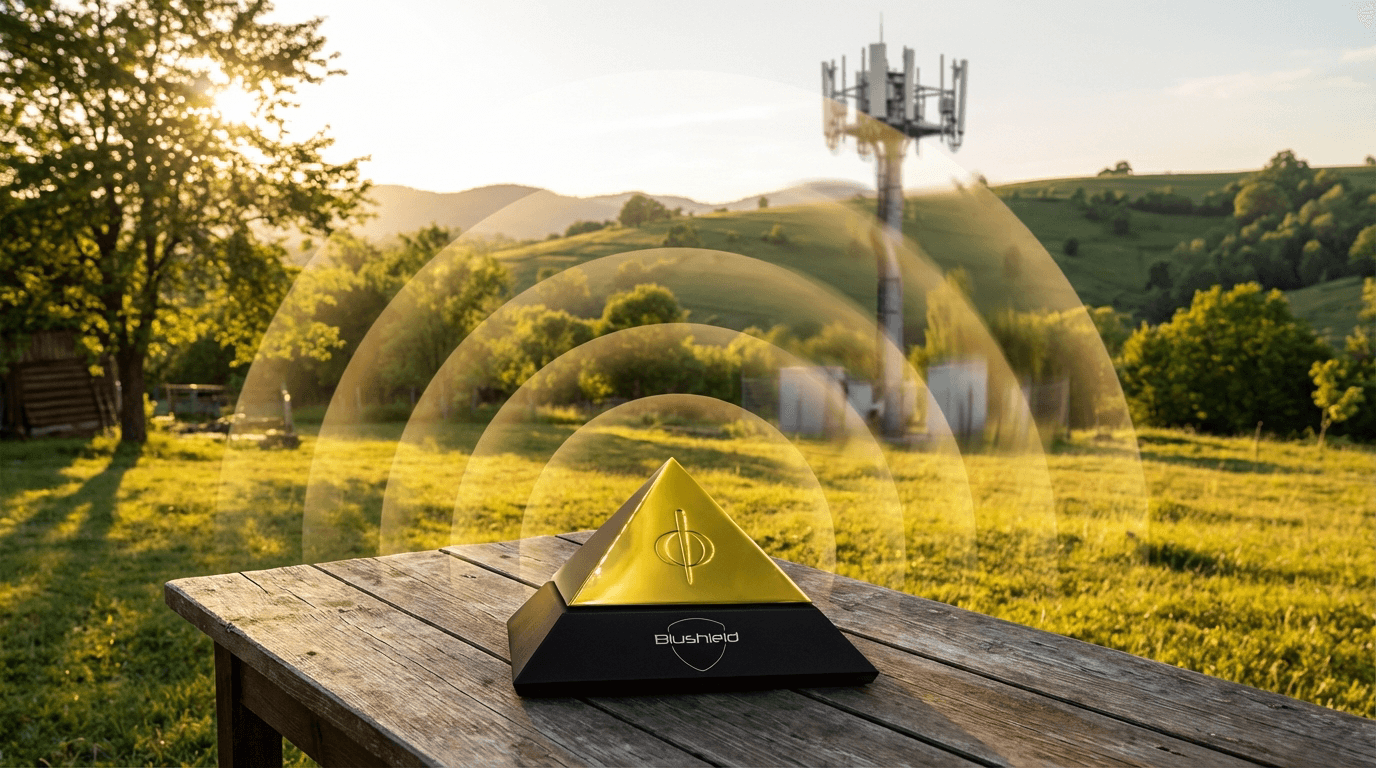
I've now had a Blushield device in my home for over a year and it's not a coincidence that literally everyone that visits comments about how relaxed the energy is at the house.
This is the only whole-house EMF protection product I've found which actually has studies which prove it's effective. Check out their videos explaining it here, and learn why this is an important investment in your health. Use my discount code: TRUTH to save when you check out and that also gives us a small kickback to help pay the bills here. https://JoshuaParker.net/blu Discount code: TRUTH |
|
|
Quote Of The Day |
"The art of medicine consists of amusing the patient while nature cures the disease. We forget, sometimes, that the body carries within it a pharmacy more ancient and more finely tuned than anything we have ever synthesised - one that responds not merely to remedies, but to rest, to clean air, to food grown close to the earth, and to the quiet confidence that healing is the body's default state, not an exception we must force into being." — Voltaire |
💡 Answer to Trivia Question: Allicin |

This newsletter also sponsored by our own product: |
The Most Bioavailable Form of Silica! For Aluminum detox and Collagen Building for Longevity |
| ★★★★★ |
| Save $10 |

| Nutriceuticals |
Orgono G5 Siliplant |
| ★★★★★(1 reviews) |
| $49.95$69.95You save $10 |
Orgono G5 Siliplant is a premium plant-based liquid silica formula crafted from springtime horsetail and rosemary - two time-honored botanicals. Developed by Dr. Loïc Le Ribault, this superior monomeric silica is designed for maximum absorption. Each 1-liter bottle delivers 67 servings to support bone and cartilage health, strengthen joints, and promote collagen production. Silica is also known to bind to aluminum and help carry it out of the body naturally - making this a clean, pure choice for everyday wellness. |
|
| Shop Now |
This newsletter also sponsored by our own product: |
Airtube Headset for Radiation Protection for Phones & Computers with USB-C |
| ★★★★★ |
| Save 17% |

| Protection Products · Anti-Radiation Headset |
AirTube Anti-Radiation Headset Pod Style for Mobile Phones, Tablets & Wireless Devices |
| ★★★★★(1 reviews) |
| $49.95$59.95You save $10 |
Stay protected without sacrificing sound quality. The AirTube Anti-Radiation Headset in sleek Pod Style features a clever hollow-tube design that keeps EMF radiation away from the sensitive soft tissue in your ears — no rubber or latex needed. Compatible with mobile phones, tablets, and wireless devices. The in-line speaker transmits audio through sound tubing for surprisingly clear, loud stereo sound — great for music, podcasts, and calls. Available in 3.5mm and USB-C. Backed by a 90-day satisfaction guarantee. |
|
| 17% Off Now! |
| Shop Now |