
22 Tons Rejected, 300,000 Tons Invited: There's One Part Nobody Checked |
Two real stories. One viral lie. And a question about 300,000 tons of beef that got buried. |

In the last week of August 2026, two stories about beef collided on social media and produced a claim that is now circulating as settled fact: that the United States is about to import contaminated beef from Argentina, the very beef China already refused. The claim is misleading. But the two events behind it are real, and the gap between them is where the actual story lives.
The story is not that America is buying China's rejected beef. The evidence does not support that. The story is the coincidence itself, and what it exposes about how the United States actually inspects imported meat, and about Argentina's regulatory track record.
What Trump Actually Announced
On August 21, 2026, President Donald Trump announced a temporary tariff pause on imported ground beef. In a Truth Social post, he wrote that the United States "will allow up to 300,000 metric tons of product for ground beef to be imported with no out-of-quota tariff," and that "we have a commitment that this beef will be sold at 25 percent below current market prices" [1]. The stated goal, in his own words, was to "reduce prices for Americans while giving space for our Great American Beef Herd to grow again" [1].
The window is real, and it is specific. The ceiling is 300,000 metric tons, and the duration is 90 days, both denominated in 2026 [4][10]. The plan concerns lean beef trimmings used for ground beef, not 300,000 tons of assorted cuts [4][13].
The 25 percent figure is different in kind. It is a commitment Trump stated, not an independently verified market outcome. It should be read as a claim about what the beef will cost, not as a delivered price that has already been achieved [1][10]. The distinction matters, because the viral version of this story treats the 25 percent discount as a done deal and then asks what kind of beef could possibly be sold that cheaply.
What China Actually Rejected
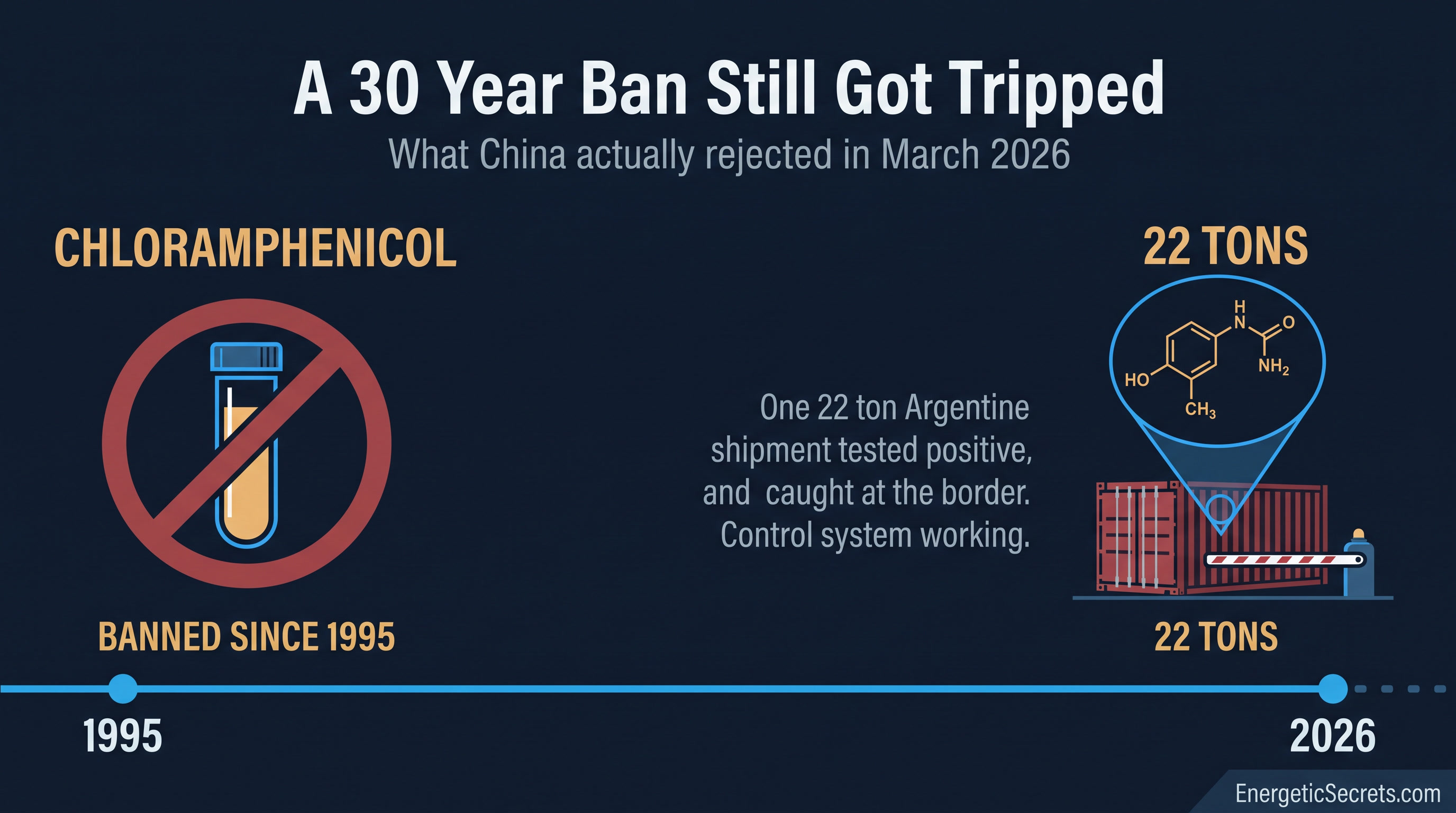
Five months earlier, on March 19, 2026, Chinese customs turned back a shipment of Argentine beef. The shipment weighed 22 tons, and testing found chloramphenicol, an antibiotic that has been banned in cattle raised for slaughter since 1995 [3]. The shipment came from an ArreBeef plant in Pérez Millán, in the Ramallo district of Buenos Aires province, and China's General Administration of Customs suspended imports from that specific plant [3]. China's response was narrow: it suspended imports from one Argentine meatpacking plant, not from Argentina as a whole [2][3].
The chloramphenicol finding is the substantive part. Chloramphenicol is not a new or obscure substance. It has been banned in cattle raised for slaughter since 1995, a ban that predates Argentina's 2001 foot-and-mouth disease outbreak by six years [3]. A positive test for it in 2026 is therefore not a novel risk. It is a failure of a control that has been in place for three decades.
That is the detail that should give a careful reader pause. A ban that has been on the books for thirty years is not a ban that a modern exporter trips by accident. It is a ban that gets tripped when a link in the supply chain, a feed source, a treatment decision, or a testing gap, fails. The fact that it was caught at the border is the system working. The fact that it happened at all is the system being tested. Both things are true at once, and the viral version of the story only wants to tell you the second one.
The Mechanism: What the US Actually Inspects
The viral claim fuses the two events into one: China refused the beef, so America is buying it. There is no evidence that the specific 22-ton shipment rejected by China has any connection to the US import program [4]. The two events are real but separate, and the US import window is governed by its own inspection regime, not by what China did or did not accept [4].
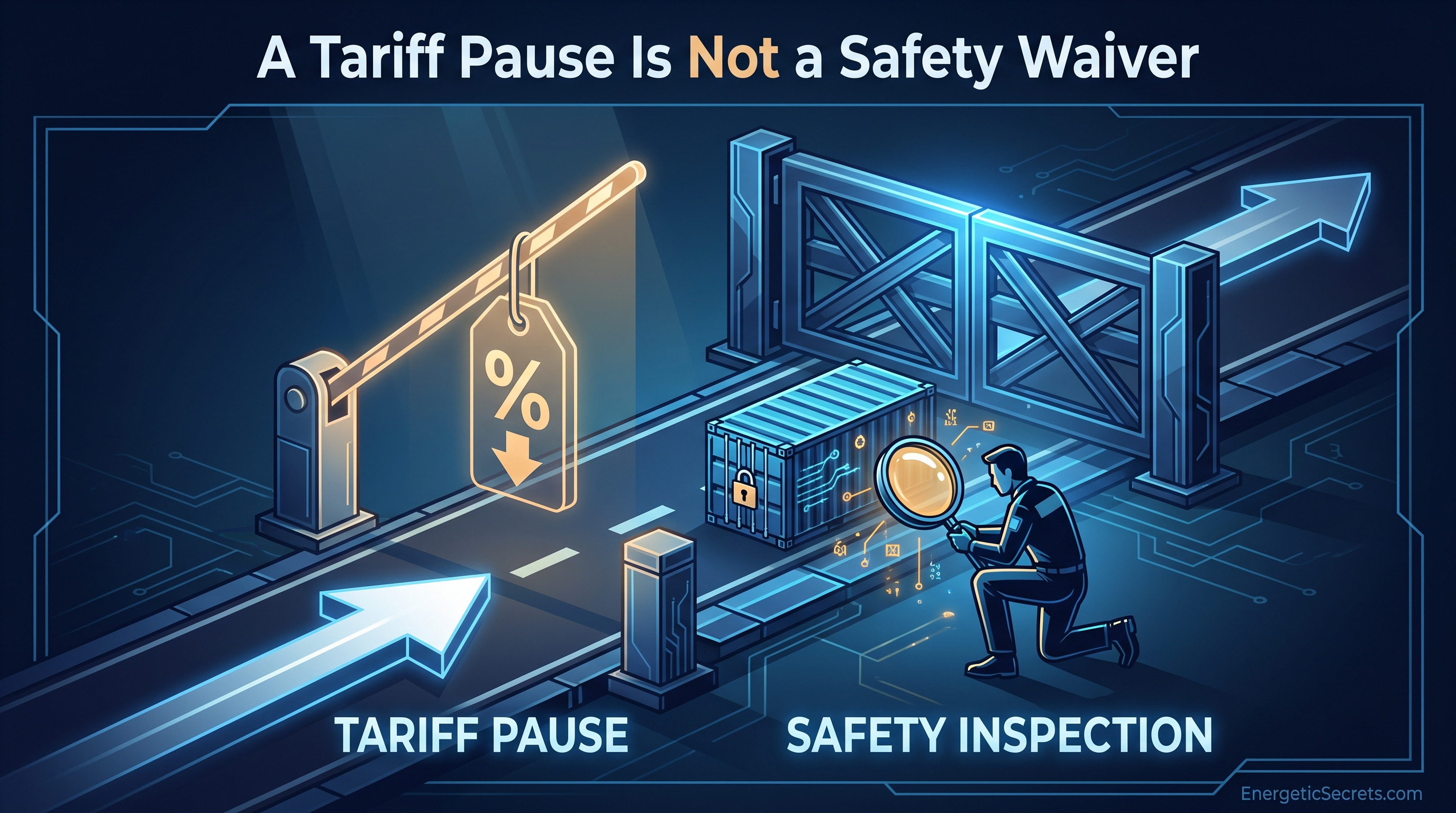
That regime is the part the viral posts skip. The United States does not simply open a tariff window and let whatever arrives through. Imported beef is subject to inspection by the USDA Food Safety and Inspection Service, which maintains its own eligibility rules for every exporting country. A tariff pause changes the price of entry. It does not change the safety standard. The USDA's Food Safety and Inspection Service is tasked with testing agricultural products entering the United States before they hit store shelves, and any imported beef that is not inspected and distributed is recalled [7].
The distinction is the whole point. A tariff is a tax on entry, and pausing it makes imported beef cheaper. An inspection regime is a gate on entry, and it stays closed to product that fails. The two levers are operated by different parts of the same government and answer to different questions. The tariff question is "how much does it cost to bring this in." The inspection question is "is this safe to sell." The viral claim collapses the two, as if a cheaper tariff meant a weaker gate. It does not.
There is a real pressure hidden in that distinction, though. A 300,000-ton window is a large volume to clear in 90 days, and inspection capacity is not infinite. The question the coincidence raises is not whether the gate is open. It is whether the gate can process the volume without the pressure of speed becoming a pressure on rigor. That is a legitimate question, and it is a different question from the one the viral posts asked.
The Economics of a 25 Percent Discount
The 25 percent figure deserves a closer look, because it is the load-bearing number in the viral claim. If beef can be sold 25 percent below current market prices, the viral logic goes, then something must be wrong with it. That is a leap, and it skips the more ordinary explanation.
Beef is a global commodity, and prices differ across markets for reasons that have nothing to do with safety. Argentina is one of the world's largest beef producers, with a herd and a cost structure that differ from the United States. A price gap between two markets is the normal state of affairs, not evidence of contamination. The 25 percent figure is Trump's stated commitment, and it should be attributed to him rather than reported as an achieved outcome [1][10]. Whether the beef actually lands at that price is a market question that will only be answered after the window opens and product moves.
The more useful economic question is what a 300,000-ton window does to the domestic market. The stated goal is to lower prices for American consumers while the domestic herd rebuilds [1]. That is a coherent policy argument, whether or not one agrees with it. The counterargument is made explicitly by the people who would feel it first.
Trump's push to waive tariffs on imported beef has triggered backlash from American ranchers [9]. Republican ranchers and cattle groups warn that cheaper imports could make it harder to rebuild America's depleted herd [4], and the National Cattlemen's Beef Association, which represents cattle farmers and ranchers, criticized the announcement, arguing that "flooding the market with government-subsidized, below-market beef is not the way to rebuild the American cattle herd" [5][8].
Ranchers say the plan will hurt American farmers and ranchers who are already struggling with increased costs of fuel and fertilizer shortages [12]. That is a real debate. It is also a completely different debate from the contamination scare, and conflating the two does a disservice to both.
Argentina's Track Record
Argentina's history with US beef imports is long and uneven. The country was shut out of the US market after a foot-and-mouth disease outbreak in 2001, and it was later recognized as eligible for beef imports again, a change generally dated to around 2018. That 2018 date is approximate and was not verified against a primary USDA or Federal Register filing in the research for this article, because I ran into research roadblocks when trying to confirm that. It should be treated as background, not as a confirmed regulatory milestone.
Argentina is a serious beef exporter, not a marginal one. Its industry is large, established, and subject to its own domestic inspection regime, which is why a single positive test for a banned antibiotic is notable rather than routine. The March 2026 rejection is a data point about one shipment, not a verdict on an entire national industry. The honest way to read it is as evidence that Argentina's controls, like every exporter's controls, are only as good as their weakest link, and that the weakest link occasionally fails.
The chloramphenicol finding in the March 2026 shipment is the more immediate data point. It is a single shipment, 22 tons, rejected by a single country's customs authority [3]. It is not evidence that Argentine beef as a category is unsafe, and it is not evidence that the United States is importing contaminated product. It is evidence that a three-decade-old ban can still be tripped, which is a different and more useful thing to know.
Why the Two Events Got Fused
The fusion of the two events is easy to understand and easy to check. A viral video of Trump saying "Argentina is dying" circulated alongside the beef stories, and it is genuine, but it was recorded in October 2025 and has nothing to do with the August 2026 announcement [2]. The fact-check that examined the claim rated it misleading, concluding that it "relies on speculation, not evidence" [2]. Gotta trust the fact-checkers, right?
The same fact-check confirmed the narrow scope of China's action. China suspended imports from one plant, and major Argentine newspapers reported that the suspension did not affect other plants owned by the same company [2]. That is a single-plant enforcement action, not a national ban, and it is a long way from the "contaminated import" framing the viral posts used.
The framing works because it is simple. Two real events, one scary word, and a question mark. But the connective tissue between the events is missing, and it is missing because it does not exist in the evidence [2][4].
There is a second reason the fusion took hold, and it is worth naming. The two events are both about beef, both about Argentina, and both about a border authority saying no. That is enough surface similarity for a social media algorithm to treat them as one story, and enough for a reader scrolling past to do the same. The human mind is built to connect dots, and it will connect them even when the line between them is drawn in nothing but coincidence. The fact-check's job, and this article's job, is to point out that the line is not there. The gods of the fact-check that never fail, we know that's a stretch but some things they get right.
The Horse Meat Rumor
A separate rumor attached itself to the story: that the imported Argentine beef is secretly horse meat. This claim is unverified and is addressed separately by a NewsNation fact-check [5]. It should not be folded into the main claim about the rejected shipment, because it is a distinct allegation with its own, weaker evidentiary basis [5]. There is no evidence to support the claim, and horse meat is not allowed to be sold for human consumption in the United States [5][6]. The backlash has been accompanied by claims spreading on social media that imported beef, particularly from Argentina, is unsafe or mislabeled [11].
The horse meat rumor and the chloramphenicol story are different claims about different things. Conflating them makes both look stronger than either is on its own. The disciplined move is to keep them separate and to attribute the horse meat claim as a rumor, not a finding. Anything for a click, right?
What It Means for Consumers
For an American consumer, the practical question is simpler than the viral version suggests. The 300,000-ton window is a tariff change, not a safety waiver. Beef entering under it still has to clear FSIS inspection, and the 25 percent price figure is a stated commitment, not a guarantee [1][7]. The real risk in the story is not that a specific contaminated shipment is headed for US shelves. It is that a tariff window this large, opened this fast, puts pressure on the inspection system to keep pace with volume.
For consumers who want to know whether the beef on their plate came from Argentina, the question of labeling and country-of-origin disclosure is the practical thread to pull [6]. Trump has not said where the imported beef will come from, and there is no evidence to suggest the rejected meat is being rerouted [6][7]. The viral claim offers a scare. The useful question is a sourcing one, and it has a more boring answer: check the label, and understand that "imported" is a category, not a verdict.
There is a broader consumer lesson in the episode, and it applies well beyond beef. A claim that fuses two real events into one scary conclusion is a claim that should be checked before it is shared. The check is not hard. It is the same check that separates a fact from a rumor in any domain: find the primary source, confirm the dates, and ask whether the link between the two events is asserted or demonstrated. In this case, the link is asserted and not demonstrated, and that is the entire clickbait story. Just proof you can't always trust a story just because it goes viral on social media!
The Bottom Line

The claim that America is importing contaminated beef that China refused is misleading. The two events it fuses are real: a 300,000-ton tariff-free import window announced in August 2026, and a 22-ton Argentine shipment rejected by China on March 19, 2026 over chloramphenicol [3][4]. What is missing is the link, and the link is missing because it does not exist on the evidence [2][4].
The story worth telling is not the contamination scare. It is the inspection question the coincidence exposes, and Argentina's three-decade-old chloramphenicol ban that a single shipment still managed to trip.
References
1. Trump, Donald. Truth Social post, August 21, 2026, as reproduced in the MEAWW fact-check cited below.
2. MEAWW News. "Fact Check: Is Trump admin importing contaminated beef from Argentina?" (c. August 24, 2026). https://news.meaww.com/fact-check-is-trump-admin-importing-contaminated-beef-from-argentina
3. Baller Alert (via MSN). "China turned back an Argentine beef shipment over a banned antibiotic, and America is about to import more beef." https://www.msn.com/en-us/food-and-drink/general/china-turned-back-an-argentine-beef-shipment-over-a-banned-antibiotic-and-america-is-about-to-import-more-beef/ar-AA2aMjnx
4. IBTimes UK (via MSN), by Audrey Liza M. Nolasco. "China rejected 22 tons of Argentine beef over a banned antibiotic as Trump opens the door to 300,000 tons." https://www.msn.com/en-gb/politics/government/china-rejected-22-tons-of-argentine-beef-over-a-banned-antibiotic-as-trump-opens-the-door-to-300-000-tons/ar-AA2aTnEa
5. NewsNation (via MSN), by Damita Menezes. "Fact check: Is imported Argentine beef unsafe or secretly horse meat?" https://www.msn.com/en-us/money/general/fact-check-is-imported-argentine-beef-unsafe-or-secretly-horse-meat/ar-AA2b3kBC
6. News Nation (via MSN), by Steph Whiteside. "How can you avoid buying beef from Argentina?" https://www.msn.com/en-us/food-and-drink/general/how-can-you-avoid-buying-beef-from-argentina/ar-AA2aZxUe
7. Straight Arrow News (SAN), by Devin Pavlou. "Viral post claims Trump is buying contaminated beef. Here's what we found." August 25, 2026. https://san.com/cc/viral-post-claims-trump-is-buying-contaminated-beef-heres-what-we-found/
8. National Cattlemen's Beef Association. "NCBA Statement on President Trump's Truth Social Post." https://www.ncba.org/news-media/news/details/50285/ncba-statement-on-president-trumps-truth-social-post
9. NewsNation. "Beef rancher costs Trump imports tariffs." https://www.newsnationnow.com/business/beef-rancher-costs-trump-imports-tariffs/
10. NewsNation. "Trump beef import plan prices." https://www.newsnationnow.com/business/your-money/trump-beef-import-plan-prices/
11. NewsNation. "Trump beef imports horse meat food inspection." https://www.newsnationnow.com/politics/trump-beef-imports-horse-meat-food-inspection/
12. NewsNation. "Farmers oppose Trump importing beef prices." https://www.newsnationnow.com/business/your-money/farmers-oppose-trump-importing-beef-prices/
13. IBTimes UK. "Trump tariff-free beef import controversy." https://www.ibtimes.co.uk/trump-tariff-free-beef-import-controversy-1815706
|



8 Comments
Join the conversation
For anyone worried just read the label. Country of origin is right there on the package. Not that hard to check before you buy your ground beef.
25 percent below market is just something he said, not a price anyone locked in. People are treating a promise like it already happened. Wait til the window opens and see what actually shows up on shelves.
Wait so the beef China rejected isnt even the same beef coming here? I definitely saw that as a fact on facebook lol. Guess I fell for it.
300,000 tons in 90 days though. I get that FSIS inspects but how do they keep up with that much that fast. That seems like the real question nobody is asking.
I appreciate an article that actually explains the difference between a tariff and an inspection. Most posts just yell contamination and move on. Thank you for the calm version.
Chloramphenicol banned since 1995 and still showing up in 2026? That is the part that actually worries me, not the viral nonsense. One bad shipment means the testing works but also that somebody messed up somewhere.
My grandpa ran cattle and this is exactly what ranchers have been warning about. Flooding the market with cheap imports right when guys are trying to rebuild their herds. That hurts real people here.
So basically the whole horse meat thing was just made up. Figures. Someone sees a scary word and it spreads like wildfire before anyone checks the date on the video.