
There is a Fourth Phase of Water Inside Every Living Cell |
The people who measured it still argue over what makes it |
Water is the one substance every textbook says we understand, right up until you look closely at what it does against a surface. In 2006, Gerald Pollack's laboratory at the University of Washington reported something that should not happen under the standard model. When water sits against a hydrophilic, or water-loving, material, it pushes dissolved solutes and suspended particles away across distances of typically several hundred micrometers [1]. That is roughly five orders of magnitude beyond the few molecular layers that mainstream surface science says a surface should influence [12]. The measurement is real. What it means is the fight.
This article lays out the mechanism as Pollack's group describes it, then separates what has been independently confirmed from what remains one laboratory's interpretation.
Having a background in geology this stuff reminds me of the debate between metamorphism and what now seems to be called metasomatism (or hydrotheramal metamorphism) but as I recall had a different name in the 90's when I studied it. But let's get back to biology...
The surface orders water into a solute-free layer
The textbook picture of hydration is short-range. Structural forces between surfaces in water decay within roughly one to three nanometers, a few molecular layers [12]. Pollack's 2006 paper in Advances in Colloid and Interface Science challenged that directly, and its own abstract puts the orthodox view in plain terms: "It is generally thought that the impact of surfaces on the contiguous aqueous phase extends to a distance of no more than a few water-molecule layers" [1].
Against hydrophilic surfaces, the group reported a different result. Colloidal particles and dissolved molecules were excluded from a region near the surface, forming a solute-free zone they called the exclusion zone, or EZ. The zone appeared near hydrogels, biological tissues, hydrophilic polymers, monolayers, and ion-exchange beads, and its width was "typically several hundred microns" [1]. The authors described the EZ as "a physically distinct and less mobile phase of water that can co-exist indefinitely with the contiguous solute-containing phase," based on microscopy, electrical potential measurements, ultraviolet-visible absorption, infrared imaging, and nuclear magnetic resonance imaging [1].
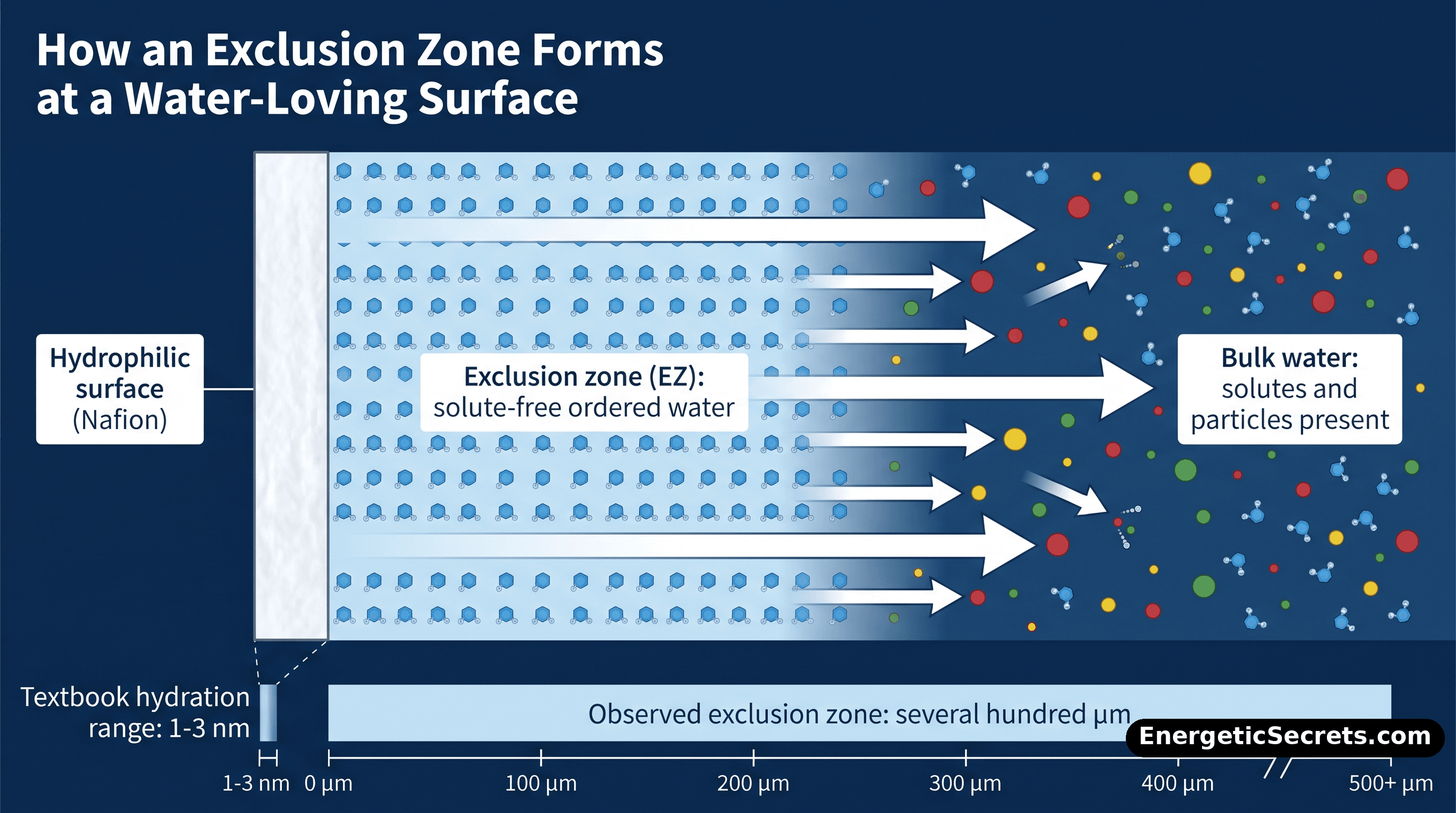
That framing, a distinct phase of water, is the claim the rest of the work rests on. The 2006 experiments establish something measurable: a solute-free region hundreds of micrometers wide. The word phase adds an interpretation, and that is where the disagreement concentrates.
Charge separation and a pH difference across the boundary
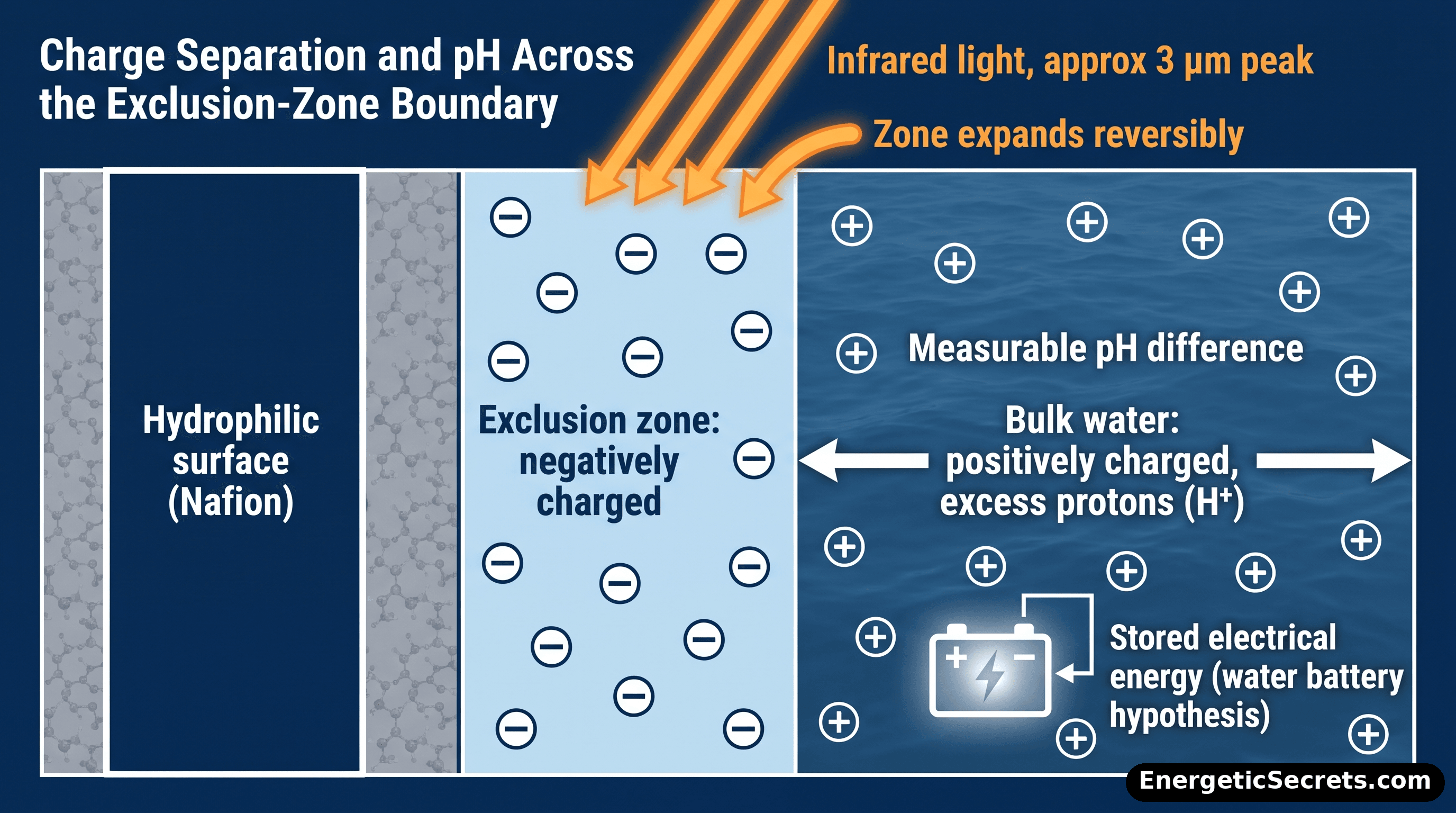
The mechanism Pollack proposes is electrical. In his account, the EZ builds up a negative charge while the water beyond it carries a positive charge. That charge separation shows up as a measurable pH difference across the boundary, and the group treats the separation as the stored energy that grows the zone.
The charge separation and the pH gradient are documented near specific surfaces, particularly ion-exchange materials like Nafion [1,3]. Nafion is a synthetic sulfonated polymer, a proton-conducting membrane that laboratories and industry use because it presents an unusually clean, repeatable hydrophilic surface. What makes it useful as a test material is that the body builds the same arrangement for itself. Thin hydrophilic layers stacked into channels with water threaded between them are what biology is built from: the glycocalyx that coats every cell, the lining of a capillary, the hydrated surface of a collagen fibril. Nafion is a laboratory stand-in for a structure biology makes everywhere, not an exotic exception to it. Whether that local electrical picture generalizes into a universal property of all biological water is a separate question, and it is one the independent literature has not settled.
The group also reported in 2003 that long-range repulsive forces extend from polymer-gel surfaces, work that laid the groundwork for the 2006 synthesis [2]. The lineage matters because it shows this is not a single stray observation but a research program that has run for two decades.
Light grows the zone
The energy claim is the boldest part of the mechanism. Pollack's group reported that radiant energy, and infrared light in particular, "profoundly expands" the exclusion zone "in a reversible, wavelength-dependent manner" [3]. The paper proposes that the incident radiant energy is stored in the water as entropy loss and charge separation, with the charge separation confirmed through pH measurements [3]. The specific finding that infrared is the most effective band, and the approximate three-micrometer peak, sit in the body of that paper rather than its abstract [3].
Follow that claim to its conclusion and you arrive at the idea that ordinary water, exposed to ordinary light, is doing work on itself. The group has also reported that solute-free interfacial zones form in polar liquids other than water [4], and that nuclear magnetic resonance shows reduced proton mobility near hydrophilic surfaces, consistent with an ordering of the water [5].
None of that, on its own, proves the larger claim. It establishes that something reproducible happens at these interfaces.
The fourth phase and the water battery
Pollack calls the exclusion zone the "fourth phase" of water, adding it to solid, liquid, and vapor. His popular book The Fourth Phase of Water and his public talks frame the EZ and its charge separation as a kind of water battery that powers biological systems.
The charge separation near specific surfaces is documented [1,3]. The claim that cells actually run on this stored charge is Pollack's hypothesis. No independent laboratory has demonstrated exclusion-zone-driven cellular energetics regardless of whether this is a simple and logical conclusion.
Mitochondrial production of ATP through oxidative phosphorylation remains the measured, mainstream account of how cells get their energy but the mathematical calculations for ATP do leave some unanswered questions about the overall "powerhouse of the cell" claim for ATP in general so I like to report on these subjects with a skeptical mind, not only for new conclusions but for debunking "accepted science" as well.
One related proposal is worth naming at its actual strength. A 2015 paper from the University of Ulm reported that interfacial water near hydrophilic surfaces is more viscous than bulk water and that near-infrared laser light modulates that viscosity; the authors proposed that mitochondrial water is effectively all interfacial water and linked this to ATP synthase efficiency [8]. That is an independent observation married to a proposed mechanism, not a demonstrated one, and the paper does not pretend otherwise.
The honest summary is that the "water battery" is Pollack's interpretation of real measurements. It may be right. It is not yet established fact but having a background in Viktor Schauberger's "Living Water" research leads me to find Pollack's work important for the understanding of biological fluids despite be groundbreaking work.
What independent labs have confirmed
The strongest argument for taking this work seriously is that pieces of it hold up outside Pollack's own laboratory. The long-range exclusion itself has been confirmed by groups that dispute his interpretation.
Eindhoven researchers, working in a convection-minimized setup, observed "repulsion of particles... over distances of up to hundreds of micrometers, in the absence of any additional external fields" [15]. They attributed it to ion exchange, ion diffusion, and diffusiophoresis, not a new phase [15]. A Barcelona group at ICN2/CSIC showed that the electric field from unequal ion diffusion is the dominant driver of the exclusion zone at Nafion, and that "not all solutes can be expelled... and hence the EZ is not always formed" [16].
Beyond the exclusion itself, other groups have corroborated the related physics. A University of Turin team used T1-weighted MRI to show interfacial water structuring at a Nafion surface [9]. The Ulm work on elevated interfacial viscosity and its infrared modulation is independent [8]. A Moscow State University and Russian Academy of Sciences group reported that humid air irradiated with infrared light partially protected enzymes from heat inactivation and oxidation, a small, preliminary study whose authors attribute the effect to exclusion-zone-type water acting as an intermediary [10]. And a UC Merced group, led by a former collaborator of Pollack's rather than a stranger to the work, measured an inhomogeneous force field inside the exclusion zone near Nafion with laser tweezers [6].
The pattern is the important thing. Independent laboratories keep confirming that water near hydrophilic surfaces behaves in ways the textbook does not predict. What they generally do not confirm is the interpretation.
What remains one lab's account
Several pieces of the story have still not been established outside Pollack's laboratory or his collaborations.
The EZ as a "fourth phase" of matter, rather than a gradient layer produced by ordinary ion motion, is one. The specific charge picture, negative EZ and positive bulk with a proton-driven pH gradient, is documented near particular surfaces like Nafion, but its status as a general rule is not [1,3]. The ultraviolet absorption peak near 270 nanometers, offered in the lab's papers and book as an EZ signature, does not appear in the indexed abstracts and would need the paper body cited and attributed to Pollack's laboratory.
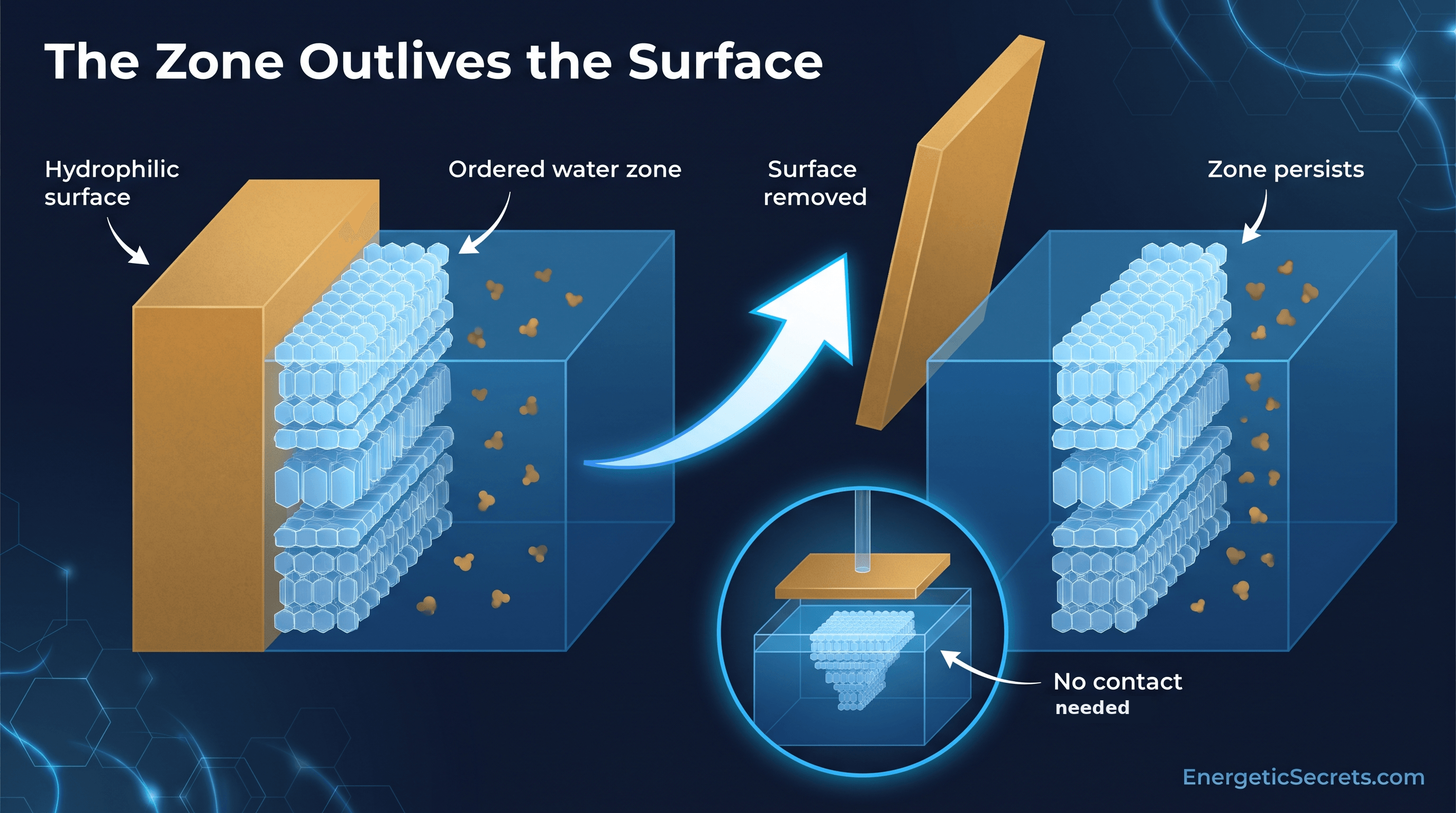
The most dramatic results are the least established. A 2018 paper in PLOS One reported a "three-dimensional cell-like structured exclusion zone" that persists in water after the hydrophilic material is removed, and even in water merely held near it [7]. That paper lists Pollack as a co-author and discloses funding from an industry source, Quantum Energy Co. Ltd. Non-contact and persistent structuring like this needs replication by a group with no Pollack involvement before it should be stated as fact.
The health-flavored results sit at the same level. A 2016 paper reported that local and general anesthetics alter interfacial water [18]. A 2018 Dose-Response paper reported that agents including turmeric, ghee, and Holy Basil increase exclusion-zone size [19]. These are exploratory findings from Pollack's lab with student co-authors, not clinical evidence. Nothing in the verified record supports hydration-protocol or health-product claims built on this literature but having decades of experience using structured water makes this line of research very interesting to me so I look forward to corroboration..
The theoretical context around this work is older than the measurements. Gilbert Ling's association-induction hypothesis, developed across his books, argued that the cell is not a bag of free water, and Emilio Del Giudice's coherent-domain theory proposed that liquid water can sustain macroscopic coherent regions [11]. Both are historical and theoretical context, not confirmed biology. A more concrete application sits alongside them: Pollack's lab with Mexican collaborators reported that interfacial water may underlie sericin's anti-biofouling effect [20]. Like the health findings, it is exploratory.
The mainstream criticism, taken seriously
The criticism of this work is not that the zones do not exist. The critics measure the zones themselves. The criticism is that they are made of ordinary physics.
The sharpest published critique came from inside Pollack's own university. J. Michael Schurr, in the chemistry department at the University of Washington, published a detailed dissection arguing that the exclusion near gels can be explained by microsphere chemotaxis in long-range hydroxide, proton, and salt diffusion gradients, that the measured potentials are liquid-junction potentials, and that the infrared and NMR results are plausible artifacts [13]. Schurr quantified the Pollack laboratory's own data: microsphere exclusion out to roughly 100 to 200 micrometers, reduced infrared emission over a region 300 to 500 micrometers wide, and reduced proton relaxation over a zone about 60 micrometers wide [13].
Pollack's reply ran in the same journal and the same issue [14]: J. Phys. Chem. B, 2013, volume 117, issue 25, pages 7843-7846, PMID 23656175, DOI 10.1021/jp312686x. The critique was published, answered, and the exchange sits in the primary literature for anyone to read. This is not a case of a claim being suppressed. It is a case of a claim being engaged, once, and then largely ignored by the wider field.
What the reply actually argues is worth setting out, because its shape matters more than its wording. Pollack opens by treating Schurr's two papers as evidence that interest in the question is broadening rather than as an attack, noting that the authors are colleagues from his own university's department of chemistry [14]. He works through the objections as four numbered issues and closes with the claim that "the four issues of challenge fail to derail the original line of interpretation, that the EZ is a distinct, ordered structure that excludes solutes," adding that "ample evidence for this interpretation (which Schurr seems to have missed) lends strength to this view" [14].
The substantive move is a reversal of cause and effect. Where Schurr reads osmosis and the formation of electrical gradients as the explanation for what is measured, Pollack reads them as consequences that follow once an exclusion zone has formed at the interface and around solute particles [14]. He also reproduces a pH-sensitive dye measurement showing a steep pH gradient close to the surface, offered as the charge separation made visible, alongside a second figure addressing the Nafion surface itself [14].
The broader alternative-mechanism literature is serious. Florea and colleagues at Eindhoven confirmed long-range colloid repulsion while attributing it to ion exchange and diffusiophoresis [15]. Esplandiu and colleagues in Barcelona showed the EZ does not always form and tied its formation to unequal ion diffusion [16]. These are well-equipped laboratories making a controlled case that the phenomenon is real and conventional.
Naming the debunking frame, and why it fails
Skeptics of the fourth phase reach for polywater, the 1960s anomalous-water claim that collapsed when impurities were shown to explain its properties [17]. The comparison is tempting, and it deserves a direct answer rather than a dodge.
Polywater failed when tested. Its properties vanished under careful measurement, and the whole episode became a cautionary tale about artifacts [17]. Exclusion zones have not vanished. They have been observed for two decades, by multiple groups, including the groups disputing what they mean [15,16]. The phenomenon survived scrutiny. The argument is over its interpretation, not its existence.
Calling the exclusion zone a fourth phase is contested. Calling it real is not.
The institutional paradox
The suppression story here is subtler than a simple blacklist. The foundational work was funded by the National Institutes of Health, whose funding tags appear on the 2006 spine paper and the 2009 light paper [1,3]. It was published in establishment journals. There is no documented suppression of Pollack.
What happened instead is a kind of marginalization by indifference. The work lives in the indexed literature, it is cited modestly, and the textbooks ignore it rather than engage it. The sharpest published challenge came from across the hall, from a chemist at Pollack's own institution [13], and the reply was published and then not much built on it [14]. Establishment science funded the observation, declined to absorb it, and then stopped looking. Clearly funding does often dictate the direction of science and that may be the extent of this "suppression" story.
That is a more defensible story than a deeper suppression fantasy. The institution asserting that water is fully understood is the one that stopped examining measurements it paid for.

Where the evidence stands
The zones exist. Everyone who has looked agrees on that, including the people who think they are ordinary ion gradients. What the zones are made of, and whether they power the cell, is where measurement ends and interpretation begins.
Here is the boundary, stated plainly. The long-range exclusion of solutes near hydrophilic surfaces is a real, replicated phenomenon [1,15,16]. The charge separation and pH gradient near specific surfaces are documented [1,3]. Light grows the zone, reversibly and by wavelength, and infrared is the most effective band [3]. Those are measurements.
The "fourth phase" is Pollack's interpretation, and it is contested [13,15,16]. The "water battery" powering the cell is his hypothesis, not established fact. The health claims may be unearned but time will tell. The persistent, non-contact structuring needs independent replication [7] so I hope this field does get some additional funding.
What the record supports is that a two-decade-old, NIH-funded, peer-reviewed observation about the most studied liquid on Earth has never been properly absorbed by the field that studies it. That gap is real, it is documented, and it is what remains worth taking from the record.
References
1. Zheng JM, Chin WC, Khijniak E, Khijniak E Jr, Pollack GH. Surfaces and interfacial water: evidence that hydrophilic surfaces have long-range impact. Adv Colloid Interface Sci. 2006 Nov 23;127(1):19-27. PMID 16952332. DOI 10.1016/j.cis.2006.07.002.
2. Zheng JM, Pollack GH. Long-range forces extending from polymer-gel surfaces. Phys Rev E. 2003 Sep;68(3 Pt 1):031408. PMID 14524770. DOI 10.1103/PhysRevE.68.031408.
3. Chai B, Yoo H, Pollack GH. Effect of radiant energy on near-surface water. J Phys Chem B. 2009 Oct 22;113(42):13953-8. PMID 19827846. DOI 10.1021/jp908163w. PMC2843558.
4. Chai B, Pollack GH. Solute-free interfacial zones in polar liquids. J Phys Chem B. 2010 Apr 29;114(16):5371-5. PMID 20369860. DOI 10.1021/jp100200y. PMC2865192.
5. Yoo H, Paranji R, Pollack GH. Impact of hydrophilic surfaces on interfacial water dynamics probed with NMR spectroscopy. J Phys Chem Lett. 2011;2(6):532-536. PMID 22003430. DOI 10.1021/jz200057g.
6. Chen CS, Chung WJ, Hsu IC, Wu CM, Chin WC. Force field measurements within the exclusion zone of water. J Biol Phys. 2012 Jan;38(1):113-20. PMID 23277674. DOI 10.1007/s10867-011-9237-5. PMC3285724.
7. Hwang SG, Hong JK, Sharma A, Pollack GH, Bahng G. Exclusion zone and heterogeneous water structure at ambient temperature. PLoS One. 2018;13(4):e0195057. PMID 29668733. DOI 10.1371/journal.pone.0195057.
8. Sommer AP, Haddad MKh, Fecht HJ. Light effect on water viscosity: implication for ATP biosynthesis. Sci Rep. 2015 Jul 8;5:12029. PMID 26154113. DOI 10.1038/srep12029.
9. Spatola G, Viale A, Brussolo E, Binetti R, Aime S. Insights into interfacial water structuring at Nafion surfaces by T1-weighted magnetic resonance imaging. Langmuir. 2020 Jan 21;36(2):540-545. PMID 31874563. DOI 10.1021/acs.langmuir.9b03435.
10. Yablonskaya OI, Voeikov VL, Novikov KN, Buravleva EV, Menshov VA, Trofimov AV. Effect of humid air irradiated with infrared light on enzyme activity. Int J Mol Sci. 2022 Jan 6;23(2):601. PMID 35054784. DOI 10.3390/ijms23020601.
11. Del Giudice E, Preparata G, Vitiello G. Water as a free electric dipole laser. Phys Rev Lett. 1988 Aug 29;61(9):1085-1088. PMID 10039515. DOI 10.1103/PhysRevLett.61.1085.
12. Leikin S, Parsegian VA, Rau DC, Rand RP. Hydration forces. Annu Rev Phys Chem. 1993;44:369-95. PMID 8257560. DOI 10.1146/annurev.pc.44.100193.002101.
13. Schurr JM. Phenomena associated with gel-water interfaces: analyses and alternatives to the long-range ordered water hypothesis. J Phys Chem B. 2013 Jun 27;117(25):7653-74. PMID 23656205. DOI 10.1021/jp302589y.
14. Pollack GH. Comment on "A theory of macromolecular chemotaxis" and "Phenomena associated with gel-water interfaces. Analyses and alternatives to the long-range ordered water hypothesis". J Phys Chem B. 2013 Jun 27;117(25):7843-7846. PMID 23656175. DOI 10.1021/jp312686x.
15. Florea D, Musa S, Huyghe JMR, Wyss HM. Long-range repulsion of colloids driven by ion exchange and diffusiophoresis. Proc Natl Acad Sci U S A. 2014 May 6;111(18):6554-9. PMID 24748113. DOI 10.1073/pnas.1322857111.
16. Esplandiu MJ, Reguera D, Fraxedas J. Electrophoretic origin of long-range repulsion of colloids near water/Nafion interfaces. Soft Matter. 2020 Apr 15;16(15):3717-3726. PMID 32232286. DOI 10.1039/d0sm00170h.
17. Rousseau DL, Porto SPS. Polywater: polymer or artifact? Science. 1970 Mar 27;167(3926):1715-1719. DOI 10.1126/science.167.3926.1715.
18. Kundacina N, Shi M, Pollack GH. Effect of local and general anesthetics on interfacial water. PLoS One. 2016;11(4):e0152127. PMID 27054588. DOI 10.1371/journal.pone.0152127.
19. Sharma A, Adams C, Cashdollar BD, et al., Pollack GH. Effect of health-promoting agents on exclusion-zone size. Dose-Response. 2018 Jul-Sep;16(3):1559325818796937. PMID 30202249. DOI 10.1177/1559325818796937.
20. Pedregal-Cortés R, Toriz G, Delgado E, Pollack GH. Interfacial water and its potential role in the function of sericin against biofouling. Biofouling. 2019 Aug;35(7):732-741. PMID 31468985. DOI 10.1080/08927014.2019.1653863. |



4 Comments
Join the conversation
Polywater comparison is lazy and I'm glad somebody said so. Polywater vanished when tested, this thing keeps showing up even for the people arguing against it.
Honestly the most interesting bit is that NIH paid for the original work and then everyone just shrugged. That happens way more than people think.
The part that bugs me is the turmeric and ghee paper. Once you start testing Holy Basil on water zones you have kind of left the lab and walked into the supplement aisle.
Hundreds of micrometers is huge compared to a couple nanometers. That gap alone makes me want to see somebody redo the Nafion test with fresh eyes.