
Methylene blue began as a blue textile dye, and it turned out to be medicine |
Made in a lab in 1876 and tried against malaria by 1891, it now makes blood able to carry oxygen again |
Before it was a drug, methylene blue was a dye, and it never stopped being one. What follows is a century of documents about a single molecule: a nineteenth-century chemistry bench, a malaria observation, the family tree that ended in the first effective antipsychotic, a long stretch in which medicine mostly stopped looking, and a hospital record that never paused.
I've been intrigued by methylene since hearing about it from some of my advanced doctor colleages when I used to frequent the Cancer Control Convention around 2009. It was one of those things that fascinated me learning about it's affect on metabolism in the electron transport chain of your mitochondria but didn't take it myself due to my focus on natural approaches.
To many clinicians this is a near-indispensable drug that has saved lives in complicated situations, including IV infusions and, as I understand it, in brain surgery as described in many podcast interviews with Dr Jack Kruse. Its marginalization is the story. This is not the biography of a dubious remedy that needs defending. After all, a drug can be filed under "stain" in the mainstream textbooks and still be sitting on the crash cart (this one is both).
I am a researcher, not a chemist or a physician, so I will mark as I go which claims rest on papers I could read and which are attested: asserted by reviews whose original sources I could not check. The oldest ones, from the 1870s and 1880s, are the attested ones.
The ring and the electron trick
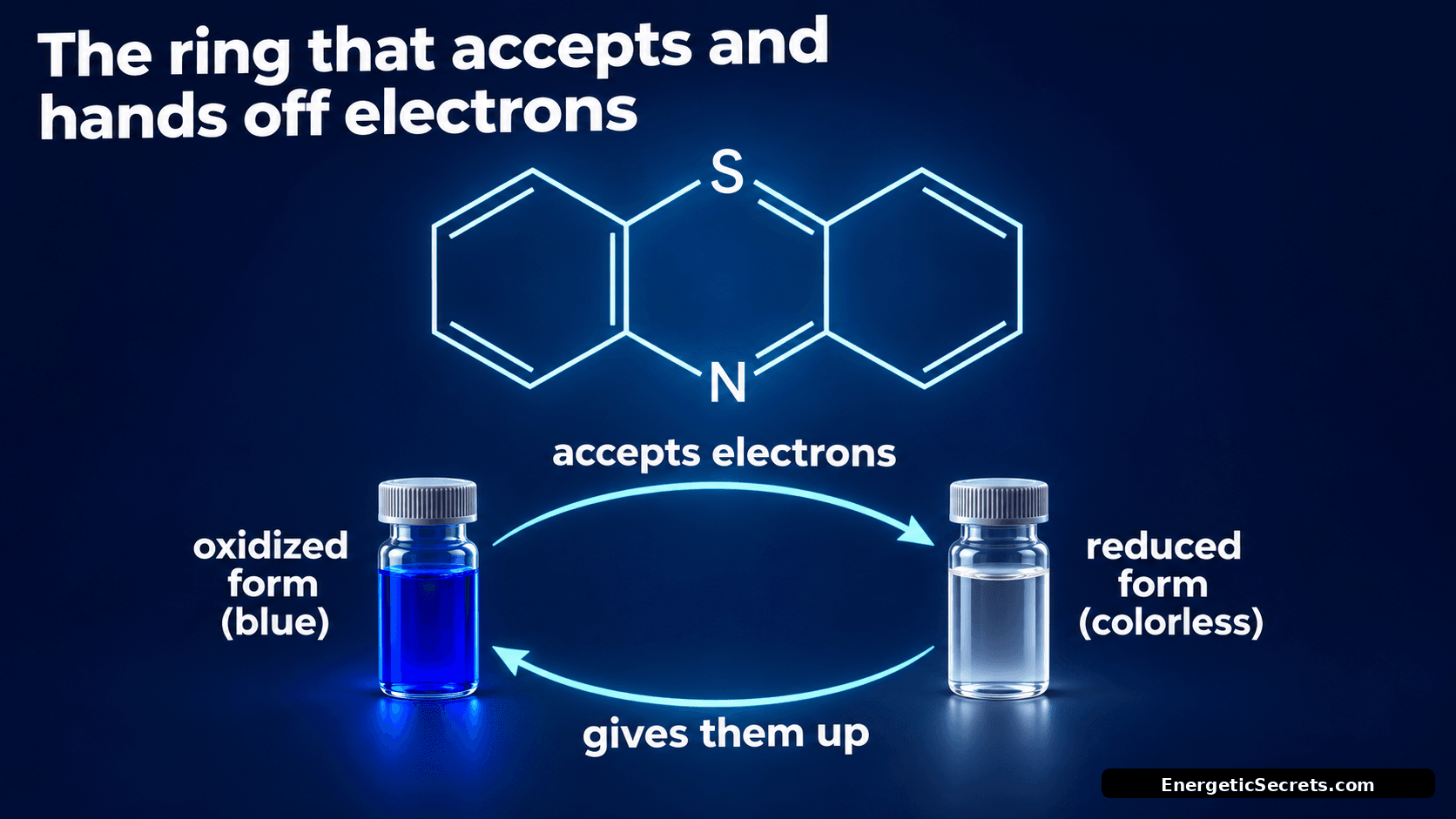
What makes the molecule useful is one property: it picks up electrons in one place and passes them on in another. Chemists call this redox (short for oxidation-reduction) chemistry. Methylene blue does it readily, switching between its blue form and a colorless form that has taken on extra electrons [1]. A 2002 review in the Journal of Chemotherapy put it plainly: the range of things this molecule does comes from its simple structure and its ease at these electron swaps [1].
The ring at the center of the molecule belongs to a family of multi-ringed chemicals called phenothiazines, and methylene blue was an early member of it [2].
The stain, the antidote, the blood-pressure rescue in heart surgery and the brain research below are all variations on that single behavior. The color shows where the dye has gone, and the chemistry is why it goes there and does something once it arrives.
A dye first
Methylene blue was first made in a laboratory in 1876 [1]. That date is what I can document about the origin, along with the long record of use that followed. Who prepared it, and when it first went into commercial textile dyeing, are questions for a dye-history text that I did not read.
The documented part is the staining. Schirmer's 2011 review describes a "120-year-long history of diverse applications, both in medical treatments and as a staining reagent" [3]. In the 1880s, according to that review and to Kristiansen's, Paul Ehrlich used methylene blue to stain nerve tissue. This is attested: I know it only through those reviews, because I did not read Ehrlich's original 1885 monograph [3][4].
A stain works because the dye collects in some structures and not in others. A molecule that seeks out one tissue and ignores its neighbor has a target. Kristiansen's 1989 review of dyes, antipsychotic drugs and antimicrobial activity follows that lineage through Ehrlich's receptor concept, the idea that cells carry specific docking sites for particular molecules [4].
Malaria in 1891
Shen's history of antipsychotic drug development gives the date: in 1891 Ehrlich observed the antimalarial effects of methylene blue, which Shen calls a phenothiazine derivative [5]. The paper behind it, Guttmann and Ehrlich's "Ueber die Wirkung des Methylenblau bei Malaria," appeared in the Berliner Klinische Wochenschrift in 1891. It is attested only. It is not indexed in any database I could search, so I only know it through the reviews [3][5].
Schirmer goes further and calls methylene blue "the first synthetic drug" [3]. That is his characterization, and it rests on the same attested record. The part I can say without hedging is smaller and still remarkable: a dye from a chemistry bench was being tried against a parasite within about fifteen years (a blink, by drug-development standards) of its synthesis.
Failed antimalarials, successful antipsychotics
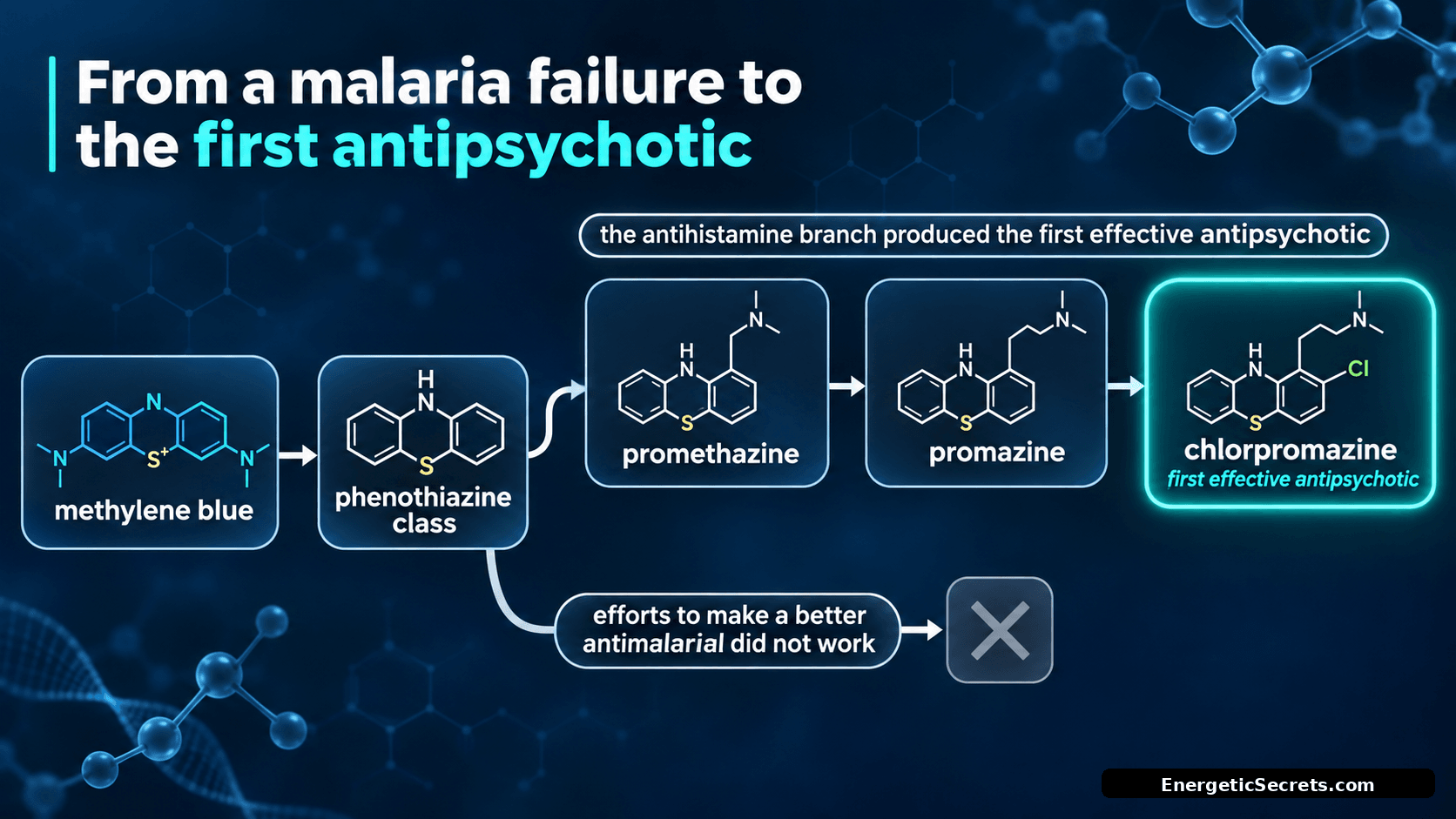
The route from there to modern psychiatry runs through two failures. Frankenburg and Baldessarini explain that failed attempts to synthesize quinine, the classic malaria drug, pushed industrial chemists toward dyes, and that methylene blue was a member of a new class of multi-ringed chemicals, the phenothiazines [2]. Efforts to modify phenothiazines into a better malaria drug did not work. They did yield new antihistamines that also stopped vomiting and calmed patients: promethazine, then promazine, and eventually chlorpromazine, which the authors call the first effective treatment for schizophrenia and mania [2]. Wainwright and Crossley make the same point from the dye side: methylene blue was a starting point for drug treatment of microbial infections and malaria, and it led to the neuroleptic drug families, the older antipsychotics [1].
Shen tells the same story from the clinical end. The phenothiazines were developed as antihistamines, drugs that dampen allergic reactions. In 1951 Laborit and Huguenard gave chlorpromazine because it showed promise as an aid to anesthesia in surgery, and then Hamon and colleagues, and Delay and colleagues, found that it acted against psychosis in psychiatric patients [5]. Kristiansen's review states the lineage in its own words: the history of phenothiazines "from methylene blue via chlorpromazine" [4].
Three independent reviews agree on the chain. Chlorpromazine was not designed as an antipsychotic. It came out of a failed antimalarial program and an interest in anesthesia, and it was built on the same ring family as methylene blue.
The psychiatric road not taken
Methylene blue itself had a psychiatric chapter, and it is the least known part of the story. In 1983 Narsapur and Naylor gave oral methylene blue to nineteen manic-depressive patients (manic-depressive illness is the older name for bipolar disorder) whose illness had not responded to standard treatments. Fourteen (about three in four) showed definite improvement [6].
Naylor and colleagues followed in 1986 with a two-year trial in thirty-one bipolar patients who were already taking lithium, a standard mood stabilizer. Each patient took two doses in turn, 300 mg/day of methylene blue and 15 mg/day, and neither patients nor doctors knew which was which (a double-blind crossover design). Depression was significantly lower on 300 mg/day, the higher dose, with no difference in mania [7]. The authors listed their own limitations: small numbers, dropouts, doubts about whether the blinding held, and the fact that 15 mg/day was not a true placebo, since it was still a dose of the drug [7]. Later laboratory work tied the antidepressant-like effects of methylene blue and related compounds to two enzyme systems that antidepressant research already knew, monoamine oxidase and nitric oxide synthase [8].
I do not know whether anyone tried to repeat that trial with a larger group, and I do not know why the clinical line went quiet. An unfinished research program is evidence of funding and fashion, not a verdict from the patients. There may have been more interest in patented new molecules for psychiatric disorders over funding research for a public domain dye discovered in the 1870's.
What it never stopped doing
Officially, methylene blue became a historical curiosity. Unofficially, it never left the building.
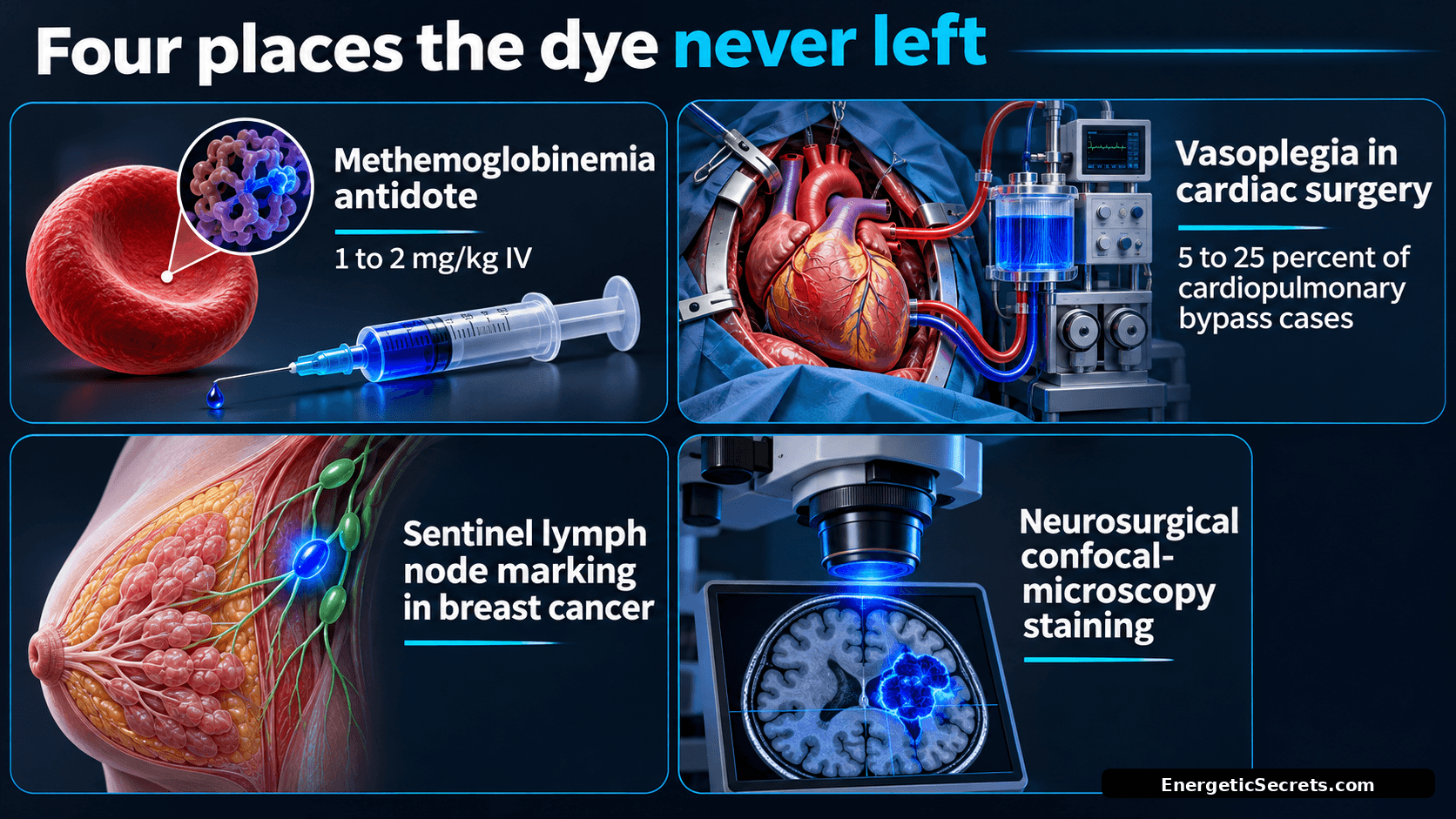
Its major established use is as the antidote for methemoglobinemia, a blood disorder in which the hemoglobin in red blood cells (the protein that carries oxygen) is converted to a form that cannot carry it. The standard dose is 1 to 2 mg/kg intravenously (milligrams per kilogram of body weight). It works by handing electrons back to the damaged hemoglobin, called methemoglobin, and restoring it to normal, the electron trick again [9].
This is a real drug with real cautions. The clinical literature notes dose-related hemolysis (red blood cells breaking apart) and the need for care in patients with G6PD deficiency, an inherited lack of an enzyme in red blood cells [9]. Any decision about using it belongs with a prescriber who knows the patient.
The blue syringe in heart surgery
Then there is the use almost nobody outside a cardiac operating room has heard of. Vasoplegic syndrome, or vasoplegia, is a collapse in the tone of the blood vessels: they go slack, will not tighten, and pressure will not hold. It complicates between 5 and 25 percent of cardiopulmonary bypass cases (the heart-lung machine run during open-heart surgery), and it raises the risk of death [10].
The accepted account is that vasoplegia comes from a nitric oxide signal that has gone out of control. Nitric oxide is a gas that cells use to tell blood vessels to widen. Methylene blue inhibits that signal: it blocks the nitric oxide and cGMP pathway, the chain of chemical messengers that carries the order to dilate [11][12]. That is why a current review of vasoplegia in cardiac surgery and mechanical circulatory support (devices that take over some of the heart's pumping) lists methylene blue among the treatment options [11]. The others are the standard blood-pressure-raising drugs, called vasopressors (catecholamines, vasopressin and angiotensin II), and hydroxocobalamin, a form of vitamin B12 [11].
A 2026 review pooled the results of nine randomized trials (trials that assign patients to treatments by chance) with 535 participants in all. Combining trials this way, a method called meta-analysis, gives a larger sample than any one trial could.
The review describes methylene blue as having re-emerged as an add-on treatment for vasoplegic shock, the state in which blood pressure stays dangerously low. It is given alongside the standard vasopressors (drugs that raise blood pressure) rather than in place of them [13]. The review reports that several of the trials found blood pressure recovered sooner and patients needed less vasopressor [13]. When the trials were combined, deaths in the short term were not significantly lower, meaning the pooled data did not show a clear difference in the death rate [13].
Nodes, stains and the operating room
The dye work never stopped either. In early breast cancer, methylene blue has been reported as the only agent needed to identify the sentinel lymph node, the first lymph node a tumor drains into [14]. A separate report from a hospital in Colombia describes using it for the same job where resources were limited, a useful real-world data point [15]. The same tendency to collect in particular tissues that showed Ehrlich nerve tissue in the 1880s now shows a surgeon a lymph node.
It turns up in spine surgery as well. A 2026 case report describes methylene blue discography, a technique in which the dye is injected into a spinal disc to mark it. The surgeons used it during an endoscopic discectomy (a disc operation done through a thin tube with a camera) for a herniated disc in the lower back whose bulge had moved upward [16]. A single case report is one data point, not a trend. It still shows the dye in current operating-room practice.
Brain surgery, and what the literature says
The published record does document methylene blue in a neurosurgical operating room. One series of 106 brain-tumor cases used intraoperative confocal microscopy, a microscope in the operating room that images fresh tissue during surgery instead of waiting for a lab. The surgeons tested a panel of rapid stains on tumor tissue, and methylene blue was among those attempted. Three other dyes that glow under the microscope's light (acriflavine, acridine orange and cresyl violet) performed best, so methylene blue finished behind them [17]. That is a small point about which stain suits that one imaging method, not a verdict on the dye.
What the series shows is narrower than routine tissue marking in brain surgery. The papers I read do not document that routine use, and I do not know how many neurosurgeons reach for the dye today. What clinicians report from practice and what the published literature covers do not yet overlap, but having followed Jack Kruse's work for a number of years now I trust he knows what he's talking about considering he's considered among the top practicing brain surgeons.
The brain, again
While psychiatry moved on, researchers studying neurodegenerative diseases, in which brain cells progressively break down, were finding methylene blue. Schirmer's 2011 review describes a surge of interest in it both as an antimalarial and as a possible treatment for conditions such as Alzheimer's disease. The suggested route is stopping tau protein, the protein whose tangles mark the Alzheimer brain, from clumping together [3]. A 2009 review reports that in laboratory models methylene blue slows the formation of amyloid plaques and neurofibrillary tangles, the protein deposits found in Alzheimer brains [12]. It also partly repairs the function of mitochondria (the cell's energy producers) and acts on the brain's chemical messenger systems that run on acetylcholine, serotonin and glutamate [12].
The mechanism review that ties this together is Rojas, Bruchey and Gonzalez-Lima's from 2012. At low doses, methylene blue acts as an electron shuttle in the electron transport chain, the line of proteins inside mitochondria that the cell uses to make energy. That enhances cell respiration (how cells turn oxygen and fuel into energy) and memory consolidation, the process that stabilizes new memories. The dose-response is hormetic, meaning low and high doses have opposite effects [18]. Protection of nerve cells at low doses has been described in humans and in disease models [18].
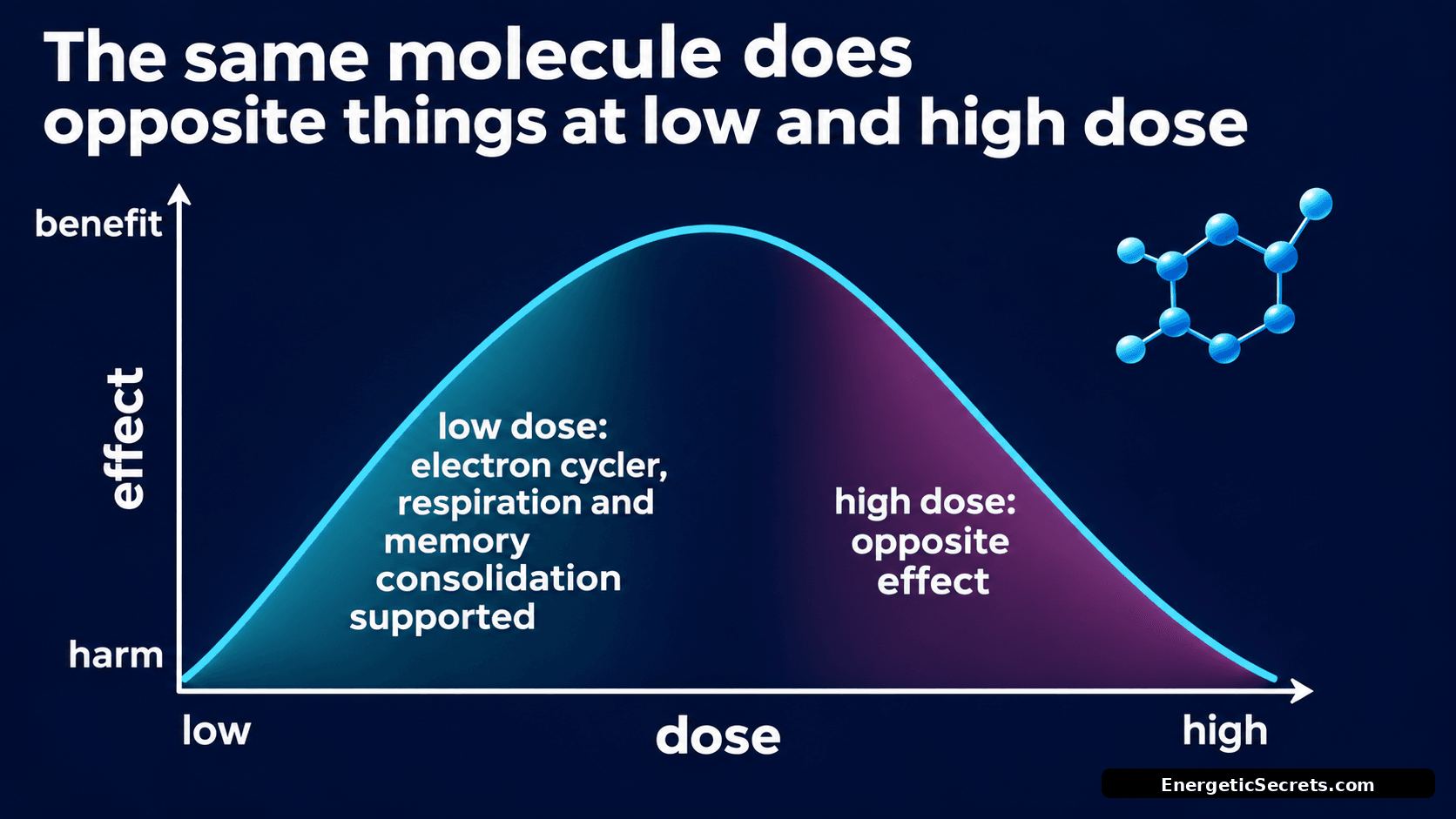
The electron shuttle from the 1870s, the same redox chemistry behind the stain, the antidote and the blood-pressure rescue, is also the proposed mechanism for the brain effects. One molecule, one trick, many tissues.
A drug the filing forgot
The official filing says methylene blue is a stain with a handful of narrow, mostly emergency uses, replaced in psychiatry and of no standing in the modern formulary, the list of approved drugs. The clinical record says it never left: it is the first antidote doctors reach for in methemoglobinemia, a rescue drug in cardiac surgery, a tissue-marking dye, and now a subject of neuroscience research.
A dye became a drug in the 1890s, parented the chemistry of chlorpromazine, was tried in manic-depressive patients in the 1980s, and was never taken off the crash cart. Absence of a modern trial is a fact about funding and fashion. It says nothing about a molecule that was reversing poisonings the whole time.
Some of this history is documented off the papers I read, and some of it (the 1876 synthesis, the 1880s staining, the 1891 malaria paper) is just referenced from reviews because the originals predate the databases but I will keep digging for those original files. Despite the bias against public domain molecules like methylene blue, the molecule keeps working and this one remains a thorn in the side of pharma.
Disclaimer: I am not a health professional of any kind and make no medical claims. I am just a researcher who likes to dig deep on effective methods to keep them from being lost to the dust bin of history. And I like to write about what I learn and as I dig deeper will report more on this. So please do your own research. Nothing in this article should be considered medical advice. None of the statements have been evaluated by the FDA. Not intended to diagnose, treat, cure or prevent any disease. If you have a medical condition seek professional help.
References
1. Wainwright M, Crossley KB. "Methylene Blue--a therapeutic dye for all seasons?" Journal of Chemotherapy. 2002;14(5):431-443. PMID 12462423.
2. Frankenburg FR, Baldessarini RJ. "Neurosyphilis, malaria, and the discovery of antipsychotic agents." Harvard Review of Psychiatry. 2008;16(5):299-307. PMID 18803105.
3. Schirmer RH, Adler H, Pickhardt M, Mandelkow E. "'Lest we forget you--methylene blue...'" Neurobiology of Aging. 2011;32(12):2325.e7-e16. PMID 21316815.
4. Kristiansen JE. "Dyes, antipsychotic drugs, and antimicrobial activity. Fragments of a development, with special reference to the influence of Paul Ehrlich." Danish Medical Bulletin. 1989;36(2):178-185. PMID 2651032.
5. Shen WW. "A history of antipsychotic drug development." Comprehensive Psychiatry. 1999;40(6):407-414. PMID 10579370.
6. Narsapur SL, Naylor GJ. "Methylene blue. A possible treatment for manic depressive psychosis." Journal of Affective Disorders. 1983;5(2):155-161. PMID 6222095.
7. Naylor GJ, Martin B, Hopwood SE, Watson Y. "A two-year double-blind crossover trial of the prophylactic effect of methylene blue in manic-depressive psychosis." Biological Psychiatry. 1986;21(10):915-920. PMID 3091097.
8. Harvey BH, Duvenhage I, Viljoen F, Scheepers N, Malan SF, Wegener G, Brink CB, Petzer JP. "Role of monoamine oxidase, nitric oxide synthase and regional brain monoamines in the antidepressant-like effects of methylene blue and selected structural analogues." Biochemical Pharmacology. 2010;80(10):1580-1591. PMID 20699087.
9. Clifton J 2nd, Leikin JB. "Methylene blue." American Journal of Therapeutics. 2003;10(4):289-291. PMID 12845393.
10. Fischer GW, Levin MA. "Vasoplegia during cardiac surgery: current concepts and management." Seminars in Thoracic and Cardiovascular Surgery. 2010;22(2):140-144. PMID 21092891.
11. De la Torre E, Pirri C. "Vasoplegia in Cardiac Surgery and Mechanical Circulatory Support: From Cardiopulmonary Bypass to Advanced Circulatory Support Devices." Journal of Cardiovascular Development and Disease. 2026;13(8):378. PMID 42645849.
12. Oz M, Lorke DE, Petroianu GA. "Methylene blue and Alzheimer's disease." Biochemical Pharmacology. 2009;78(8):927-932. PMID 19433072.
13. Rodriguez-Lima DR, Rodriguez-Villegas A, Toro Egas JD, Bautista EMC. "The Effectiveness of Methylene Blue in Adult Shock: A Systematic Review, Meta-Analysis, and Trial Sequential Analysis of Randomized Controlled Trials." Journal of Clinical Medicine. 2026;15(12):4481. PMID 42355649.
14. Nour A, Aljawad H, Nizami M. "Success and safety of methylene blue as the sole agent for sentinel lymph node identification in early breast cancer." Breast Journal. 2012;18(4):386-388. PMID 22716953.
15. Angarita FA, Acuna SA, Cervera S, Torregrosa L, Tawil M. "Meeting surgical necessities for sentinel lymph node biopsy in breast cancer: experience with methylene blue in a Colombian hospital." Breast Journal. 2012;18(6):618-619. PMID 23110749.
16. Marques MVB, Machado FG, Ponte JLM, de Sant'Anna RS, de Brito MBS. "Use of methylene blue discography in transforaminal endoscopic discectomy for cranially migrated lumbar disc herniation: A case report." Radiology Case Reports. 2026;21(12):5825-5830. PMID 42724631.
17. Martirosyan NL, Georges J, Eschbacher JM, Belykh E, Carotenuto A, Spetzler RF, Nakaji P, Preul MC. "Confocal scanning microscopy provides rapid, detailed intraoperative histological assessment of brain neoplasms: Experience with 106 cases." Clinical Neurology and Neurosurgery. 2018;169:21-28. PMID 29604507.
18. Rojas JC, Bruchey AK, Gonzalez-Lima F. "Neurometabolic mechanisms for memory enhancement and neuroprotection of methylene blue." Progress in Neurobiology. 2012;96(1):32-45. PMID 22067440. |




3 Comments
Join the conversation
So a failed malaria drug turned into the first schizophrenia treatment by accident. Medicine is wild sometimes.
The part about the 1986 trial with only 31 people is doing a lot of heavy lifting here. Two doses of the same drug compared against each other is not really a placebo trial and the authors even said so.
My dad had a reaction to a numbing agent at the dentist and they gave him methylene blue in the ER. Nurse said his lips went back to normal color in minutes. Had no idea it was the same thing they stain slides with.