
Nine Months After Mailing $95 Million in Siri Surveillance Checks, Apple Wants $299 for a Camera and Microphone in Your Kitchen |
The wall camera recognizes your face, and its own disclosure lets it show your personal data with your phone gone |
On October 13, 2026, Apple began taking pre-orders for a product it calls Apple HomeView. The price is $299, the launch date is November 13, and the company's own press release pitches it as "a new way to enjoy entertainment, stay connected, and manage the home." [1] What that headline does not mention is what the hardware actually is: a camera and a microphone array, plugged into the wall, always powered, always on, sitting in the middle of your home.
The $299 price tag obfuscates the real business model which many have suspected when seeing ads for a plumber shortly after discussing a plumbing problem near their mobile phone.
Now, I have been digging through corporate privacy fine print for decades, and I have learned a simple habit that has never once let me down. Ignore the marketing. Read the legal pages. The thing is, Apple makes this easy, because its marketing pages and its legal pages are both public, and if you put them side by side they argue with each other. That argument is the whole story here.
What Is Actually in the Box
Start with the hardware, because the hardware is honest even when the marketing is selective. Apple's own technical specifications page lists a 7-inch Liquid Retina display at 1088 by 1088 resolution, mounted on a speaker base or a wall bracket, with wired power only. There is no battery. This thing does not move, and it does not turn off unless you unplug it. [2]
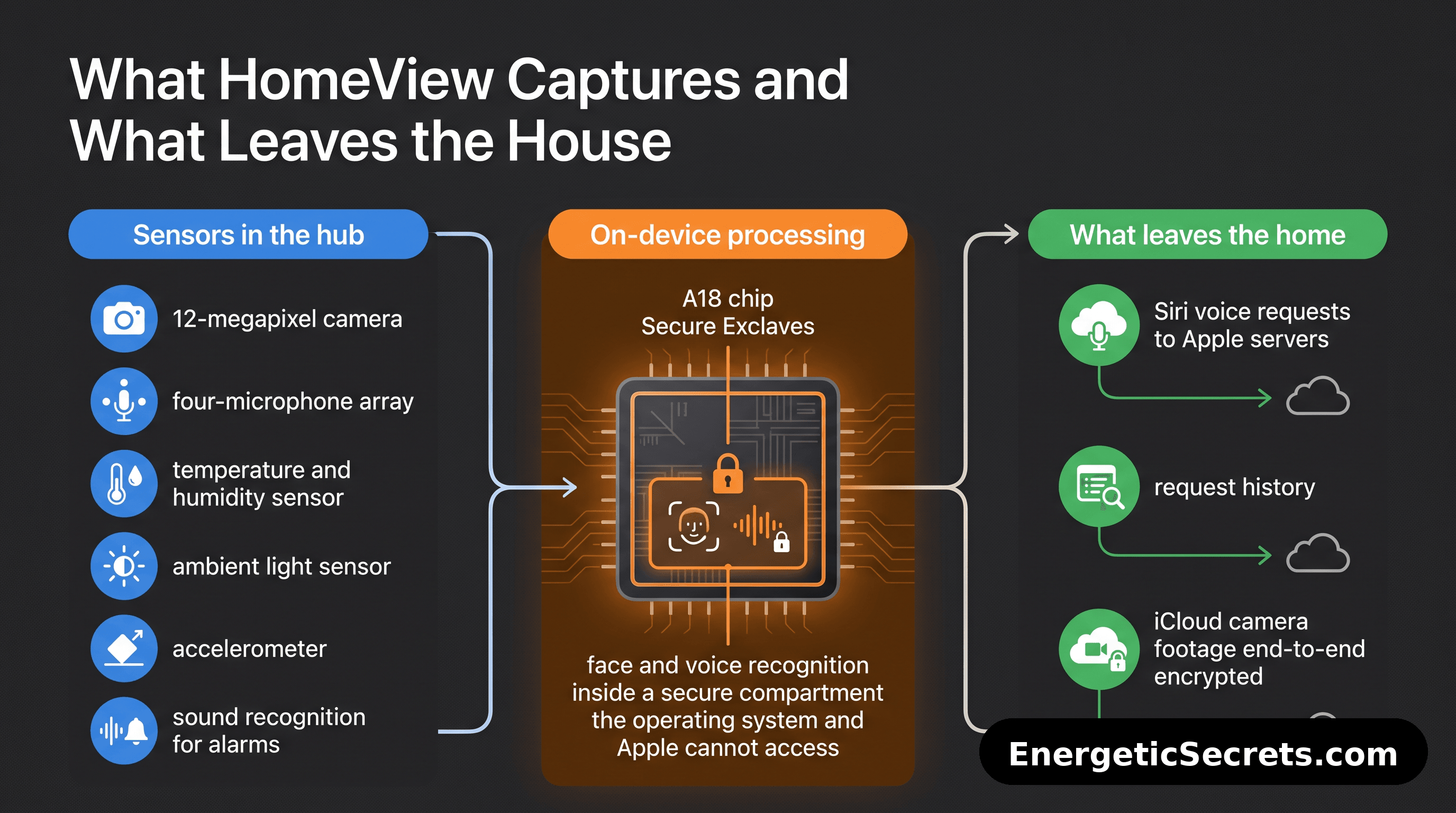
The sensor list is where it gets interesting. A 12-megapixel Center Stage camera with an f/2.4 aperture. A four-microphone far-field array, designed to pick up your voice clearly from across a room rather than up close. An ambient light sensor. A temperature and humidity sensor. An accelerometer. Apple's A18 chip, Wi-Fi 6E, Bluetooth 6, and Thread radios. [2] The product page also notes a Sound Recognition feature that detects the sounds of the smoke and carbon monoxide detectors in your home, and pushes an alert to your iPhone, iPad or Watch if it hears one. [3]
Keep in mind what that feature quietly confirms. For the hub to recognize an alarm sound, the microphones have to be analyzing the sound in your home around the clock. That is not an accusation. It is simply how the feature works, and Apple lists it as a selling point.
Six Faces, Six Voices
Here is the part most coverage glossed over. HomeView, in Apple's own words, "recognize[s] up to six people and seamlessly switch[es] between them." It does this two ways at once: by face, through the camera, and by voice, through the microphones (two biometrics for the price of one). The screen even responds to proximity, showing richer personal detail as you physically step closer to it, while guests and unrecognized users get accessory control rather than personal content. [3][4]
To its credit, Apple describes a genuine piece of security engineering underneath this. The product page says the A18 chip uses what Apple calls "Secure Exclaves," processing the camera and microphone feeds "in a secure compartment that cannot be accessed by the operating system or by Apple," so face and voice recognition happen "without exposing the audio and visual data used for recognition to the operating system." [3] Note whose claim that is. It is Apple's, and I am quoting it as Apple's (I have learned the hard way not to take a press release at its word).
The Secure Exclave is real silicon, first detailed by developer Guilherme Rambo's firmware analysis in 2024 as a new component in Apple's M4 and A18 chips. It is distinct from the older Secure Enclave (the vault that holds your encryption keys), and one of its jobs is to render the camera and microphone indicator lights in hardware, so malware cannot hide the fact that a sensor is live. [5] That is a real protection against third-party snooping. What it does not do is limit what Apple's own services collect once a voice request leaves the device. For that, you have to read a different set of pages entirely.
Apple's senior vice president of worldwide marketing, Greg Joswiak, framed the product this way at launch: it "recognizes your face to shift from a household screen to your own experience," and it is "powered by Apple Intelligence with Siri AI at its core," all while "keeping everyone's information private and secure." [6] Hold that sentence in mind. We are about to compare it with the terms.
Read the Terms, Not the Marketing
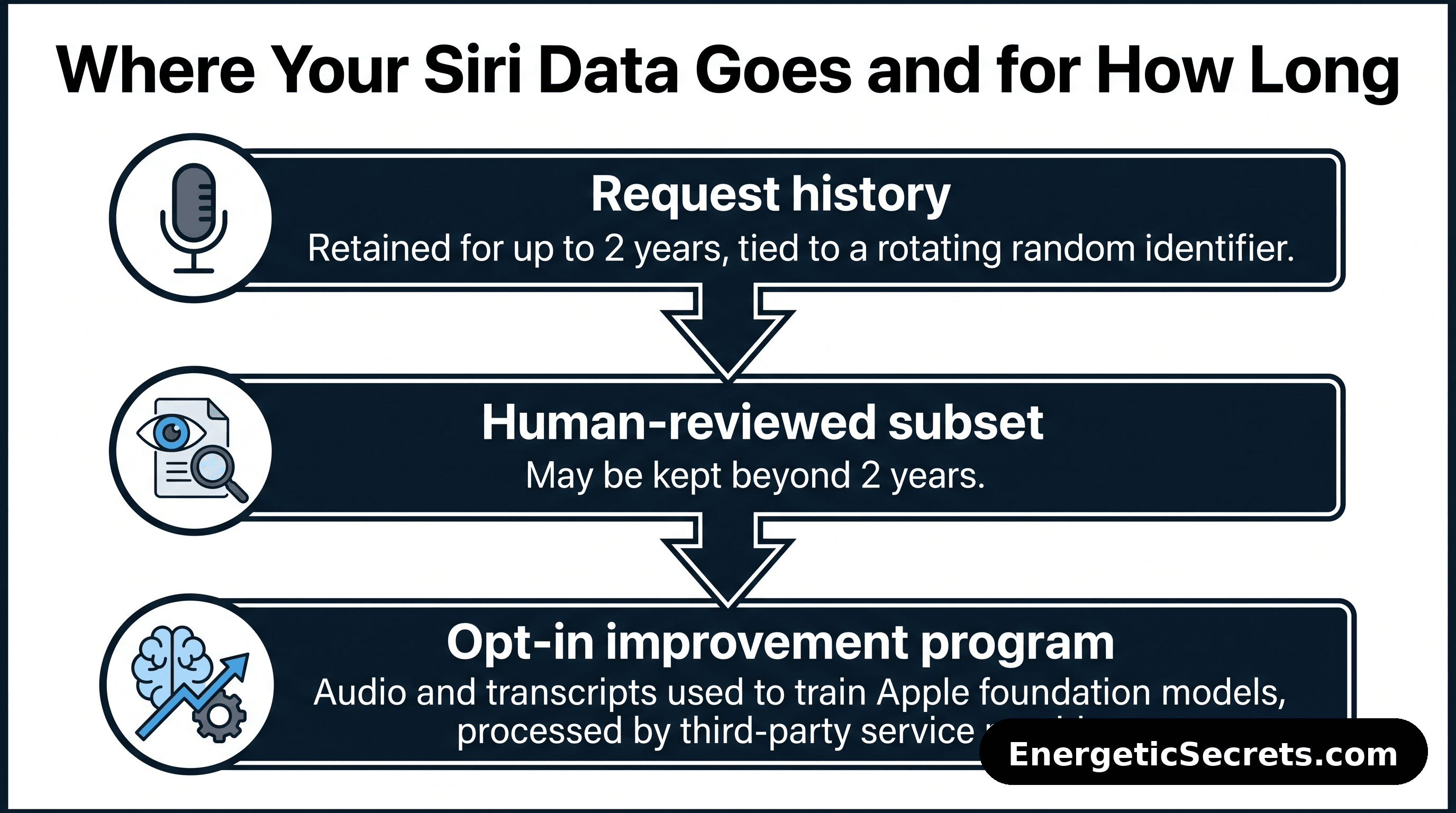
Apple's legal page titled "Siri, Dictation & Privacy," dated September 14, 2026, four weeks before pre-orders opened, discloses the following. When you use Siri, your audio may be sent to Apple's servers. Your request history, meaning the transcripts of what you asked plus associated request data, is retained for up to two years, tied to a rotating random identifier (a stand-in serial number that is not your name, but that still ties two years of your requests to each other). If Location Services is on, the approximate location of the device at the time of the request is stored alongside it. And a subset of recordings that goes through human review, Apple's page says, "may be kept beyond two years." [7]
Then there is the opt-in program. A second legal page, "Improve Siri & Apple Intelligence & Privacy," same date, describes what happens if you toggle it on. Apple may store your Siri interactions, the audio and the transcripts and the responses, and use them to train Apple's foundation models (the large in-house AI models that sit underneath Siri's new abilities). Human graders review samples, and Apple says audio is reviewed only by Apple employees rather than contractors. Your data "may be processed and stored with trusted third-party service providers." [8]
Now here is the sentence that matters for HomeView, and I want to quote the policy exactly: the improvement setting you choose on your iPhone or iPad "will apply to any new Apple connected device or supported HomeKit accessory set up with that iPhone or iPad." [8] In plain terms, a toggle you flipped on your phone two years ago, and forgot about, follows the new microphone box into your kitchen. Most people will never open either of these pages (I only opened them because it is my job). Apple is counting on that, and I do not think that is an unfair thing to say.
The Camera Network
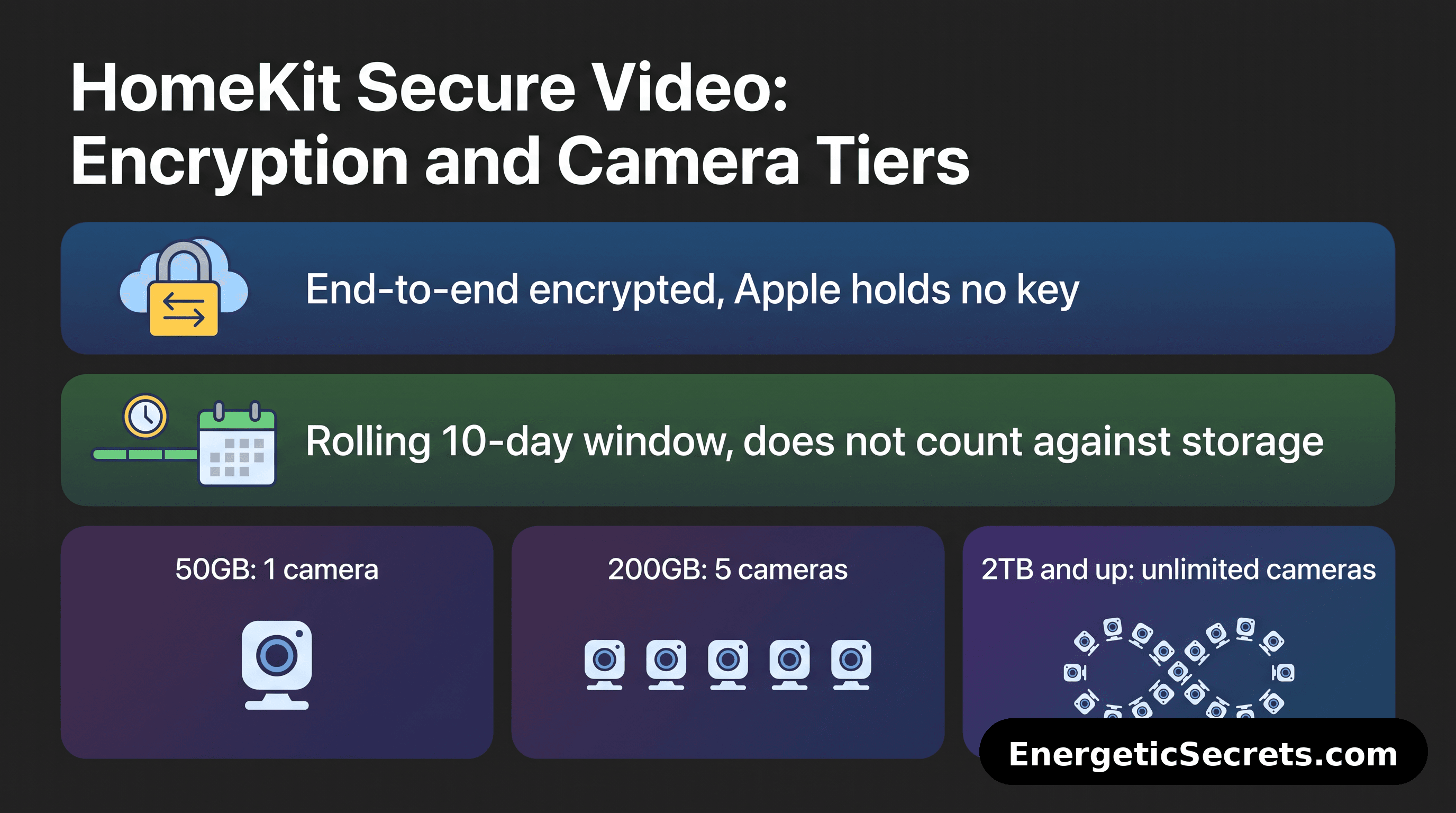
HomeView is not just a listener. With an iCloud+ subscription it becomes the brain of Apple's camera system, HomeKit Secure Video. Apple's support guide describes the home hub using "on-device intelligence" to analyze your camera footage, with the video stored in iCloud end-to-end encrypted, meaning Apple itself holds no key to read it, on a rolling ten-day window that does not count against your storage quota. Camera counts are tiered by what you pay: one camera on the 50GB plan, five on 200GB, unlimited on 2TB and up. [9]
Layered on top, per the press release, is recognition of "people, familiar faces, pets, packages, and vehicles," plus AI-generated "video descriptions" that let you, in Apple's own words, "understand what happened in a video clip without even watching it." [1] The Home Camera face of the hub can livestream up to nine camera feeds on one screen at the same time. [3][1] Nine simultaneous windows into your property, summarized by machine, so the machine can tell you what happened in your own home (a sentence I never expected to type).
Apple Will Sell You the Rest of the Net
Announced the same day, October 13, is the Apple Home Collection, a first-party accessory line developed with LG Electronics and Schneider Electric and sold on apple.com. [10][11] Read the lineup slowly, because each item is a sensor pointed at your life:
• LG Video Doorbell, $249.95: dual cameras, a 2.5K front camera plus a second camera angled down at packages.
• LG Outdoor Cam, $299.95.
• LG Floodlight Cam, $399.95: motion-activated dual floodlights with a camera between them.
• LG Indoor Cam, $199.95: this one has what Apple calls a privacy tilt. The camera tilts to view the room when a user checks in remotely, and tilts back down to stop monitoring as soon as a member of the household returns. [11]
• LG Smart Deadbolt Lock, $349.95: uses ultra-wideband radio to sense your phone approaching and unlock the door as you walk up to it.
• LG and Schneider thermostats and room temperature/humidity sensors, $199.95 and $39.95. [10][11]
Availability starts December 2026, with select items in early 2027, and Apple states that "each accessory is encrypted end-to-end in Apple Home." [11] Suffice it to say, the doorbell watches the street, the floodlight watches the yard, the indoor camera watches the room, the lock logs the door, and the hub in the kitchen ties all of it to your face and your voice.
Am I the only one who sees a clear path to hacking stacked on top of the obvious privacy invasion in these devices?
The Footnote
Every Apple press release carries footnotes, and almost nobody reads them. This one should be read. Describing how HomeView shows your personal content, Apple states: "When a paired device is disconnected from Wi-Fi, personal information may remain accessible provided the user is recognized by their face, and the device was recently on the same Wi-Fi network, has an active cellular connection, is in the same location, and has been recently unlocked." [1]
What this means is simple. Your phone can leave the house, drop off the network entirely, and the hub on the wall can keep displaying your personal information to anyone whose face it recognizes as yours. The camera, not your phone, becomes the proof of identity. I am not going to editorialize that sentence. It stands on its own reiterating my concern about hacking and other such vulnerabilities. 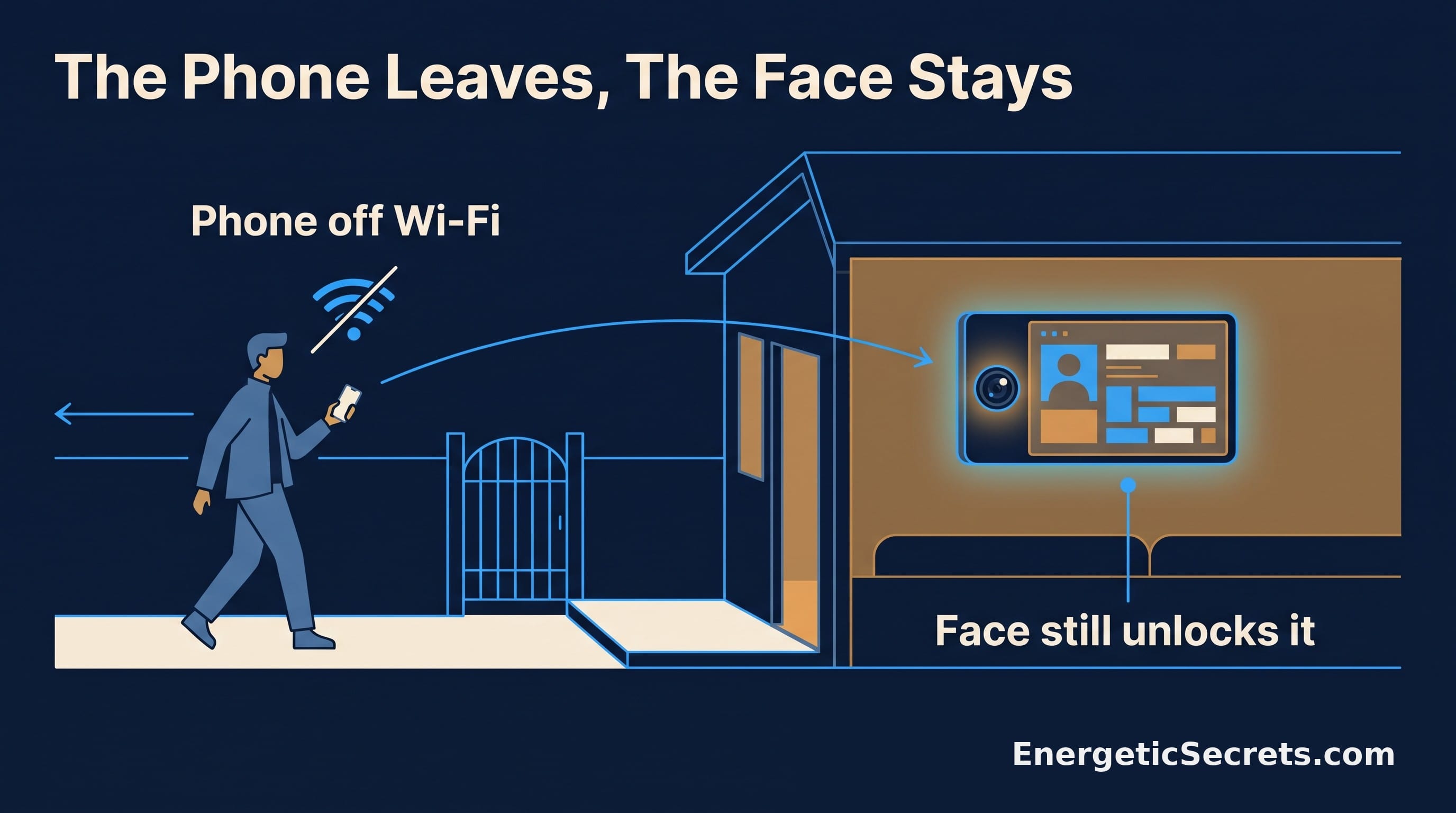
The Patent: Looking at the Device Is the Wake Word
While the marketing machine was warming up, Apple was also publishing paperwork. Patent application US20260196221A1, titled "Detecting visual attention during user speech," lists Apple as assignee and Maxwell C. Horton as inventor, with a priority date of May 27, 2022 and publication on July 9, 2026. [12]
The mechanics, as summarized from its claims, are worth understanding. A device runs its front camera and its microphone at the same time. It tracks gaze, meaning where a person's eyes are pointed, and uses whether you are looking at the device while speaking to decide if your speech is an intentional command. It handles multiple users, tracking who is looking and who is talking. And it requires no wake word at all: no "Hey Siri," because looking at the screen is the trigger. [13]
Keep in mind, a patent application describes what a company wants to protect, not proof of what a shipping product does today, and I am not claiming HomeView ships with this switched on. What I am saying is that the direction is documented in Apple's own filing. The camera and the microphone are designed to work as one sensor, and the "wake word" of Siri's language is being engineered away.
We Have Seen This Movie
If any of this feels familiar, it should. On July 26, 2019, The Guardian reported that Apple contractors reviewing Siri recordings "regularly hear confidential medical information, drug deals, and recordings of couples having sex." Apple admitted at the time that less than 1% of daily Siri activations went to human review, and that this had not been explicitly disclosed to users. The Apple Watch and the HomePod were named as among the worst offenders for accidental activations. [14]
On August 28, 2019, Apple apologized and changed course: audio would no longer be retained by default, grading would be opt-in only, and only Apple employees, not contractors, would hear the samples. [15] Read the 2026 improvement-program page again and you will notice those exact promises have become the current terms. Opt-in grading. Employees only. The 2019 apology is now the 2026 feature list (read that twice if you need to).
Then there is the settlement. Lopez v. Apple Inc., a class action over unintended Siri activations covering a class period from September 17, 2014 to December 31, 2024, settled for $95 million, with Apple denying wrongdoing. Settlement payments began landing on January 23, 2026. [16] Do the arithmetic on the calendar. The checks for the last listening scandal started arriving about nine months before Apple opened pre-orders for an always-on, four-microphone hub that recognizes six people by voice.
The Map Tells Its Own Story
One more detail, and it is a quiet one. Apple's press release states: "Apple HomeView is not available for sale in the European Union, as Siri AI is currently unavailable in iOS in the EU. Apple is working constructively with the EU in an attempt to find a path forward." [1] The launch markets are the United States, the United Kingdom, Canada, Australia, New Zealand, India, Singapore, and South Africa through resellers. [1][4]
Of course, Apple attributes the exclusion to Siri AI availability and nothing more, and I will not put a regulatory motive in its mouth that it has not stated. But the pattern is worth sitting with. The jurisdiction with the strictest privacy rules in the Western world does not get this product at launch. The United States, where the rules are looser and the settlement checks just started landing, gets it first.
What the Transaction Actually Is
Let me lay the whole exchange out plainly, because abstract talk about privacy is how these stories lose their teeth.
What is collected: your voice requests and their transcripts, your approximate location when you make them, camera footage from every camera you attach, and the faces and voices of up to six members of your household. Where it goes: request history to Apple's servers for up to two years under a random identifier, a human-reviewed slice kept beyond two years, and, if that opt-in toggle is on, your audio and transcripts into training data for Apple's AI models, processed in part by third-party service providers. [7][8] Who is paid: Apple, first with $299 for the hub, then with a monthly iCloud+ subscription whose tiers decide how many cameras you are allowed, then with accessory revenue shared with LG and Schneider Electric on every doorbell, camera and lock. [9][10]
What you experience in return is convenience. A screen that knows you. A house that watches itself. I am not going to tell you that trade is always wrong; that is your call to make. But after all the years I have spent in this rabbit hole, I will say the trade is never free, and the price is almost never printed on the box. We are now moving beyond the commonly stated "When it's free, you are the product" because now you are paying and YOU are still the product.
In Closing
I do not know whether HomeView will become the listening device Apple's critics fear, or whether the Secure Exclave engineering genuinely keeps the worst of it walled off. Honest answer: nobody outside Cupertino knows, and anyone who claims certainty either way is selling something. What I do know is what the documents say, and the documents say that the same company mailing out $95 million in settlement checks over unintended Siri recordings is now selling a wired, always-on camera and microphone array for your kitchen, marketed under the word privacy. I remain skeptical.
If you found this useful, share it with someone who is about to put one of these on their wall. And if you want more of this kind of digging, the newsletter at EnergeticSecrets.com is where it lands first.
Disclaimer: I am not a health professional of any kind and make no medical claims. I am just a researcher who likes to dig deep on effective methods to keep them from being lost to the dust bin of history. And I like to write about what I learn. So please do your own research. Nothing in this article should be considered medical advice. None of the statements have been evaluated by the FDA. Not intended to diagnose, treat, cure or prevent any disease. If you have a medical condition seek professional help.
References
1. Apple Newsroom: "Meet Apple HomeView, a new way to enjoy entertainment and manage the home" (Oct 13, 2026). https://www.apple.com/newsroom/2026/10/meet-apple-homeview-a-new-way-to-enjoy-entertainment-and-manage-the-home/
2. Apple HomeView Technical Specifications. https://www.apple.com/apple-homeview/specs/
3. Apple HomeView product page. https://www.apple.com/apple-homeview/
4. MacRumors: "Apple HomeView: Everything We Know" (roundup). https://www.macrumors.com/roundup/apple-homeview/
5. 9to5Mac: "iPhone 16 has the same new privacy feature as the M4 iPad Pro" (Sep 11, 2024). https://9to5mac.com/2024/09/11/iphone-16-privacy-feature-m4-ipad-pro/
6. MacRumors: "Apple Announces 'HomeView' Smart Home Hub" (Oct 13, 2026). https://www.macrumors.com/2026/10/13/apple-announces-homeview-smart-home-hub/
7. Apple Legal: "Siri, Dictation & Privacy" (page dated Sep 14, 2026). https://www.apple.com/legal/privacy/data/en/ask-siri-dictation/
8. Apple Legal: "Improve Siri & Apple Intelligence & Privacy" (page dated Sep 14, 2026). https://www.apple.com/legal/privacy/data/en/improve-intelligence/
9. Apple Support/iCloud guide: "Store encrypted security camera footage in iCloud with HomeKit Secure Video." https://support.apple.com/guide/icloud/icloud-homekit-secure-video-mme054c72692/icloud
10. MacRumors: "Apple Launches 'Apple Home Collection' With Cameras, Lock, Thermostats and More" (Oct 13, 2026). https://www.macrumors.com/2026/10/13/apple-home-collection/
11. Apple Newsroom: "Introducing Apple Home Collection, a new lineup of smart home accessories" (Oct 13, 2026). https://www.apple.com/newsroom/2026/10/introducing-apple-home-collection-a-new-lineup-of-smart-home-accessories/
12. Google Patents: US20260196221A1, "Detecting visual attention during user speech," assignee Apple Inc., inventor Maxwell C. Horton, priority May 27, 2022, filed Feb 27, 2026, published Jul 9, 2026. https://patents.google.com/patent/US20260196221A1/en
13. Patentlyze: "Apple Patent Reveals Siri Detecting When Users Are Actually Addressing It." https://patentlyze.com/patent/apple-eye-contact-detection-siri-commands/
14. The Guardian: "Apple contractors 'regularly hear confidential details' on Siri recordings" (Jul 26, 2019). https://www.theguardian.com/technology/2019/jul/26/apple-contractors-regularly-hear-confidential-details-on-siri-recordings
15. Apple Newsroom: "Improving Siri's privacy protections" (Aug 28, 2019). https://www.apple.com/newsroom/2019/08/improving-siris-privacy-protections/
16. NBC New York: "Apple distributes checks from $95 million settlement over Siri." https://www.nbcnewyork.com/news/apple-settlement-95-million-payments/6465861/ |




0 Comments
Join the conversation
Be the first to comment
Share your thoughts above.