
Oxidation: Approved for the Chicken, Called Bleach When You Drink It |
Your white blood cells use this chemistry to kill infection, yet it is approved for your food and water and warned against the moment it is aimed at your own body |

Your white blood cells make oxidants on purpose. An oxidant is a chemical that pulls electrons off other molecules (the same move that lets bleach whiten cloth). A neutrophil, one of the first cellular responders to an infection, swallows a microbe into a sealed compartment and floods it with oxidants made by an enzyme called NADPH oxidase. Klebanoff and colleagues present a second enzyme, myeloperoxidase, as a major arm of that killing (1). Babior's 1984 paper is titled "The respiratory burst of phagocytes", the field's name for that sudden oxygen chemistry (2).
Hydrogen peroxide, one of the three oxidants at the center of oxidation therapy (ozone and chlorine dioxide are the other two), also works as a signal inside healthy cells. Helmut Sies puts that signaling range at roughly 1 to 10 nanomolar (billionths of a mole per liter, a very dilute solution) and calls it oxidative eustress. Above about 100 nanomolar it damages biomolecules, which he calls oxidative distress (3). After all, a body that builds oxidants for defense and for signaling is using the chemistry on purpose.
Back in 2004 while researching natural cancer therapies and attending related conferences I first came across ozone therapy and have used it almost daily ever since then. I consider it one of the backbones of my natural approach to slowing down the aging process. Since that time I've also explored both hydrogen peroxide and chlorine dioxide and especially find chlorine dioxide to be super powerful and dirt cheap to implement.
Regulators have written rules about all three agents. The oldest and most specific is a device rule about ozone.
What the ozone rule says
The rule is 21 CFR 801.415, Maximum acceptable level of ozone. It sits in FDA's device labeling regulations, and the current text runs five paragraphs (4). Our earlier ozone article covers the mechanism.
Paragraph (a) states as fact that ozone would have to reach a concentration far above what people and animals tolerate before it worked as a germicide. No study is cited beside it (4).
Paragraph (b) describes the physiology, and every route it mentions is inhalation. Inhaled ozone irritates the moist lining of the nose, throat and lungs and can fill the lungs with fluid, often hours after exposure. The nose also stops registering the smell quickly, so neither symptoms nor odor tell you how much is in the air (4). No injection, rectal or blood route is mentioned anywhere in the section.
It's important to note, and anyone that uses ozone therapy in practice already knows this, that ozone is rarely breathed into the lungs. That's the typically avoided path of absorption. Instead it is bubbled in water and carried into the body by drinking the water (quickly because it's unstable), injected in various ways, infused in the rectum, vagina, ear, etc.
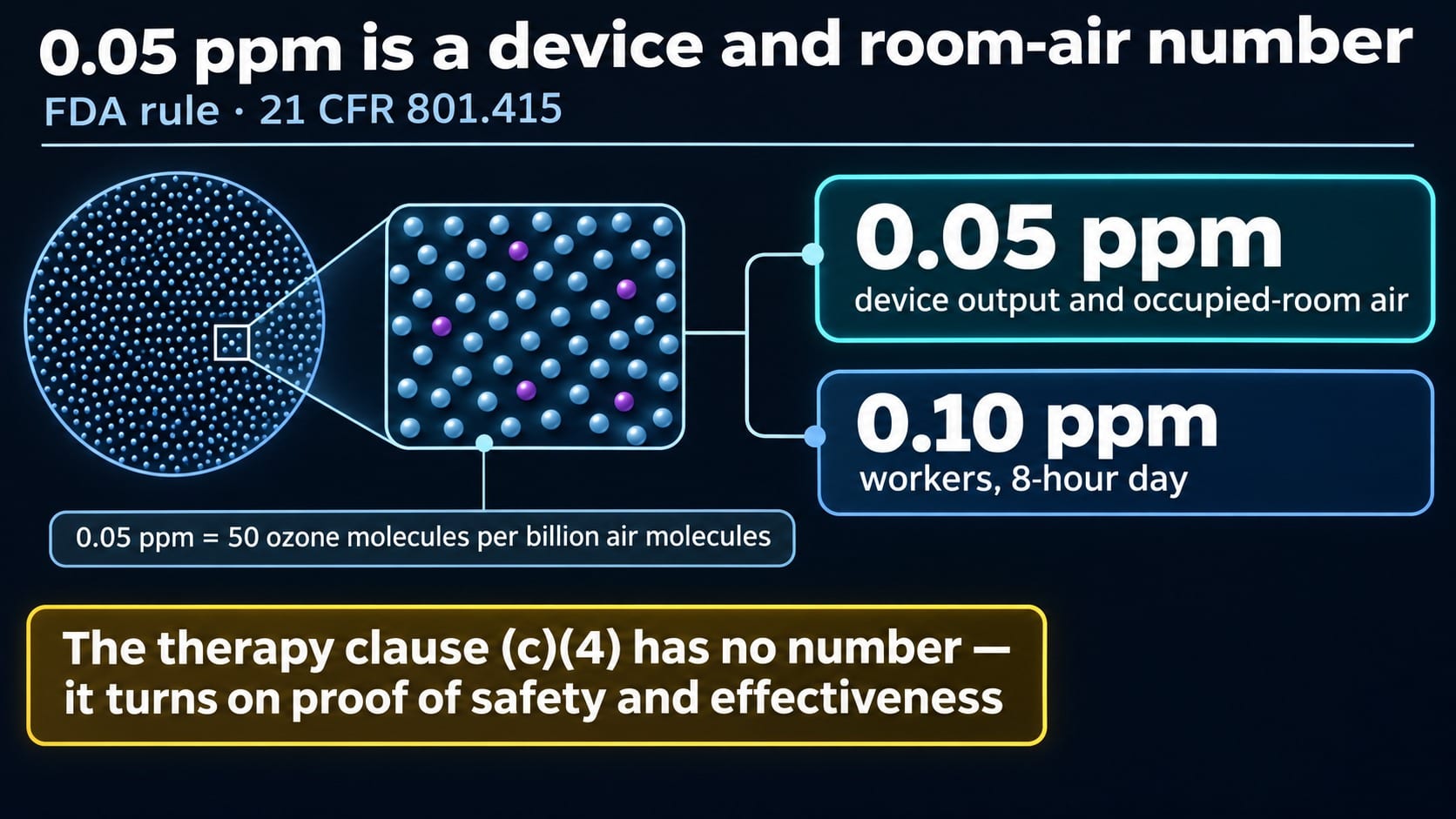
Paragraph (c) is the trigger. A device that generates ozone, by design or as a byproduct, is considered adulterated or misbranded (the two charges FDA's statute uses against unsafe or falsely labeled products) under any of five conditions (4). Four of them concern air or labels. They cover output or room buildup above 0.05 parts per million (fifty molecules of ozone in every billion of air), release into hospital air, and a missing output label. They also catch a sub-limit device labeled as a germicide or deodorizer.
The fifth, condition (c)(4), is the only one that reaches therapy. It reads in full: "In any medical condition for which there is no proof of safety and effectiveness." It carries no number, and the text does not say what counts as proof or who decides (4).
Every number in the rule measures air, and nothing in it sets a dose for therapy. Paragraph (d) leaves a separate figure standing for workers: 0.10 parts per million over an eight-hour day, a threshold limit value recommended by the American Conference of Governmental Industrial Hygienists (4).
The section was not written in 1976. A Federal Register notice of February 13, 1976 (41 FR 6896) recodified it, meaning it moved existing text to new section numbers and called the change nonsubstantive (5). Its conversion table shows the ozone text was older section 3.96.
I was not able to locate the original rulemaking for 3.96, and I don't know whether a preamble explaining the 0.05 figure exists in a form a reader can find today. FDA still applies the rule: a 2015 order classifying an ultraviolet disinfection chamber lists 801.415 as a special control for devices that generate ozone (6).
Three agents, three different verdicts in the documents
The ozone rule never mentions hydrogen peroxide or chlorine dioxide, so whatever binds the three together has to come from other documents. Those documents do not match each other.
FDA's 2010 release on Miracle Mineral Solution (MMS) says that, used as directed, it produces an industrial bleach that can cause serious harm (7). The 2019 release describes sodium chlorite sold with an acid activator and says FDA has not approved it for any use. It quotes then Acting Commissioner Ned Sharpless, M.D.: "ingesting these products is the same as drinking bleach" (8).
The food side uses the same two ingredients. 21 CFR 173.325 says acidified sodium chlorite "may be safely used," under conditions it then sets out, as an antimicrobial in poultry processing water, red meat processing and seafood water and ice (9). It is made by mixing sodium chlorite with any generally recognized as safe acid. In a bottle sold for drinking it is an industrial bleach, and on poultry it is a regulated antimicrobial.
Chlorine dioxide itself is allowed in food under 21 CFR 173.300 (10). EPA registered aqueous chlorine dioxide as a disinfectant and sanitizer in 1967 and the gas as a sterilant in 1988, and lists products for agricultural, commercial, industrial, medical and residential use (11). Hydrogen peroxide gets a third posture. 21 CFR 184.1366 affirms it as generally recognized as safe for treating food (12). 21 CFR 310.534 calls it safe as an oral wound healing agent but says the data are too thin to establish that its effectiveness is generally recognized. A product promoted for that use needs an approved new drug application (13).
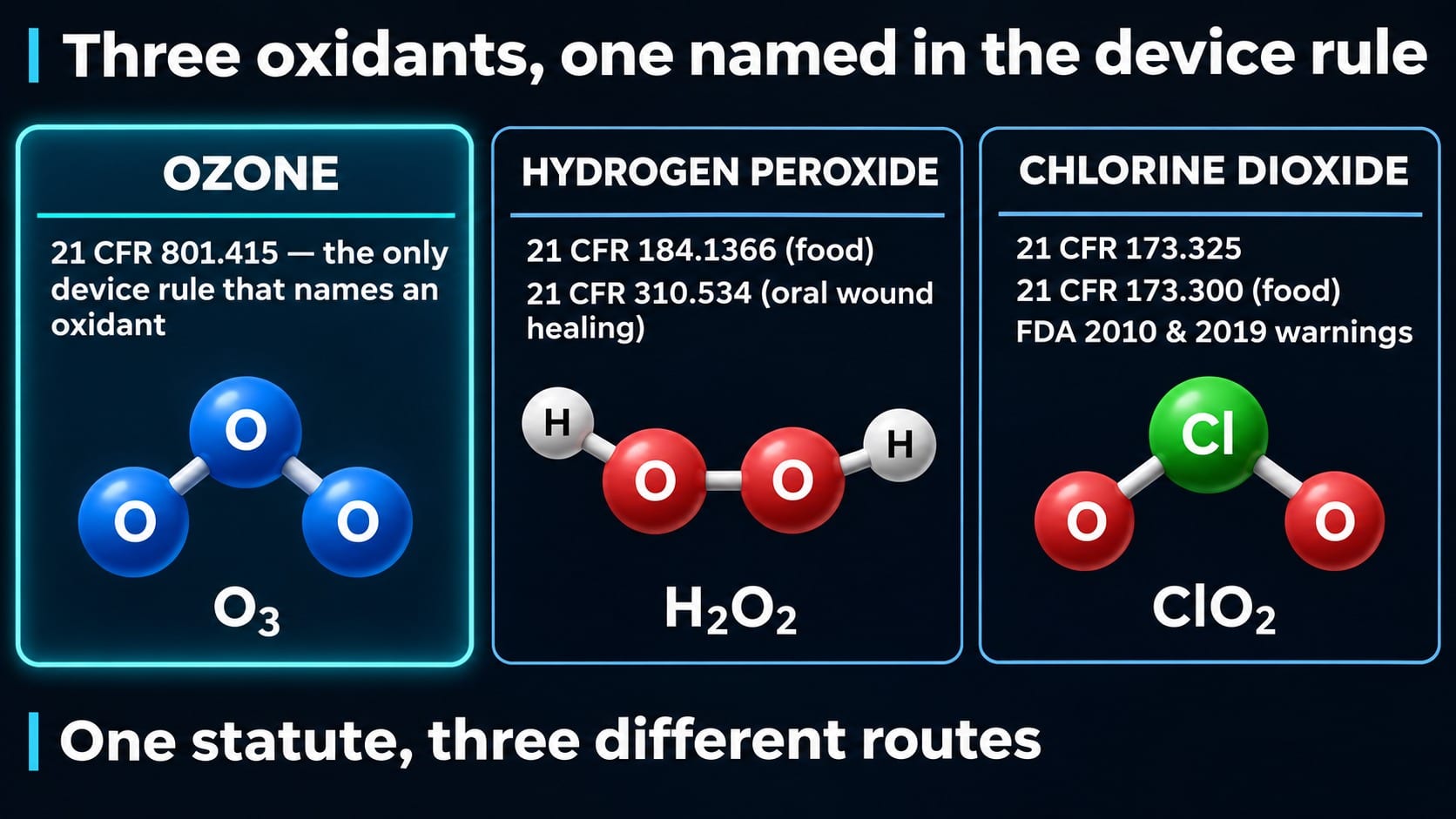
So the documents do not hand down one verdict. Ozone is declared to have no known useful medical application. Chlorine dioxide as a drink is not approved for any use. Hydrogen peroxide is safe, with effectiveness unproven for one oral use. My argument is that they get one posture anyway. Each is approved or declared safe when aimed at water, food or surfaces, and each meets a warning, a prohibition or a safe-but-unproven label when the use is medical.
The clearest single document I found that puts the family in one box is a 1993 American Cancer Society paper. It names hydrogen peroxide, germanium sesquioxide and ozone as the most touted hyperoxygenating agents (agents said to raise oxygen in the body) and grants that they have been the subject of legitimate research. Then it concludes there is "little or no evidence that they are effective for the treatment of any serious disease" (14). That is the mainstream narrative in a sentence, from a cancer charity and not from FDA.
What Kalcker's papers and patent say
Andreas Ludwig Kalcker has published on chlorine dioxide solution (CDS) in three forms: two review papers, a patent application and his 2018 book, "Forbidden Health" (25), which I have read and studied it's various references. His 2025 paper, "Clarifying the Science of Chlorine Dioxide Solution (CDS)", appeared in the International Journal of Multidisciplinary Research and Analysis (15). Its byline gives him as Dr.h.c. (an honorary doctorate) and Biophysics Researcher at the Swiss Institute of Biophysics, an affiliation he describes himself. His 2026 paper, "The Mechanism of Action of Chlorine Dioxide (CDS)", is in Biophysica (16).
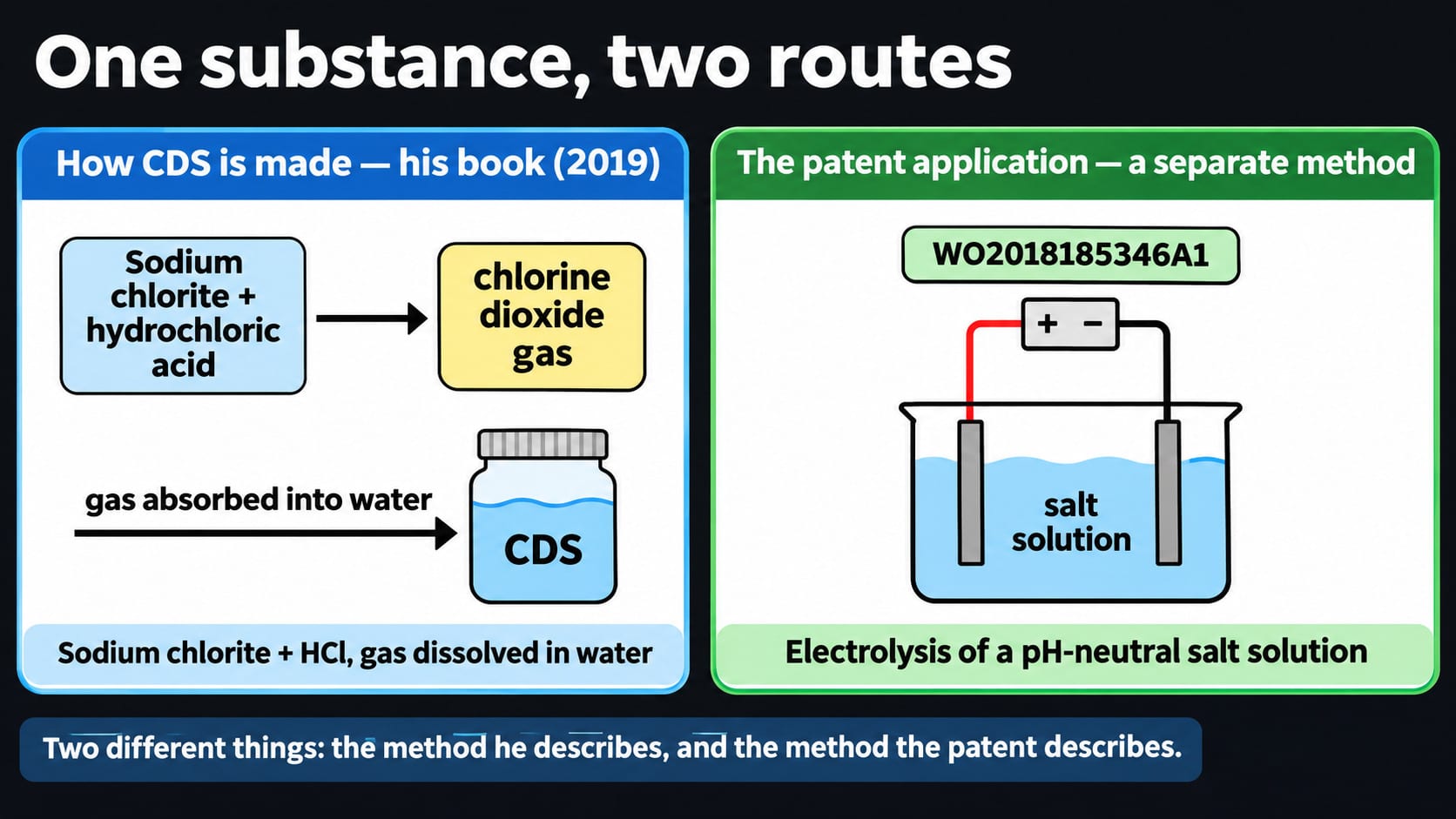
The patent application, WO2018185346A1 (published 2018), describes a separate manufacturing method for the pharmaceutical composition it claims. It makes chlorine dioxide by electrolysis (running an electric current through a salt solution) instead of by acid, and its claims describe a finished solution free of hydrochloric acid or holding only a trace (17). That is a different route for a different purpose, and it sits alongside the acid method he describes elsewhere.
The 2025 paper states no reaction equation and no acid step. It defines CDS as chlorine dioxide gas dissolved in water (15).
FDA's text describes a two-part kit, and Kalcker writes that agencies "equate CDS with household bleach" (15). The FDA documents I read speak only of sodium chlorite plus an acid activator (I use HCl exclusively). The 2019 list ends on "other similar products." Whether that phrase also reaches a solution made by the patented electrolytic method is not something I can determine at this point (8). I also don't know how FDA would answer but could venture a guess.
His two papers disagree on chlorite (the ion left when chlorine dioxide gains an electron). The 2025 paper says "Unlike MMS, CDS avoids chlorite metabolites" (15). The 2026 abstract says "the principal metabolite (chlorite) is associated with documented developmental toxicity in animals and regulatory caution by EPA/WHO" (16). Both statements cannot stand as written. The patent gives a third answer: the end products are chloride ions and water (17).
Bench chemistry explains why the answer depends on conditions. In a test tube, chlorine dioxide takes electrons from the amino acid cysteine and from glutathione (a small sulfur-containing molecule cells make), forming cysteic acid and chloride in acid and chlorite at higher pH (18).
I don't know which of Kalcker's two statements on chlorite he would defend today. The Biophysica full text was blocked to me, so I read only its abstract and reference list and can't report what its body says about the reaction.
Having read his book I can explain that at least in 2018 his method of preparing CDS involves mixing sodium chlorite and hydrochloric acid in a one ounce shot glass inside a slightly larger, hermetically sealed glass jar with water in it. The released gas is absorbed by the water and that's the product he calls CDS or chlorine dioxide solution. CDS, because it's the pure chlorine dioxide gas dissolved in water, doesn't have issues with downstream metabolites that come about when the sodium chlorite and HCl are mixed into the solution.
Clearly, Kalcker has been investigating new ways to produce CDS with his new patented device. I'll report more on that once I know more.
Bench chemistry, volunteers and rats
Noszticzius and colleagues report that chlorine dioxide kills selectively by size: smaller organisms die faster, and bacteria cannot develop resistance because the gas reacts with biological thiols (sulfur groups in proteins) (19). Kalcker's 2025 paper cites this work for the claim that CDS spares human cells at low concentrations. The paper's own example is a strong antiseptic solution in contact for a few minutes, which is a different situation from anything inside a body (19).
Lubbers and colleagues ran controlled tests of chlorine dioxide, chlorite and chlorate in healthy adult male volunteers in the early 1980s, when chlorine dioxide was being considered as a water disinfectant. Their abstract reports a twelve-week course of daily ingestion that "completed uneventfully" (20). Those were drinking-water studies in men, not therapy trials. Gill and colleagues gave rats sodium chlorite in drinking water across two generations (21), and EPA's reregistration decision takes its lowest-effect level from that work: a weaker startle response and lower brain weights (11).
Hydrogen peroxide has one intravenous animal study I could pin to a design. Shenep and colleagues infused it into rabbits with Escherichia coli sepsis (an infection in the bloodstream) and saw no decrease in bacteremia (bacteria in the blood) at the maximum rate the rabbits tolerated (22). That is one species, one infection and one route. Personally I think there's a lot more to that story that the clinical literature fails to address.
The safety record, pinned to route
FDA says it received reports of severe vomiting, severe diarrhea, life-threatening low blood pressure from dehydration and acute liver failure after people drank the sodium chlorite and acid product (8). Pritchett and colleagues report one case: a 39-year-old man who swallowed an unlabeled 35 percent hydrogen peroxide product sold for natural health use, with caustic injury and oxygen gas formation among the mechanisms (23). A concentrated product swallowed by mistake belongs to a different route and strength than the low-strength products oxidation therapy discusses.
Harm also turns up inside approved use. Hassel and colleagues describe a hospital cleaner with acute respiratory distress after exposure to a chlorine dioxide disinfectant. Its chlorine dioxide content sat below the level that requires a hazard label, yet, by the authors' own estimate, exposure limits may be exceeded under normal use (24). That is a regulator-approved product by the inhalation route, which is the route paragraph (b) of the ozone rule describes.
What the documents leave standing
The ozone rule regulates air in rooms and the devices that make the gas. Its only reach into therapy is a clause asking for proof without saying what counts. FDA's chlorine dioxide warnings describe a two-part kit of sodium chlorite and acid, the same chemistry the agency approves for poultry water. The hydrogen peroxide rule calls it safe and unproven for one oral use. Kalcker's two papers disagree on chlorite, and the acid method is in his book. Every one of these texts is public, and a reader can check each against the original.
I think the three agents end up under one category that we call oxidation therapy. Where I sit with it is daily use which for me means daily ozonated water first thing for hydration and cleansing and a few drops of chlorine dioxide along with it only if I feel run down from working too much and can feel a sore throat coming on. I also use chlorine dioxide topically and at some point will make a video on this topic so follow me on Rumble.com/psyoptruth to see that since youtube is likely still censoring this topic.
Disclaimer: I am not a health professional of any kind and make no medical claims. I am just a researcher who likes to dig deep on effective methods to keep them from being lost to the dust bin of history. And I like to write about what I learn. So please do your own research. Nothing in this article should be considered medical advice. None of the statements have been evaluated by the FDA. Not intended to diagnose, treat, cure or prevent any disease. If you have a medical condition seek professional help.
References
1. Klebanoff SJ, Kettle AJ, Rosen H, Winterbourn CC, Nauseef WM. Myeloperoxidase: a front-line defender against phagocytosed microorganisms. J Leukoc Biol. 2013;93(2):185-198. PMID 23066164. DOI 10.1189/jlb.0712349.
2. Babior BM. The respiratory burst of phagocytes. J Clin Invest. 1984;73(3):599-601. PMID 6323522. DOI 10.1172/jci111249.
3. Sies H. Hydrogen peroxide as a central redox signaling molecule in physiological oxidative stress: Oxidative eustress. Redox Biol. 2017;11:613-619. PMID 28110218. DOI 10.1016/j.redox.2016.12.035.
4. 21 CFR 801.415, Maximum acceptable level of ozone. Electronic Code of Federal Regulations, current text up to date as of November 12, 2026. ecfr.gov, 21 CFR 801.415.
5. Food and Drug Administration. Recodification Docket No. 11. Federal Register. 1976 Feb 13;41:6896 ff. govinfo.gov, Federal Register issue of February 13, 1976.
6. Medical Devices; General Hospital and Personal Use Devices; Classification of the Ultraviolet Radiation Chamber Disinfection Device. Federal Register. 2015 Nov 20; document 2015-29660. federalregister.gov, document 2015-29660.
7. Food and Drug Administration. FDA Warns Consumers of Serious Harm from Drinking Miracle Mineral Solution (MMS). News release, 2010 Jul 30 (archived copy; the original FDA address no longer resolves). Internet Archive capture of August 3, 2010.
8. Food and Drug Administration. FDA warns consumers about the dangerous and potentially life threatening side effects of Miracle Mineral Solution. News release, 2019 Aug 12 (archived copy; the live FDA address no longer resolves). Internet Archive capture of August 14, 2019.
9. 21 CFR 173.325, Acidified sodium chlorite solutions. Electronic Code of Federal Regulations. ecfr.gov, 21 CFR 173.325.
10. 21 CFR 173.300, Chlorine dioxide. Electronic Code of Federal Regulations. ecfr.gov, 21 CFR 173.300.
11. US Environmental Protection Agency. Reregistration Eligibility Decision (RED) for Chlorine Dioxide and Sodium Chlorite (Case 4023). 2006 Aug. EPA RED, Case 4023 (PDF).
12. 21 CFR 184.1366, Hydrogen peroxide. Electronic Code of Federal Regulations. ecfr.gov, 21 CFR 184.1366.
13. 21 CFR 310.534, Oral wound healing agents (over-the-counter). Electronic Code of Federal Regulations. ecfr.gov, 21 CFR 310.534.
14. Questionable methods of cancer management: hydrogen peroxide and other "hyperoxygenation" therapies. CA Cancer J Clin. 1993;43(1):47-56. PMID 8422605. DOI 10.3322/canjclin.43.1.47.
15. Kalcker ALK. Clarifying the Science of Chlorine Dioxide Solution (CDS): Addressing Misinformation and Establishing Evidence for Medical Use. Int J Multidiscip Res Anal. 2025;8(3):1367-1374. DOI 10.47191/ijmra/v8-i03-54.
16. Kalcker ALK. The Mechanism of Action of Chlorine Dioxide (CDS): Electron-Transfer Chemistry, Antimicrobial Selectivity and Redox-Regulatory Effects. Biophysica. 2026;6(5):91. DOI 10.3390/biophysica6050091.
17. Kalcker AL. Pharmaceutical composition for treating infectious diseases. Patent application WO2018185346A1, published 2018 Oct 11. Google Patents, WO2018185346A1.
18. Ison A, Odeh IN, Margerum DW. Kinetics and mechanisms of chlorine dioxide and chlorite oxidations of cysteine and glutathione. Inorg Chem. 2006;45(21):8768-8775. PMID 17029389. DOI 10.1021/ic0609554.
19. Noszticzius Z, Wittmann M, Kály-Kullai K, Beregvári Z, Kiss I, Rosivall L, Szegedi J. Chlorine dioxide is a size-selective antimicrobial agent. PLoS One. 2013;8(11):e79157. PMID 24223899.
20. Lubbers JR, Chauan S, Bianchine JR. Controlled clinical evaluations of chlorine dioxide, chlorite and chlorate in man. Environ Health Perspect. 1982;46:57-62. PMID 6961033. DOI 10.1289/ehp.824657.
21. Gill MW, Swanson MS, Murphy SR, Bailey GP. Two-generation reproduction and developmental neurotoxicity study with sodium chlorite in the rat. J Appl Toxicol. 2000;20(4):291-303. PMID 10942904.
22. Shenep JL, Stokes DC, Hughes WT. Lack of antibacterial activity after intravenous hydrogen peroxide infusion in experimental Escherichia coli sepsis. Infect Immun. 1985;48(3):607-610. PMID 3888840. DOI 10.1128/iai.48.3.607-610.1985.
23. Pritchett S, Green D, Rossos P. Accidental ingestion of 35% hydrogen peroxide. Can J Gastroenterol. 2007;21(10):665-667. PMID 17948137. DOI 10.1155/2007/423217.
24. Hassel E, Smedbold HT, Lauritzen HB. Acute respiratory distress after exposure to chlorine dioxide-based disinfectant. Occup Med (Lond). 2022;72(7):492-494. PMID 35932248. DOI 10.1093/occmed/kqac078.
25. Kalcker AL. Forbidden Health: Incurable Was Yesterday. Henares A, Ikawa M, translators. Voedia; 2018. English translation of Salud Prohibida. Printed in Spain. ISBN 978-84-617-4272-1. |


1 Comment
Join the conversation
The part that got me is the same sodium chlorite and acid combo is approved for spraying on chicken in processing plants. So it's bleach in a bottle but fine on my dinner? That's wild.