
Ozone and Mitochondrial Light Intensity: Brighter Means Stress But Not All Stress Is Bad |
The Light Your Body Makes: Ozone, Oxidation, and the Measurable Glow of Human Tissue |
Your Body Is Emitting Light Right Now
Right now, your skin is giving off light. It always is. These are real photons, not a metaphor and not heat. The rate is far too low for a camera to catch, but an instrument built for the job picks them up easily. Researchers call this ultraweak photon emission, and they have been counting these photons in people for decades (long before anyone thought to point a counter at a therapy clinic).
The trail starts in 1954. Two Italian physicists, Colli and Facchini, pointed a photomultiplier tube at germinating plants and found a faint light that no instrument had ever been able to find before [1] (and to be clear, they were not looking for it). By the 1990s, the Popp group in Germany was counting photons coming off the human hand and forehead in vivo [2]. A German skin-research group then showed two things: ultraviolet exposure raises the emission from living skin, and antioxidants applied to the skin change it [3]. The same group later validated skin photon emission as a quantitative, non-invasive readout of oxidative stress in people [4].
Now the numbers are small (and I mean genuinely small). Depending on the lab and the instrument, tissue emits somewhere between tens and hundreds of photons per second per square centimeter. Labs do not agree on the exact rate, because they used different detectors, corrected for background noise differently, and measured different slices of the spectrum. That last detail matters later. What they do agree on is the source.
In 1999, a Japanese group produced the first two-dimensional images of this faint glow coming from a living rat's brain [5][6]. They built the photon-counting apparatus themselves (which is the kind of detail I love, because it means nobody handed them the answer). The glow followed the animal's energy metabolism. Take away glucose and it dimmed. Block the mitochondrial respiratory chain and it brightened. The authors concluded the photons come from reactive oxygen produced by metabolism [5]. A brain dims when you starve its fuel and brightens when you jam the machinery that burns it. That one is worth sitting with.
Mainstream doctors would likely call all of this a curiosity (a fair word, honestly). But a curiosity that dims when you pull the glucose is measuring something real about how a brain runs.
Blood tells the same story. A Russian research school has used the chemiluminescence kinetics (say that 5 times fast!) of human blood plasma as a systemic oxidative-stress measure [7], and applied the same method to the blood of patients with type 2 diabetes [8]. Photon counting has even told human breast cancer tissue apart from the normal tissue beside it, because the oxidative chemistry of the two differs [9]. The principle running through all of it: oxidation in tissue produces light, and the light is a readout of the chemistry.
What Ozone Actually Does in a Biological Fluid
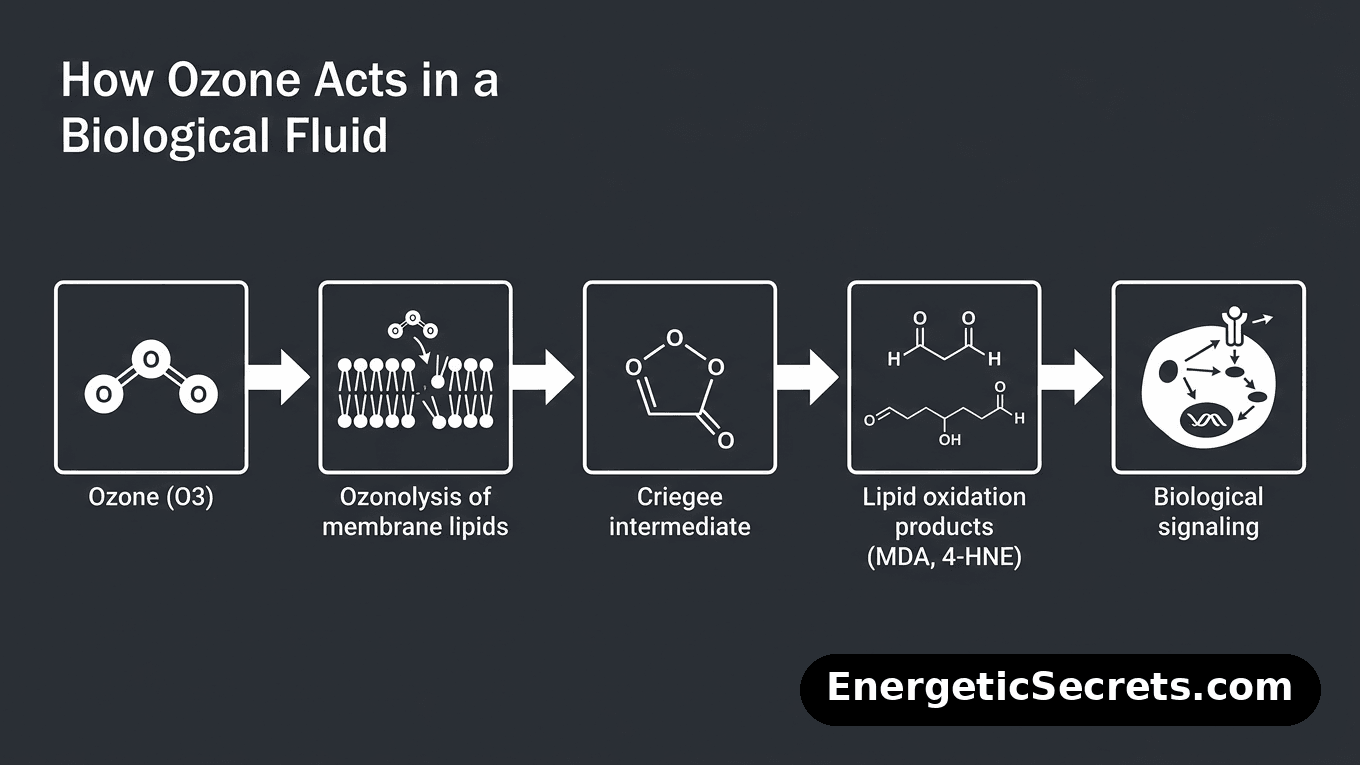
Ozone is one of the strongest oxidants ever proposed as a therapy (which is why the safety question further down is so hotly contested). The first thing to understand is that it does not survive contact with the body. It does not circulate (no half-life, no bloodstream tour, nothing to measure later). It reacts the instant it touches something, and what it meets first is water, antioxidants, proteins, and above all the polyunsaturated fatty acids in your cell membranes.
Rudolf Criegee worked out the mechanism, and it is still textbook chemistry [10]. Ozone adds across a carbon-carbon double bond and forms an unstable primary ozonide. That breaks apart through the Criegee intermediate into carbonyl compounds and peroxide species (chemistry named after the man who worked it out, which is at least a fair monument). Work on ozone's reactions with lung-lining molecules showed that ozone itself never reaches cells. Only its reaction products do [11]. Studies on human red blood cell membranes found the same selectivity: ozone attacks polyunsaturated fatty acids and antioxidants, not cells directly [12].
What this means: by the time ozone has done anything inside a body, ozone is gone. What is left is a burst of reaction products, and those products are what every downstream effect is actually made of.
Those products have names. Malondialdehyde and 4-hydroxynonenal are the best characterized aldehydes of lipid peroxidation, cataloged in a landmark review cited thousands of times [13]. The ozone literature calls this class lipid oxidation products, and credits them, not ozone, with whatever signaling follows. Keep in mind why that matters. These are the same products your body makes on its own every day as part of ordinary oxidative stress.
The thing is, the therapy literature's central mechanistic claim is a dose-response inversion. A small, controlled oxidative stimulus provokes an adaptive antioxidant response instead of pure harm. A Cuban group published primary experimental evidence for this oxidative preconditioning account in an animal model in 1998, showing that low-dose ozone pre-treatment protected against later free-radical damage [14]. That is a mechanism study, not a clinical outcome, and should be read as one but it's also the backbone of why dose matters so much when it comes to ozone.
Why Oxidation Makes Light at All
Here is the physics that makes the wavelength question answerable. When molecules react and release energy, a small fraction of the product molecules are left electronically excited. Think of them as holding more energy than they want. They can shed it as heat or as a photon. Only a tiny fraction goes the photon route, which is why the glow is ultraweak, but the route is not random (that word matters, because it is the whole reason a spectrum is readable). Each emitting species releases photons at wavelengths set by its own electronic structure. After all, that is the whole trick. The molecule tells you who it is by the color it gives off.
What this means: the wavelength of light is a fingerprint of the chemistry. It is never a property of a therapy or a machine. If you catch the color, you can name the emitter, which is the entire basis for everything below.
The most specific emitter in this story is singlet oxygen, an excited electronic state of the ordinary oxygen molecule. Nothing exotic about it (your immune cells make it on purpose). Your own neutrophils generate it during phagocytosis, demonstrated by chemical trapping in 1992 [15].
Crucially, it is also generated chemically from lipid hydroperoxides, the actual products of fatty-acid oxidation. A São Paulo group showed in 2006 that linoleic acid hydroperoxide reacting with hypochlorous acid produces singlet molecular oxygen through peroxyl radical intermediates [16]. That is the bridge between the lipid chemistry ozone provokes and the light-emitting species a spectrometer detects.
Excited carbonyl compounds and triplet-state products of lipid peroxidation add emission across the visible range. Of course, that leads to a conclusion worth sitting with. Light from living tissue comes out as an envelope made by several emitters at once, never a laser line, so the honest answer to "what wavelength does tissue emit" is a spectrum with features, not a single wavelength number.
The Measured Spectrum, With Its Numbers
The most precisely characterized features belong to singlet oxygen, and they come from primary spectroscopy. In 1970, Khan and Kasha described the chemiluminescence arising when two singlet oxygen molecules relax simultaneously, the so-called dimol emission, with bands assigned at 634 and 703 nanometers in the red spectrum [17]. Cadenas and Sies later established low-level chemiluminescence, including that red dimol emission, as an indicator of singlet oxygen in biological systems such as rat liver microsomes [18]. A German photochemistry group confirmed the dimol phenomenon in peroxide reactions with modern methods in 2007 [19].
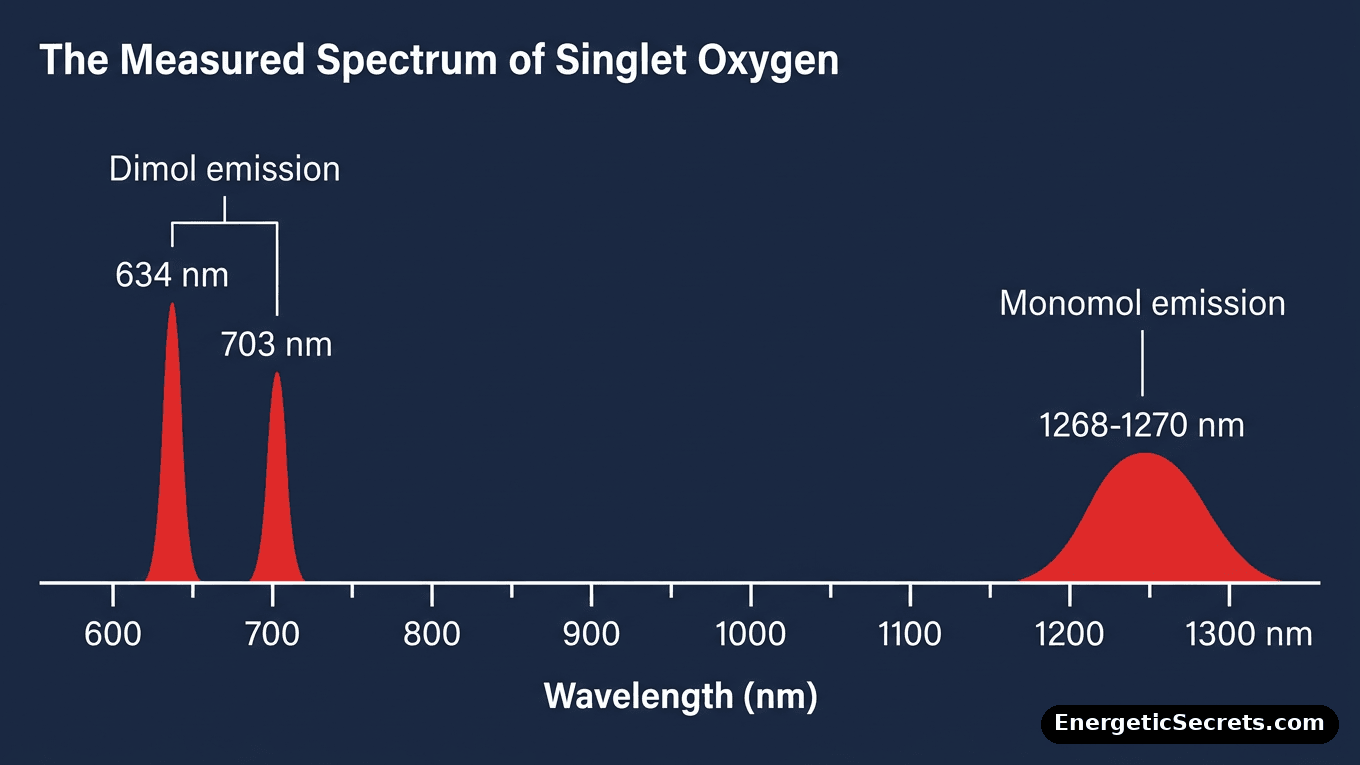
Singlet oxygen also emits on its own. A Soviet observation of singlet-oxygen near-infrared photoluminescence from pigment solutions appeared in 1977 [20] (in a journal most of us will never hold). In 1979, Khan and Kasha reported the first direct spectroscopic observation of the single-molecule emission at 1268 nanometers in liquid solution, using a near-infrared spectrophotometer they built for the purpose [21]. The key living-system measurement came in 2002, when Niedre, Patterson, and Wilson detected singlet-oxygen emission at 1270 nanometers from the skin and liver of living rats, and described it as the first direct observation of in vivo singlet oxygen [22]. That slight gap, 1268 in solution and 1270 in vivo, is good confirmation of some accuracy.
Now the direct ozone connection, which does exist, just not where most people assume. In 1991, Kanofsky and Sima reacted ozone with common biological molecules in solution and detected the singlet oxygen by its 1270-nanometer chemiluminescence [23]. The yields were high (higher than I expected when I first read the paper). About one mole of singlet oxygen per mole of ozone for methionine (1.13), NADPH (1.07), albumin (1.00), and ascorbic acid (0.96). Lower for cysteine (0.49), glutathione (0.33), and uric acid (0.64), and near-stoichiometric for NADH (0.95). They concluded singlet oxygen may be an important intermediate in the biochemical damage ozone causes.
In 1995, the same pair exposed plant leaves to ozone and detected 1270-nanometer emission from the leaves' intercellular fluid [24]. Destroying the ascorbic acid in that fluid cut the emission to about a fifth of control, which identified ascorbate as the major ozone target generating the singlet oxygen (a clean experiment, and I wish there were more like it). Intact leaves gave weaker but detectable emission [24].
This is what a real measurement looks like, and the instruments are why the numbers hold up. The experiments use photon-counting photomultiplier tubes and cooled detectors, run against dark counts (the false photons a detector registers in total darkness). A count rate tells you how much light. A spectrum tells you its color. Most tissue-emission papers report count rates and never resolve a spectrum, and the schools that built this field in Germany, Japan, and Russia used different instruments with different spectral windows. That is one reason no single canonical count rate exists.
The Measurement That Does Not Exist
What wavelength of light is released metabolically when a person receives ozone therapy? Here is the honest answer, and it is the most important sentence in this article. I searched the indexed literature across four decades and I was not able to find a single published study that measured an emission wavelength, spectrum, or photon count during ozone therapy administration to a human being, by any route or with any instrument. I would be glad to be shown one. What does exist is a single thread of direct ozone-emission measurements: the Kanofsky and Sima work above, conducted in solutions of biological molecules and in plant leaves, all at 1270 nanometers, none in a person and none in a clinic [23][24].
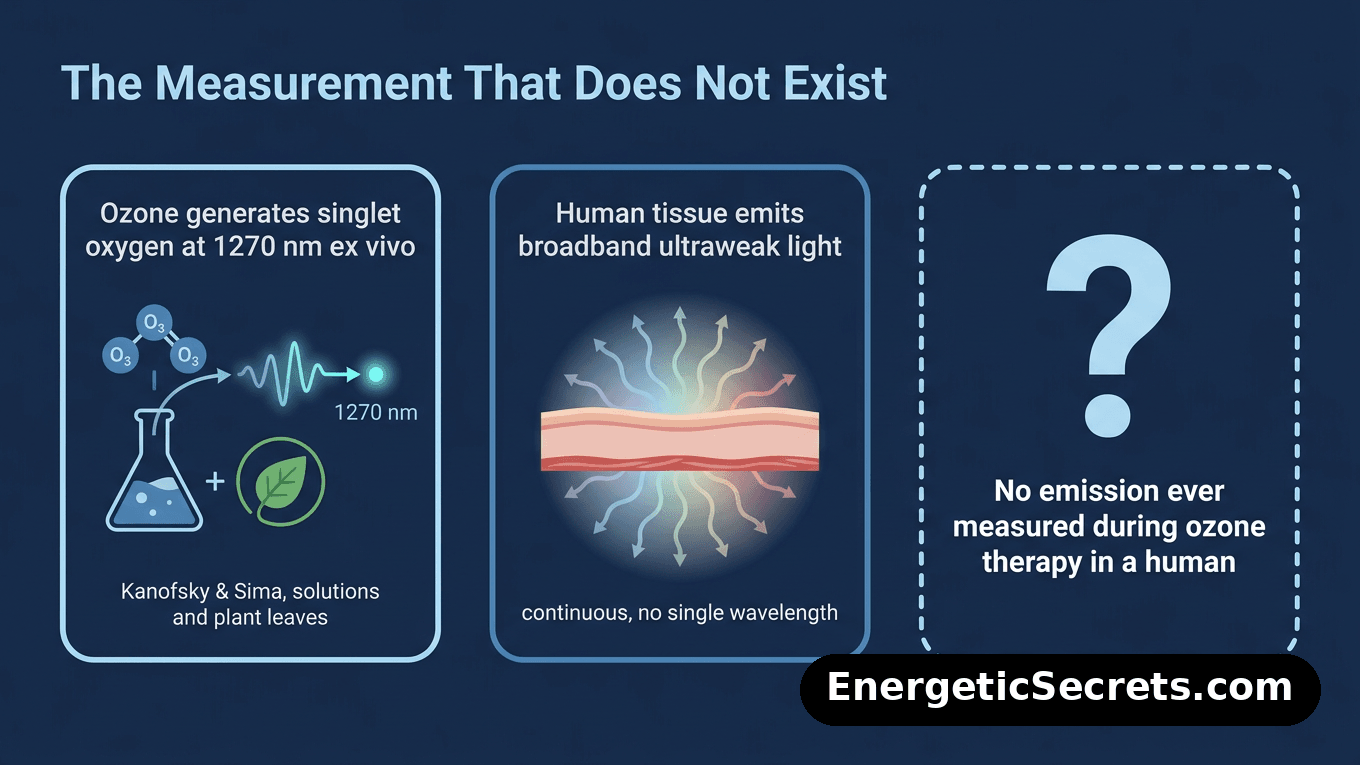
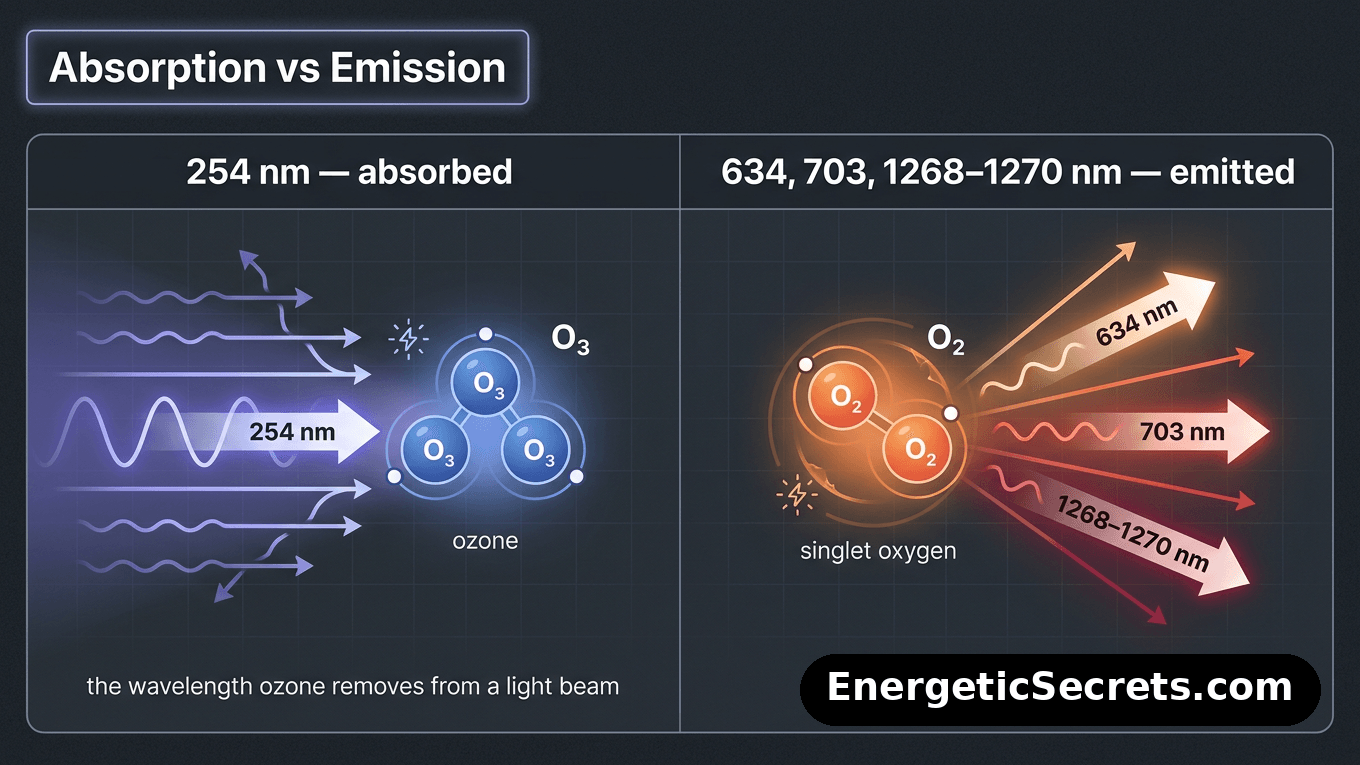
What exists instead are two solid findings and a gap between them. The chemistry ozone provokes in blood constituents demonstrably generates singlet oxygen, whose emission bands are measured at 634 and 703 nanometers (the two-molecule dimol emission) and at 1268 to 1270 nanometers (the single-molecule emission) [17][21][22][23]. Human tissue continuously emits broadband ultraweak light tied to oxidative metabolism, with no single wavelength [2][5]. The claim that a specific nanometer wavelength is "released metabolically during ozone therapy" fuses those two findings and applies them to a setting where the measurement has never been made. Anyone quoting you one number as "the wavelength of ozone therapy" is quoting a measurement that does not exist. Which means what, exactly? The claim is not wrong so much as unfinished. The chemistry is real, the wavelengths are real, and the sentence joining them to a therapy session has no citation behind it, at least not yet.
There is a second, more mundane corruption worth naming. Ozone absorbs ultraviolet light strongly near 254 nanometers, the basis of the standard laboratory ozone analyzer. Absorption is not emission: 254 nm is a wavelength ozone takes out of a light beam, not one a body gives off. In marketing copy, the two are easily garbled, and a detector specification quietly becomes a biological claim.
What the Clinical Literature Actually Looks Like
If the institutional position were simply "the trials are magnificent and the mechanism is proven," the regulatory asymmetry below would be easy to resolve. It is not that simple in either direction. The clinical literature on ozone therapy is real, published in indexed journals from university and hospital settings in multiple countries, and uneven in ways that deserve precision rather than a wave of the hand.
The strongest-designed studies cluster around spinal disc disease. A 2003 multicenter controlled trial, not randomized, reported on oxygen-ozone treatment for lumbar disc herniation [25]. A 2009 multicenter trial in Spine was randomized, double-blind, and controlled with simulated injections, among the most rigorous designs the field has produced [26]. A 2010 meta-analysis pooled roughly a dozen studies of ozone treatment for herniated lumbar discs; a 2026 critical appraisal notes the pooled literature is dominated by small, non-blinded studies [27][28].
That 2026 appraisal, published in Frontiers in Medicine, is the most current honest map of the field: evidence strength is indication-specific, recurring flaws are small samples, weak blinding, and publication bias, and the existing literature, in the authors' words, more often reflects an absence of high-certainty evidence than definitive proof of either efficacy or inefficacy [28]. The evidence is thin, and "thin" is not the same word as "negative."
I'd like to note that in a field like ozone therapy, which has been roadblocked in many countries by legalities it's not surprising that even the best methods of use are hotly debated by the experienced doctors. This ultimately reflects as a relatively smaller number of published studies. So this is far from saying ozone therapy doesn't work, it's just one of the therapeutic methods that has still been kept on the fringes due to regulatory pressure.
The Safety Record, Stated Plainly
Skepticism aimed at physics would be misplaced; skepticism aimed at practice is not optional. Ozone is a documented respiratory irritant, which is why its lung chemistry has been studied so carefully [11]. Bottom line, ozone is not inhaled for therapy and anyone that tells you otherwise (exception being bubbled through olive oil) is misguided.
A forensic case report in 2000 described a fatal gas embolism during an autohemotherapy procedure [29]. In 2005, investigators documented a cluster of hepatitis C infections in Rome linked to ozone-enriched transfusion of autologous blood under non-standardized procedures [30]. These are real injuries in the peer-reviewed record, and any honest account of this field includes them. Then again there are always going to be good and bad doctors so I'd avoid blaming the good docs that use ozone effectively with the negligent ones.
One Rule in Washington, Another in Ankara and Brasília
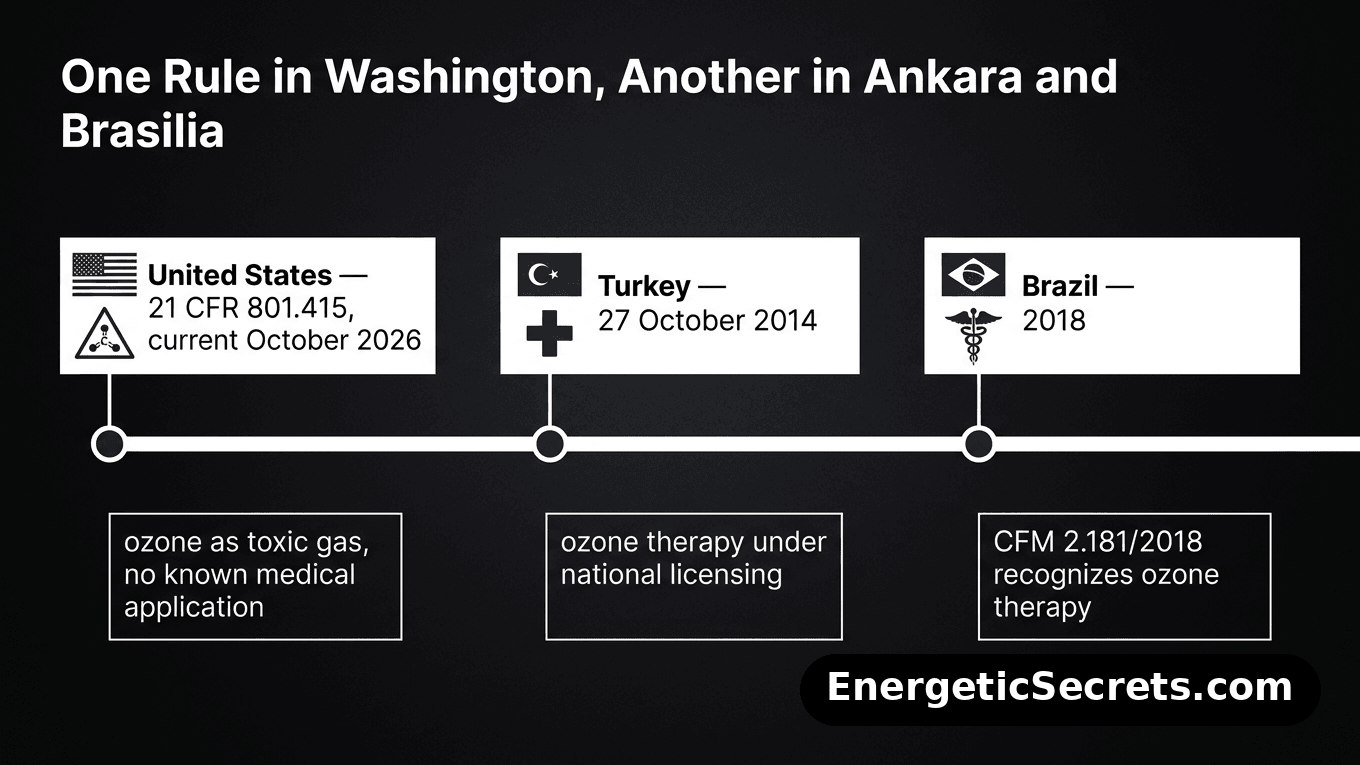
Now the asymmetry. In the United States, the federal device regulation on ozone states, verbatim: "Ozone is a toxic gas with no known useful medical application in specific, adjunctive, or preventive therapy" [31]. The rule declares ozone-generating devices adulterated or misbranded if they exceed 0.05 parts per million of ozone in the air circulating through the device, if they release ozone into spaces occupied by the ill, or if they are marketed for any medical condition for which there is no proof of safety and effectiveness. That text stands in the Code of Federal Regulations, unchanged, current as of November 2026, and has stood for decades.
Other jurisdictions have looked at the same chemistry and written different rules, more recently. Turkey brought ozone therapy under a national licensing framework for traditional and complementary medicine through a Ministry of Health regulation published in the Official Gazette on 27 October 2014 [32]. In 2018, Brazil's Federal Council of Medicine formally recognized ozone therapy as a legitimate medical procedure by resolution, CFM 2.181/2018 [33].
The field's own international scientific committee has maintained a consensus document, the Madrid Declaration on Ozone Therapy, since its first edition in 2010, with a third edition in 2020; it is a position statement by practitioners, not evidence of efficacy, but it documents what the field claims and where it claims legal standing [34].
Put the dates side by side and the finding states itself. The United States codified its position, ozone as a toxic gas with no known useful medical application, in a device labeling rule whose text still stands unchanged as of November 2026; Turkey wrote ozone therapy into national law in 2014, and Brazil's Federal Council of Medicine recognized it by resolution in 2018 [31][32][33]. One regulator's settled conclusion is another regulator's licensed medical act, and the gap between them is measured in decades, and likely pushed by pharma interests. Whatever you conclude about the therapy, that divergence is a fact about institutions and regulators, not about chemistry.
What the Light Actually Tells You
Strip away the marketing and a genuinely interesting picture remains. Oxidation in living tissue produces electronically excited molecules, and some of those molecules pay off their energy as light. Human skin, blood, and brain emit that light continuously, at rates photon counters can measure, as a direct readout of oxidative chemistry [2][5][7]. Ozone reacting with the body's own molecules generates singlet oxygen in high yield, and singlet oxygen announces itself at known wavelengths: 634 and 703 nanometers in the red, 1268 to 1270 nanometers in the near infrared [17][21][23].
What remains unmeasured is the claim that started the question. Nobody has put a photon counter on a person receiving ozone therapy and published the spectrum. Until someone does, the honest answer is: the chemistry predicts bands, the bands are measured in test tubes and in living tissue under other conditions, and the therapy-session measurement does not exist.
That is not a debunking. It is an invitation, to anyone with a dark box, a photomultiplier, and a clinic, to take the measurement. The light is there. Count it.
Disclaimer: I am not a health professional of any kind and make no medical claims. I am just a researcher who likes to dig deep on effective methods to keep them from being lost to the dust bin of history. And I like to write about what I learn. So please do your own research. Nothing in this article should be considered medical advice. None of the statements have been evaluated by the FDA. Not intended to diagnose, treat, cure or prevent any disease. If you have a medical condition seek professional help.
References
1. Colli L, Facchini U. "Light emission by germinating plants." Il Nuovo Cimento. 1954;12:150-153. DOI 10.1007/bf02820374.
2. Cohen S, Popp FA. "Biophoton emission of the human body." J Photochem Photobiol B. 1997;40(2):187-189. PMID 9345786. DOI 10.1016/s1011-1344(97)00050-x.
3. Sauermann G, Mei WP, Hoppe U, Stäb F. "Ultraweak photon emission of human skin in vivo: influence of topically applied antioxidants on human skin." Methods Enzymol. 1999;300:419-428. PMID 9919543. DOI 10.1016/s0076-6879(99)00147-0.
4. Hagens R, Khabiri F, Schreiner V, Wenck H, Wittern KP, Duchstein HJ, Mei W. "Non-invasive monitoring of oxidative skin stress by ultraweak photon emission measurement. II: biological validation on ultraviolet A-stressed skin." Skin Res Technol. 2008;14(1):112-120. PMID 18211609. DOI 10.1111/j.1600-0846.2007.00207.x.
5. Kobayashi M, Takeda M, Sato T, Yamazaki Y, Kaneko K, Ito K, Kato H, Inaba H. "In vivo imaging of spontaneous ultraweak photon emission from a rat's brain correlated with cerebral energy metabolism and oxidative stress." Neurosci Res. 1999;34(2):103-113. PMID 10498336. DOI 10.1016/s0168-0102(99)00040-1.
6. Kobayashi M, Takeda M, Ito K, Kato H, Inaba H. "Two-dimensional photon counting imaging and spatiotemporal characterization of ultraweak photon emission from a rat's brain in vivo." J Neurosci Methods. 1999;93(2):163-168. PMID 10634501. DOI 10.1016/s0165-0270(99)00140-5.
7. Sozarukova MM, Polimova AM, Proskurnina EV, Vladimirov YA. "[Changes in Kinetics of Chemiluminescence of Plasma as a Measure of Systemic Oxidative Stress in Humans]." Biofizika. 2016;61(2):337-344. PMID 27192837.
8. Proskurnina EV, Polimova AM, Sozarukova MM, Prudnikova MA, Ametov AS, Vladimirov YA. "Kinetic Chemiluminescence as a Method for Oxidative Stress Evaluation in Examinations of Patients with Type 2 Diabetes Mellitus." Bull Exp Biol Med. 2016;161(1):131-133. PMID 27259495. DOI 10.1007/s10517-016-3362-x.
9. Takeda M, Kobayashi M, Takayama M, Suzuki S, Ishida T, Ohnuki K, Moriya T, Ohuchi N. "Biophoton detection as a novel technique for cancer imaging." Cancer Sci. 2004;95(8):656-661. PMID 15298728. DOI 10.1111/j.1349-7006.2004.tb03325.x.
10. Criegee R. "Mechanism of Ozonolysis." Angew Chem Int Ed Engl. 1975;14(11):745-752. DOI 10.1002/anie.197507451.
11. Pryor WA. "Mechanisms of radical formation from reactions of ozone with target molecules in the lung." Free Radic Biol Med. 1994;17(5):451-465. PMID 7835752. DOI 10.1016/0891-5849(94)90172-4.
12. Uppu RM, Cueto R, Squadrito GL, Pryor WA. "What does ozone react with at the air/lung interface? Model studies using human red blood cell membranes." Arch Biochem Biophys. 1995;319(1):257-266. PMID 7771793. DOI 10.1006/abbi.1995.1294.
13. Esterbauer H, Schaur RJ, Zollner H. "Chemistry and biochemistry of 4-hydroxynonenal, malonaldehyde and related aldehydes." Free Radic Biol Med. 1991;11(1):81-128. PMID 1937131. DOI 10.1016/0891-5849(91)90192-6.
14. León OS, Menéndez S, Merino N, Castillo R, Sam S, Pérez L, Cruz E, Bocci V. "Ozone oxidative preconditioning: a protection against cellular damage by free radicals." Mediators Inflamm. 1998;7(4):289-294. PMID 9792340. DOI 10.1080/09629359890983.
15. Steinbeck MJ, Khan AU, Karnovsky MJ. "Intracellular singlet oxygen generation by phagocytosing neutrophils in response to particles coated with a chemical trap." J Biol Chem. 1992;267(19):13425-13433. PMID 1320020. DOI 10.1016/s0021-9258(18)42228-4.
16. Miyamoto S, Martinez GR, Rettori D, Augusto O, Medeiros MH, Di Mascio P. "Linoleic acid hydroperoxide reacts with hypochlorous acid, generating peroxyl radical intermediates and singlet molecular oxygen." Proc Natl Acad Sci USA. 2006;103(2):293-298. PMID 16387855. DOI 10.1073/pnas.0508170103.
17. Khan AU, Kasha M. "Chemiluminescence arising from simultaneous transitions in pairs of singlet oxygen molecules." J Am Chem Soc. 1970;92(11):3293-3300. DOI 10.1021/ja00714a010.
18. Cadenas E, Sies H. "Low-level chemiluminescence as an indicator of singlet molecular oxygen in biological systems." Methods Enzymol. 1984;105:221-231. PMID 6328183. DOI 10.1016/s0076-6879(84)05029-1.
19. Kazakov DV, Schmidt R. "On the effect of 1,4-diazabicyclo[2.2.2]octane on the singlet-oxygen dimol emission: chemical generation of (1O2)2 in peroxide reactions." J Phys Chem A. 2007;111(20). PMID 17455924. DOI 10.1021/jp070629p.
20. Krasnovskiĭ AA. "[Photoluminescence of singlet oxygen in solutions of chlorophylls and pheophytins]." Biofizika. 1977;22(5):927-928. PMID 911917.
21. Khan AU, Kasha M. "Direct spectroscopic observation of singlet oxygen emission at 1268 nm excited by sensitizing dyes of biological interest in liquid solution." Proc Natl Acad Sci USA. 1979;76(12):6047-6049. PMID 16592729. DOI 10.1073/pnas.76.12.6047.
22. Niedre M, Patterson MS, Wilson BC. "Direct near-infrared luminescence detection of singlet oxygen generated by photodynamic therapy in cells in vitro and tissues in vivo." Photochem Photobiol. 2002;75(4):382-391. PMID 12003128. DOI 10.1562/0031-8655(2002)075<0382:dnildo>2.0.co;2.
23. Kanofsky JR, Sima P. "Singlet oxygen production from the reactions of ozone with biological molecules." J Biol Chem. 1991;266(14):9039-9042. PMID 2026612. DOI 10.1016/s0021-9258(18)31548-5.
24. Kanofsky JR, Sima PD. "Singlet oxygen generation from the reaction of ozone with plant leaves." J Biol Chem. 1995;270(14):7850-7852. PMID 7713876. DOI 10.1074/jbc.270.14.7850.
25. Andreula CF, Simonetti L, De Santis F, Agati R, Ricci R, Leonardi M. "Minimally invasive oxygen-ozone therapy for lumbar disk herniation." AJNR Am J Neuroradiol. 2003;24(5):996-1000. PMID 12748111.
26. Paoloni M, Di Sante L, Cacchio A, Apuzzo D, Marotta S, Razzano M, Franzini M, Santilli V. "Intramuscular oxygen-ozone therapy in the treatment of acute back pain with lumbar disc herniation: a multicenter, randomized, double-blind, clinical trial of active and simulated lumbar paravertebral injection." Spine (Phila Pa 1976). 2009;34(13):1337-1344. PMID 19478653. DOI 10.1097/brs.0b013e3181a3c18d.
27. Steppan J, Meaders T, Muto M, Murphy KJ. "A meta-analysis of the effectiveness and safety of ozone treatments for herniated lumbar discs." J Vasc Interv Radiol. 2010;21(4):534-548. DOI 10.1016/j.jvir.2009.12.393.
28. Galassi FM, Zauli E, Vaccarezza M, Varotto E. "Clinical use of ozone therapy: a critical appraisal of evidence, safety, and methodological quality." Front Med (Lausanne). 2026;13:1893156. PMID 42755540. DOI 10.3389/fmed.2026.1893156.
29. Marchetti D, La Monaca G. "An unexpected death during oxygen-ozone therapy." Am J Forensic Med Pathol. 2000;21(2):144-147. PMID 10871129. DOI 10.1097/00000433-200006000-00010.
30. Faustini A, Capobianchi MR, Martinelli M, Abbate I, Cappiello G, Perucci CA. "A cluster of hepatitis C virus infections associated with ozone-enriched transfusion of autologous blood in Rome, Italy." Infect Control Hosp Epidemiol. 2005;26(9):762-767. PMID 16209382. DOI 10.1086/502614.
31. US Food and Drug Administration. 21 CFR 801.415, "Maximum acceptable level of ozone." Code of Federal Regulations, Title 21, current as of 21 October 2026. Electronic Code of Federal Regulations, ecfr.gov/current/title-21/part-801/section-801.415.
32. Republic of Turkey, Ministry of Health. "Geleneksel ve Tamamlayıcı Tıp Uygulamaları Yönetmeliği" (Regulation on Traditional and Complementary Medicine Practices). Resmî Gazete (Official Gazette), 27 October 2014. Ozone therapy appears as item 13 of the regulation's Ek-3 list of licensed practices. resmigazete.gov.tr/eskiler/2014/10/20141027-3-1.pdf (scanned gazette).
33. Conselho Federal de Medicina (Brazil). Resolução CFM nº 2.181/2018, recognizing ozone therapy as a legitimate medical procedure. 2018. sistemas.cfm.org.br/normas/arquivos/resolucoes/BR/2018/2181_2018.pdf.
34. ISCO3 (International Scientific Committee of Ozone Therapy). "Madrid Declaration on Ozone Therapy." 1st edition 4 June 2010; 3rd edition Madrid: ISCO3, 2020. isco3.org. |




4 Comments
Join the conversation
The 254 nm thing is a good catch. That is just what the analyzer uses to measure the gas. I bet half the clinic brochures out there have that number printed on them somewhere.
My husband got ozone injections for a herniated disc in Italy years ago and swears it was the only thing that helped him. No idea about wavelengths but his back got better.
So nobody has ever actually stuck a photon counter on a person getting ozone? That seems like a pretty easy experiment for somebody with the right gear. Kind of wild it hasn't been done.
The rat brain thing got me. Take away the glucose and the glow dims. I had no idea anyone had even tried to photograph a brain glowing.