
The Last Leaded Fuel on Earth Burns Over America's Schools |
The EPA says it's America's biggest source of lead in the air. One county banned it, and the FAA opened an investigation. |
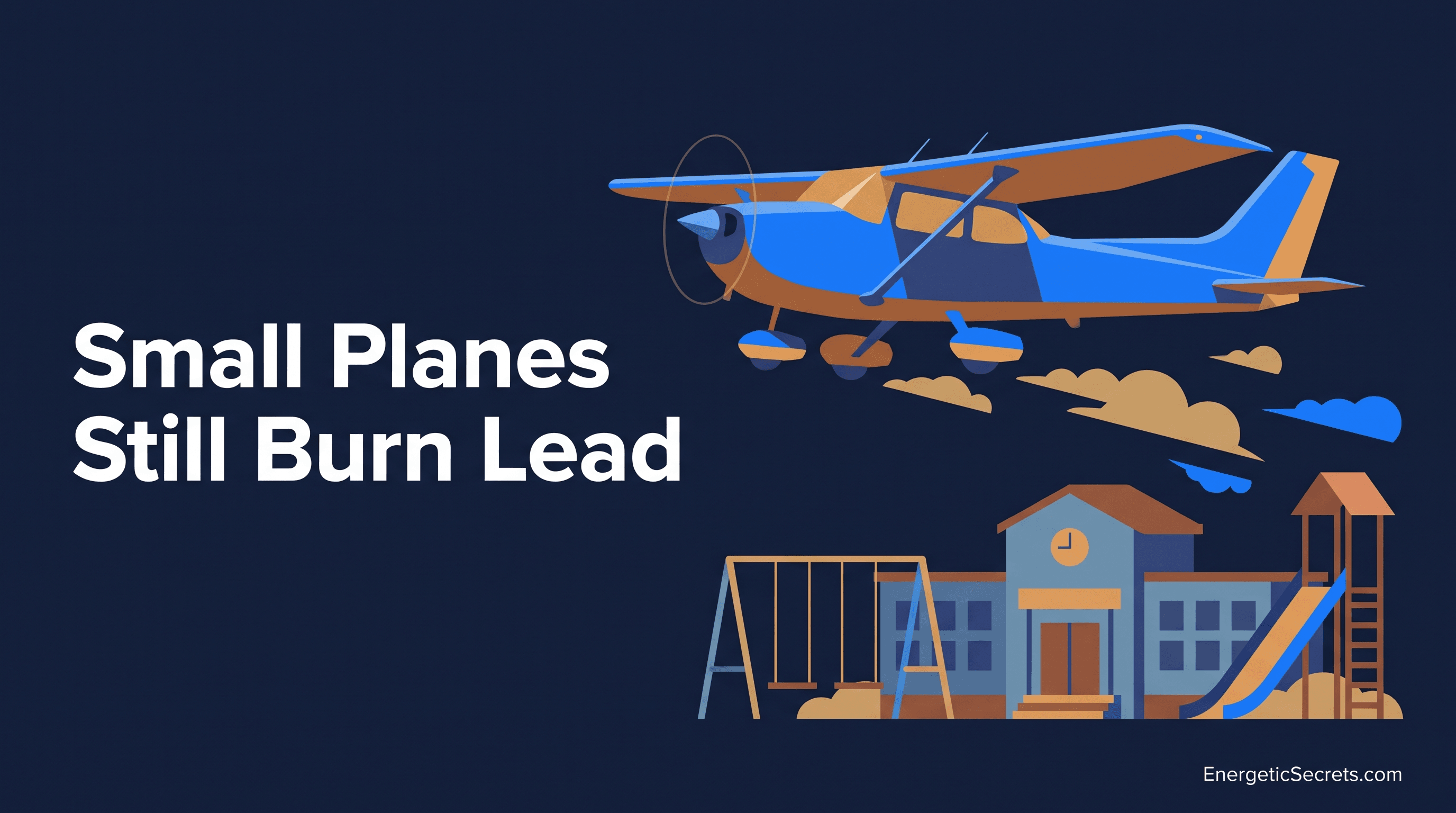
Every country on earth finished phasing out leaded gasoline for cars by the middle of 2021. One leaded fuel survived that entire global cleanup, and it still burns every day over the neighborhoods where children live, play, and go to school.
Why Lead Was Ever in the Tank
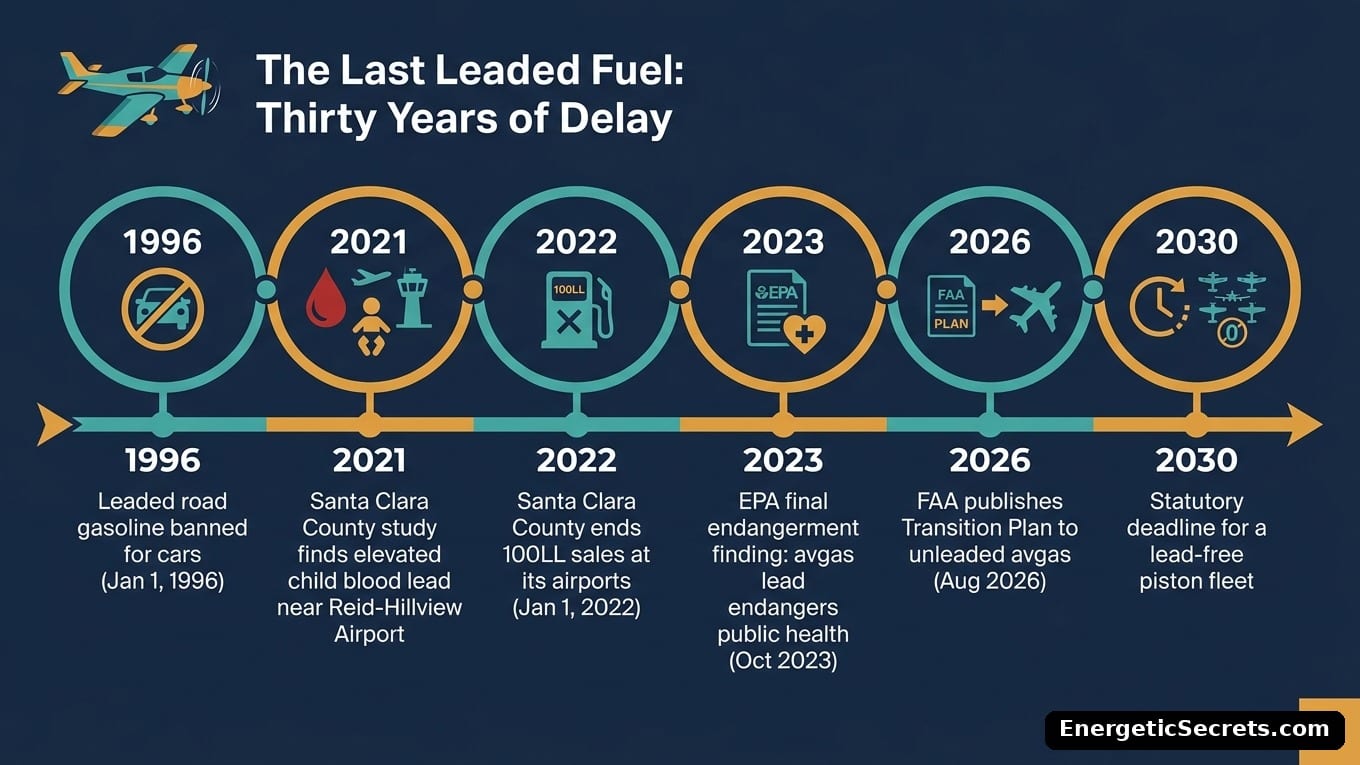
Sometime around the end of 1995, the United States finished the long job of getting lead out of the gasoline people pump into their cars. The law took effect on January 1, 1996, and from that day it has been unlawful to sell or supply gasoline containing lead for any motor vehicle on the road [4]. You would be forgiven for thinking that was the end of the story.
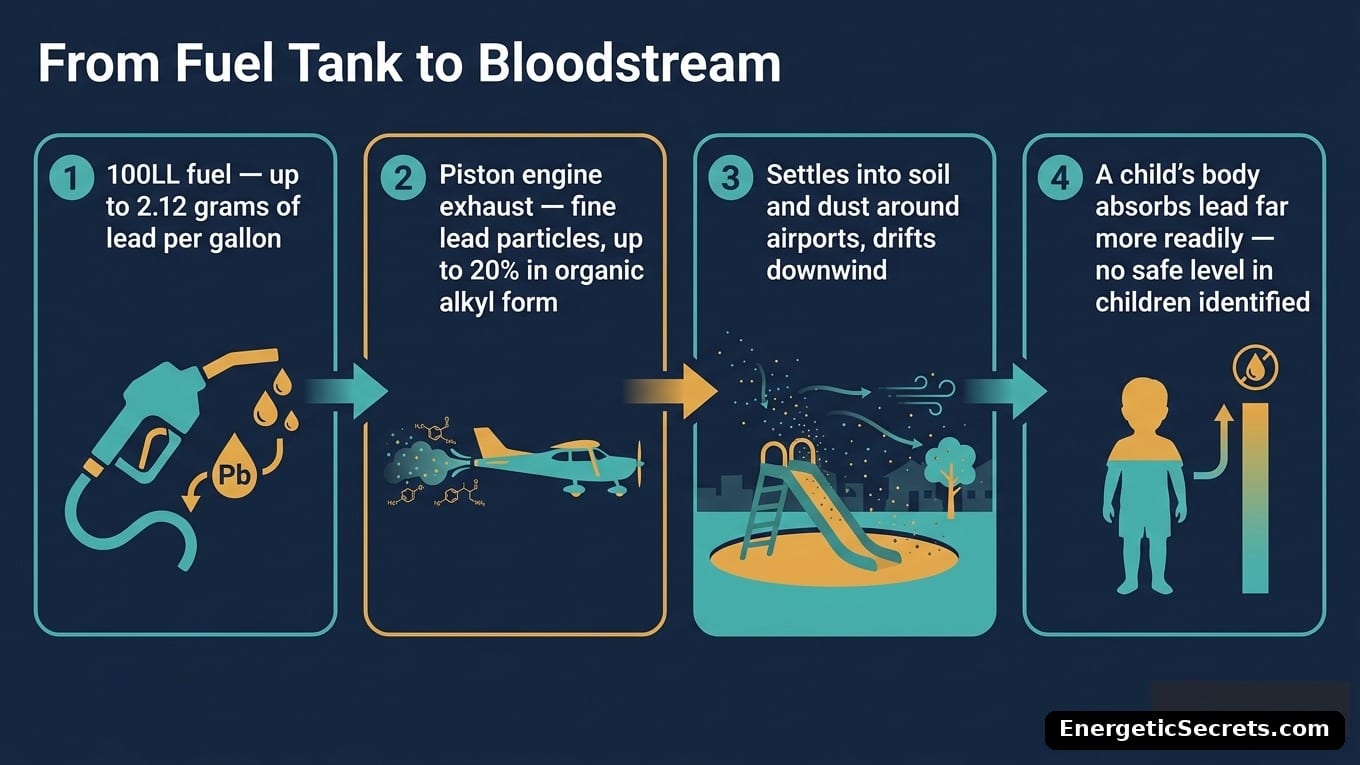
It was not the end. One leaded fuel was never covered, and it is on sale today, more than a quarter century later. It is called 100LL, the "low lead" aviation gasoline that powers most of the roughly 170,000 piston-engine airplanes in the country [6]. The "low lead" in the name is relative. 100LL can carry up to 2.12 grams of lead per gallon, exactly half of what the older 100-octane avgas carried, but lead all the same [1]. (Half a poison is still a poison, but 100LL does sound friendlier.)
I grew up being taught that when the official agencies say something is safe, you set the question down and move on. As I grew up and questioned it loudly I learned to distrust government and media, one lead story at a time.
The pattern never changes: the fuel, the paint, the pipe, the pesticide stays in use for decades while the people selling it insist it is fine, and the proof that it was never fine arrives only after a generation of children has already been exposed.
Lead was put into aviation gasoline for the same reason it was put into road gasoline. Tetraethyl lead, a compound built from lead and organic groups, boosts octane. It lets an engine run at higher compression without knocking, and it protects valve seats from wear. It had been added to road gasoline since 1922, and piston-engine aircraft picked it up in 1927 [1, 11].
What It Becomes When It Burns
Here is the part most people have never thought through. Tetraethyl lead is highly volatile. When a piston engine burns 100LL, not all of the lead stays locked in the metal of the engine. Some of it leaves through the exhaust as fine particles, and the EPA's own 2013 lead assessment puts as much as 20 percent of the lead in piston-aircraft exhaust in the organic, alkyl form, as an upper-bound estimate [1].
That lead settles into the soil and the dust around airports. It drifts with the wind. And because a child's body absorbs lead far more readily than an adult's, and a child's brain is still wiring itself, the dust that lands on a playground a few blocks from a runway does not stay outside.
The scale of the exposure is not small. The EPA's final finding, published in October 2023, states plainly that lead emissions from aircraft engines operating on leaded fuel are the largest single source of lead to air in the United States, contributing more than 50 percent of lead emissions to air starting in 2008 [1].
In 2017, the year the finding breaks out, piston-powered aircraft emitted roughly 470 tons of lead, about 70 percent of that year's total airborne lead [1]. Since 1930, by the EPA's estimate, piston-engine aircraft have burned about 38.6 billion gallons of leaded avgas in this country, putting roughly 113,000 tons of lead into the air [1]. And the agency's own forecast shows the fuel persisting through the next decade, 185 million gallons in 2026 easing only to 179 million gallons by 2041 [1].
Who lives under that? The EPA estimates that about 5.2 million people live within 500 meters of an airport runway, including 363,000 children aged five and under, and that 573 schools attended by 163,000 children in kindergarten through twelfth grade sit that close to a runway [1]. That figure counts airports of every kind, including quiet fields with little piston traffic, so treat it as a ceiling rather than a precise exposure map. The finer, better-bound number comes from a single airport where someone actually measured.
The Children Under the Traffic Pattern
In 2021, the County of Santa Clara commissioned a study of the children living around Reid-Hillview Airport, a busy general-aviation field near San Jose [5]. The analysis was carried out by the Mountain Data Group in cooperation with the California Department of Public Health's Childhood Lead Poisoning Prevention Branch, and it drew on actual blood-lead surveillance records. What it found should have settled the argument years ago.
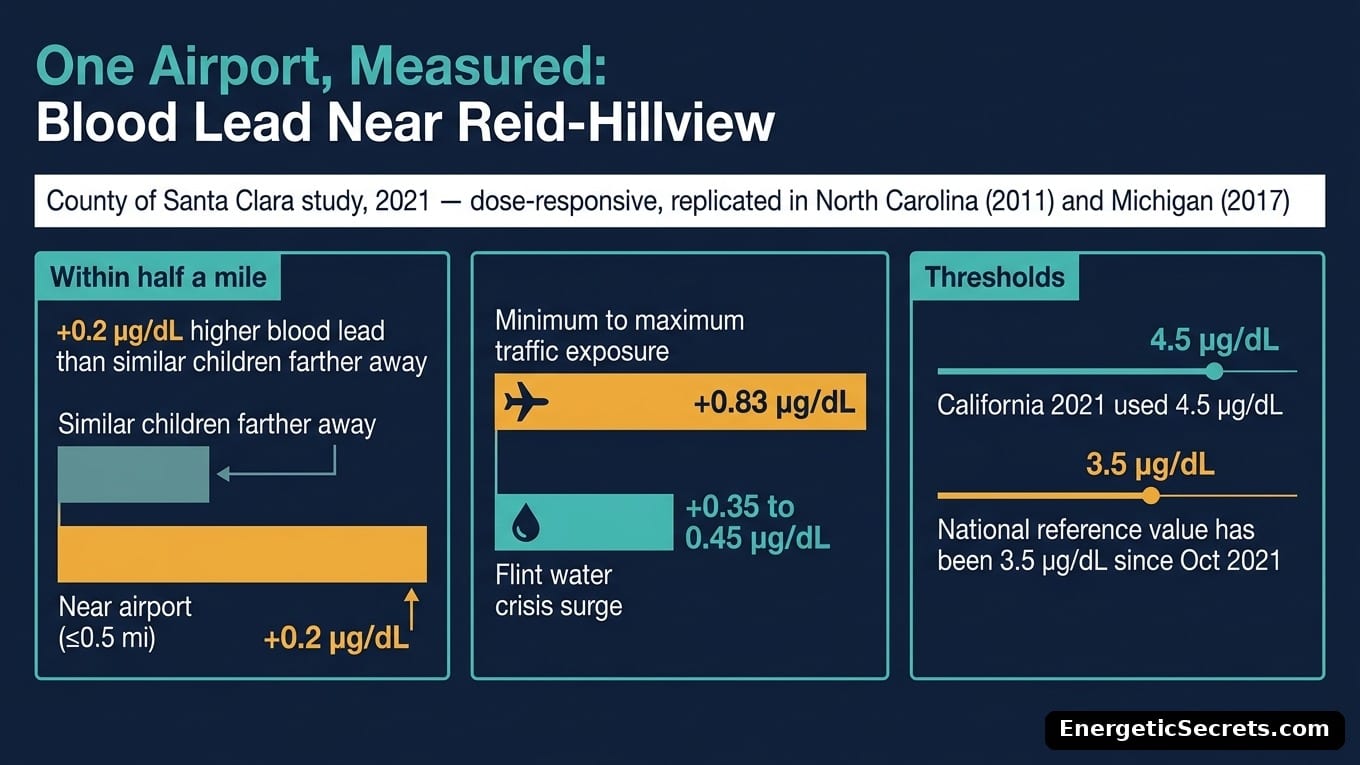
Children living within half a mile of the airport had blood lead levels about one-fifth of a microgram per deciliter higher than statistically similar children living farther away, after accounting for other lead exposures, child characteristics, and neighborhood conditions [5]. The effect was dose-responsive. Blood lead climbed with proximity, with living downwind to the east of the field, and with the volume of piston-engine traffic.
For children within half a mile, moving from minimum to maximum traffic exposure was associated with an estimated 0.83 microgram per deciliter increase in blood lead, an effect the study's authors describe as exceeding what children experienced at the height of the Flint water crisis, when the surge was 0.35 to 0.45 micrograms per deciliter [5].
The study also looked at thresholds. All of the aviation-exposure indicators raised the odds that a child would present with blood lead at or above 4.5 micrograms per deciliter, the threshold California used at the time, and the estimated probability of crossing that line was 20 to 27 percent higher in the nearest orbit than in the outer bands [5]. So the closer the kid was to the downwind part of the airport, the more lead was measured.
Keep one distinction straight, because it matters. That 4.5 mcg figure was the state's 2021 threshold. The national blood lead reference value was lowered again in October 2021, just after the report came out, and it has stood at 3.5 micrograms per deciliter ever since [9]. The bar the county measured against was already higher than the bar the country now uses. I personally consider the EPA and most regulators captured agencies, essentially owned by the polluters and don't assume any of their thresholds are actually safe.
The Same Pattern, Three Times Over
This was not a one-off finding that could be waved away as a county with an agenda. The same analysis survived peer review and appeared in PNAS Nexus in January 2023 [6]. It was not even the first study to find the pattern. Miranda and colleagues found children's blood lead rising with proximity to airports in six North Carolina counties in 2011 [7], and Zahran and colleagues found the same dose-responsive relationship across more than a million children near 448 Michigan airports in 2017, with blood lead falling again when traffic did [8].
The reason any of this matters in micrograms is the part the regulatory apparatus has known for decades and still treats gently. The 2013 Lead Integrated Science Assessment, which the EPA itself quotes in its 2023 finding, concludes there is no evidence of a threshold below which lead has no harmful effect on a child's cognition, and that some lead-related cognitive effects may be irreversible and persist into adulthood [1].
The largest pooled analysis of its era, published in 2005 by Bruce Lanphear and colleagues across seven cohorts, found intellectual deficits associated with lead at blood levels below 10 micrograms per deciliter, with the steepest decrement per unit dose at the lowest exposures [10]. The Centers for Disease Control has long maintained that no safe blood lead level in children has been identified [9].
Put those two facts together and the picture is blunt. There is no known safe level, and the exposure from one busy airport moves a child's blood lead by fractions of a microgram that sit exactly in the range where the pooled data say the harm (per unit dose) is steepest. "Low lead" fuel is a marketing phrase. The toxicology has no "low" setting. (Ask any pediatrician who has explained a blood-lead number to a worried parent.)
Why This Fuel Survived the Ban
So why is the fuel still there? This is where the story gets uncomfortable, and where the skepticism has to point at the institutions rather than at the parents doing the measuring.
The reason the leaded road fuel died in 1996 but the leaded aviation fuel survived is structural, not accidental. The 1990 amendments to the Clean Air Act prohibited lead in gasoline "for use in any motor vehicle," and "motor vehicle" is defined in a way that excludes aircraft [4]. Nobody stood up and voted to exempt airplanes in some grand bargain. The definition simply never reached them. The result is the same either way: a fuel that was illegal for every car on the road stayed legal for every small plane in the sky, for thirty more years and counting.
The federal government has since admitted the danger. In October 2023, the EPA issued a final endangerment finding under the Clean Air Act: lead emissions from aircraft engines operating on leaded fuel cause or contribute to air pollution that may reasonably be anticipated to endanger public health and welfare [1]. That finding is not a ban but it does create a legal duty. Under the Clean Air Act, the EPA must now propose and promulgate emission standards, and the FAA must then write the rules that ensure compliance [1].
Here is the part to notice. The finding is from October 2023. What came next was not a standard. It was, in August 2026, nearly three years later, a transition plan [2]. The FAA published Version 1.0 of its plan to move the piston-engine fleet to unleaded fuel, following a draft released for comment in January 2026 [2].
The plan is phased: fuel testing and authorization first, then market experience, then a national transition, with a separately managed transition in Alaska [3]. The 2024 FAA Reauthorization Act set a statutory deadline of 2030 for the fleet to complete the move [3].
Consider what that timeline means. The world's last leaded road gasoline was pumped in Algeria in July 2021, closing a nineteen-year United Nations campaign that began in 2002 [11]. The UN Environment Program estimates the global phase-out prevents more than 1.2 million premature deaths a year and saves some $2.45 trillion annually [11].
America's own road fuel has been lead-free since 1996. The agency found aviation lead dangerous in 2023, and the plan to stop it targets 2030, seven years later, with no emission standard yet on the books. A child born the year the danger was formally declared would be in grade school before the fuel that endangers her is scheduled to be gone, on the most generous reading.
The Strongest Case for Delay, Answered
The general-aviation industry does have a real argument, and it would be dishonest to pretend otherwise. High-compression piston engines need 100-octane fuel to prevent detonation, the uncontrolled combustion that can destroy an engine in flight. After all, a drop-in unleaded replacement has to be certified for each engine and airframe pair, and that is slow, careful work [12]. The industry is genuinely doing it.
GAMI's G100UL is approved through the Supplemental Type Certificate pathway, and the FAA is testing LyondellBasell/VP Racing's UL100 and Swift Fuels' 100R [3]. The industry's public partnership with the FAA, called EAGLE, is committed to a lead-free fleet by 2030 [12]. During the rollout, federal grant obligations actually require airports to keep 100LL available, which preserves the leaded supply while the alternatives scale up [3].
That is the strongest version of the case, and I will answer it directly. Certifying engines is hard because it's complex to change aviation fuel on such diverse aircraft. The same industry that spent decades explaining that leaded fuel was irreplaceable found, once the pressure mounted, that replacement fuels could be certified one by one. The technical constraints are real, but they have also served as a comfortable argument for delay, and delay is a policy choice whose measurable cost lands on children, not on the people who fly the planes.
The collision between the federal system and the people who live under the traffic pattern played out in public in Santa Clara County. The county became the first in the nation to ban the sale and use of leaded aviation fuel at its airports: the Board of Supervisors voted in 2021, and leaded fuel sales ended at Reid-Hillview and San Martin airports on January 1, 2022 [13, 16]. The FAA opened an investigation into whether that ban violated federal grant obligations, then paused it under an agreement that invites both county airports into a national unleaded-fuel demonstration project [13].
Since I know aviators of small planes, it's important to emphasize the nuance here. There are a ton of planes originally built as far back as the 1950s that are still maintained and considered aviation certified. Changing the fuel on such a varied lot of engines is not an easy task, and consequences are deadly serious.
What 100LL Actually Powers
The roughly 170,000 piston-engine airplanes that still burn 100LL are not a random assortment. They are the Cessna 172 Skyhawk and the Piper Cherokee and Warrior that carry most of the primary flight instruction in this country, the Cessna 150 and 152 two-seaters that have trained more pilots since the Second World War than any other type, the Cirrus SR20 and SR22 that private owners step up into, and the air-taxi and cargo airplanes that do the unglamorous everyday work [22]. There are plenty of others as well. Nearly all of them were designed around a 100-octane engine, and the fuel is the last part of that design anyone expected to change.
What should stop anyone who pictures a modern fleet is the age. The FAA's 2024 General Aviation Activity Survey counts 163,047 single-engine piston airplanes in the United States, and nearly 80 percent of them were built before 1980. More than half were built before 1970. A little over 26,000 were built in 1949 or earlier. The largest single age group in the entire fleet is not this decade or the last one: it is the 28,326 airplanes built between 1975 and 1979 [17].
An airplane that old is not a relic sitting in a hangar waiting to be retired. It is maintained to an airworthiness standard, inspected, and flown. That is the point the pilots I know make, and they are right to make it: these are not cars, where a recall or a new fuel specification eventually pushes the old models off the road.
The margin is thinner than people outside aviation realize. Detonation is not a rough-running annoyance; it is an uncontrolled burn that can hole a piston in flight. Pilots I know who handle and blend their own fuel treat the job with a caution that looks like superstition until you understand what a mistake costs at altitude.
Nowhere does that arithmetic get harder than in Alaska. About 7,000 piston airplanes operate there, in the state with the highest per capita use of general aviation in the country [19]. EAGLE, the industry and FAA partnership running this transition, reports that roughly 82 percent of Alaskan communities depend on piston-engine aircraft for mail, groceries, and emergency medical transport [21]. When Senator Dan Sullivan argued for a longer timeline for his state, the figures he put on the Senate floor were more than 200 communities with no road access and 8,734 registered aircraft, or twelve airplanes for every thousand residents [20].
The logistics are not a question of will. Fuel reaches most of those communities by barge during the short ice-free window and then sits in a single central tank for a year or longer. There is no second tank to segregate a new fuel from the old one, and the only window for maintenance and alterations is winter, when the flying slows [19, 21]. Congress wrote a two-year carve-out for exactly this: the statutory target is 2030 for the lower 48 and 2032 for Alaska [18].
Put those two facts next to each other and the uncomfortable part arrives. A deadline that grounded the fleet in bush Alaska would not be obeyed. It would be quietly worked around, and in a place where the airplane is the ambulance, working around it is the rational choice. A rule that only holds where compliance is convenient is not a rule. That is the real argument for why this transition has to produce a certified drop-in fuel that works in the engines already flying, rather than a date on a calendar.
None of this makes the lead harmless, and this is the part I will not soften. The same fuel that keeps a village supplied is putting a known neurotoxin into the lungs of children under the traffic pattern. Both things are true at once. The people who benefit from pretending only one of them is true are the ones who have been setting the pace, and that is why the answer has to be a fuel rather than a ban, and soon rather than in 2032.
I do not know all the answers to why the pace has been what it is, but it sure seems like the people with the loudest stake in the delay are not the ones breathing the exhaust. The exposure is broader than the children under the pattern anyway. Aircraft maintenance crews who handle leaded avgas carry elevated blood lead too [15], and the physicians who organized against leaded avgas at another California airport wrote up their advocacy in the medical literature [14].
Children near a busy airport have measurably higher blood lead, dose-responsive and replicated, in a range where the pooled science says no safe level exists and the harm per microgram is steepest. The federal government declared the danger three years ago and, as of this writing, has produced a phased plan for 2030 rather than a standard. And when a county tried to protect its own children, the federal system's first move was an investigation, not a remediation, which is what you get when an institution's reflex is to police the local government before it polices the pollution.
None of that is theory. Every piece of it is in the docket, the statute, the county report, and the peer-reviewed literature cited below. The question the story leaves you with is not whether leaded aviation fuel is a problem. It is who has been allowed to decide how slowly the problem gets solved. But then again, governments and bureaucrats are always slow to make good decisions.
Disclaimer: I am not a health professional of any kind and make no medical claims. I am just a researcher who likes to dig deep on effective methods to keep them from being lost to the dust bin of history. And I like to write about what I learn. So please do your own research. Nothing in this article should be considered medical advice. None of the statements have been evaluated by the FDA. Not intended to diagnose, treat, cure or prevent any disease. If you have a medical condition seek professional help.
References
1. U.S. Environmental Protection Agency. "Finding That Lead Emissions From Aircraft Engines That Operate on Leaded Fuel Cause or Contribute to Air Pollution That May Reasonably Be Anticipated To Endanger Public Health and Welfare." Federal Register, 88 FR 72372, October 20, 2023. https://www.federalregister.gov/documents/2023/10/20/2023-23247/finding-that-lead-emissions-from-aircraft-engines-that-operate-on-leaded-fuel-cause-or-contribute-to
2. Federal Aviation Administration. "FAA Transition Plan to Unleaded Aviation Gasoline V1.0." Federal Register, 91 FR 48969, August 3, 2026. https://www.federalregister.gov/documents/2026/08/03/2026-15644/faa-transition-plan-to-unleaded-aviation-gasoline-v10
3. Federal Aviation Administration. "FAA Releases Plan for Transitioning General Aviation Aircraft to Unleaded Gas." FAA Newsroom, July 30, 2026. https://www.faa.gov/newsroom/faa-releases-plan-transitioning-general-aviation-aircraft-unleaded-gas
4. Clean Air Act, 42 U.S.C. §7545(n). Cornell Legal Information Institute. https://www.law.cornell.edu/uscode/text/42/7545
5. Mountain Data Group. "Leaded Aviation Gasoline Exposure Risk at Reid-Hillview Airport in Santa Clara County, California." County of Santa Clara, August 3, 2021. https://files.santaclaracounty.gov/migrated/RHV-Airborne-Lead-Study-Report.pdf
6. Zahran S, Keyes C, Lanphear B. "Leaded aviation gasoline exposure risk and child blood lead levels." PNAS Nexus 2(1): pgac285, January 2023. PMID 36712926. https://pubmed.ncbi.nlm.nih.gov/36712926/
7. Miranda ML, Anthopolos R, Hastings D. "A geospatial analysis of the effects of aviation gasoline on childhood blood lead levels." Environmental Health Perspectives 119(10):1513–1516, October 2011. PMID 21749964. https://pubmed.ncbi.nlm.nih.gov/21749964/
8. Zahran S, Iverson T, McElmurry SP, Weiler S. "The Effect of Leaded Aviation Gasoline on Blood Lead in Children." Journal of the Association of Environmental and Resource Economists 4(2):575–610, 2017. DOI 10.1086/691686. https://doi.org/10.1086/691686
9. Ruckart PZ, et al. "Update of the Blood Lead Reference Value — United States, 2021." MMWR Morbidity and Mortality Weekly Report 70(43):1509–1512, October 29, 2021. PMID 34710078. https://pubmed.ncbi.nlm.nih.gov/34710078/
10. Lanphear BP, et al. "Low-level environmental lead exposure and children's intellectual function: an international pooled analysis." Environmental Health Perspectives 113(7), July 2005. PMID 16002379. https://pubmed.ncbi.nlm.nih.gov/16002379/
11. UN Environment Programme. "Era of leaded petrol over, eliminating a major threat to human and planetary health." August 30, 2021. https://www.unep.org/news-and-stories/press-release/era-leaded-petrol-over-eliminating-major-threat-human-and-planetary
12. EAGLE (Eliminate Aviation Gasoline Lead Emissions). https://flyeagle.org/
13. San José Spotlight. "FAA pauses investigation of Santa Clara County leaded fuel ban." https://sanjosespotlight.com/faa-pauses-investigation-of-santa-clara-county-leaded-aviation-airplane-fuel-ban/
14. Gilbertson et al. "The Role of Physician Advocacy in Supporting Policy Change That Reduces Leaded Aviation Gasoline Emissions." Journal of Community Health 48(3):446–449, June 2023. PMID 36609625. https://pubmed.ncbi.nlm.nih.gov/36609625/
15. Park W, Gu K, Lee K. "Blood lead level and types of aviation fuel in aircraft maintenance crew." Aviation, Space, and Environmental Medicine 84(10):1087–1091, October 2013. PMID 24261063. https://pubmed.ncbi.nlm.nih.gov/24261063/
16. Godlewski M. "100LL Ban Takes Effect in Santa Clara County." FLYING Magazine, January 12, 2022. https://www.flyingmag.com/100ll-ban-takes-effect-in-santa-clara-county/
17. Federal Aviation Administration. "General Aviation and Part 135 Activity Survey, CY 2024, Table 2.4a: Population Size, Active Aircraft, Total Flight Hours, and Average Flight Hours by Age of Aircraft, Fixed Wing Piston Single-Engine Aircraft Only." https://www.faa.gov/data_research/aviation_data_statistics/general_aviation/cy2024/2024GASurveyCh2.xlsx
18. Federal Aviation Administration. "Draft FAA Transition Plan to Unleaded Aviation Gasoline." Federal Register, 91 FR 1230, January 12, 2026. https://www.federalregister.gov/documents/2026/01/12/2026-00296/draft-faa-transition-plan-to-unleaded-aviation-gasoline
19. AVweb. "EAGLE Assesses Alaska's Specialized Avgas Needs." https://www.avweb.com/ownership/eagle-assesses-alaskas-specialized-avgas-needs/
20. AVweb. "Alaska Senator Blasts FAA Reauthorization On Unleaded Fuel Requirement." https://avweb.com/aviation-news/alaska-sen-blasts-faa-reauthorization-on-unleaded-fuel-requirement/
21. EAGLE (Eliminate Aviation Gasoline Lead Emissions). "What's on the Unleaded AvGas Horizon? Preparing for National Transition." September 28, 2026. https://flyeagle.org/2026/09/28/whats-on-the-unleaded-avgas-horizon-preparing-for-national-transition/
22. Aircraft Owners and Pilots Association. "Training Aircraft Review." https://www.aopa.org/training-and-safety/learn-to-fly/flying-for-fun/choose-where-to-train/training-aircraft-review |




3 Comments
Join the conversation
The Flint comparison got me. Flint was on the news every night for months and this has been going on for 30 years with barely a word.
I fly a 172 from 1976 and nobody wants lead gone more than we do, it fouls plugs and gums up the valves. The issue is getting the fuel certified for every engine out there, that part is real and not an excuse.
I live about a mile from a small field and never once thought about what was coming out of those little planes. I just figured they ran on regular gas like a lawn mower.