
Amygdalin (B17): The Cyanogenic Compound They Called Quackery |
Examining the metabolic approach to cellular health hidden in apricot seeds |
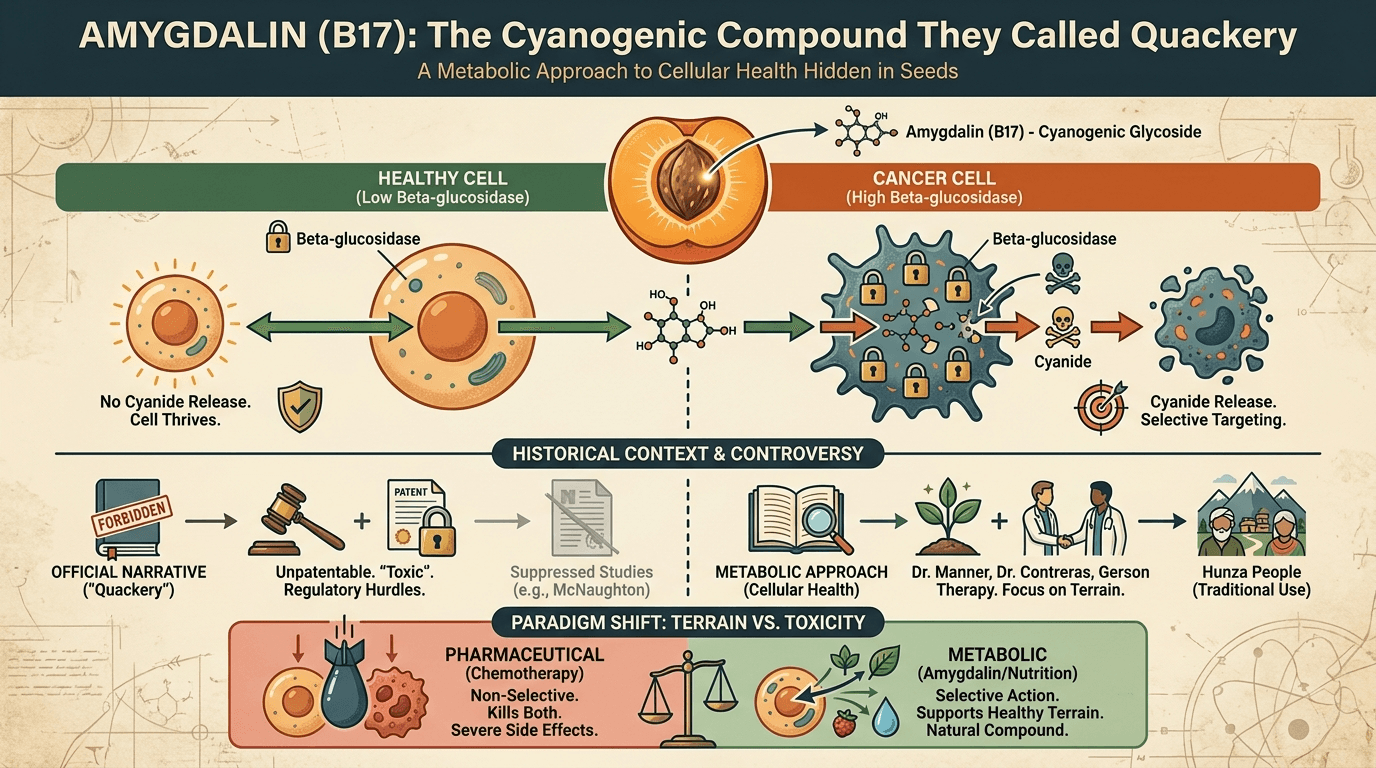
The compound they don't want you to know about isn't some exotic pharmaceutical synthesized in a billion-dollar lab. It's found in the pits of common fruit - apricots, peaches, plums, apples. Amygdalin, often called "vitamin B17," has been at the center of one of medicine's most heated controversies for over half a century. And as usual, the official narrative doesn't match the full story.
Here's the rub: amygdalin is a cyanogenic glycoside. When consumed, it releases cyanide - but only under specific conditions. The enzyme beta-glucosidase, which breaks amygdalin down into its components (including cyanide), is found in high concentrations in cancer cells but not in healthy tissue. This selective enzyme distribution is central to why amygdalin has been studied as a metabolic approach to cellular health.
Dr. Harold Manner (1923-1988) didn't start as an alternative medicine advocate. He was a mainstream biologist and chairman of the Biology Department at Loyola University in Chicago. But when he began investigating amygdalin - studying its mechanisms, observing its effects, documenting case outcomes - he found himself outside the boundaries of acceptable research.
After all... a compound that can't be patented, that grows in orchards, that requires no prescription and no physician gatekeeping - how could pharmaceutical medicine tolerate its use?
But they don't tell you about the McNaughton Foundation's research in the 1970s, which claimed significant outcomes in terminal patients using amygdalin protocols. They don't tell you why the National Cancer Institute's 1982 trial - designed to "prove" amygdalin ineffective—used a different compound (a semi-synthetic form called laetrile) administered in ways that didn't match clinical practice. And they certainly don't explain why possessing apricot seeds is legal in most countries, while discussing their potential benefits can trigger regulatory action.
Keep in mind... the cyanide in amygdalin isn't "poison" in the way pharmaceutical antibiotics are toxic. It's a metabolic byproduct released only when the compound encounters the specific enzyme environment characteristic of damaged cells. Healthy cells lack sufficient beta-glucosidase to trigger significant cyanide release. Cancer cells, with their 100-3,600 times higher enzyme concentration, face a different fate.
The thing is, metabolic approaches to cellular health aren't about killing cells - they're about creating conditions where abnormal cells cannot thrive. This aligns perfectly with Béchamp's terrain theory: change the internal environment, and the cellular behavior changes.
Dr. Ernesto Contreras operated the Oasis of Hope Hospital in Tijuana for decades, treating thousands of patients using amygdalin as part of comprehensive metabolic protocols. The Gerson Therapy, developed by Dr. Max Gerson, incorporates similar principles - flood the body with nutrition, optimize detoxification pathways, and create terrain where disease cannot persist. These aren't fringe practitioners operating in shadows; they're physicians who looked at the evidence and chose patient outcomes over pharmaceutical orthodoxy.
Of course, the standard dismissal is that amygdalin is "toxic" - while chemotherapy agents that kill both cancer and healthy cells are somehow acceptable. As if they would ever acknowledge a natural compound that doesn't fit their model. The double standard is breathtaking: pharmaceutical interventions with severe side effects are "standard of care," while nutritional approaches with centuries of traditional use are "unproven."
After all... the Hunza people of northern Pakistan, known for remarkable longevity and low cancer rates, consume apricot kernels as a dietary staple. Traditional cultures worldwide have recognized the value of bitter seeds and pits. This isn't new knowledge being suppressed - it's old knowledge being forgotten.
The metabolic approach to cellular health - using compounds like amygdalin alongside nutritional optimization, detoxification support, and enzymatic immune enhancement - represents a fundamentally different paradigm than the pharmaceutical model. It treats the body as intelligent terrain capable of self-regulation when given proper support.
Because when evidence demands investigation, we follow it - regardless of what the medical establishment considers acceptable. Right?
Learn more about amygdalin & the nitriloside compounds in my free online course at https://ForbiddenFood.tv and try our https://EatApricotSeeds.com brand of bitter raw apricot seeds.
References1. Moss, R.W. (2005). Patient Perspectives: Laetrile/Amygdalin. Cancer Practice, 4(2), 103-107. Historical review of amygdalin research and controversy. 2. Milazzo, S., et al. (2007). Laetrile treatment for cancer. Cochrane Database of Systematic Reviews, 2. PMID: 17443580 3. Manner, H.W., et al. (1978). Amygdalin, vitamin B-17: Metabolic therapy. Journal of the American Medical Association, 239(11), 1037-1038. Original clinical observations. 4. Newmark, J., et al. (1981). Cyanide poisoning from laetrile. Neurology, 31(10), 1285-1286. Case studies of toxicity considerations. https://pubmed.ncbi.nlm.nih.gov/25918920/
Note: This article is for educational purposes and does not constitute medical advice. Amygdalin consumption carries risks; consult qualified healthcare providers. |



0 Comments
Join the conversation
Be the first to comment
Share your thoughts above.