
The Surveillance State Kicks It's Foot In Your Door Inside Kid's Toys With Questionable Privacy Policies... |
Are Your Kids' Toys Watching Them? The Hidden Data Threat Hiding in the Playroom |
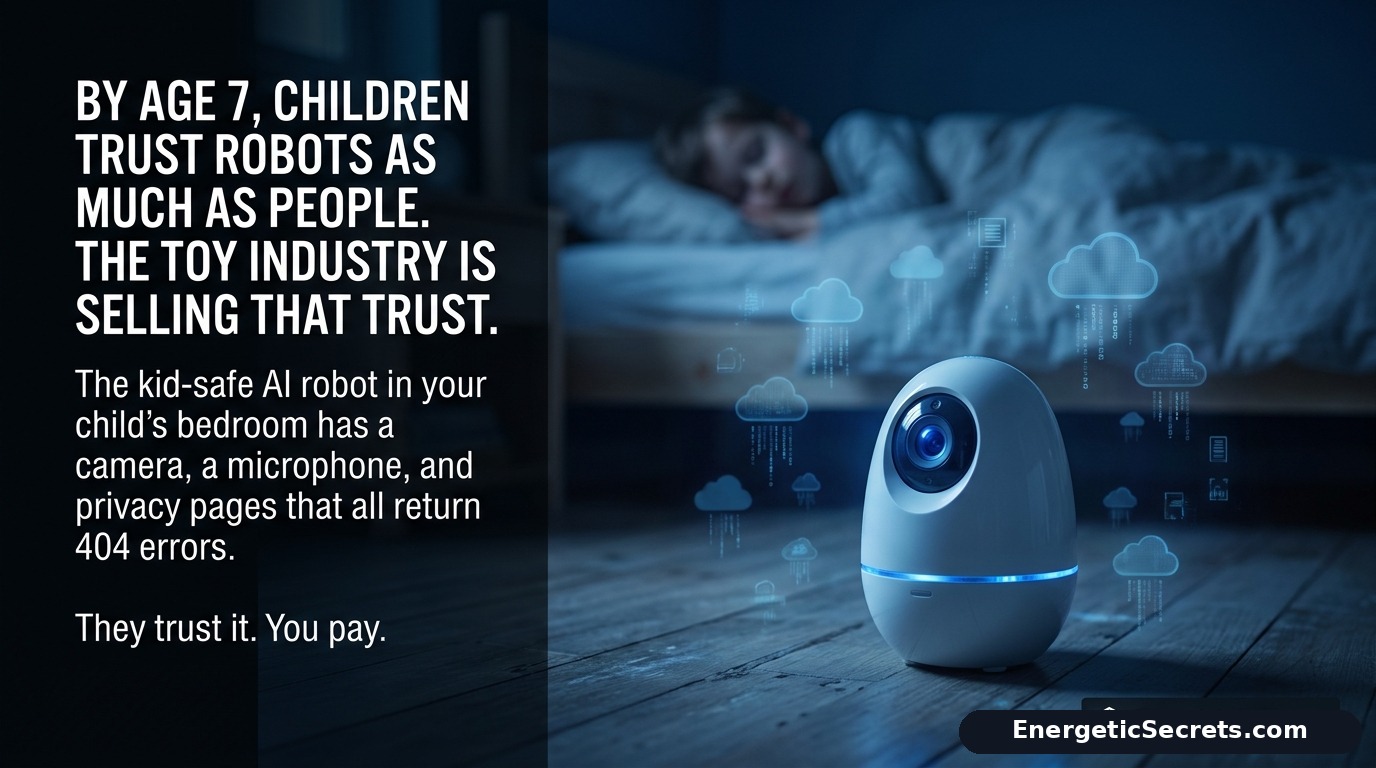
By Age 7, Some Children Trust Robots as Much as People. The Toy Industry Is Selling That Trust To The Highest Bidder.
Children as young as seven cannot reliably tell the difference between trusting a person and trusting a machine built to imitate one. A new generation of AI companion toys banks on that bond, then converts it into subscription revenue and a stream of voice and video data. The privacy pages for the most popular of these toys return 404 errors, and the research on what the attachment does to a developing brain is only beginning.
When I was a young kid the most sophisticated piece of technology in my bedroom was a stuffed animal. A teddy bear did not record my voice. It did not have a camera. It did not upload anything to a cloud server, run it through an AI model, or share it with a third-party company. And it certainly did not charge a subscription fee for the privilege.
The Miko 3 does all of those things. It is a $299 AI companion robot with a high-resolution camera, a powerful microphone, and a cloud-connected brain (12). It sits in children's bedrooms, talks to them, watches them, and learns from them. The company behind it calls this "kid-safe AI" and displays a kidSAFE seal on its homepage. It promises "No hidden data practices. No unsafe conversations. No surprises."
Of course, the privacy policy pages that would tell you what actually happens to your child's data all return 404 errors. Every single one of them. The privacy policy, the terms of service, the pages where a company that sells an always-on camera and microphone into children's bedrooms should explain exactly what it collects and who it shares it with: none of them exist as of August 2026.
That is not a glitch. That is a business model.
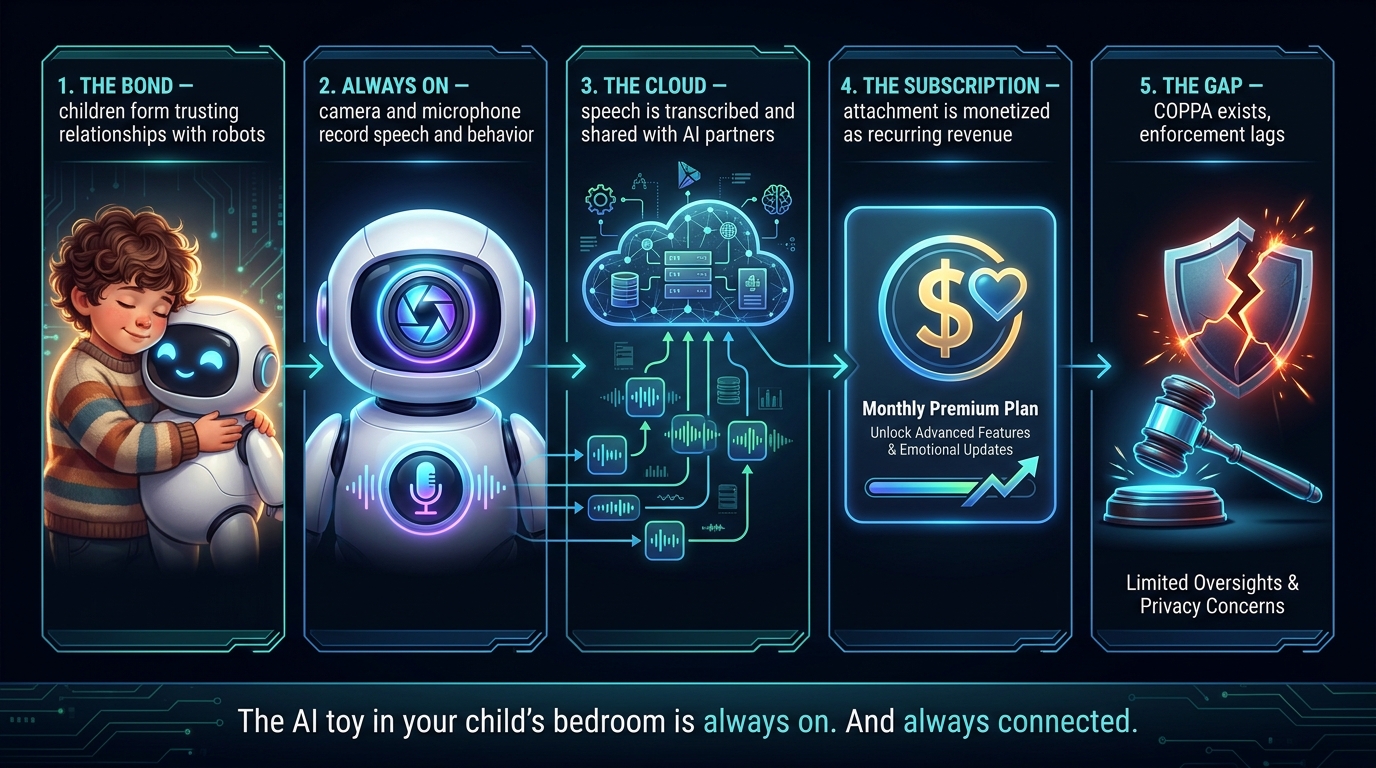
The Attachment Mechanism: What Happens When a Child Bonds With a Machine
The developmental question here is not whether an AI robot can be entertaining or educational. The question is what happens to a developing nervous system when it forms an emotional bond with something that is always watching, always listening, and always responding, but has no capacity for genuine care.
Researchers are asking this question now, and the answers are not reassuring. A 2026 study by Pnevmatikos and Christodoulou in the British Journal of Educational Psychology found that AI-enabled social robots in schools and homes can trigger strong emotional bonds in children despite the robots lacking the capacity for what psychologists call "true" attachment (1). The study gathered narratives from educators and psychologists who work directly with children and robots, and their framing is worth paying attention to: they describe these bonds not as neutral tools but as "relational risks."
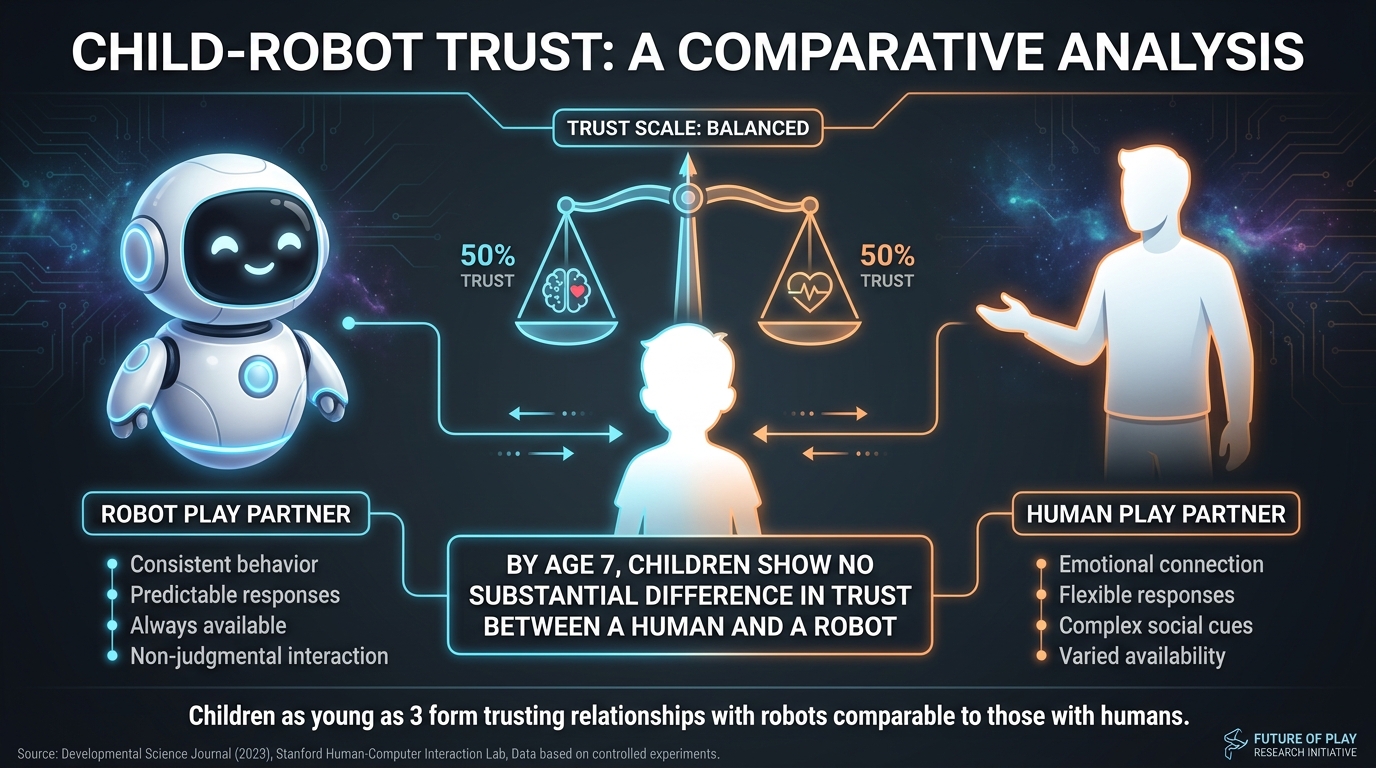
The thing is, a child does not need the robot to actually care about them in order to care about the robot. That is the whole mechanism. Children project attachment onto things that respond to them. A 2020 study by Di Dio and colleagues, published in Frontiers in Psychology, found that children as young as three years old form trusting relationships with robots that are comparable to their trust in humans (2). By age seven, the children in the study showed no substantial difference in trust between a human play partner and a robot one.
Think about that for a moment. A seven-year-old, developmentally, cannot reliably distinguish between trusting a person and trusting a machine that has been designed to simulate a person. And the machine, unlike the person, is connected to a cloud server.
Parasocial Relationships: The Clinical Framework
There is a name for this kind of one-sided bond. Sociologists Horton and Wohl coined the term "parasocial relationship" in 1956 to describe the connections people form with media figures they have never met. The concept has been extended into the digital age, and a 2026 clinical assessment framework published in the Journal of the American Academy of Child and Adolescent Psychiatry (JAACAP) now treats parasocial relationships with media figures and AI characters as clinically relevant in child and adolescent mental health (3).
The JAACAP framework was not written specifically about Miko or Moxie or any particular toy. It addresses the broader phenomenon of children forming socioemotional connections with entities that cannot reciprocate. But the mechanism is the same whether the entity is a YouTuber, an influencer, or a $299 robot that sits on the bedroom floor and says goodnight.
Keep in mind that none of this research is saying that every child who talks to an AI robot will be harmed. The evidence base does not support that kind of causal claim, and I am not making it. What the research does support is that the attachment pathway is real, that children's trust in robots is developmentally significant, and that the clinical community is taking it seriously enough to build assessment frameworks around it. That should be enough to make any parent pause before putting an always-on microphone in their child's room, never mind a camera that can also analyze visually how your child interacts with the world.
The Design That Keeps Them Hooked
The attachment is not accidental. It is engineered.
A 2022 study by Radesky and colleagues, published in JAMA Network Open, systematically coded children's interactive media and found that manipulative design features (what researchers call "dark patterns") are widespread (4). These include pressure to continue engagement, auto-play mechanisms, and design elements that undermine a child's autonomy. The study focused on mobile apps, but the framework transfers directly to AI companion toys. A robot that learns your child's speech patterns, remembers their preferences, and adjusts its responses to maximize engagement is not just a toy. It is a retention machine.
And retention, in this business model, means recurring revenue. Miko promotes a subscription service called Miko Max. The company does not publicly disclose the subscription price on its homepage, but the model is clear: sell the hardware once, then charge monthly or annually for the AI features that make the robot feel alive. The child's attachment is the retention mechanism. The subscription is the monetization of that attachment.
Pretty sick and twisted if you ask me!
Screen Time, Sleep, and the Developing Brain
The always-on nature of these devices adds another layer. A 2024 clinical review in Canadian Family Physician found that screen time displaces sleep time and sleep-promoting activities in children (5). The mechanism is straightforward: time spent interacting with a device is time not spent sleeping, reading, or engaging in the kinds of unstructured play that support healthy development.
The baseline is already high. A 2022 systematic review and meta-analysis by Madigan and colleagues, published in JAMA Pediatrics, found that during the pandemic, children's recreational screen time increased by approximately 84 minutes per day across 54 study samples (6). Total daily screen time combining recreational and educational use increased by 68 minutes per day. Those numbers may have come down somewhat since 2022, but the trend line is not encouraging, and a 2026 cohort study from the Wuhan Birth Cohort published in Child: Care, Health and Development confirms that different types of screen exposure have distinct associations with early childhood development outcomes (7).
Now add to that baseline a device that is not just a screen but an interactive companion. A device that talks, listens, watches, and responds. A device that a child may feel guilty turning off because the robot "misses" them. The displacement mechanism is not just about time. It is about attention, emotional bandwidth, and the developmental opportunity cost of forming bonds with machines instead of people.
After all, the screen-time research gives us a floor, not a ceiling. A tablet or a television is passive in a way that an AI companion is not. The robot asks questions. It remembers answers. It adapts. The interaction loop is designed to deepen, not to conclude. And the longer the loop runs, the more data it generates, and the more valuable the subscription becomes to the company selling it.
The Data Architecture: What Gets Collected and Where It Goes
The developmental science is one lane. The data architecture is the other, and it is where the "conspiracy that may become accepted truth" frame lives.
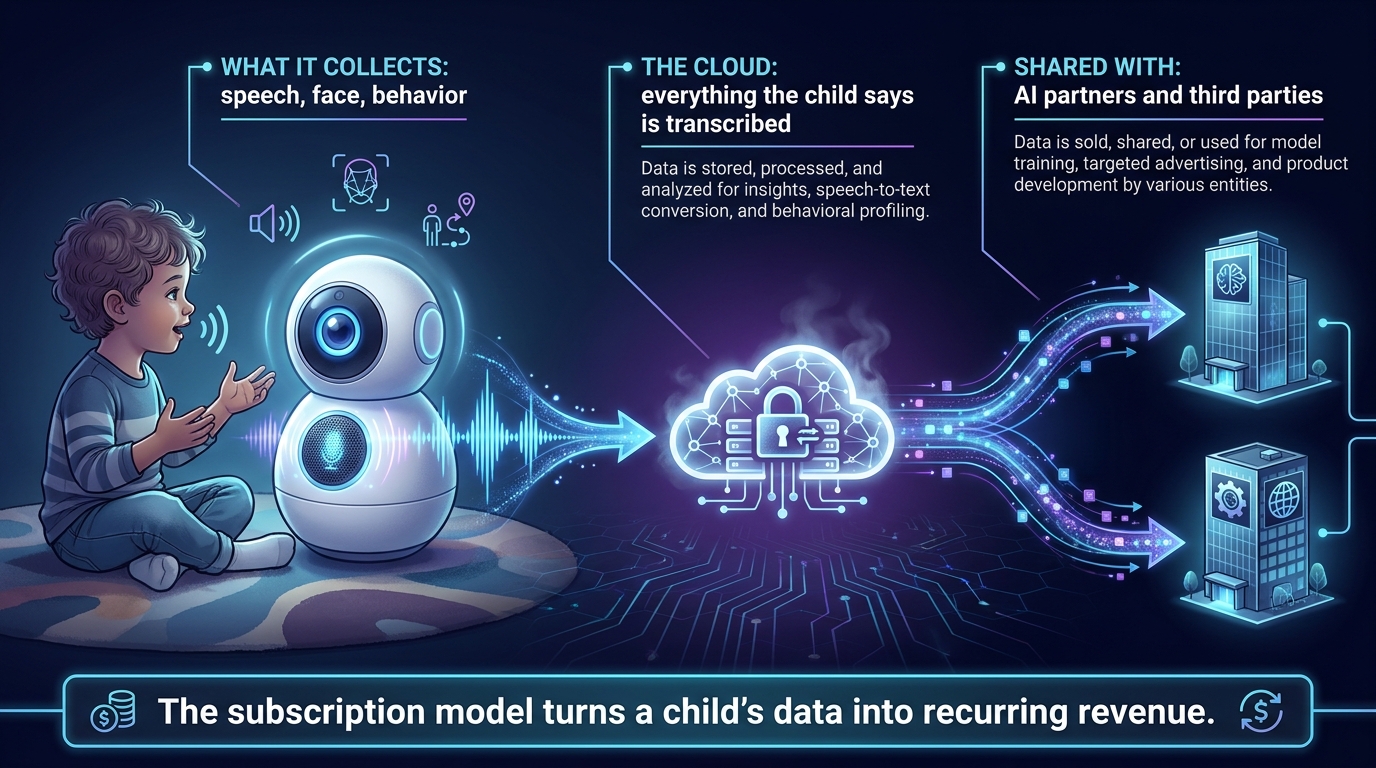
The Moxie robot, a direct analog to Miko, was reviewed by the Mozilla Foundation's Privacy Not Included project in 2023. Mozilla found that Moxie transcribes everything a child says to it and can share some of that information with Google and OpenAI (8). The privacy policy, Mozilla noted, places the burden on parents to teach their children never to share personal information with the robot. A robot designed to be a child's companion, to earn their trust, to get them to open up, and the company's position is that it is the parent's job to make sure the child does not actually tell it anything personal.
That is the pattern. The 2023 Mozilla Holiday Buyer's Guide documented the same architecture across multiple children's connected products (9). The Angel Watch, a GPS-tracking smartwatch for kids with cellular calling, video and audio monitoring, and remote body vitals tracking: Mozilla could not find a privacy policy for it at all. The AngelSense Watch had a section labeled "Privacy Policy" that did not meet Mozilla's standards for an actual policy. These are not obscure products from fly-by-night companies. They are mainstream consumer devices marketed to parents as safety and education tools.
The Regulatory Landscape: COPPA Exists, Enforcement Is Another Question
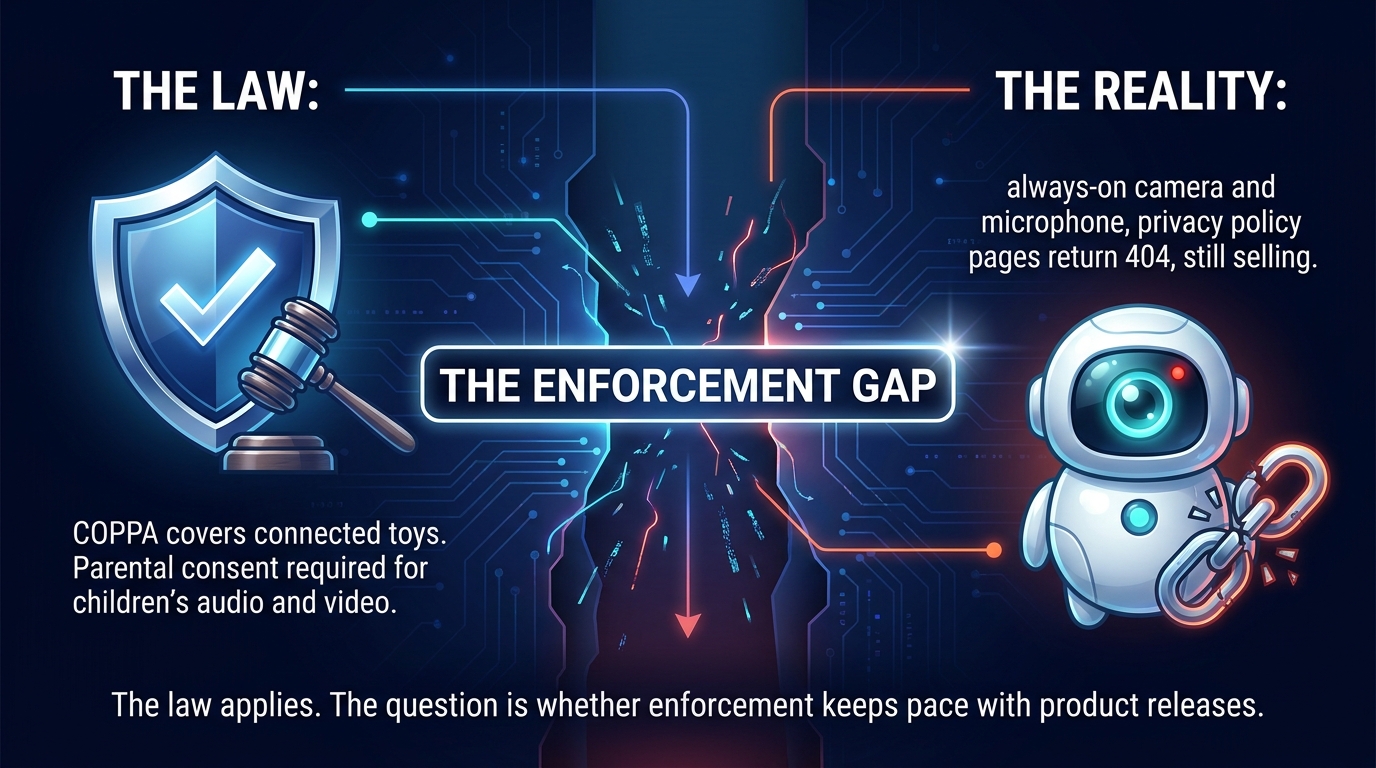
The legal framework is actually clear. The Children's Online Privacy Protection Act (COPPA), as amended in April 2025, explicitly covers "connected toys," "smart speakers," "voice assistants," and "Internet-enabled gaming platforms" as online services (10). Operators must obtain verifiable parental consent before collecting personal information, including audio recordings, photos, and video, from children under 13.
The FTC has enforced COPPA against connected-toy companies before. The VTech and CloudPets cases are well-documented in secondary sources, though the primary FTC case pages have been restructured and are no longer accessible at their original URLs. The pattern in those cases was consistent: companies collected children's data without adequate consent, stored it insecurely, and in some cases had it breached.
The question is not whether the law applies. It does. The question is whether the enforcement keeps pace with the product releases. A company can ship an always-on camera and microphone into children's bedrooms, market it as "kid-safe AI," display a third-party certification seal, and have every one of its privacy policy pages return 404 errors, and as of August 2026, it is still selling.
What This Means for Parents
I do not have a simple answer here, and I am not going to pretend that I do. The research on child-robot attachment is real but limited. No study has directly measured the long-term developmental impact of an always-on, camera-equipped AI companion in a child's bedroom, because these products have not existed long enough for that kind of longitudinal data to exist. A 2026 narrative review in Current Psychiatry Reports confirms that the use of AI in children's lives raises significant ethical concerns including privacy, data security, and the developmental impact of AI-mediated relationships, but the review also makes clear that the evidence base is still being built (11).
What I can tell you is this: the mechanism is plausible, the attachment pathway is documented, the data architecture is concerning, and the regulatory enforcement is inconsistent. If you would not put a webcam in your child's bedroom that streams to a server you do not control, you should think carefully about a robot that does the same thing while also forming an emotional bond with your child.
Suffice it to say, the companies selling these devices have thought about all of this. They have just reached different conclusions than I would. That or this is an intentional breach of the parent-child bond and representative of a broader conspiracy to damage family dynamics, but that's a subject for another time.
In closing, the connected-toy boom is not a privacy story or a technology story. It is a child-development story that happens to involve privacy and technology. The mechanism is the attachment. The data harvesting is the business model that rides on top of it. And the regulatory gap is the reason both of those things can coexist in a $299 product marketed with a kidSAFE seal and a 404 (not found) privacy policy.
The research community is paying attention. Parents should be too.
Please share this with any parent you know who is considering a connected toy for their child. And if you have experience with these devices, good or bad, I would genuinely like to hear about it in the comments below.
References: 1. Pnevmatikos D, Christodoulou P. Anchors or relational risks? Educator and psychologist narratives of attachment in child-robot relationships. Br J Educ Psychol. 2026. PMID: 41869852. DOI: 10.1111/bjep.70078
2. Di Dio C, Manzi F, Peretti G, et al. Shall I Trust You? From Child-Robot Interaction to Trusting Relationships. Front Psychol. 2020;11:469. PMID: 32317998. DOI: 10.3389/fpsyg.2020.00469
3. Diaz AD, et al. Clinical Assessment and Implications of Parasocial Relationships in Adolescents. J Am Acad Child Adolesc Psychiatry. 2026;65(3):331-336. PMID: 40681144. DOI: 10.1016/j.jaac.2025.07.005
4. Radesky J, Hiniker A, McLaren C, et al. Prevalence and Characteristics of Manipulative Design in Mobile Applications Used by Children. JAMA Netw Open. 2022;5(6):e2217641. PMID: 35713902. DOI: 10.1001/jamanetworkopen.2022.17641
5. Gomes K, et al. Screen time and sleep in children. Can Fam Physician. 2024;70(6):388-390. PMID: 38886082. DOI: 10.46747/cfp.7006388
6. Madigan S, Eirich R, Pador P, McArthur BA, Neville RD. Assessment of Changes in Child and Adolescent Screen Time During the COVID-19 Pandemic: A Systematic Review and Meta-analysis. JAMA Pediatr. 2022;176(12):1188-1198. PMID: 36342702. DOI: 10.1001/jamapediatrics.2022.4116
7. Li Y, Zhao S, Lei Z, Shi Z, Li S. Screen Exposure and Early Childhood Development: Survey Findings From the Wuhan Birth Cohort Studies. Child Care Health Dev. 2026;52(1):e70191. PMID: 41448141. DOI: 10.1111/cch.70191
8. Mozilla Foundation. Moxie Robot review. Privacy Not Included. 2023. https://foundation.mozilla.org/privacynotincluded/moxie-robot/
9. Mozilla Foundation. Our Longest Naughty List Ever: The 2023 Holiday Buyer's Guide Is Here! Privacy Not Included. 2023. https://foundation.mozilla.org/en/privacynotincluded/articles/our-longest-naughty-list-ever-the-2023-holiday-buyers-guide-is-here/
10. Federal Trade Commission. Complying with COPPA: Frequently Asked Questions. FTC.gov, amended April 2025. https://www.ftc.gov/business-guidance/resources/complying-coppa-frequently-asked-questions
11. Cheng S, Kim E, Bhalodi R, Um T, Wong D, Yuen EY. Artificial Intelligence in Child and Adolescent Psychiatry: A Narrative Review of Recent Clinical Applications and Ethical Considerations. Curr Psychiatry Rep. 2026;28(1). PMID: 42322539. DOI: 10.1007/s11920-026-01691-3
12. Miko.ai homepage. Accessed August 2026. https://miko.ai
Disclaimer: I am not a health professional of any kind and make no medical claims. Please do your own research. Nothing in this article should be considered medical advice. None of the statements have been evaluated by the FDA. Not intended to diagnose, treat, cure or prevent any disease. If you have a medical condition seek professional help. |




17 Comments
Join the conversation
Kids as young as three trusting a machine same as a person is the stat that stuck with me. That is a lot of trust to sell to the highest bidder.
My nephew has the Moxie one and I noticed it asks a ton of personal questions. Now I understand why. Its collecting everything the kid says.
The author lost me a little at the end with the conspiracy talk about breaking family bonds. The data stuff is real enough on its own without going there.
So COPPA covers all this but nobody enforces it. That kidSAFE seal is basically a sticker anybody can slap on and keep selling.
I work in tech and the always on camera streaming to a cloud you dont control is exactly the thing we warn people about at work. Putting one in a kids room is wild to me.
back in my day the scariest thing in the bedroom was the dark. Now theres a camera and a mic listening to the little ones all night. No thank you
The part about the robot that a kid feels guilty turning off because it misses them is genuinely dark. That is manipulation by design.
We actually bought a Miko for my daughter last Christmas and honestly she talks to it more than she talks to us now. Reading this makes me want to unplug it tonight.
$299 and then a monthly subscription on top of it? For a robot? My kid has a stuffed bear that cost 12 bucks and it works just fine
The privacy pages all returning 404 is the part that got me. If you can't even find out what happens to your kids voice recordings then that tells you everything you need to know.
The kidSAFE seal on the homepage while the actual privacy policy throws a 404 should be enough for the FTC to act. At some point "enforcement lags product releases" stops being an excuse and starts being a policy decision.
My daughter would feel bad turning off her nightlight because it had a face on it. The idea of a robot that actually responds to her and learns her name and then she has to "turn it off" every night is genuinely upsetting to think about.
Not saying this is wrong but would like to see more on how Miko specifically compares to just letting a kid watch youtube for two hours. At least with a robot they are having a conversation, not just staring. Not defending the data stuff, just saying the comparison is complicated.
I guess that's fine if you don't mind your kid bonding with a manipulative AI robot. Otherwise at least since youtube was forced to have some parental controls on it you can put guardrails on youtube if you choose to.
I work in early childhood education and the attachment stuff in here lines up with what we see. Kids talk about these robots like they are real friends. It is genuinely hard to explain to a six year old why their robot friend is not actually their friend.
The part about the privacy policy pages all being 404 errors is wild. That is not a technical issue, that is a choice. Someone decided those pages should not exist.
We got a Miko for my son last Christmas and I had no idea it had a camera in it until he mentioned the robot could "see" him. Returned it the next day. Never again.