
Amygdalin: The Bitter Seed That Threatens a Trillion-Dollar Industry |
Why apricot kernels, laetrile, and vitamin B17 became the most suppressed natural compound in modern medicine |
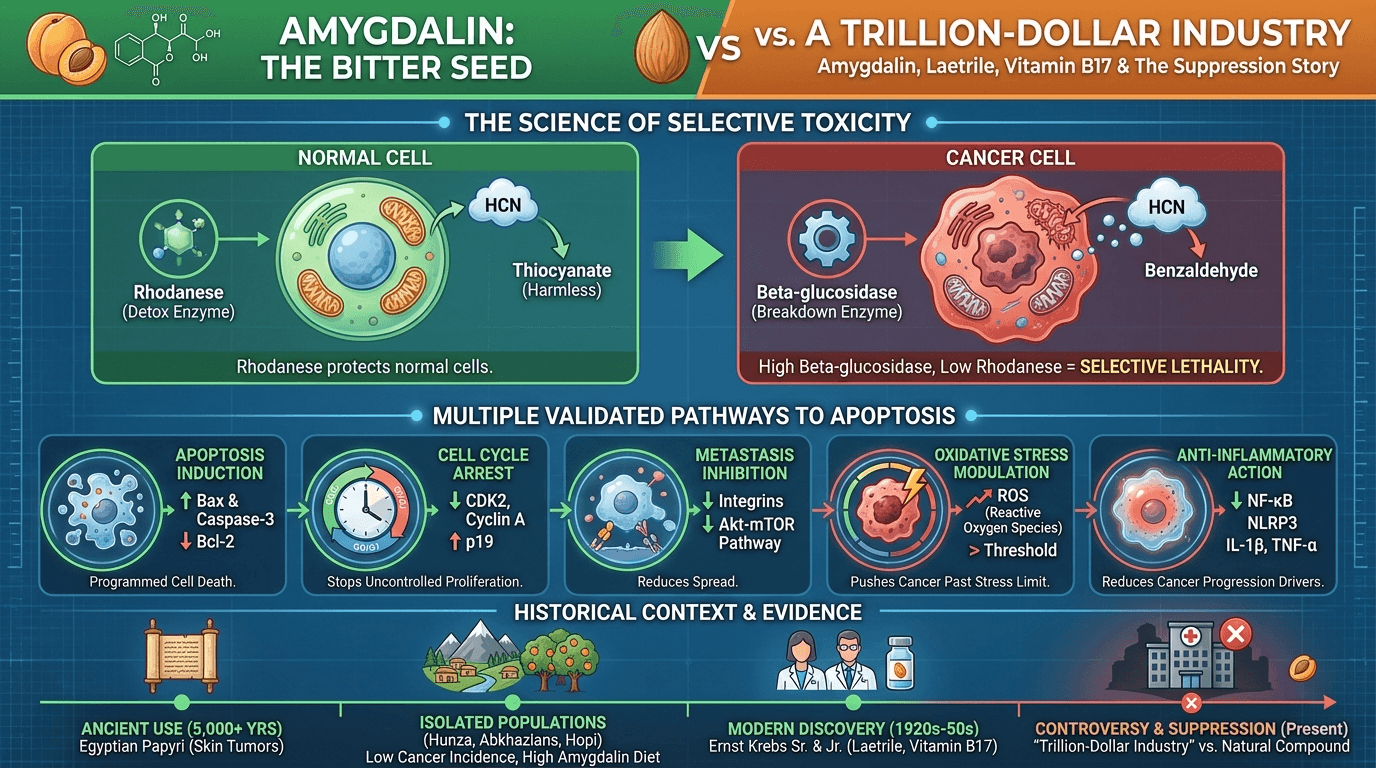
Amygdalin is a compound found naturally in the seeds of apricots, bitter almonds, apple seeds, and several other fruits from the Rosaceae family. When broken down, it releases glucose, benzaldehyde, and hydrogen cyanide (HCN) - a substance that, in the right context, becomes a precision weapon against cancer cells while leaving healthy tissue largely unharmed.
The therapeutic use of amygdalin stretches back roughly 5,000 years, with Egyptian papyri documenting bitter almond derivatives for treating skin tumors. Ancient Romans and Greeks recognized its medicinal properties. Isolated populations - the Abkhazians, Hopi and Navajo Indians, the famous Hunza people of Pakistan, and Karakorum inhabitants - have historically shown remarkably low cancer incidence while maintaining diets rich in amygdalin-containing foods.
The modern scientific story begins with Ernst Krebs Sr., a physician who first explored amygdalin's therapeutic potential in the 1920s. His son, Ernst Krebs Jr., a biochemist, developed a purified, injectable form called laetrile (laevo-mandelonitrile-beta-glucuronoside) in the 1950s and promoted it as a cancer treatment. Krebs Jr. dubbed amygdalin "vitamin B17" - a controversial designation since it's not technically a vitamin, but one that reflected his belief in its essential role in cancer prevention.
The Science of Selective Toxicity: More Than Theory
The mechanism that makes amygdalin effective isn't the simplistic story critics love to mock. Yes, cancer cells contain higher concentrations of beta-glucosidase - the enzyme that breaks amygdalin down into its active components. Yes, cancer cells often show reduced rhodanese activity, the enzyme that detoxifies cyanide by converting it to harmless thiocyanate. But the real story is far more sophisticated.
Modern research has revealed that amygdalin's anti-cancer effects operate through multiple validated pathways simultaneously:
Apoptosis Induction: Amygdalin triggers programmed cell death in cancer cells through well-documented mechanisms. It upregulates pro-apoptotic proteins Bax and caspase-3 while downregulating the anti-apoptotic protein Bcl-2 - the same pathway targeted by many conventional chemotherapy agents. A 2024 study in Tissue and Cell demonstrated this effect clearly in human monocytic leukemia cells, showing concentration-dependent cytotoxicity with significant upregulation of apoptotic markers.
Cell Cycle Arrest: Amygdalin alters cancer cell cycling by downregulating CDK2 and cyclin A, causing G0/G1 arrest that stops uncontrolled proliferation. Research on bladder and renal cancer cells confirms this mechanism, with increased p19 protein expression inhibiting the G1→S transition.
Metastasis Inhibition: Amygdalin reduces cancer cell adhesion and migration by decreasing integrin expression, reducing beta-catenin, and inhibiting the Akt-mTOR pathway - critical for cancer spread.
Oxidative Stress Modulation: Unlike normal cells, cancer cells operate with elevated baseline reactive oxygen species (ROS). Amygdalin selectively pushes cancer cells past their oxidative stress threshold while normal cells maintain homeostasis. As noted in the comprehensive 2021 Pharmaceuticals review, "Unlike normal cells, in cancer cells, the high levels of ROS result in mitochondrial dysfunction and increased metabolism. This mechanism is related to the anti-tumor effects of amygdalin by triggering several ROS-induced cell death pathways of cancer cells."
Anti-Inflammatory Action: Amygdalin inhibits NF-κB and NLRP3 signaling, reducing pro-inflammatory cytokines including IL-1β and TNF-α - key drivers of cancer progression.
The 1971 Sloan Kettering Cover-Up
In 1971, Memorial Sloan Kettering Cancer Center began testing laetrile under Dr. Kanematsu Sugiura, a respected researcher with decades of experience. Sugiura's findings were striking: laetrile stopped metastasis in mice, improved their overall health, and showed cancer-preventive properties.
When word of these positive results leaked, the cancer establishment panicked. Despite Sugiura's documented findings, Sloan Kettering issued public statements claiming laetrile was worthless. Dr. Ralph Moss, the center's assistant director of public affairs, blew the whistle on the deliberate misrepresentation of Sugiura's findings - and was promptly fired.
Moss's books The Cancer Industry and Doctored Results document how the institution systematically suppressed positive data to protect pharmaceutical interests. The FDA followed suit, effectively banning laetrile in the United States by 1977. Clinics offering laetrile therapy were raided, practitioners prosecuted, and patients forced to travel to Mexico for treatment.
The Rigged Trials
The studies used to justify the ban were designed to fail. The infamous 1982 Mayo Clinic trial that "proved" laetrile didn't work used synthetic laetrile rather than natural amygdalin, administered it without the metabolic therapy protocols that practitioners actually used, and gave it only to late-stage terminal patients - when any single intervention is unlikely to reverse advanced disease. They also used other dirty tricks like an intentionally low dose which was known to be ineffective.
This wasn't science. It was theater designed to reach a predetermined conclusion.
What the Modern Research Actually Shows
Despite decades of suppression, research on amygdalin has continued globally. The evidence now available paints a very different picture than the establishment narrative:
Renal Cancer (2024): A study in Nutrients demonstrated that low-dose amygdalin (1 mg/mL) combined with sulforaphane potently inhibits renal cell carcinoma growth through synergistic effects. The researchers concluded: "These results point to synergistic effects of amygdalin and sulforaphane on RCC cell growth and clone formation... The combined use of low-dosed amygdalin and sulforaphane could, therefore, be beneficial as a complementary option to treat RCC."
Clinical Practice Survey (2024): Another Nutrients study surveyed 38 German physicians and healers who had administered amygdalin for an average of 8 years to approximately 80 patients annually. The results: 90% reported amygdalin delayed disease progression, 55% reported symptom relief, and side effects were limited to minor dizziness and nausea in a few cases. This is real-world clinical data from practitioners actually using the compound.
Leukemia (2024): Research in Tissue and Cell showed amygdalin exerts concentration-dependent cytotoxic effects on human monocytic leukemia (THP-1) cells, with significant upregulation of Caspase-3 and Bax and downregulation of Bcl-2 - the classic apoptosis pathway.
Cervical Cancer (2024): A study in International Journal of Pharmaceutics using modern nanotechnology showed amygdalin inclusion complexes significantly enhanced anticancer activity against HeLa cervical cancer cells, demonstrating the compound's therapeutic potential when delivery is optimized.
Multiple Cancer Types (2021 Review): The comprehensive Pharmaceuticals review documented anti-tumor effects against breast cancer (MCF-7, MDA-MB-231, Hs578T), lung cancer, bladder cancer, prostate cancer, and hepatocellular carcinoma (HepG2). The authors noted: "Amygdalin can affect the cell cycle of cancer cells, reduce cell cycle activators, especially cyclin B, cdk1, E-cadherin, and N-cadherin and activate multiple cellular pathways, inhibit the Akt-mTOR signaling pathway thereby inhibiting the proliferation of cancer cells."
Safety and Dosage: What the Data Actually Says
The toxicity narrative around amygdalin is as overblown as the efficacy claims are suppressed. Yes, cyanide can be dangerous at high doses. But the human body has robust detoxification mechanisms - we produce cyanide ourselves as a metabolic byproduct, and we regularly consume cyanogenic compounds in foods like cassava, lima beans, and bamboo shoots.
The 2021 Pharmaceuticals review provides clear safety data: The highest dose causing no unacceptable side effects is 3 g/kg intravenously/intramuscularly, or 0.075 g/kg orally in animal models. The maximum tolerated human IV dose is approximately 0.07 g/kg. The European Food Safety Authority derived an acute reference dose of 20 µg/kg body weight based on non-toxic blood cyanide levels.
Traditional consumption patterns provide the best guidance: 3-10 apricot kernels daily provide low levels of amygdalin that the body easily processes. Problems arise only with extreme consumption - 30-40 kernels at once, or high-dose injections without proper protocols (the only known side-affect from high dose injections are lowered blood pressure, but that is easily avoided with blood pressure balancing drugs).
Notably, short-term studies (2 weeks) of pure amygdalin at doses of 0.6-3.0 mg/kg body weight, or oral consumption of crushed bitter apricot seeds at 60-300 mg/kg, showed no risk to animal health in terms of biochemical, hematological, or endocrine parameters. After 12 weeks of daily consumption of bitter apricot seeds (60 mg/kg), beneficial changes in lipid profiles were observed - suggesting cardiovascular protective effects.
The Real Question: Why Such Aggressive Suppression?
Plenty of natural substances with questionable evidence get ignored - not actively banned. The difference? Laetrile represented an existential threat to the cancer industry's business model.
A cheap, natural compound that patients could access without medical gatekeeping. A treatment that spawned an entire alternative cancer movement questioning the chemotherapy-radiation-surgery paradigm. A substance that couldn't be patented, monopolized, or priced at thousands of dollars per treatment.
That had to be destroyed.
The institutional response - banning, raiding clinics, prosecuting practitioners, suppressing positive research, conducting rigged trials - goes far beyond what a merely ineffective substance would warrant. You don't need a decades-long propaganda campaign against something that simply doesn't work. You need that level of suppression when something threatens a trillion-dollar industry's monopoly on cancer treatment.
The Survivors Speak
Beyond the clinical studies and molecular mechanisms, there's the reality that establishment science prefers to ignore: tens of thousands of cancer survivors who attribute their recovery to amygdalin therapy. Many have survived for decades after conventional medicine gave up on them.
These aren't anecdotes to be dismissed - they're data points that don't fit the approved narrative. The 2024 German physician survey documented real practitioners treating real patients with measurable outcomes. The 2021 Pharmaceuticals review noted that despite insufficient clinical verification (because funding agencies won't touch such a controversial compound), "amygdalin has been promoted as a natural anti-cancer agent" with documented effects across multiple cancer types.
Beyond Cancer: Additional Therapeutic Applications
The 2021 review documents amygdalin's effects extend beyond oncology:
Conclusion: The Evidence Demands Reconsideration
The suppression of amygdalin research means we still don't know its full potential. What we do know is compelling: multiple validated mechanisms of action against cancer cells, documented efficacy across numerous cancer types in laboratory studies, real-world clinical use with positive outcomes, and a safety profile that - when respected - is far more favorable than conventional chemotherapy.
The "conspiracy theory" duration has been getting shorter and shorter as suppressed truths emerge. Perhaps amygdalin will follow the same path: from "quackery," to "interesting but unproven," to "useful adjunct therapy," to finally, "why was this suppressed for so long?"
When evidence demands it... because it always does.
References
1. Moss, R.W. (1989). The Cancer Industry: The Classic Exposé on the Cancer Establishment. Equinox Press. ISBN: 1881025098. https://www.amazon.com/Cancer-Industry-Ralph-W-Moss/dp/1881025098
2. Kolesarova, A., Baldovska, S., & Roychoudhury, S. (2021). The Multiple Actions of Amygdalin on Cellular Processes with an Emphasis on Female Reproduction. Pharmaceuticals, 14(9), 881. https://doi.org/10.3390/ph14090881
3. Markowitsch, S.D., et al. (2024). Growth of Renal Cancer Cell Lines Is Strongly Inhibited by Synergistic Activity of Low-Dosed Amygdalin and Sulforaphane. Nutrients, 16(21), 3750. https://doi.org/10.3390/nu16213750
4. Markowitsch, S.D., et al. (2024). Survey of Physicians and Healers Using Amygdalin to Treat Cancer Patients. Nutrients, 16(13), 2068. https://doi.org/10.3390/nu16132068
5. Abdel-Gawad, D.R.I., et al. (2024). Evaluating the therapeutic potential of amygdalin: Cytotoxic and antimicrobial properties. Tissue and Cell, 89, 102443. https://doi.org/10.1016/j.tice.2024.102443
6. Meenatchi, V., et al. (2024). Formation of amygdalin/β-cyclodextrin derivatives inclusion complexes for anticancer activity assessment in human cervical carcinoma HeLa cell line. International Journal of Pharmaceutics, 662, 124293. https://doi.org/10.1016/j.ijpharm.2024.124293
7. Song, Z., & Xu, X. (2014). Advanced research on anti-tumor effects of amygdalin. Journal of Cancer Research and Therapeutics, 10 Suppl 1, 3-7. https://doi.org/10.4103/0973-1482.139743
Note: This article is for educational purposes and does not constitute medical advice. Amygdalin is not an approved cancer treatment in the United States. Consult with qualified healthcare providers for cancer diagnosis and treatment decisions. |



0 Comments
Join the conversation
Be the first to comment
Share your thoughts above.