
Big Brother on Wheels: The Secret Network Tracking Your Every Drive |
A "free" camera offer, a subscription trap, and a national database that tracks every vehicle on American roads (with no warrant, no vote, and no way to opt out). |
Your License Plate Is a Product: How Flock Safety Built a Private Surveillance Network Without Asking Permission
In May 2025, the city of Eugene, Oregon installed Flock Safety cameras at key intersections around town. By October, the city council voted unanimously to turn them off. The reason? Residents and council members alike had discovered what the cameras were really doing: feeding a national database of automated license plate reader (ALPR) scans, a technology that photographs every passing vehicle's plate and logs its location and time, that any subscribing police department (or federal agency) could search without a warrant. [1]
Eugene is not alone. By June 2026, at least 53 municipalities across 20 states had terminated or rejected Flock contracts. [2] Yet the company's network keeps growing (crossing 100,000 cameras deployed nationwide, scanning more than 20 billion license plates per month). [2][1] The pattern raises a question that goes far beyond traffic cameras: when surveillance technology is sold as a "free" service, who is really paying the price?
For readers of HealthHarmonic, this story fits a familiar pattern. Surveillance capitalism (the business model that treats personal data as raw material for profit) does not stop at your search history or shopping habits. It now tracks where you drive, when you drive, and who you visit. And like so many technologies sold to the public as safety tools, the real threat is not the one advertised.
How Flock Safety's Business Model Works
Flock Safety does not sell cameras. It sells subscriptions. The hardware is offered at a steep discount (sometimes free) in exchange for a multi-year contract and, crucially, the data rights that come with it. [1] The numbers tell the story. Subscriptions run approximately $3,000 per camera per year. [1] Flock's annual recurring revenue hit $300 million in early 2025, growing roughly 70% year over year. [1] The company raised $275 million at a $7.5 billion valuation in March 2025, backed by Andreessen Horowitz, Founders Fund, Kleiner Perkins, and Tiger Global (a total of $658 million in venture funding).
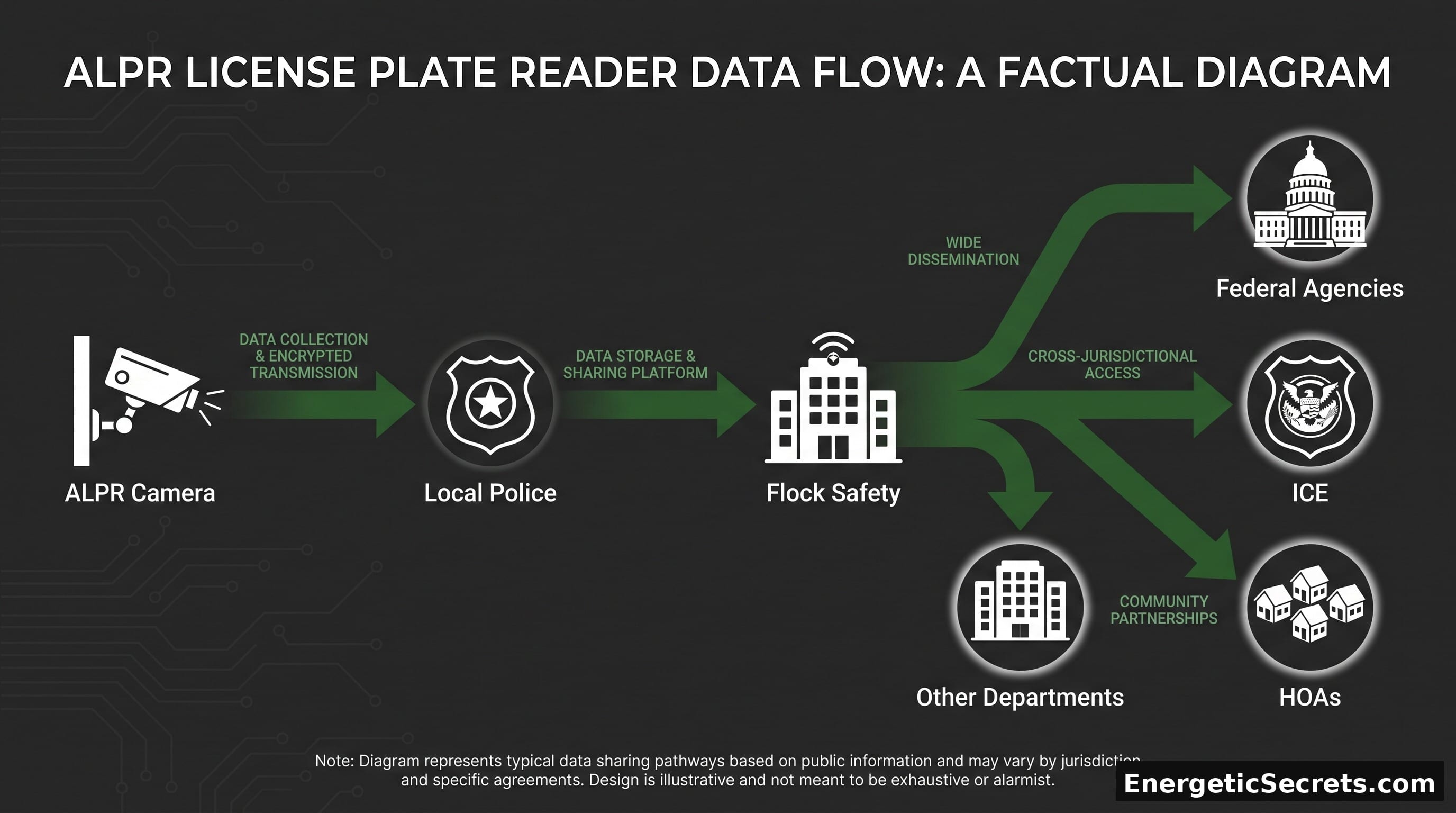
By April 2026, its internal valuation had climbed to $8.4 billion. [1] The pitch to police departments is simple: get cameras for almost nothing, solve more crimes, keep your community safe. But the fine print tells a different story. Flock's terms of service give the company the right to "create and sell public indexes, analysis, or insights" from the data its cameras collect. [3] And the "Enable National Lookup" checkbox (a single click in Flock's training interface) shares every plate read from a local department's cameras with every other agency in Flock's national network. [4]
This is the core of the model: local police departments provide the infrastructure and the legitimacy. Flock provides the network. And the data flows everywhere.
The Data-Sharing Network: A National Surveillance System Without a Law
When a Flock camera reads your license plate, that data does not stay local. It is uploaded (unencrypted, according to the ACLU of Oregon) to Flock's cloud servers, where it becomes part of a searchable national database. [1] Any of the 5,000-plus law enforcement agencies and 6,000-plus communities using Flock can query plates captured by any other agency's cameras. [1] The scale is staggering. A single query can reach 83,345 cameras across nearly the entire country. [5] In one documented case, a Texas sheriff's deputy searched the entire Flock network for a woman who had self-administered an abortion (logging the search reason as "had an abortion, search for female"). [6] The Johnson County Sheriff's Office initially claimed it was a missing person check; documents later showed deputies had initiated a "death investigation" of a "non-viable fetus" and consulted prosecutors about possible charges. [6] The woman was not charged, but the search had already happened (across tens of thousands of cameras, without a warrant).
The EFF obtained records of more than 12 million searches logged by 3,900 agencies between December 2024 and October 2025. [5] Hundreds of those searches were related to protest activity (including the 50501 movement, Hands Off protests, and No Kings demonstrations). [7] Tulsa Police Department alone logged at least 38 protest-related searches. [7] Border Patrol agents used Flock to monitor protest streets. [7]
Flock's standard agreement gives the company a "worldwide, perpetual, royalty-free right and license" to disclose agency data for "investigative purposes" (even if the local department has restricted its own officers from accessing it). [8] Senator Ron Wyden has conducted oversight inquiries into Flock's data-sharing practices. [8]
The Competitor Surge
When a community rejects Flock, the surveillance vacuum does not stay empty for long. A network of competitors (some larger, some more specialized) stands ready to fill the gap.
Motorola Solutions / Vigilant Solutions operates the largest commercial network of these license plate reader systems in the United States. Acquired by Motorola in January 2019, Vigilant's Law Enforcement Archival & Retrieval Network (LEARN) database stores billions of plate records aggregated from commercial sources (repo vehicles, parking enforcement, toll systems) and law enforcement feeds. [9] The data feeds into Palantir systems and Thomson Reuters CLEAR. ICE holds a $22.8 million contract for database access running through 2026. [9] In 2025, ICE placed a purchase order for four mobile ALPR units worth approximately $95,500 for its Enforcement and Removal Operations. [9]
Rekor Systems (NASDAQ: REKR) is a publicly traded company focused on roadway intelligence, traffic data collection, and license plate reading with AI analytics. [10] Rekor positions itself in the smart city and traffic management space (a framing that can bypass the surveillance debate entirely by calling its cameras "traffic sensors"). [10]
Axon / Fusus (the company best known for Tasers and body cameras) acquired Fusus, a real-time camera integration platform. Fusus unifies live video, license plate reader overlays, officer location, dispatch data, and 911 call context on a single live map. [11] Axon's "real-time crime center" model connects police, private cameras, and public cameras into one live feed (a direct competitor to Flock's approach). [11]
Haas Alert operates Safety Cloud, a connected-vehicle safety platform that delivers real-time digital alerts for roadside hazards and emergency response vehicles. [16] While not an ALPR or surveillance camera company, Haas Alert fills the adjacent "smart traffic" niche that overlaps with the infrastructure ecosystem Flock operates in.
The pattern is consistent: when one company faces public rejection, another quietly steps in (often with less public scrutiny, because the debate has already been exhausted).
When Communities Say No
The list of cities that have rejected or terminated Flock contracts is growing. By June 2026, at least 53 municipalities across 20 states had ended their relationships with the company. [2] The reasons are remarkably consistent: unauthorized federal access, misleading statements to city councils, and a business model that treats local surveillance data as a national asset.
In Dayton, Ohio, an audit found more than 7,000 immigration enforcement searches conducted through Flock cameras (despite a city policy explicitly banning such use). Workers bagged 72 cameras with trash bags after what officials called "egregious violations." [1] In Oshkosh, Wisconsin, Flock's Chief Information Security Officer told the city council that the system does not create "heat maps" showing vehicle locations over time. The next morning, the city learned this was false. The council revoked the contract the following day (making it, according to the ACLU, the shortest Flock contract on record: one day). [12]
In Loveland, Colorado, Police Chief Tim Doran raised concerns about federal access to Flock data. Flock told the city that federal agencies no longer had access (a claim contradicted by evidence). [12]
The LAPD let its three-year agreement with Flock expire in July 2026 over privacy and civil liberty concerns. [13] An audit of the department's 138 Flock cameras found 161 people falsely flagged as stolen vehicles. [14] Other jurisdictions that walked away include Mountain View, Santa Cruz, Santa Clara County, South Pasadena, Flagstaff, and Hillsborough, North Carolina. [13]
Yet even as cities cancel, Flock's network keeps growing (crossing 100,000 cameras in June 2026). [2] The company's 40% business from homeowners' associations means that even as municipal contracts shrink, the surveillance network expands through private communities. [1]
The Local Politics Problem
Surveillance technology does not arrive in a community by accident. It is sold (often directly to police chiefs or city managers who can sign contracts without a public vote).
Flock's playbook is well documented: a free trial offer, followed by integration into police workflows, followed by a contract renewal that is far harder to cancel than it was to accept. [3] In Oakland County, Michigan, officials voted 13-4 to accept a nine-month "free" drone trial that was structured to become a $2.5 million contract. [3] The company's acquisition of Aerodome (a drone company) for $300 million in October 2024 was, by Flock's own logic, about having more products to upsell to the same customers. [3] Once a police department is dependent on Flock's data for daily operations, canceling becomes politically difficult (even when the public objects). At least 30 cities discovered unauthorized federal access to their Flock data only after the cameras were already installed and the contracts signed. [3] By then, the data had already flowed into the national network.
EUGENE, OREGON: A Case Study
Eugene, Oregon represents one of the clearest examples of a community pushing back against Flock Safety (and one of the most instructive tests of whether rejection actually stops surveillance). In May 2025, Flock Safety cameras began operating in Eugene. [1] The city council voted unanimously on October 8, 2025 to turn them off "until further notice." [1] The ACLU of Oregon, which has tracked Flock's presence across the state (at least 15 police and sheriff departments in Oregon have active Flock contracts), confirmed the vote. [1]
The decision placed Eugene on a growing list of cities (including Evanston, Mountain View, Cambridge, Santa Cruz, and Flagstaff) that have canceled or deactivated Flock contracts. [15]
As of December 2025 it had been announced that the Eugene Police had canceled their contract with Flock. [18] Eugene, Oregon is still listed on DeFlock.org as a city which has terminated it's contract with Flock.
What happened next?
As of July 24, 2026, no verified public records confirm that a competitor license plate reader system (from Motorola/Vigilant Solutions, Rekor Systems, Axon/Fusus, or any other company) has been installed in Eugene following the Flock rejection. Searches of the Eugene Register-Guard (paywalled), OregonLive (paywalled), Oregon Public Broadcasting, and the Eugene city website did not return verifiable results for competitor ALPR deployment. [16]
This does not mean the threat has passed. The pattern seen in other communities (where surveillance companies quietly step in after a public rejection) means residents should stay vigilant. Public records requests to the Eugene Police Department, Lane County Sheriff's Office, and city council meeting minutes from October 2025 through July 2026 would provide a clearer picture.
What is known is that Eugene's Flock cameras were operating for five months before the council vote (from May to October 2025). [1] During that time, any plate data captured by those cameras was shared through Flock's national network, accessible to agencies across the country. The data cannot be un-shared.
What You Can Do
The Flock Safety story is not unique. Surveillance technology is being deployed in communities across the country (often without public knowledge, let alone public consent). But there are concrete steps residents can take.
File public records requests. Ask your local police department for copies of any license plate reader contracts, data-sharing agreements, and audit logs. The ACLU (American Civil Liberties Union) and EFF (Electronic Frontier Foundation) both provide template public records request letters for surveillance technology. [5][12]
Attend city council meetings. Surveillance contracts are often approved with minimal public discussion. Showing up (and speaking) makes a difference. The Eugene City Council vote shows that public pressure can work. Contact the ACLU and EFF. Both organizations track license plate reader deployment nationally and provide resources for local advocacy. The ACLU of Oregon's "Know Your Tech" campaign is a model for what local advocacy looks like. [1] Ask your city council to pass surveillance ordinances. Some cities have passed "surveillance technology ordinances" that require public hearings and council approval before any new surveillance tool can be purchased or deployed. These ordinances create the democratic oversight that Flock's business model is designed to bypass. Check your state laws. Some states have preemption laws that prevent local communities from banning license plate reader networks outright. Knowing your state's legal landscape is the first step in changing it. Use DeFlock to see and document the cameras around you. DeFlock is an open-source, volunteer-powered project that maps automated license plate readers across the United States using crowdsourced reports and OpenStreetMap data. Its searchable map helps residents identify known cameras near their homes, workplaces, and regular routes. It also gives people a practical way to contribute: if you find a camera that is not yet listed, you can help document it so the public record becomes harder to ignore. [17]
Conclusion
Flock Safety's rise (and the backlash against it) tells a story about how surveillance technology enters American life. Not through a national debate or a federal law, but through local contracts signed one police department at a time. A "free" camera here, a subscription fee there, and before anyone has fully debated the question, a national license plate database is operational (searchable by thousands of agencies, accessible to federal immigration enforcement, and governed by terms of service written by a private company).
The 53 cities that have said no prove that resistance is possible. But the 100,000 cameras still scanning 20 billion plates a month prove that resistance is not enough without structural change. When surveillance is sold as a product, privacy becomes a subscription (and the default is always opt-out).
For the HealthHarmonic reader, the lesson is the same one that emerges across so many stories of institutional overreach: the technology that tracks you was never designed with your consent in mind. It was designed to scale. The only question is whether the communities it tracks will demand a say before the next camera goes up. References
|
 |




7 Comments
Join the conversation
The Texas abortion search is what got me. A deputy searched tens of thousands of cameras across the whole country for a woman who self-administered an abortion, with no warrant, and just typed the reason right into the system. And she wasn't even charged. That data is just out there now. This is not a hypothetical privacy concern, it already happened.
Genuine question, does canceling the contract actually help at this point? The article says the data can't be un-shared. So Eugene canceled but everything those cameras captured for five months is still sitting in Flock's servers, still searchable by thousands of agencies. What's the actual remedy here?
One could argue that the totalitarian surveillance state relies on real time/ongoing collection of data so the more we can shut these things down (peacefully) the more we at least slow their agenda. It is important to understand however that "surveillance state" now is being defined by PRIVATE companies with government contracts doing things that are technically a violation of our Constitution.
I work in local government and the free trial to locked-in contract pipeline is very real and very common, not just with Flock. A department head accepts a trial, staff get trained on it, it gets baked into daily workflow, and then when the real contract comes up for a vote it's almost impossible to say no because everyone is already depending on it. It's a deliberate strategy.
ok but 40% of their business is HOAs now. so even if every city in the country cancelled tomorrow the cameras would still be everywhere because your neighbor's gated community signed up. thats the part nobody is talking about enough
The Oshkosh story is wild to me. Their security officer looked a city council in the face and said it doesn't track heat maps, and the very next morning they found out that was a lie. One day contract, shortest on record apparently. Good. Companies that lie to elected officials to get contracts shouldn't get second chances.
I live in Eugene and had no idea these cameras were even installed until after the council voted to shut them off. Five months of my plates being scanned and uploaded to some national database I never agreed to. Really glad the council acted but the damage is already done, that data doesn't just disappear.