
Bioelectricity: The Body's Hidden Code That Medicine Ignores |
Your cells run on voltage - and cracking that code is rewriting how we heal |
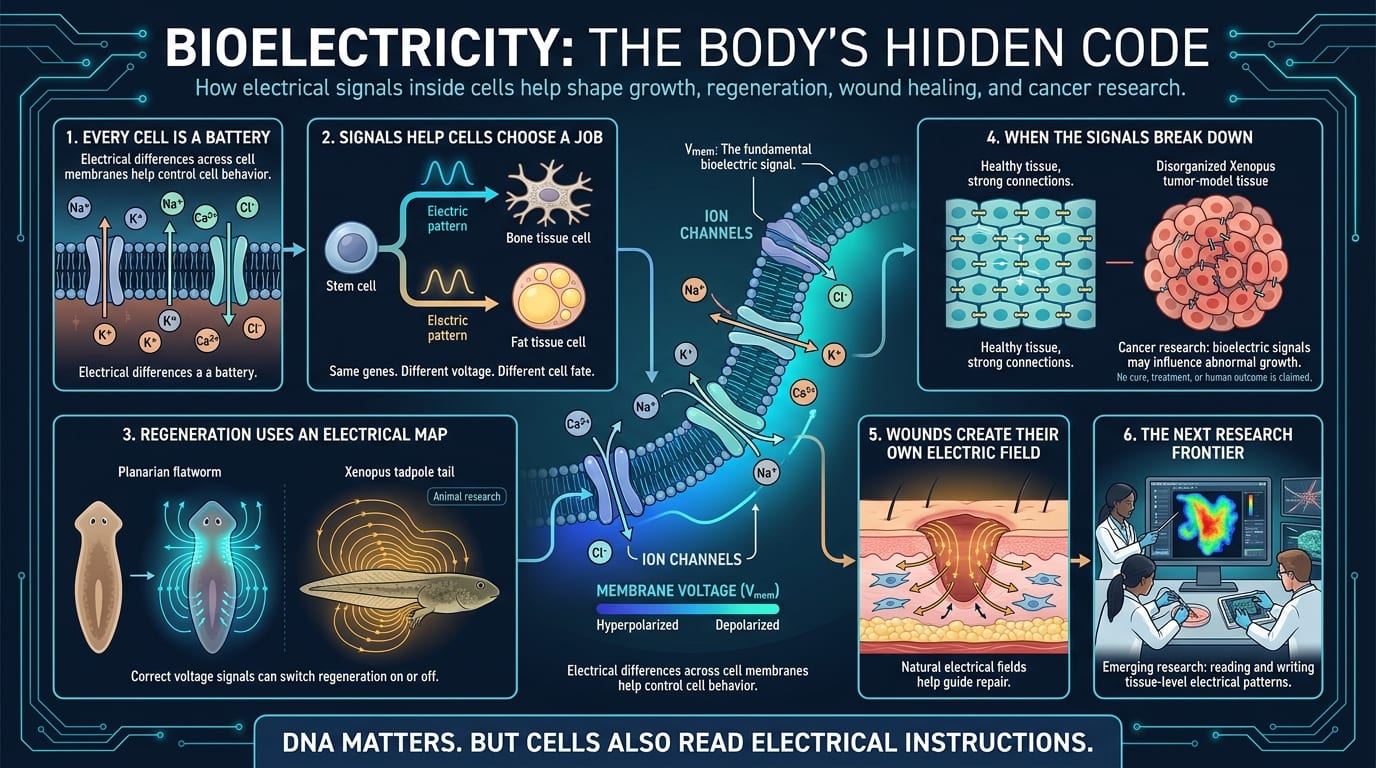
Every cell in your body is a battery. The membrane that surrounds it maintains a voltage difference between the inside and the outside (a resting potential, or Vmem) that is as fundamental to life as DNA.
This voltage is not a passive byproduct of metabolism. It is an active, dynamic signal that tells cells what to become, where to grow, and when to stop.
So while you may have heard that healthy cells have a -90 mV charge it is actually much more dynamic than that with different cells at different voltages.
The same electrical gradient that determines whether a stem cell turns into bone or fat also guides the regeneration of a severed tail in a frog tadpole, patterns the development of an eye in a frog embryo, and may hold the key to understanding why cancer cells grow uncontrollably.
This is the field of developmental bioelectricity, and it represents a layer of biology that mainstream medicine has largely overlooked.
One of the first scientists to recognize the importance of the body's electrical systems was Robert O. Becker, a pioneer in the field of regeneration and its relationship to electrical currents in living things.
In his landmark book The Body Electric (1985, with Gary Selden), Becker explored the theory that electricity is vital to life and healing - a concept that had been largely discarded by mainstream medicine. He performed experiments with salamanders (and newts) who can regenerate limb and proved the process which they achieved this related to bioelectric charge.
He followed this with Cross Currents (1990), which examined both the healing potential of electromagnetic medicine and the dangers of electromagnetic pollution. Becker's work laid important groundwork for the modern field of developmental bioelectricity.
The Battery Inside Every Cell
To understand bioelectricity, start with the cell membrane. It is a thin lipid bilayer that acts as both a barrier and a capacitor, storing electrical charge like a microscopic battery. Ion channels embedded in the membrane act as gates, opening and closing to allow charged particles (sodium, potassium, calcium, chloride) to flow in and out.
The difference in ion concentration between the inside and outside of the cell creates a voltage gradient across the membrane, typically between -10 and -90 millivolts depending on the cell type (1).
This voltage is the cell's resting potential, and it is not a fixed number. A neuron might sit at -70 mV, a muscle cell at -90 mV, and an embryonic stem cell at a very different voltage entirely. These differences are not random. They correspond to what the cell is doing and what it is about to become.
This voltage is not static. Cells change their Vmem dynamically in response to signals from their environment, from neighboring cells, and from the body as a whole.
Gap junctions, protein channels that directly connect the interiors of adjacent cells, allow these voltage signals to propagate across entire tissues, creating what researchers call bioelectric networks (2). These networks function as a primitive, pre-neural communication system that coordinates cell behavior at the tissue and organ level.
The key insight is that Vmem is not merely a readout of cellular health. It is an instructive signal. Changes in resting potential directly control whether a cell divides, differentiates, migrates, or dies (1). This means the electrical state of a cell is not a consequence of its genetic program; it is a regulator of it. Bye bye eugenics and hello bioelectricity and epigenetics!
The Software of Life
Michael Levin is the biologist who has done more than anyone to build this field. He thinks of bioelectric networks - the tiny electrical signals that cells use to communicate - as a kind of software that runs the body's hardware. In a 2025 paper, he argues that these electrical signals give scientists a powerful way to control how organs grow and repair themselves (13).
This idea is not just a clever comparison. Over the past twenty years, Levin's lab at Tufts University has run experiment after experiment showing that changing a cell's voltage can change what that cell becomes - even when its DNA stays the same.
In one famous study, researchers showed that the voltage of a stem cell directly decides whether it turns into a fat cell or a bone cell (4). Same cell. Same genes. Different voltage, different result. In another study, they showed that voltage controls how an eye forms in a frog embryo (15).
What does this mean? It means your DNA is not a complete blueprint for your body. Yes, your genes matter. But the instructions that tell a group of cells to build an arm instead of a liver are written, at least in part, in the electrical signals that cells send to each other. This takes epigenetics to the next level!
Regrowing What Was Lost
Perhaps the most dramatic demonstrations of bioelectric control come from regeneration research. As noted in the Becker work some animals can regrow entire body parts after injury.
Planarian flatworms, for example, can regenerate a complete head and brain after being cut in half. This is something parasitologists likely rave about.
In 2011, researchers showed that this ability depends on a specific ion pump (H,K-ATPase) that generates the correct membrane voltage required for head regeneration (5). Block the pump, and the worm cannot regrow its head. Restore the voltage, and regeneration proceeds normally.
Maybe this was one of the mechanism Hulda Clark and other researchers were stumbling upon when using frequencies to kill parasites?
The same principle applies in vertebrates. In Xenopus frog tadpoles, a V-ATPase proton pump that changes the membrane voltage is both necessary and sufficient for tail regeneration. When researchers blocked the pump, regeneration failed. When they artificially induced the same voltage change in a non-regenerating tadpole, the tail grew back (6). This was the first demonstration that a specific bioelectric signal could be both required and sufficient to trigger vertebrate regeneration.
Even more striking: as Xenopus tadpoles age, they lose the ability to regenerate. In a 2013 study, Levin's team used optogenetics (light-activated ion pumps) to restore the correct membrane voltage in aged tadpoles. The result was a reversal of age-related regenerative decline in that model (7). Tadpoles that should have been unable to regrow tissue could, simply because their cells' electrical state had been corrected!
These results are in animal models, not humans. No study has yet demonstrated that bioelectric manipulation can regrow a human limb. But the principle (that electrical state controls regenerative capacity) is now well established across multiple species, from flatworms to frogs.
And it is well known by advanced pediatricians that healthy children under 6 can regenerate finger tips above the first knuckle including the fingernail. These doctors often advise cutting off a mangled finger tip in young children with such an injury but don't mistake this as medical advice, seek professional care for any such case.
The implications are hard to overstate. If a simple voltage change can tell a tadpole to grow a tail, it raises a question that developmental biology has struggled with for decades: what tells a collection of cells to build a specific anatomical structure? The bioelectric answer is that the cells are not following a rigid genetic blueprint. They are reading a dynamic electrical map that encodes positional information, and that map can be rewritten.
Cancer as an Electrical Disease
The same bioelectric signals that guide development and regeneration also appear to play a central role in cancer. The connection is straightforward: if Vmem controls whether cells divide and differentiate, then a breakdown in bioelectric signaling could cause cells to proliferate uncontrollably, the defining feature of cancer.
Evidence for this view has been accumulating for over a decade. In 2012, researchers showed that changes in resting potential are causally linked to tumor formation and metastasis in Xenopus models (8). A follow-up study demonstrated that Vmem could be used not only to detect tumors but to control them in the same model; manipulating the voltage of cancerous cells could suppress their growth (9).
A 2024 systematic review identified 109 drugs that target ion channels and have measurable effects on the cancer phenotype (10). The review suggests opportunities for repurposing these candidates in the field of cancer electroceuticals. The National Cancer Institute took notice: in September 2024, it held a dedicated conference on cancer bioelectricity, covering how cell collectives change their bioelectrical coupling during cancer formation and new tools for reading and writing bioelectrical signatures in cells and whole organisms (11).
The emerging view is that cancer is not solely a genetic disease. Some of us argue that most cancers are not genetic at all but that's a chicken before the egg discussion for another day. The point here is that it's also a failure of the bioelectric communication network that normally suppresses aberrant growth. As one review puts it, bioelectric signaling is part of the morphogenetic signals that may act as cancer suppressors (10).
This reframing has practical consequences. If cancer is partly a bioelectric disorder, then ion channels and gap junctions become therapeutic targets alongside the usual molecular ones. The 109 drugs identified in the systematic review are already sitting on pharmacy shelves, approved for epilepsy, hypertension, cardiac arrhythmias, and other conditions. Understanding their bioelectric effects could open new treatment avenues without the decade-long wait for a novel drug to clear clinical trials.
But who wants to wait for repurposed toxic drugs with lists of terrible side affects anyway if there's a chance we can just use pulsed electromagnetic therapy and plasma devices to rebalance the voltage without delay?
The Electric Field That Heals Wounds
Of all the clinical applications of bioelectricity, wound healing is the closest to practical use. When tissue is injured, an endogenous electric field arises spontaneously at the wound site. This field is not a laboratory artifact; it is a natural, measurable phenomenon that occurs in human skin and other epithelial tissues, and it is necessary for normal healing (12).
The electric field at a wound acts as a guidance signal. It directs the migration of cells into the wound bed, orients the division of new cells, and coordinates the complex process of tissue repair. When researchers enhance this electrical activity, wound healing accelerates. When they inhibit it, healing slows (12).
Pharmacological strategies that modulate the wound electric field are being investigated as therapeutic approaches for chronic wounds. The mechanism involves endogenous electric fields and ion fluxes that guide cell behavior during repair (12). But again, why not just use exogenous (outside) pulsed fields directly? Oh yeah, less money for pharma...
Fact is we already have advanced microcurrent technologies that mimic endogenous bioelectricity which are even FDA classified and available without a prescription.
Of course what makes the pharma approach attractive (aside from profit) is that it targets a fundamental biological process rather than a single molecular pathway. A drug that enhances the wound electric field could potentially accelerate healing across many types of wounds, regardless of their underlying cause. This is the opposite of the current trend toward ever more narrowly targeted therapies, and it reflects bioelectricity's broader lesson: sometimes the most powerful signals are the most basic ones.
Why You Have Not Heard of This
If bioelectricity is so fundamental (if it controls development, regeneration, cancer, and wound healing), why is it not more widely known? The answer lies in the dominance of the genetic paradigm. Likely a remnant of Eugenics since that was a Rockefeller paradigm along with pharma medicine.
Modern biomedicine has long been built on the assumption that the genome is the master controller of biology. The central dogma (DNA makes RNA makes protein) has guided research funding, medical training, and drug development for over half a century. Bioelectricity does not fit neatly into this framework. It operates at a different level of organization, using a different language (13).
As a result, the field has fallen between disciplinary cracks. It is related to neurophysiology but distinct from it. It touches developmental biology but is not part of the standard curriculum. It has implications for cancer research but is not taught in oncology training. Despite experiments dating back to Galvani in the 1790s, developmental bioelectricity was still described as an "emerging discipline" in 2017 (2).
Who else isn't surprised by this?
The problem is compounded by how research funding works. Major funding bodies organize their grant programs around established categories (genetics, biochemistry, neuroscience), and a field that straddles them often falls through the gaps. Bioelectricity requires expertise in electrophysiology, developmental biology, and computational modeling, a combination that few labs possess.
As a result, the number of research groups working on developmental bioelectricity remains small relative to its potential importance.
Who benefits from this compartmentalization?
This is not a conspiracy theory, though there could be a conspiracy mixed into this. It is a structural problem in how science is organized. Either way, the consequence is the same: a fundamental layer of biology remains underappreciated by the clinicians and researchers who could put it to use.
What Comes Next
The field is moving quickly. The NCI conference in 2024, the systematic review of 109 ion channel drugs, and the growing body of animal-model evidence all point toward a future in which bioelectric medicine plays a larger role. The most immediate applications are likely to be in wound healing, where the endogenous electric field is already well characterized and pharmacological enhancement strategies are under investigation (12). And where advanced microcurrent devices already perform phenomenally.
Cancer electroceuticals (drugs that target ion channels to restore normal bioelectric signaling in tumors) represent a longer-term application. The fact that many of the relevant drugs are already approved for other conditions creates opportunities for repurposing, though regulatory, dosage, and safety requirements remain (10). However all drugs carry some level of side effects due to their toxicity.
Regenerative medicine is the most distant horizon. The ability to regrow human limbs or restore lost tissue through bioelectric manipulation remains in the realm of animal models. But the principle has been demonstrated across multiple species, from planaria to frogs (5, 6, 7), and the tools for reading and writing bioelectric signals in living tissue were a topic of discussion at the NCI conference (11).
The body's electrical code is real. It is ancient, an evolutionarily conserved, pre-neural form of cellular communication (3, 14). And it may be one of the most important overlooked areas in modern medicine. The question is not whether bioelectricity matters. It is how long the rest of biology will take to catch up.
References
|
 |




8 Comments
Join the conversation
the funding structure problem is so real. I work adjacent to academic research and you would not believe how many genuinely interesting ideas die because they don't fit a grant category. bioelectricity straddling neuroscience and developmental biology and oncology all at once basically guaranteed it would be underfunded for decades
good overview but I wish it spent more time on the actual mechanisms of how microcurrent devices replicate endogenous fields. the science up front is great then it kind of turns into an advertisement toward the end which undercuts the credibility a bit
What you are asking for is a big can of worms and would divert the point of this article. This article isn't about microcurrent but when I know about and have used such technology literally for 20 years it would be a mistake not to mention it. Not a sales pitch just a link!
the cancer section is what really got me. 109 existing drugs that target ion channels and nobody is connecting those dots in oncology clinics yet? that feels criminal honestly. my mom went through chemo twice and the idea that there might be another angle nobody told us about is hard to sit with
so if membrane voltage controls whether a stem cell becomes fat or bone, does that mean things like PEMF mats are actually doing something real? been using one for a bad knee and my doctor just rolls his eyes every time I bring it up
the part about kids under 6 being able to regrow fingertips blew my mind. my nephew lost the tip of his finger in a door hinge accident when he was 4 and the doctor literally told my sister not to do anything and it grew back. always thought that was just some fluke thing the doctor said
dave_m77Not a fluke at all! Same thing happened with my son when he was 3 — caught his fingertip in a car door, lost almost the whole tip including the nail. ER doctor told us the same thing, just keep it clean and leave it. We thought he was crazy but that finger healed perfectly. Took a few months but you'd never know now. Wish more parents knew this so they don't panic and push for surgery that could actually interfere with the process.
I read The Body Electric years ago and couldn't believe it wasn't being talked about more. glad to see Becker finally getting some recognition alongside the newer research. felt like such a lonely rabbit hole back then!