
This Common Antibiotic Breaks Your Mitochondria the Same Way It Breaks Bacteria |
Europe restricted it in 2018. The FDA added four warnings and never changed a prescribing rule. |

My father is a mainstream doctor. He has practiced medicine for most of his life and guided into trusting the system that trained him. Now in his retirement years he's began to question some of the bias that I've spotted for decades in healthcare. This came from watching how long it takes that system to catch up to what the evidence already shows and seeing how conflicts of interest prevail in our revolving door system of regulators.
Fluoroquinolone antibiotics, the class that includes ciprofloxacin, levofloxacin, and moxifloxacin, are the clearest version of that lag I have come across in a long time. Two drug regulators, the European Medicines Agency and the US Food and Drug Administration, looked at essentially the same body of evidence over the same decade. One of them changed what a doctor is legally allowed to prescribe. The other added another warning line to the label.
The thing is, this is not a story about a shady supplement or a cure somebody is supposedly hiding from you. Fluoroquinolones are real, FDA-approved, enormously prescribed antibiotics that genuinely save lives in serious infections. That is exactly what makes the divergence worth taking seriously. If the mechanism behind the injury is real (and the newest research says it is, down to the specific proteins involved), then the question of who gets to keep prescribing it the old way, and why, becomes a story about regulatory nerve, not just drug safety in the abstract.
Why Your Mitochondria Can't Tell This Drug Apart From a Bacterium
Here is the piece most people never get told. Mitochondria, the structures inside nearly every cell in your body that generate its usable energy, descend from free-living bacteria that got absorbed into larger cells roughly two billion years ago (if you believe that history). This is called the endosymbiotic theory, and it is settled biology for what that's worth, just badly under-taught biology. Mitochondria still carry their own small loop of DNA, and they still run some of the same enzyme machinery bacteria use to manage that DNA.
Fluoroquinolones work by jamming a bacterial enzyme called topoisomerase (think of it as the bacterium's DNA repair tool), which a bacterium needs to unwind and repair its DNA before it can divide. Jam the enzyme, the bacterium cannot copy itself, and the infection clears. Of course, if your own mitochondria run a cousin version of that same enzyme machinery (and they do), the drug does not automatically know the difference between the invader and your own cells.
Makes you think a bit more about what are commonly referred to as "auto-immune" diseases, huh?
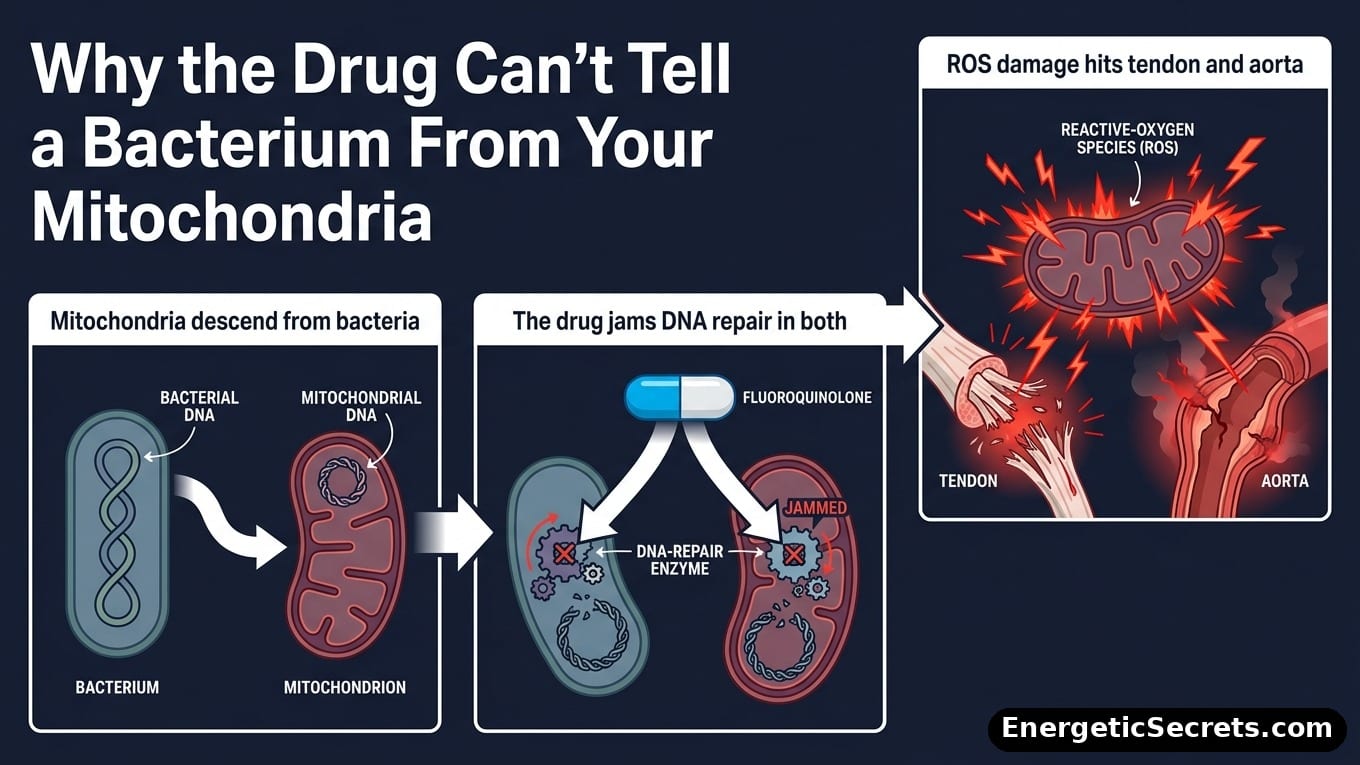
In 2013, a team led by Kalghatgi published a study in Science Translational Medicine confirming exactly that. Clinically relevant doses of bactericidal antibiotics, fluoroquinolones named specifically among them, triggered mitochondrial dysfunction and reactive oxygen species overproduction in mammalian cells [1]. Reactive oxygen species, usually shortened to ROS, is simply the name for the unstable, damage-causing molecules that pile up once mitochondria stop running cleanly. The study found oxidative damage to DNA, to proteins, and to the fatty membranes that hold cells together, and mice given the drugs showed the same oxidative stress markers turning up in their blood. The damage eased when the animals were given an antioxidant called N-acetyl-L-cysteine, which is itself a clue that the mitochondrial pathway was doing the real driving.
The 2025 Paper That Named the Exact Molecular Target
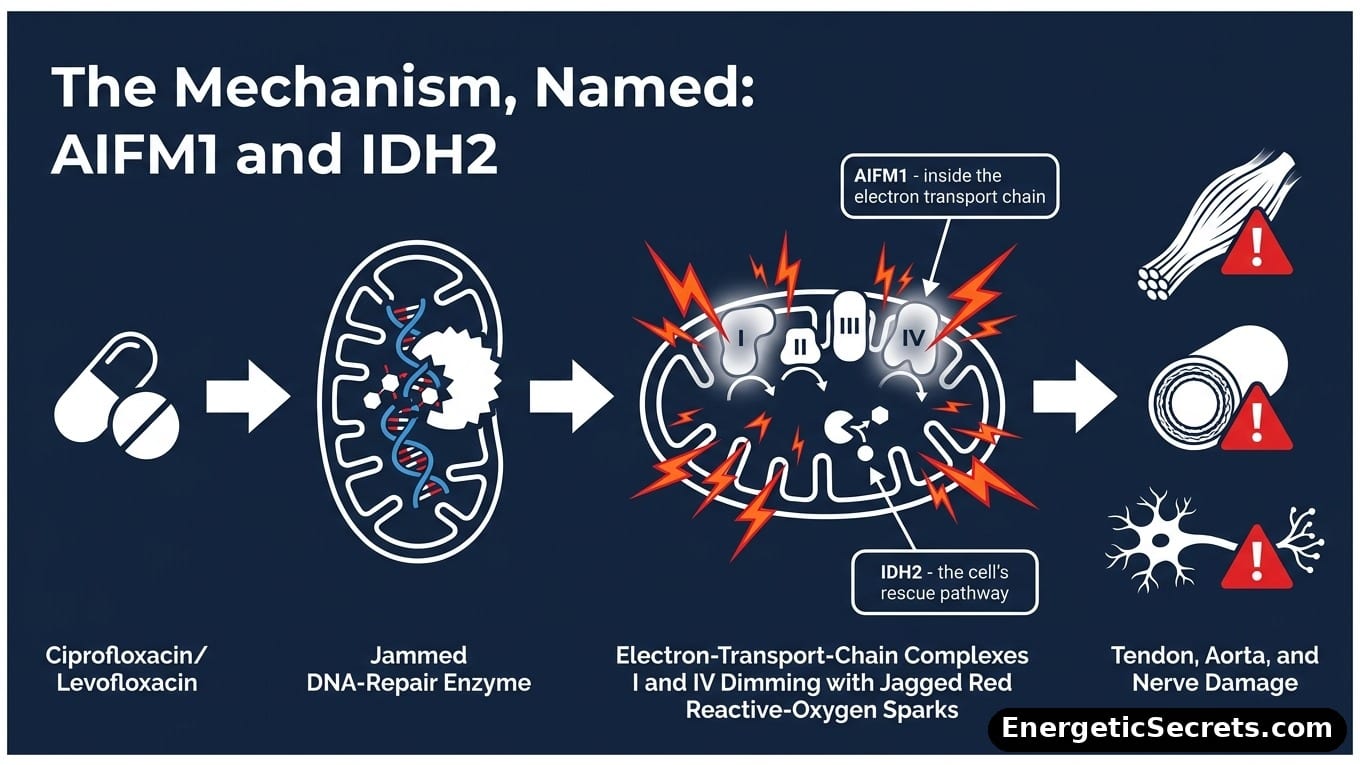
Suffice it to say, the 2013 finding sat for over a decade as a plausible mechanism rather than a fully proven one. That changed in 2025. A team led by Reinhardt ran whole-proteome analyses (a technique that scans essentially every protein in a cell at once rather than guessing which one to look at) on human cells treated with ciprofloxacin and levofloxacin [2]. They found pronounced mitochondrial dysfunction, specifically in complexes I and IV of the electron transport chain, which is the assembly line of proteins that actually manufactures the energy your cells run on.
More importantly, they identified the exact human proteins the drugs were hitting: a protein called AIFM1 and an enzyme called IDH2. AIFM1 sits directly inside the electron transport chain. IDH2 is part of a backup pathway the cell tries to use to rescue itself once that chain is damaged. When both were disabled at once, the mitochondrial injury got measurably worse, not better. That is about as specific as mechanism research gets, and it is a world away from a vague claim that "toxins" are involved.
A separate 2025 study, led by Sailer, confirmed the same effect through direct measurement instead of inference [3]. Using high-resolution respirometry (a method that tracks, in real time, how efficiently mitochondria burn fuel) the researchers found that ciprofloxacin impaired human mitochondrial respiration in a dose-dependent and time-dependent way. A related antibiotic, gentamicin, did the same. Amoxicillin, a non-fluoroquinolone drug tested for comparison, did not touch mitochondrial function at all. (Two of the paper's authors are affiliated with the company that makes the respirometer used in the study. The paper discloses the conflict itself. It is worth weighing, even though it does not overturn the finding.)
After all, three separate research teams, three separate methods, spanning twelve years, landed on the same conclusion.
What Fluoroquinolone Damage Actually Looks Like in a Patient
The mechanism explains why the visible injuries cluster where they do. Tendons and the aorta are both collagen-dependent, mitochondria-dense tissues that work under constant mechanical load, which leaves them the least room for error when cellular energy production falters. A 2015 case series led by Golomb described four previously healthy, employed adults who developed tendinopathy, muscle weakness, peripheral neuropathy, autonomic dysfunction, sleep disruption, cognitive trouble, and psychiatric symptoms after taking a fluoroquinolone [4]. The detail that should unsettle anyone reading this as a one-off drug reaction is that the symptoms did not resolve when the drug was stopped. In some cases they got worse afterward.
The authors name the known mitochondrial toxicity mechanism as "a compatible mechanism" for exactly that kind of delayed, progressive injury. Four patients is not an epidemic. It is, at minimum, a pattern that deserved the decade of research that followed it.
The scale shows up more clearly in the pharmacovigilance data. A 2022 analysis of the FDA's own Adverse Event Reporting System, known as FAERS, reviewed more than 35,000 fluoroquinolone-associated adverse events reported between 2016 and 2021. Led by Shu and colleagues, it found over 1,700 tendonitis cases and more than 1,000 tendon ruptures with a fluoroquinolone named as the suspected drug [5].
Ciprofloxacin carried the strongest tendonitis signal. Levofloxacin carried the strongest rupture signal. Keep in mind this is self-reported, post-market data. People report the bad outcomes, not the uneventful courses. Even so, it is the FDA's own system, reporting on the FDA's own approved drug class, at a scale that is hard to wave away as noise.
The Aortic Signal That Finally Moved the FDA
Tendon injury is the best-known fluoroquinolone side effect, but the aortic signal is what eventually forced the FDA's hand. A 2015 nested case-control study using Taiwan's national health insurance database, led by Lee, found current fluoroquinolone use associated with more than double the risk of aortic aneurysm or dissection compared to non-use, an adjusted rate ratio of 2.43 [6]. A much larger 2018 Swedish national cohort study, led by Pasternak, compared 360,088 fluoroquinolone treatment episodes against an equal number of amoxicillin episodes. It found a 66 percent increase in aortic aneurysm or dissection risk within 60 days of use, a hazard ratio of 1.66 [7].
Pasternak's data is worth reading closely rather than skimming past: the elevated risk was driven almost entirely by aneurysm, not dissection specifically, a nuance that matters for stating the claim precisely instead of overselling it. A 2019 study led by Etminan found a further connection to mitral and aortic valve regurgitation, broadening the cardiovascular signal beyond the aorta's main wall [8].
One Drug, Two Regulators, Two Completely Different Answers
On November 15, 2018, the European Medicines Agency finalized an Article 31 referral (the EU's mechanism for reviewing a medicine's safety across the entire bloc at once) and concluded that quinolone and fluoroquinolone antibiotics were associated with "disabling and potentially permanent side effects" [9]. The decision was precise, not sweeping, and the precision matters: four older, less-used agents (cinoxacin, flumequine, nalidixic acid, and pipemidic acid) had their marketing authorizations suspended outright.
The fluoroquinolones still in wide use today, ciprofloxacin, levofloxacin, moxifloxacin, and others, were restricted rather than banned. The restriction itself is specific: they should not be used for infections likely to resolve on their own, for non-bacterial conditions, for preventing traveler's diarrhea or recurring urinary infections, or for mild to moderate infections when another commonly recommended antibiotic would do the job. By early 2019, the European Commission had made the decision legally binding across every member state. That is a regulator changing what a doctor is allowed to write on a prescription pad, not just changing what a label says.
The FDA's path through the same decade looks different. In 2013, the agency required updated labeling describing peripheral neuropathy, nerve damage that can occur soon after the drug is taken and can be permanent [10]. In 2016, it went further and advised that fluoroquinolones be reserved for patients with acute sinusitis, acute bronchitis, or uncomplicated urinary infections who have no other treatment option, language that gestures toward the EU's restriction without matching its binding force or its broader scope [11].
In 2018, the FDA strengthened its warnings twice more. In July, it flagged serious drops in blood sugar and mental health effects including delirium [12]. In December, it added the aortic aneurysm and dissection risk described above, citing its own review of four observational studies that it said together "provide consistent evidence of an association" [13]. That is four rounds of warning language inside six years, which is not nothing. But not one of those four rounds changed a prescribing rule.
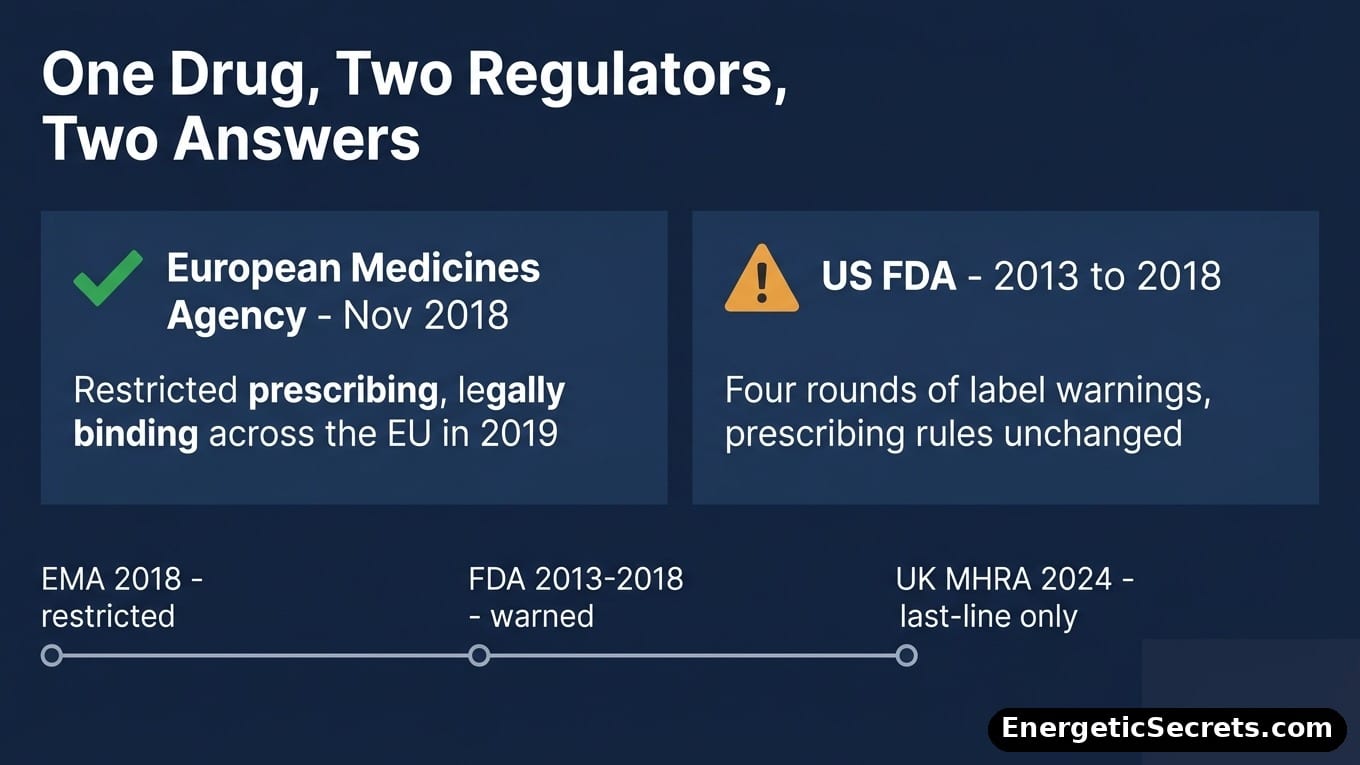
A doctor in Berlin and a doctor in Boston are reading warnings about the identical drug, issued around the identical dates, describing the identical injuries. Only one of them is bound by law to try something else first.
Taking the FDA's Best Argument Seriously
Now, the honest version of the FDA's position deserves a real answer, not a dismissal, because this is not a debunking piece and fluoroquinolones are not a hoax. Serious fluoroquinolone injury is, by the numbers available, genuinely rare (this may not include long term gut problems but that's a topic for another article). The UK's own medicines regulator, which has gone further than the FDA (more on that in a moment), estimates serious adverse reactions at somewhere between 1 and 10 people per 10,000 who take the drug [14]. Pasternak's own data put the excess absolute risk at roughly 82 extra aortic events per million treatment courses, a real number, but a small one set against how often these drugs get prescribed. For a genuinely serious infection where a fluoroquinolone is the best available option, that tradeoff can be the correct one, and I am not going to pretend otherwise.
What the rarity argument does not explain is why only some patients are hit hard while most sail through without incident. A 2026 paper led by Sewell and Jensen proposes what they call a Mitochondrial Vulnerability Threshold: the idea that whether a standard dose produces serious toxicity may depend on a given patient's pre-existing mitochondrial reserve, rather than on some fixed property of the drug itself [15]. The authors are careful to flag this as a testable hypothesis rather than an established fact, and one piece of their proposed mechanism they describe, in their own words, as unvalidated. I don't know whether that threshold idea will hold up under further testing. What I do know is that it is the first serious attempt to explain the pattern the pharmacovigilance data keeps producing: a rare, severe reaction concentrated in a subset of patients, not a mild reaction spread evenly across everyone who takes the drug.
The US Hasn't Said a New Word Since 2018
Here is where the trajectory matters as much as any single decision. The FDA's own live safety communication index shows no new fluoroquinolone warning issued since that December 2018 aortic alert, as of this writing. The UK, by contrast, kept moving.
In January 2024, its Medicines and Healthcare products Regulatory Agency went further than its earlier 2019 measures and restricted systemic fluoroquinolones to situations where other commonly recommended antibiotics are inappropriate, explicit last-line style language that did not exist in UK policy before [14]. The US, the EU, and the UK all started from the same mechanism, the same injured patients, and largely the same published studies. Two of the three kept tightening the rule as the evidence accumulated. The US has not issued a new word on fluoroquinolones in over seven years.
Is this a sign of regulatory capture?
What This Means If You're Holding a Prescription
None of this is a reason to refuse a fluoroquinolone your doctor has prescribed for a genuinely serious infection, and I am not telling you to do that. Fluoroquinolones remain indicated, by both the EMA and the FDA, for severe infections where other antibiotics will not do the job, and stopping a prescribed antibiotic on your own is its own risk.
What this is a reason for is a real conversation with your own doctor (the kind you can have in the typical five minutes your doc gives you, before the prescription is filled). Ask whether a narrower-spectrum antibiotic would treat the specific infection you have. That matters most for a sinus infection, a bronchitis, or an uncomplicated urinary tract infection, the exact three conditions the FDA itself flagged back in 2016.
The mechanism is no longer theoretical. It has a name, two protein targets, and three independent research teams behind it. The regulators who are supposed to act on that evidence read the identical research and reached two different answers seven years apart. You are allowed to ask your own doctor which answer they are working from.
Disclaimer: I am not a health professional of any kind and make no medical claims. I am just a researcher who likes to dig deep on effective methods to keep them from being lost to the dust bin of history. And I like to write about what I learn. So please do your own research. Nothing in this article should be considered medical advice. None of the statements have been evaluated by the FDA. Not intended to diagnose, treat, cure or prevent any disease. If you have a medical condition seek professional help.
References
1. Kalghatgi et al. Bactericidal antibiotics induce mitochondrial dysfunction and oxidative damage in mammalian cells. Science Translational Medicine. 2013 Jul 3;5(192):192ra85. PMID 23825301. https://pubmed.ncbi.nlm.nih.gov/23825301/
2. Reinhardt et al. Chemical proteomics study identifying the human mitochondrial off-targets (AIFM1 and IDH2) of fluoroquinolone antibiotics in human cells. Angewandte Chemie International Edition. 2025 Apr 25;64(18):e202421424. PMID 39964703. DOI 10.1002/anie.202421424. https://pubmed.ncbi.nlm.nih.gov/39964703/
3. Sailer et al. High-resolution respirometry study of the direct effects of clinically relevant antibiotic doses, including ciprofloxacin, on human mitochondrial respiration. International Journal of Molecular Sciences. 2025 Jun 4;26(11):5379. PMID 40508187. DOI 10.3390/ijms26115379. https://pubmed.ncbi.nlm.nih.gov/40508187/
4. Golomb et al. Case series: fluoroquinolone-induced serious, persistent, multisymptom adverse effects in four previously healthy adults. BMJ Case Reports. 2015 Oct 5;2015:bcr2015209821. PMID 26438672. DOI 10.1136/bcr-2015-209821. https://pubmed.ncbi.nlm.nih.gov/26438672/
5. Shu et al. Disproportionality analysis of fluoroquinolone-associated tendonitis and tendon rupture reports in the FDA Adverse Event Reporting System (FAERS), January 2016 to March 2021. Frontiers in Pharmacology. 2022 Sep 6;13:990241. PMID 36147351. DOI 10.3389/fphar.2022.990241. https://pubmed.ncbi.nlm.nih.gov/36147351/
6. Lee et al. Nested case-control study of oral fluoroquinolone use and aortic aneurysm or dissection, Taiwan National Health Insurance Research Database. JAMA Internal Medicine. 2015 Nov;175(11):1839-1847. PMID 26436523. DOI 10.1001/jamainternmed.2015.5389. https://pubmed.ncbi.nlm.nih.gov/26436523/
7. Pasternak et al. Fluoroquinolone use and risk of aortic aneurysm and dissection: nationwide cohort study. The BMJ. 2018 Mar 8;360:k678. PMID 29519881. DOI 10.1136/bmj.k678. https://pubmed.ncbi.nlm.nih.gov/29519881/
8. Etminan et al. Oral fluoroquinolone use and risk of mitral and aortic regurgitation. Journal of the American College of Cardiology. 2019 Sep 17;74(11):1444-1450. PMID 31514945. DOI 10.1016/j.jacc.2019.07.035. https://pubmed.ncbi.nlm.nih.gov/31514945/
9. European Medicines Agency. Disabling and potentially permanent side effects lead to suspension or restrictions of quinolone and fluoroquinolone antibiotics. Article 31 referral, finalized 15 November 2018. https://www.ema.europa.eu/en/medicines/human/referrals/quinolone-fluoroquinolone-containing-medicinal-products
10. US Food and Drug Administration. FDA Drug Safety Communication: FDA requires label changes to warn of risk for possibly permanent nerve damage from antibacterial fluoroquinolone drugs taken orally or by injection. 15 August 2013. Archived (original live URL returns 404 as of October 2026): https://web.archive.org/web/20150101034412id_/http://www.fda.gov/Drugs/DrugSafety/ucm365050.htm
11. US Food and Drug Administration. FDA Drug Safety Communication: FDA advises restricting fluoroquinolone antibiotic use for certain uncomplicated infections; warns about disabling side effects that can occur together. 12 May 2016, updated 26 July 2016. Archived (original live URL returns 404 as of October 2026): https://web.archive.org/web/20190505045849id_/https://www.fda.gov/drugs/drug-safety-and-availability/fda-drug-safety-communication-fda-advises-restricting-fluoroquinolone-antibiotic-use-certain
12. US Food and Drug Administration. FDA Drug Safety Communication: FDA reinforces safety information about serious low blood sugar levels and mental health side effects with fluoroquinolone antibiotics. 10 July 2018. Archived (original live URL returns 404 as of October 2026): https://web.archive.org/web/20191213084127id_/https://www.fda.gov/drugs/drug-safety-and-availability/fda-reinforces-safety-information-about-serious-low-blood-sugar-levels-and-mental-health-side
13. US Food and Drug Administration. FDA Drug Safety Communication: FDA warns about increased risk of ruptures or tears in the aorta blood vessel with fluoroquinolone antibiotics in certain patients. 20 December 2018. Archived (original live URL returns 404 as of October 2026): https://web.archive.org/web/20191112145512id_/https://www.fda.gov/drugs/drug-safety-and-availability/fda-warns-about-increased-risk-ruptures-or-tears-aorta-blood-vessel-fluoroquinolone-antibiotics
14. UK Medicines and Healthcare products Regulatory Agency. Drug Safety Update: fluoroquinolone antibiotics must now only be prescribed when other commonly recommended antibiotics are inappropriate. 22 January 2024. https://www.gov.uk/drug-safety-update/fluoroquinolone-antibiotics-must-now-only-be-prescribed-when-other-commonly-recommended-antibiotics-are-inappropriate
15. Sewell and Jensen. Hypothesis paper proposing a Mitochondrial Vulnerability Threshold (MVT) model of fluoroquinolone-associated multisystem toxicity (FQMT). Frontiers in Pharmacology. 2026 Sep 23;17:1905942. PMID 42846278. DOI 10.3389/fphar.2026.1905942. https://pubmed.ncbi.nlm.nih.gov/42846278/ |



1 Comment
Join the conversation
I took levaquin for a sinus infection years ago and my achilles hurt for months after. Doctor told me it was just getting older. I was 34.