
Epistemicide: Knowledge Doesn't Just Disappear - It Gets Killed |
Not censorship, not suppression: a word for when a whole way of knowing is erased, and the five moves that do it... |

There is a word for what happens when a whole way of knowing is erased from the record. It is not "censorship," which implies a single document or a single voice. It is not "suppression," which implies a temporary hold. The word is epistemicide: the killing of a knowledge system itself.
I have spent most of my adult life chasing knowledge that the mainstream would rather I not have. My father is a medical doctor, and I grew up inside the very institution I now question. That is not a coincidence. When you grow up inside a system, you learn its blind spots from the inside. And the biggest blind spot, the one almost nobody inside the system can see, is that the system does not just ignore inconvenient knowledge. It actively works to make sure that knowledge stops existing.
The term "epistemicide" was popularized by the Portuguese sociologist Boaventura de Sousa Santos, most centrally in his 2014 book Epistemologies of the South: Justice Against Epistemicide (Paradigm Publishers, 2014). Santos developed the concept across his work, from his earlier legal theory in Toward a New Legal Common Sense (2002) through to the 2014 volume that made the term central. His argument is that colonialism did not only take land, labor, and lives. It also took knowledge: the medical systems, agricultural practices, cosmologies, and ways of knowing of the peoples it conquered.
Santos was not working in a vacuum. The intellectual ground was prepared by Gayatri Chakravorty Spivak, whose 1988 essay "Can the Subaltern Speak?" introduced the related idea of "epistemic violence," the way colonial discourse silences the subaltern's own voice and knowledge. Walter Mignolo's 2002 essay "The Geopolitics of Knowledge and the Colonial Difference" argued that knowledge is geopolitically located, and that Western epistemology has systematically marginalized non-Western knowledge systems. Aníbal Quijano's 2000 essay "Coloniality of Power and Eurocentrism in Latin America" made the case that colonial structures of knowledge and power persist long after formal decolonization. Nelson Maldonado-Torres extended that framework in his 2007 essay "On the Coloniality of Being."
That is a lot of academic lineage, and I want to be honest about why it matters. These scholars gave us a vocabulary for something that had been happening for five centuries without a name. Once you have the name, you can see the mechanism. And once you see the mechanism, you can see it operating in your own lifetime.
The First Mechanism: Burning the Archive
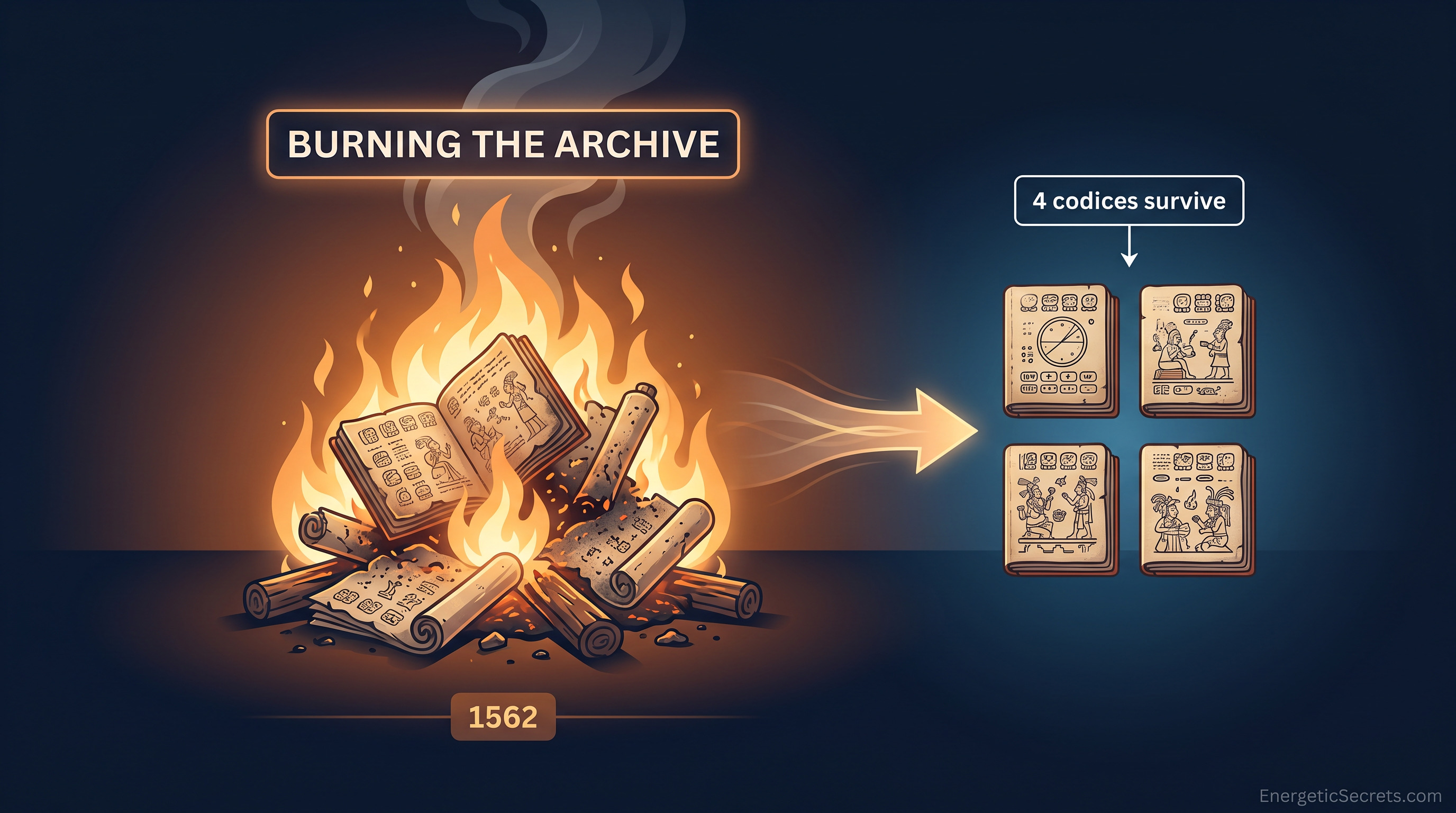
The most direct way to kill a knowledge system is to destroy its physical record. The clearest documented case is the Spanish friar Diego de Landa, who in July 1562 at Maní, in the Yucatán, held an inquisition and burned Maya books and idols. De Landa himself described the destruction in his Relación de las cosas de Yucatán, written around 1566. He was, in a grim irony, also one of the few Europeans who bothered to record Maya writing and culture, which means our knowledge of what he destroyed comes partly from the man who destroyed it.
The scale of the loss is hard to overstate. Only four pre-Columbian Maya codices are known to survive today: the Dresden Codex, the Madrid Codex, the Paris Codex, and the Grolier Codex, now officially renamed the Códice Maya de México. And even that fourth one carries a caveat. The Grolier's authenticity was disputed for decades, with some Mayanists arguing for it while others doubted it, until Mexico's INAH authenticated it in 2018 and gave it its current name. The fact that we argue over whether a fourth book is real tells you how thoroughly the rest were erased.
I will not pretend the "only four survive" count is a settled, single-source fact. It is the standard framing in Maya scholarship, but it deserves a careful reader's skepticism, the same skepticism I ask you to bring to everything I write. What is not in dispute is that de Landa burned books, and that the surviving record of an entire civilization's written knowledge fits in a handful of codices.
Think about what that means in practical terms. The Maya had a fully developed writing system, sophisticated astronomy, and a calendar that still fascinates people today. What we know of all of it comes down to four books and whatever was carved in stone. Everything else, the medical texts, the agricultural records, the histories, the poetry, went into a bonfire in a single afternoon. That is what epistemicide looks like at its most literal.
The same mechanism reappeared, almost unchanged, four centuries later. On May 10, 1933, in Berlin and other German university cities, students marched against what they called the "un-German spirit" and threw tens of thousands of books into bonfires. The United States Holocaust Memorial Museum documents that Propaganda Minister Joseph Goebbels attended the Berlin burning, and that while the burnings were the initiative of German university students, the Nazi government supported them. The books were not random. They were the work of Jewish, leftist, and dissenting authors, the intellectual opposition to the regime. Burn the books, and you burn the ideas, and you burn the people who carried them.
The Second Mechanism: Imposing Official Doctrine
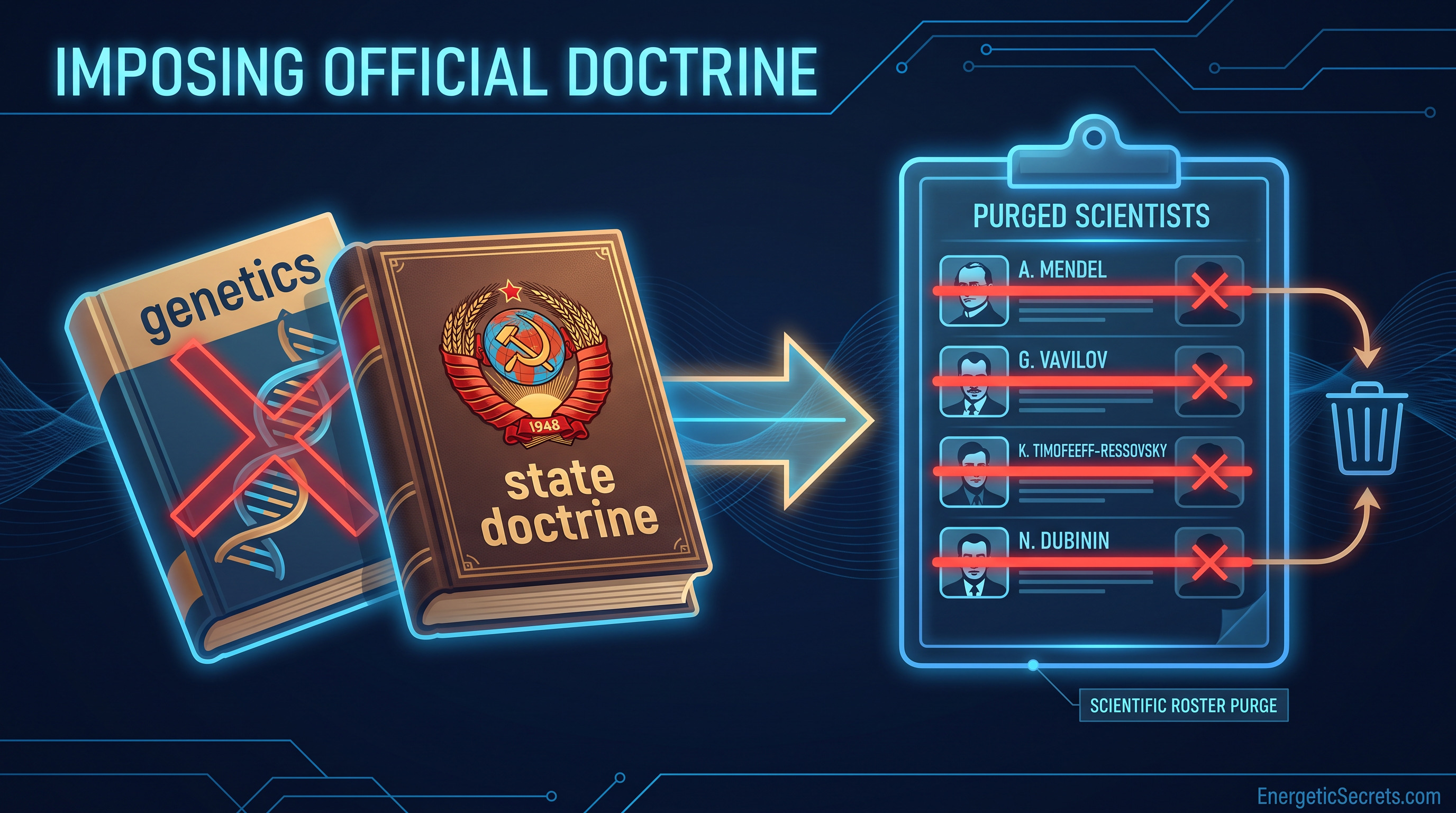
Burning books is crude. A more sophisticated form of epistemicide is to declare one doctrine official and purge everyone who disagrees. The canonical case is Soviet Lysenkoism.
In August 1948, at a session of the Lenin All-Union Academy of Agricultural Sciences (VASKhNIL), Trofim Lysenko's anti-genetics doctrine, called Michurinism, was imposed as official Soviet biology. The session's published transcript, The Situation in Biological Science, was issued in English in 1949 by the Foreign Languages Publishing House in Moscow. The result was the purge of Mendelian geneticists, the destruction of a generation of Soviet genetics, and the elevation of a pseudoscience to state doctrine. Real genetics did not recover in the Soviet Union for decades.
The Nazis used a different tool for the same job. On April 7, 1933, Germany enacted the Law for the Restoration of the Professional Civil Service, which the United States Holocaust Memorial Museum documents as a mechanism to remove Jewish and politically "unreliable" civil servants from their posts. The law's own text allowed dismissal "even if there are no grounds for such action under the prevailing law." That is the state telling its scientists: your credentials do not protect you, because the state has redefined what counts as legitimate.
China's Cultural Revolution, from 1966 to 1976, was a third variation. It was a period of systematic persecution of intellectuals and scholars, of "bourgeois" knowledge treated as a crime. I am not going to name a single scholar's case here, because I have not verified one to my own standard. The general persecution is well documented; the specific stories deserve sources I have not yet gathered.
Notice the pattern across all three. In each case, the state did not merely disagree with certain scientists. It redefined who was allowed to be a scientist at all. The knowledge was not refuted. It was made illegitimate, and the people who held it were removed from the conversation entirely.
The Third Mechanism: Manufacturing Doubt

The modern, corporate form of epistemicide is subtler than any bonfire. It does not burn the knowledge. It buries it under manufactured uncertainty.
Naomi Oreskes and Erik Conway documented this in their 2010 book Merchants of Doubt. They traced how a handful of scientists, some of them the same people who had worked for the tobacco industry, spent decades obscuring the truth on issues from tobacco smoke to acid rain to the ozone hole to global warming. The playbook was consistent: fund contrarian scientists, attack the credibility of mainstream researchers, and demand "balance" where no genuine scientific balance exists. The goal was never to win the argument. The goal was to make it look like there was still an argument.
This is epistemicide by a thousand cuts. You do not have to destroy the research. You just have to make sure the public, the press, and the regulators can never be quite sure what the research says. The knowledge still exists, technically. It is just buried under enough noise that it might as well not.
The Fourth Mechanism: Political Interference
Sometimes the state does not need a bonfire or a purge. It just needs to edit the science before it reaches the public. The Union of Concerned Scientists documented this in two reports: Atmosphere of Pressure (2007), on political interference in federal climate science, and Interference at the EPA (2008), on science and politics at the U.S. Environmental Protection Agency. These are named, documented cases of political appointees altering, suppressing, or misrepresenting the work of government scientists.
This mechanism is quieter than the others, and in some ways more corrosive. The scientists still have their jobs. The research still gets done. But the version of it that reaches the public has been edited by people whose job is not to find the truth but to protect a political position. The knowledge is not destroyed. It is laundered.
The Fifth Mechanism: Gatekeeping, Delegitimization, and Harassment
There is a final set of mechanisms I want to name, and I want to be careful about how I name them. Publication gatekeeping, where inconvenient research cannot get past a journal's reviewers. Credential delegitimization, where a researcher's qualifications are attacked rather than their findings. Legal harassment, where a critic is sued into silence not to win but to exhaust. These mechanisms are real and they are the everyday texture of suppressed science.
But here is the honest part, and I promised you honesty. I have not yet gathered the specific, verified, named cases of these modern mechanisms to my own standard. I will not hand you a list of companies and studies and deplatformed scientists that I have not checked. What I can tell you, and what Oreskes and Conway and the Union of Concerned Scientists do document, is that the machinery exists and has been used. The specific modern cases are a follow-up I owe you, not a shortcut I will take but I will say that Peter Duesberg is at least one perfect example, read about him right here.
Why This Matters to You
Of course, I did not come to this topic as an academic. I came to it as someone who watched the mainstream medical system, the one my father works inside, dismiss and bury ideas that later turned out to matter. Terrain theory, the work of Antoine Bechamp and Gaston Naessens, the frequency work of Royal Rife, the nitriloside research of Ernst T. Krebs Jr. These are not fringe curiosities to me. They are knowledge systems that were, in their own ways, subjected to the same mechanisms I have just described: delegitimized, defunded, and written out of the record.
I do not know the full answer to why this keeps happening. I have my suspicions, and they are not flattering to the institutions involved. But I know this much: the first step in defending knowledge is recognizing when it is being killed. Epistemicide is not a metaphor. It is a set of repeatable mechanisms, and once you can name them, you can see them operating in your own lifetime.
In closing, I want to ask you to do something. Please share your thoughts in the comments below, and share this with anyone you feel would benefit from reading it. And if you want to keep digging into the knowledge the mainstream would rather you not have, subscribe to this newsletter here at EnergeticSecrets.com.
References
1. Boaventura de Sousa Santos, Epistemologies of the South: Justice Against Epistemicide, Paradigm Publishers, 2014. ISBN 978-1-61205-544-2.
2. Boaventura de Sousa Santos, Toward a New Legal Common Sense: Law, Globalization, and Emancipation, Butterworths LexisNexis, 2002. ISBN 0-406-94997-2.
3. Gayatri Chakravorty Spivak, "Can the Subaltern Speak?", in Cary Nelson and Lawrence Grossberg (eds.), Marxism and the Interpretation of Culture, University of Illinois Press, Urbana, 1988, pp. 271–313.
4. Walter D. Mignolo, "The Geopolitics of Knowledge and the Colonial Difference," South Atlantic Quarterly 101(1): 57–96, 2002. DOI 10.1215/00382876-101-1-57.
5. Aníbal Quijano, "Coloniality of Power and Eurocentrism in Latin America," International Sociology 15(2): 215–232, 2000. DOI 10.1177/0268580900015002005.
6. Nelson Maldonado-Torres, "On the Coloniality of Being: Contributions to the Development of a Concept," Cultural Studies 21(2–3): 240–270, 2007. DOI 10.1080/09502380601162548.
7. Diego de Landa, Relación de las cosas de Yucatán, c. 1566; Alfred M. Tozzer (ed. and trans.), Landa's Relación de las cosas de Yucatán: A Translation, Papers of the Peabody Museum of American Archaeology and Ethnology, Harvard University, Vol. XVIII, 1941.
8. Martínez del Campo Lanz (coordinator), Códice Maya de México, INAH, 2018. ISBN 978-607-539-158-8.
9. T. D. Lysenko, The Situation in Biological Science: Proceedings of the Lenin Academy of Agricultural Sciences of the U.S.S.R., Session: July 31–August 7, 1948. Verbatim Report, Foreign Languages Publishing House, Moscow, 1949.
10. United States Holocaust Memorial Museum, "Book Burning," Holocaust Encyclopedia. https://encyclopedia.ushmm.org/content/en/article/book-burning
11. United States Holocaust Memorial Museum, "Law for the Restoration of the Professional Civil Service," Holocaust Encyclopedia. https://encyclopedia.ushmm.org/content/en/article/law-for-the-restoration-of-the-professional-civil-service
12. China During the Cultural Revolution, 1966–1976, Greenwood Press, 1999. ISBN 978-0-313-30905-2.
13. Naomi Oreskes and Erik M. Conway, Merchants of Doubt: How a Handful of Scientists Obscured the Truth on Issues from Tobacco Smoke to Global Warming, Bloomsbury Press, 2010. ISBN 978-1-59691-610-4.
14. Timothy Quinn Donaghy, Interference at the EPA: Science and Politics at the U.S. Environmental Protection Agency, Union of Concerned Scientists, 2008.
15. Timothy Quinn Donaghy, Atmosphere of Pressure: Political Interference in Federal Climate Science, Union of Concerned Scientists, 2007.
Disclaimer: I am not a health professional of any kind and make no medical claims. I am just a researcher who likes to dig deep on effective methods to keep them from being lost to the dust bin of history. And I like to write about what I learn. So please do your own research. Nothing in this article should be considered medical advice. None of the statements have been evaluated by the FDA. Not intended to diagnose, treat, cure or prevent any disease. If you have a medical condition seek professional help. |




6 Comments
Join the conversation
My grandfather was a librarian and he used to say destroy the records and you can rewrite whatever history you want. This article is basically that idea with a fancy name attached.
Never heard the word epistemicide before today. Kind of a heavy read but I did learn something. The book burning in 1933 part gave me chills.
Lysenko is the scariest example on here. A whole country wrecked its own science because one guy told the government what it wanted to hear. People forget that stuff really happened.
I get the point about manufactured doubt with tobacco and climate but lumping Rife and terrain theory in with actual persecuted geneticists feels like a stretch to me. Those got tested and didn't hold up.
I would disagree, if anything they were tested and succeeded but were suppressed nonetheless. Perfect examples which is why I included them. You might want to do some more research about what you are actually talking about and question yourself if you may just be feeding into the same narrative that I'm exposing the history of in this article.
The de Landa story always gets me. The same guy who burned the books is the reason we know anything about the Maya writing. Wild how that works out.