
Your Bluetooth Safety Limit Is Running on 1996 Math a Federal Court Already Threw Out |
The rule your earbuds answer to was written in 1996, by the industry it regulates. Five years ago a court told the FCC to explain itself - It still hasn't... |
Are the regulators captured by the agencies they are supposed to be regulating?
The wireless industry is one that warrants some scrutiny and here we'll break down some important history to give you context on some deeper answers to the above question.
I grew up learning to distrust the official line, not because every official line is wrong, but because nobody ever checks whether it's still right. The story of Bluetooth, Wi-Fi, and the radiofrequency (RF) radiation both of them use is a near-perfect case study in exactly that problem.
The Year the Clock Stopped
On August 1, 1996, the Federal Communications Commission adopted a Report and Order setting the RF exposure limits that still govern every Bluetooth earbud, Wi-Fi router, and cell phone sold in the United States today (FCC 96-326, 1996). The limits took effect five days later. They were built on specific absorption rate, or SAR, a measure of tissue heating, and they trace back through the 1992 ANSI/IEEE C95.1 standard to a 1986 report from the National Council on Radiation Protection and Measurements. Every link in that chain assumes the only thing worth protecting against is heat.
That assumption mattered less in 1996, before anyone carried a radio transmitter against their skull for eight hours a day. It matters more now. And here is the part that should stop you: the FCC has had chances to revisit it and has chosen not to, twice confirmed in writing.
In 2019, the agency closed a multi-year proceeding by declining to change anything. Its own order says the 1996 guidelines "remain in effect today" and that the Commission found "no appropriate basis" to reopen them (FCC 19-126, 2019). The deciding input was a letter from the FDA's device center, dated April 24, 2019, stating that "no changes to the current standards are warranted at this time." That's it. That's the entire modern evidentiary basis for declining to touch a standard built in the Reagan administration.
The part that didn't get nearly enough coverage is this. Environmental Health Trust and others sued, and in August 2021 the United States Court of Appeals for the D.C. Circuit agreed with them. The court didn't rule that RF radiation causes cancer (it specifically found the FCC's cancer reasoning adequate). What it ruled is sharper and, frankly, more damning: the FCC's refusal to update its guidelines for everything else, reproductive effects, neurological effects, children's exposure, environmental harm, was "arbitrary and capricious" because the agency never explained why decades of post-1996 evidence didn't matter (Environmental Health Trust v. FCC, 2021). The court's own words: the Commission "failed to provide a reasoned explanation for its determination that its guidelines adequately protect against the harmful effects of exposure to radiofrequency radiation unrelated to cancer." It sent the whole question back to the agency with instructions to answer it properly.
That was five years ago as I write this. The limits are the same ones from 1996. After all, a remand only works if someone follows up on it, and nobody with subpoena power has made the FCC finish its homework.
Who Was in the Room When the Clock Stopped
The thing people miss about 1996 is that the limits weren't handed down from some neutral panel of disinterested scientists. The FCC's own commissioners, in their joint statement accompanying the order, praised what they called the "open, voluntary, industry-driven" ANSI process that produced the underlying standard (FCC 96-326, 1996). Look at who actually filed comments in that docket and you find Motorola, Ericsson, AT&T, BellSouth, CTIA, TIA, McCaw, Sprint, GTE, and Raytheon, alongside the IEEE committee that wrote the standard itself. The industry that would be regulated helped write the rule that would regulate it. The FCC said so itself. That's not a conspiracy theory. That's the record.
The pattern repeats at the international level. In 2017, the oncologist and epidemiologist Lennart Hardell published a peer-reviewed review documenting that five of the six scientists on the World Health Organization's core review group for RF radiation were affiliated with the International Commission on Non-Ionizing Radiation Protection, or ICNIRP, the same body that sets the guidelines being reviewed (Hardell, 2017). Hardell calls ICNIRP an "industry loyal NGO," his words, and reports that when the conflict was raised directly with the WHO at a March 2017 Geneva meeting, the organization stated it had "no intention to change the Core Group." The people checking the homework and the people who wrote it were, substantially, the same people.
The United Kingdom's own safety review fared no better under scrutiny. In 2016, Stewart Starkey published a peer-reviewed critique of the UK's 2012 AGNIR report (the document British and many other health agencies lean on) describing "incorrect and misleading statements, omissions and conflict of interest" throughout, and noting pointedly that independence was needed "from ICNIRP, the group that set the exposure guidelines being assessed" (Starkey, 2016). Of course, a single critique doesn't settle the matter. But when the pattern shows up in the FCC's own docket, in the WHO's own core group, and in the UK's own flagship review, it stops looking like coincidence and starts looking like structure.
What Everyone Else Was Willing to Permit
The numbers get interesting here, and my original instinct about Europe deserves a real hearing. A 2014 peer-reviewed study measured actual regulatory ceilings for mobile-base-station RF across four European cities and found roughly a tenfold spread (Urbinello et al., 2014). Amsterdam permits 41 to 61 volts per meter. Ghent permits 3 to 4.5. Brussels permits 2.9 to 4.3. Basel, under Switzerland's precautionary Ordinance on Non-Ionising Radiation, permits only 4 to 6.
Switzerland adopted that stricter ceiling deliberately, as a precaution, not because its regulators found evidence of harm at the looser Dutch level. That distinction matters, so I want to be precise about it rather than overstate it the way an average article on this topic would.
The same 2014 study found that measured outdoor RF exposure in all four cities, Basel included, sat far below even the tightest of these permitted ceilings. Basel's own measured average was roughly twenty to thirty times under its own limit. The researchers also checked whether Switzerland's tighter rule pushed exposure higher somewhere else, a kind of regulatory whack-a-mole, and found no evidence that it did (Urbinello et al., 2014). I don't know whether a European-style precautionary ceiling would change anything measurable in American daily exposure today, and I'd be lying if I said otherwise. What the numbers actually show is narrower and, in its way, more useful: this is a story about what a regulator is willing to permit as new technology densifies, not a claim that anyone in Amsterdam or Chicago is currently being cooked by their earbuds. Switzerland decided the ceiling itself should be lower. The United States hasn't revisited its ceiling since Bill Clinton's first term.
Why the Divergence Matters: The Evidence Underneath It
None of the regulatory history above would matter much if the thermal-only model were actually correct, if heat really were the only mechanism in play. A string of peer-reviewed, non-thermal findings, most of them European, argue it isn't.
In 2003, a Lund University group led by Leif Salford exposed rats to two hours of GSM-frequency microwave radiation and found "highly significant" neuronal damage (p less than 0.002) in the cortex, hippocampus, and basal ganglia (Salford et al., 2003). The same Lund group followed up in 2009 with a study of blood-brain-barrier permeability, finding a statistically significant leak at a non-thermal SAR of just 12 milliwatts per kilogram, a tiny fraction of the thermal thresholds the 1996 rule was built around (Nittby et al., 2009).
The European Union's own REFLEX project produced one of the clearest non-thermal findings on record. In 2005, researchers in Vienna exposed human fibroblasts and rat granulosa cells to 1800 megahertz RF and found single- and double-strand DNA breaks, concluding in their own words that the damage "cannot be based on thermal effects" (Diem et al., 2005). A German team led by Alexander Lerchl ran a careful replication a decade later and reported the same conclusion in the bluntest way possible: the title of the paper itself states that tumor-promoting effects showed up "below exposure limits for humans," at SAR levels of just 0.04 and 0.4 watts per kilogram (Lerchl et al., 2015). The dose-response wasn't perfectly clean, and the authors say so, but the central finding stands on its own title.
Human data carries the same thread, with the honest caveats attached. Lennart Hardell's pooled analysis of Swedish case-control studies found glioma risk rising from an overall odds ratio of 1.3 to 3.0 among users with more than 25 years of exposure (Hardell and Carlberg, 2015). A companion pooled analysis found acoustic neuroma risk rising even further at long latency, to an odds ratio of 6.5 beyond 20 years, though that specific estimate is built on a small number of exposed, long-latency cases and carries a correspondingly wide confidence interval (Hardell et al., 2013). These are case-control studies, which means they depend on people remembering their own phone habits accurately, and that's a real limitation, not a footnote to bury. But the pattern across Salford, Nittby, REFLEX, and Lerchl is the same pattern Hardell finds in humans: effects showing up at exposures the 1996 framework assumes are inert.
Where Bluetooth Actually Fits In
Most of what I've described above concerns cell phones and Wi-Fi more directly than Bluetooth specifically, and I want to be straight about that rather than blur it. Bluetooth shares the 2.4 gigahertz band with Wi-Fi, but it transmits at lower power and in shorter bursts. The honest Bluetooth-specific literature is thinner than the cell-phone literature, and a reputable article has to say so.
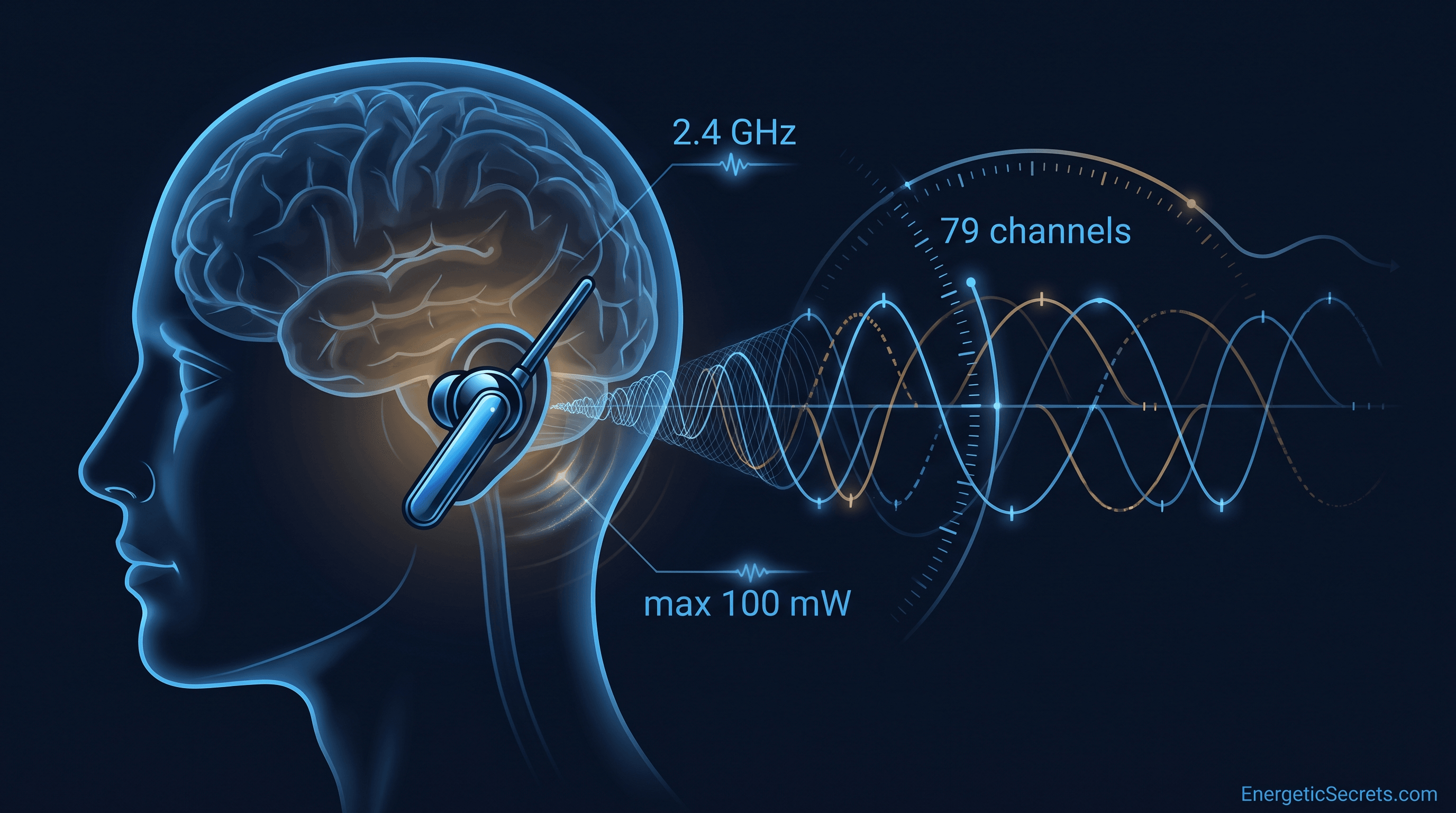
What exists is still telling. A 2026 study out of the EU-funded GOLIAT research program measured real-world personal RF exposure in 143 Swiss adolescents over roughly 72 hours each, using wearable exposimeters, and found that Wi-Fi and Bluetooth combined were the single largest contributor to total measured exposure, at 35 percent, ahead of every other individual source category, including broadcast at 31 percent, uplink at 19 percent, and downlink at 10 percent (Jalilian et al., 2026). The researchers added an important caveat of their own: personal exposimeters systematically underestimate exposure from sources worn close to the body, meaning the true contribution from an earbud sitting inside the ear canal is probably higher than even that 35 percent figure suggests.
Martin Pall, professor emeritus of biochemistry at Washington State University, has argued in a 2018 peer-reviewed review that seven effects, oxidative stress, reproductive damage, neuropsychiatric changes, apoptosis, DNA damage, endocrine disruption, and calcium channel overload, are "repeatedly found" with Wi-Fi-band exposure specifically (Pall, 2018). His framework is contested, and I'll say plainly that mainstream regulators don't accept it as a basis for policy. A 2012 study at the closer end of the evidence, by contrast, is a straightforward laboratory result: Avendaño and colleagues exposed human sperm samples to a Wi-Fi-connected laptop for four hours and found decreased motility and increased DNA fragmentation, describing the effect in their own words as nonthermal (Avendaño et al., 2012). That's 2.4 gigahertz band exposure, in human tissue, outside the body, with a measurable biological result at non-heating power.
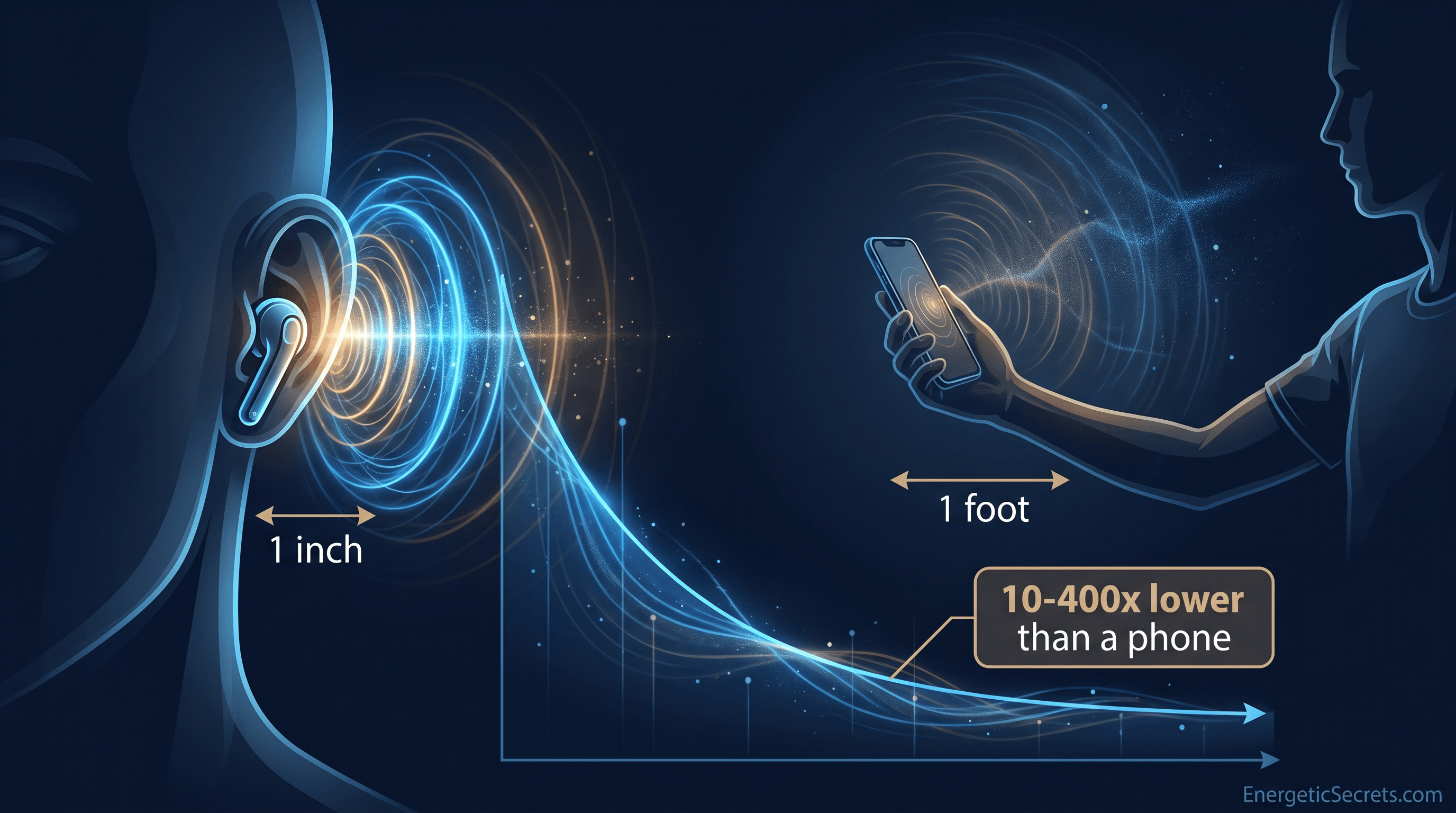
There's one Bluetooth-specific comparison worth keeping, and worth using honestly. A 2019 real-world measurement study found that Bluetooth headsets deliver 10 to 400 times less power density at the head than the phones they connect to (Wall et al., 2019). That's a genuinely useful number. It is not, however, a safety finding, and the original version of this article leaned on it as one. Lower than a cell phone tells you nothing about whether either exposure is actually safe under a 1996 standard a federal appeals court has already found inadequately justified for anything other than cancer. The comparison answers "compared to what," not "is this fine."
The One Lever You Control While the Fight Continues
The regulatory fight here is going to take years, maybe longer. The FCC still hasn't fully answered the D.C. Circuit's remand. Nobody is forcing it to move faster, and I don't have a tidy prediction for when, or whether, that changes.
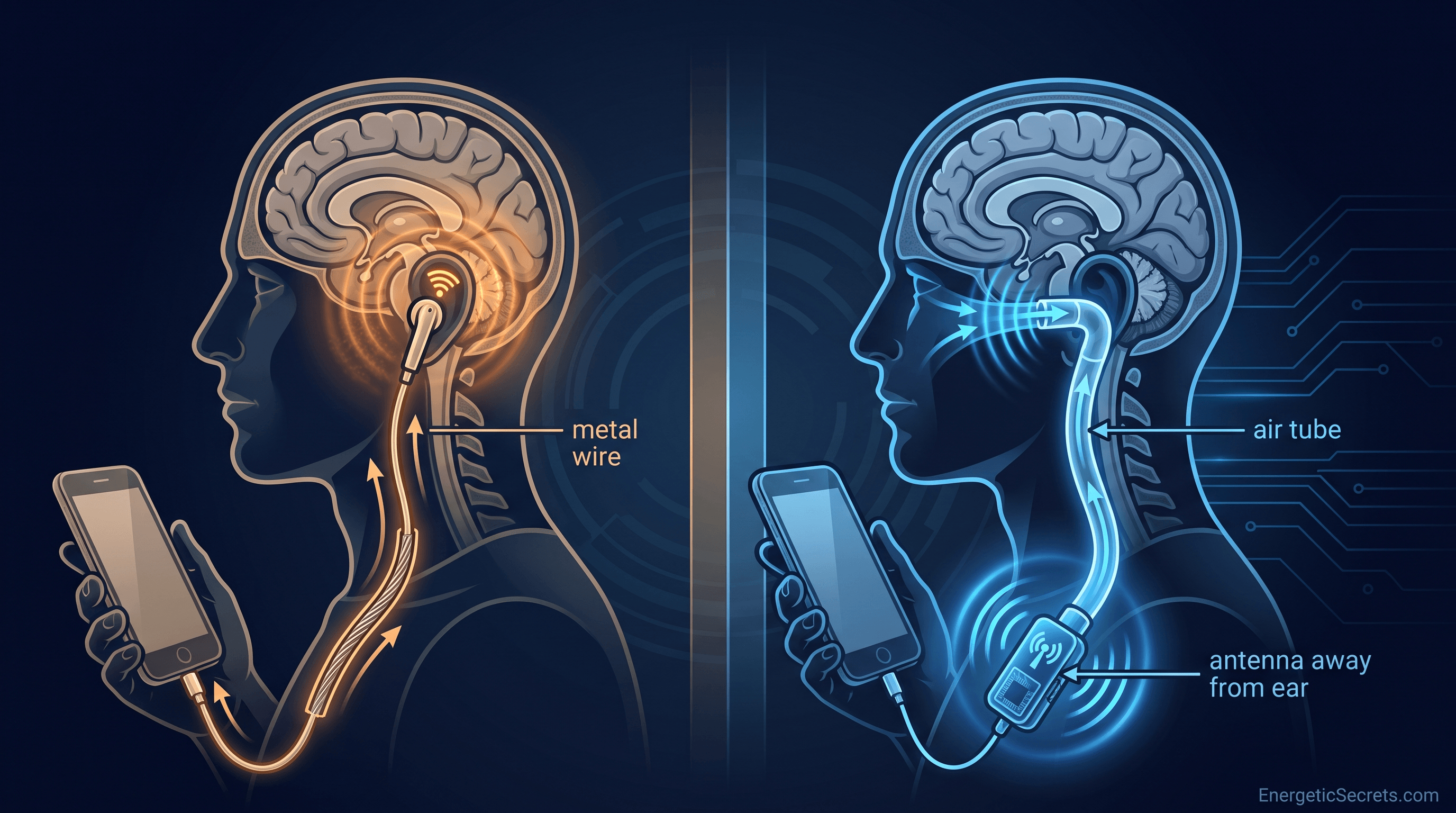
What you can control today is distance, and both the FCC and the National Toxicology Program say so themselves: speaker mode, hands-free accessories, and keeping a transmitting device off your skin all reduce near-field exposure (FCC SAR consumer guide; NTP). An airtube headset applies the same principle mechanically: it carries sound through a hollow tube instead of a wire, so there is no Bluetooth radio and radiation from the phone can't travel up the wire to your ear, it's interrupted by the tube that carries the sound.
That's not a cure for a regulatory gap three decades wide. It's the one adjustment within reach while the actual fight, over what the FCC has to explain and when, keeps grinding through the courts.
In Closing
The 1996 limits were set by a process the FCC's own commissioners called industry-driven, reviewed by a WHO panel five-sixths staffed by the body that wrote the underlying guidelines, and never meaningfully revisited since, despite a federal court ruling that the agency's silence on non-cancer harm was arbitrary and capricious. Meanwhile, newer work, much of it European, keeps finding biological effects below the thresholds that 1996 framework assumes are safe. I don't know exactly where the number should sit. I do know that "we checked this in 1996 and an FDA letter in 2019 said don't bother" isn't an answer to a federal court's question, and it shouldn't be one for you either.
Disclaimer: I am not a health professional of any kind and make no medical claims. I am just a researcher who likes to dig deep on effective methods to keep them from being lost to the dust bin of history. And I like to write about what I learn. So please do your own research. Nothing in this article should be considered medical advice. None of the statements have been evaluated by the FDA. Not intended to diagnose, treat, cure or prevent any disease. If you have a medical condition seek professional help.
References
1. Federal Communications Commission. "Guidelines for Evaluating the Environmental Effects of Radiofrequency Radiation." Report and Order, ET Docket No. 93-62, FCC 96-326, 11 FCC Rcd 15123, adopted August 1, 1996, effective August 6, 1996. https://transition.fcc.gov/Bureaus/Engineering_Technology/Orders/1996/fcc96326.pdf
2. Federal Communications Commission. "Proposed Changes in the Commission's Rules Regarding Human Exposure to Radiofrequency Electromagnetic Fields." Second Report and Order and Notice of Proposed Rulemaking, FCC 19-126, adopted November 27, 2019, released December 4, 2019. https://docs.fcc.gov/public/attachments/FCC-19-126A1.pdf
3. Environmental Health Trust, et al. v. Federal Communications Commission and United States of America, No. 20-1025 (consolidated with 20-1138), 9 F.4th 893 (D.C. Cir. 2021), decided August 13, 2021. https://www.courtlistener.com/opinion/4957479/environmental-health-trust-v-fcc/
4. Hardell L. "World Health Organization, radiofrequency radiation and health - a hard nut to crack (Review)." International Journal of Oncology. 2017;51(2):405-413. doi:10.3892/ijo.2017.4046. PMID 28656257. https://pubmed.ncbi.nlm.nih.gov/28656257/
5. Starkey SJ. "Inaccurate official assessment of radiofrequency safety by the Advisory Group on Non-ionising Radiation." Reviews on Environmental Health. 2016;31(4):493-503. doi:10.1515/reveh-2016-0060. PMID 27902455. https://pubmed.ncbi.nlm.nih.gov/27902455/
6. Urbinello D, Joseph W, Huss A, Verloock L, Beekhuizen J, Vermeulen R, Martens L, Röösli M. "Radio-frequency electromagnetic field (RF-EMF) exposure levels in different European outdoor urban environments in comparison with regulatory limits." Environment International. 2014;68:49-54. doi:10.1016/j.envint.2014.03.007. PMID 24704639. https://pubmed.ncbi.nlm.nih.gov/24704639/
7. Salford LG, Brun AE, Eberhardt JL, Malmgren L, Persson BR. "Nerve cell damage in mammalian brain after exposure to microwaves from GSM mobile phones." Environmental Health Perspectives. 2003;111(7):881-883. doi:10.1289/ehp.6039. PMID 12782486. https://pubmed.ncbi.nlm.nih.gov/12782486/
8. Nittby H, Brun A, Eberhardt J, Malmgren L, Persson BR, Salford LG. "Increased blood-brain barrier permeability in mammalian brain 7 days after exposure to the radiation from a GSM-900 mobile phone." Pathophysiology. 2009;16(2-3):103-112. doi:10.1016/j.pathophys.2009.01.001. PMID 19345073. https://pubmed.ncbi.nlm.nih.gov/19345073/
9. Diem E, Schwarz C, Adlkofer F, Jahn O, Rüdiger H. "Non-thermal DNA breakage by mobile-phone radiation (1800 MHz) in human fibroblasts and in transformed GFSH-R17 rat granulosa cells in vitro." Mutation Research. 2005;583(2):178-183. doi:10.1016/j.mrgentox.2005.03.006. PMID 15869902. https://pubmed.ncbi.nlm.nih.gov/15869902/
10. Lerchl A, Klose M, Grote K, et al. "Tumor promotion by exposure to radiofrequency electromagnetic fields below exposure limits for humans." Biochemical and Biophysical Research Communications. 2015;459(4):585-590. doi:10.1016/j.bbrc.2015.02.151. PMID 25749340. https://pubmed.ncbi.nlm.nih.gov/25749340/
11. Hardell L, Carlberg M. "Mobile phone and cordless phone use and the risk for glioma - Analysis of pooled case-control studies in Sweden, 1997-2003 and 2007-2009." Pathophysiology. 2015;22(1):1-13. doi:10.1016/j.pathophys.2014.10.001. PMID 25466607. https://pubmed.ncbi.nlm.nih.gov/25466607/
12. Hardell L, Carlberg M, Söderqvist F, Mild KH. "Pooled analysis of case-control studies on acoustic neuroma diagnosed 1997-2003 and 2007-2009 and use of mobile and cordless phones." International Journal of Oncology. 2013;43(4):1036-1044. doi:10.3892/ijo.2013.2025. PMID 23877578. https://pubmed.ncbi.nlm.nih.gov/23877578/
13. Jalilian H, et al. "Personal radio frequency electromagnetic field exposure among Swiss adolescents in the 5G era." Environmental Research. 2026;304:124775. PMID 42176942. https://pubmed.ncbi.nlm.nih.gov/42176942/
14. Pall ML. "Wi-Fi is an important threat to human health." Environmental Research. 2018;164:405-416. doi:10.1016/j.envres.2018.01.035. PMID 29573716. https://pubmed.ncbi.nlm.nih.gov/29573716/
15. Avendaño C, Mata A, Sanchez Sarmiento CA, Doncel GF. "Use of laptop computers connected to internet through Wi-Fi decreases human sperm motility and increases sperm DNA fragmentation." Fertility and Sterility. 2012;97(1):39-45. doi:10.1016/j.fertnstert.2011.10.012. PMID 22112647. https://pubmed.ncbi.nlm.nih.gov/22112647/
16. Wall S, Wang ZM, Kendig T, Dobraca D, Lipsett M. "Real-world cell phone radiofrequency electromagnetic field exposures." Environmental Research. 2019;171:581-592. doi:10.1016/j.envres.2018.09.015. PMID 30448205. https://pubmed.ncbi.nlm.nih.gov/30448205/
17. Federal Communications Commission. "Specific Absorption Rate (SAR) For Cell Phones: What It Means For You." Consumer guide. Archived via the Internet Archive, capture December 25, 2023. https://web.archive.org/web/20231225150646/https://www.fcc.gov/consumers/guides/specific-absorption-rate-sar-cell-phones-what-it-means-you
18. National Toxicology Program / NIEHS. "Cell Phone Radio Frequency Radiation." Topic page. https://ntp.niehs.nih.gov/whatwestudy/topics/cellphones |



0 Comments
Join the conversation
Be the first to comment
Share your thoughts above.