
Rife Built the Microscope of the Century and Died Penniless: the Documents Explain Why |
The microscope was real, the research was published, and organized medicine walked away |
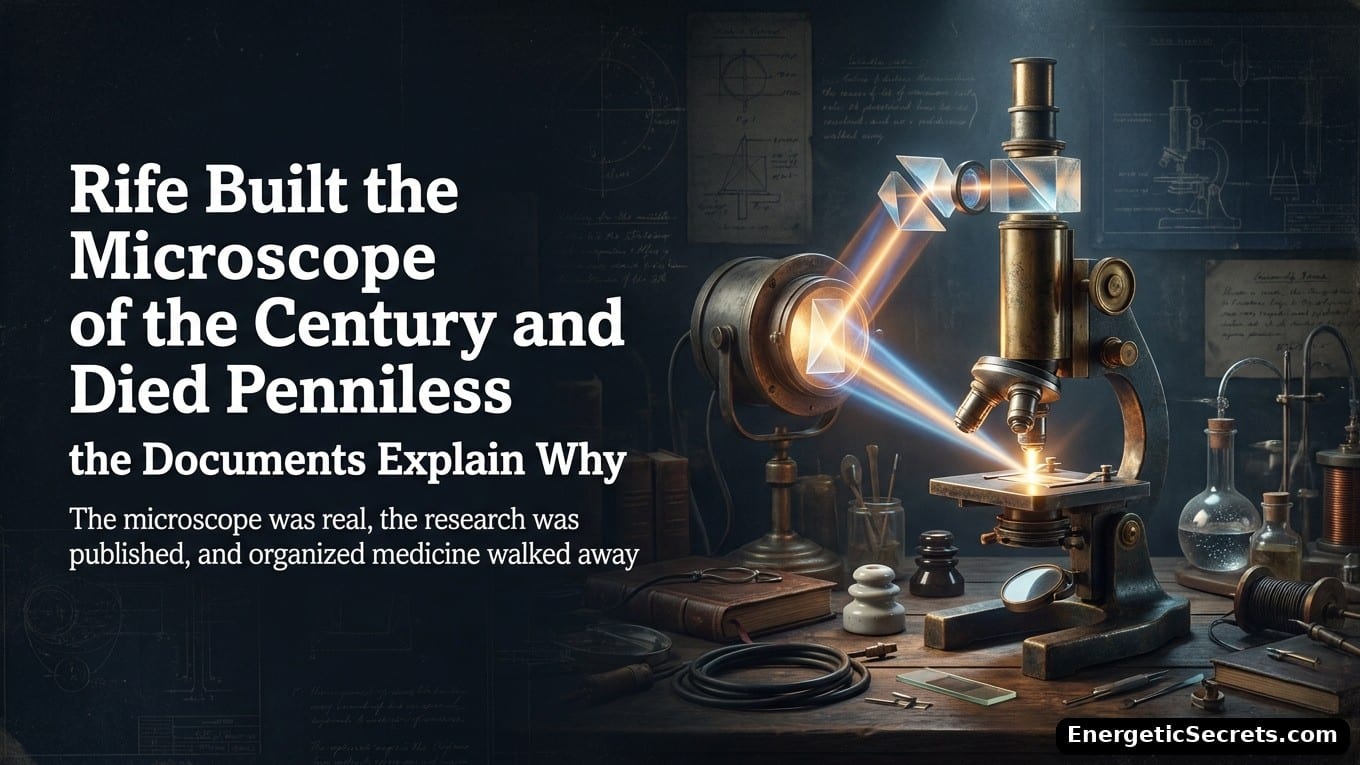
Royal Raymond Rife has spent seventy years being argued about by people who never touched his equipment. I have spent a good part of my adult life in this corner of medical history, along with the EMF and frequency research that grew out of it, and the argument almost always starts in the wrong place. It starts with whether Rife was right. It should start with what he actually built.
Because what he built is not in dispute. It is in the Smithsonian.
In its 1944 annual report, the Smithsonian Institution published a survey article called "The New Microscopes," written by R. E. Seidel and M. Elizabeth Winter. The report contains a section headed "The Universal Microscope," and it describes Rife's instrument in the kind of technical detail you only get from examining a thing that exists (nobody writes down 100 threads to the inch about a rumor). Rife's microscopes, the authors write, "far surpass the theoretical limitations of the ordinary variety of instrument." The largest of them, developed in 1933, "consists of 5,682 parts."
That is a real instrument, described by real people, in a government publication. And once you read how it worked, the whole shape of this story changes.
The prism was the invention
Most retellings of Rife mention the microscope and move on. Nobody explains it. So let me explain it, because the Smithsonian text walks you through the mechanism and the mechanism is the whole point.
The entire optical system of the universal microscope was made of block-crystal quartz, chosen because quartz transmits ultraviolet light well. The illuminating unit alone contained 14 lenses and prisms: three in the high-intensity incandescent lamp, four in a Risley prism, and seven in an achromatic condenser with a numerical aperture of 1.40.
Then comes the part that made it work. Between the light source and the specimen sat two circular, wedge-shaped block-crystal quartz prisms, which polarized the light passing through. Those prisms could be rotated with vernier control through 360 degrees. Rotating them in opposite directions bent the transmitted light at variable angles and projected a slice of spectrum up into the axis of the microscope. By working that spectrum back and forth, you could walk the illumination from the infrared end all the way to the ultraviolet.
Here is why that mattered. When the portion of the spectrum reached the point where the organism and the color band "vibrate in exact accord," the organism itself emitted a characteristic spectrum. Each organism responded to its own specific wavelength. The filter-passing form of typhoid bacillus, for example, emitted a blue spectrum and deviated the plane of polarization by plus 4.8 degrees. The operator would then reset the prisms to minus 4.8 degrees and send a monochromatic beam through the specimen, illuminating the organism in its true chemical color.
What that meant in practice was that you could see a living organism without killing it and without staining it. That is not a small thing. Staining kills the specimen (you destroy the very thing you are trying to look at). Rife's prism system, if it worked as described, let you watch living organisms in their own light, distinguish them by species, and do it with a resolution the Smithsonian authors called a surpassing of the ordinary limits.
There was a second prism trick further up the tube. Normally a microscope's light rays run parallel, then start to converge, and eventually cross, arriving at the ocular spread apart. In the universal microscope, a specially designed quartz prism was inserted at each point where the rays were about to cross, pulling them parallel again. Those prisms sat in tracks of magnelium (a metal with an expansion coefficient close to quartz), aligned by micrometer screws of 100 threads to the inch and spaced only 30 millimeters apart. The result was that light traveled 449 millimeters through a tube whose physical length was only 229 millimeters, zigzagging the whole way.
So when someone tells you Rife's microscope is folklore, you can point them at the mechanism.
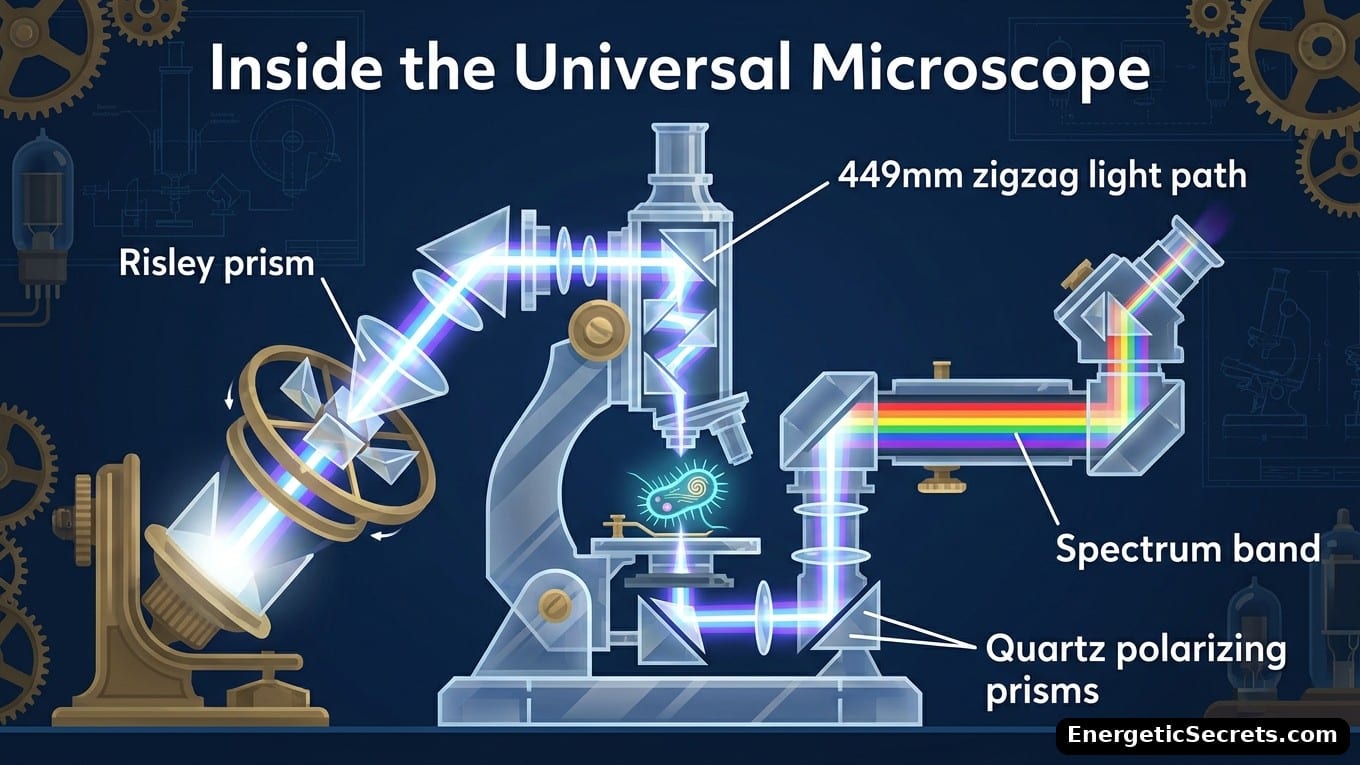
The quartz prism train is not a legend. It is written down, with spacing and thread counts, in the 1944 Smithsonian report. Of course, a description is a description: the Smithsonian was reprinting a survey from the Journal of the Franklin Institute, and it certified nothing. But describing an instrument's prism geometry in that much detail is not how you describe something that never existed.
Why there is no microscope patent, and why that is not a scandal
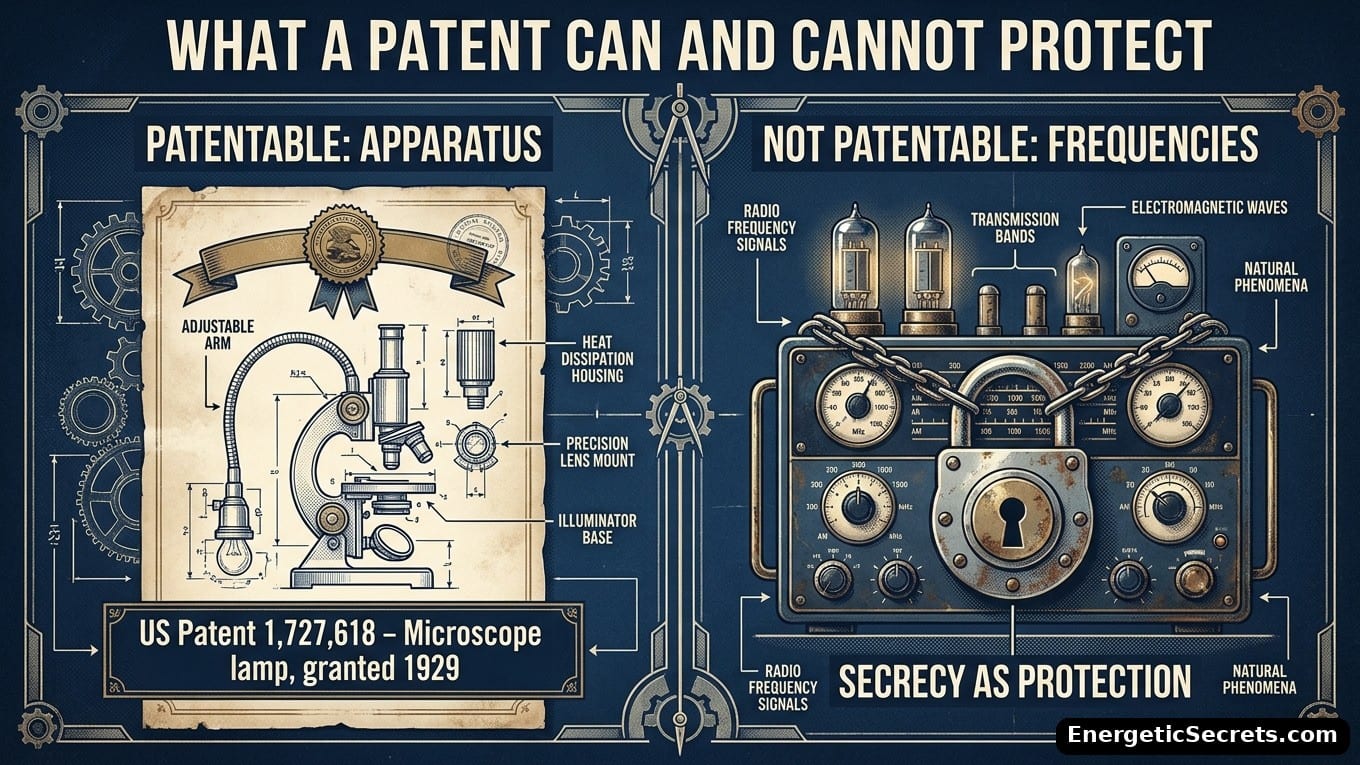
Rife never patented the universal microscope. People treat that absence as a confession. It is not. It is an explanation, and the record supplies it.
Start with what he did patent. On August 2, 1927, Rife filed an application that issued on September 10, 1929 as US patent 1,727,618, "Microscope lamp." You can read the whole thing today. It is a compact, well-thought-out device: a cylindrical housing that mounts in the mirror yoke of a standard microscope, a lens over one end, a reflector over the other, an incandescent lamp entering from the side, and a rheostat to control intensity. His stated aims include light that is "flat and uniform," excellent for microphotography, with ventilation to prevent heat and no fluctuation to strain the operator's eyes. Bausch & Lomb and Swift Instruments both cite it in later patents, which is about the highest compliment a piece of optical equipment can receive.
That is a man who filed for protection when he had something to protect, and what he protected was itself an optical instrument for microscopy.
And this reframes the whole patent argument. A search of the patent index under his name returns exactly one patent. Not a suppressed portfolio, not a stack of filings pulled by interested parties: one lamp. Under the Royal spellings of his name, the index returns nothing at all. He patented the small thing and never patented the big thing. That pattern is not what a cover-up looks like. It is what an unpatentable invention looks like.
So why did the bigger machine never get its own patent? The answer comes from the Rife research community's own technical history, a 313-page report published at rifevideos.com that reproduces and page-cites the 1939 court transcript. Their account is blunt: they had no way to patent the Beam Ray instrument because everything they were doing with the frequency-generating equipment was already in the public domain, and frequencies themselves cannot be patented. The report, citing the trial transcript, makes the point twice: Rife "had no ability to patent the Rife Ray tube instrument."
Keep in mind what a patent actually protects. It protects an apparatus or a process, not a set of frequencies that occur in nature. Rife's machinery used standard transmitting technology, the kind any competent radio engineer of the day could assemble. The only thing worth hiding was which frequencies worked, and there is no patent office on earth that will grant you a number. So the protection he actually had was secrecy. That is the fact that drives everything that happens next.
The engineer, the partnership, and the thing that went wrong
Rife's 1934 equipment was cumbersome, several pieces that were hard to move and use. With Rife's approval, his new engineer, Philip Hoyland of Pasadena, was hired in 1935 by Dr. Milbank Johnson and the University of Southern California Special Medical Research Committee to build a portable instrument. Hoyland delivered the Rife Ray #4 that year, with a 500-watt output.
Then came the change that mattered. In the summer of 1936 Hoyland designed the Rife Ray #5, also called the Beam Ray Clinical instrument. Instead of a damped waveform, which puts only about 11 percent of its power into the output, the new machine effectively used a square wave, which puts in about 50 percent. That let Hoyland cut the power from 500 watts down to 75 and still beat the earlier machine. The community report states that the Rife Ray #5 "worked better than any of the previous machines."
Hoyland also built in a concealment system. He generated Rife's frequencies through harmonic sidebands, so that the numbers on the dials were not the numbers that mattered, and he used a code to give frequencies at all. His stated reason, according to the same report, was fear that the technology would be stolen. Now, that fear had some basis. The report describes a British partner, Mr. Parsons, trying to take the instrument. But it also put an engineer between Rife and his own research.
Here is where the story turns, and it is documented in Rife's own hand. On May 14, 1939, Rife wrote to Dr. Bertram Winter Gonin in England:
"I spoke only Friday evening to a Mr. John Chamblin, a radio man now connected with Beam Ray Inc., about the redesign and building of a device according to the old Rife Ray principles; as the present instrument has been so deviated away from that old principle that it is nowhere near the same... those devices which you have are merely working on a harmonic and not a true frequency."
Read that again. The inventor is describing his own company's flagship product as deviated away from his principles. Whatever Rife and Hoyland had been to each other, by 1939 they were not aligned.
The company, and the trial that destroyed it
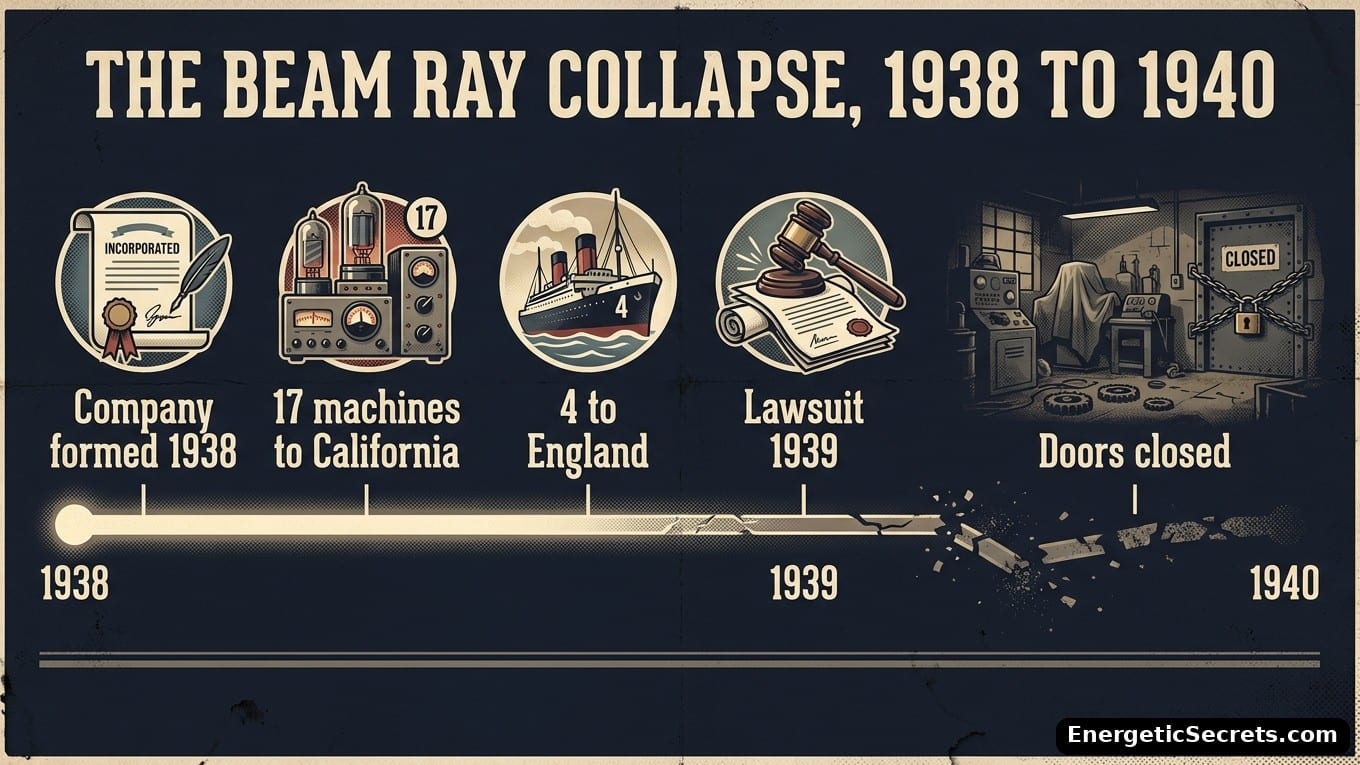
The company itself was formed in 1938, at the urging of Rife's friend Ben Cullen, after Gonin's British group wanted to buy machines and Rife had no commercial operation to sell them. It was called Beam Rays, later the Beam Ray Corporation. Hoyland held the majority ownership of the rights to the machine and became Rife's partner in the business. Around 17 instruments went to doctors in California, and four went to England. Dr. James B. Couche and Dr. Hamer were among the buyers.
Then it came apart. The community report describes the company being destroyed in 1939 and 1940 when Hoyland brought a lawsuit against Beam Rays, seeking to stop one of the partners from illegal stock trading and to dissolve the British contract. I want to be careful here, because I have seen this episode described as a straight act of sabotage and the record does not support that as flatly as people say. What the record does support is a company that blew itself apart in litigation within two years of forming.
And the litigation is not folklore. It left a paper trail. Rife's attorney was Bertrand Comparet. Both Rife and Hoyland took the stand. The transcript, scanned from a copy that survives, runs to thousands of pages and is quoted by page number in the community report (I have gone back to those pages more than once, and they read like a company arguing with itself in public). From it we get exchanges like this one, on where the frequencies actually came from:
COMPARET: "He set his machine and you measured his frequencies?"
And this, from the bench:
JUDGE KELLY: "Is that the machine Mr. Hoyland got the frequencies from?"
The trial also shows how thin the protection was. Asked whether the work was to be done under Rife's direction, Hoyland answered simply: "That's what the contract called for." The contract called for it. It did not happen that way.
What the trial cost
The aftermath is the part that gets left out, and it is the part that matters.
From the stress of the Beam Ray trial, Rife began drinking, and, in the words of the community report, "all that he had worked so hard to accomplish was almost destroyed." Doctors who had bought instruments returned them, and the reason given is pressure from the American Medical Association. Rife parted out some of those returned Beam Ray machines and sold them for radio parts. Beam Ray Corporation closed its doors.
Let me put that plainly, because it is the documented suppression story and it does not need a conspiracy to land. The man had working instruments in the hands of practicing physicians. The instruments came back. The company that made them shut down. He spent the rest of his life trying to rebuild the work, with a new engineer, Verne Thompson, through the 1940s and 1950s, and he never did get back to where he had been.
When he died in 1971, the Daily Californian's obituary was headlined "Scientific Genius Dies: Saw Work Discredited." Rife told that reporter that organized medicine had "brainwashed and intimidated" his colleagues. He died, in the paper's words, penniless and embittered.
Now, I have to flag something. The claim that Morris Fishbein of the AMA personally commissioned Hoyland to break up the company circulates widely in this field, and people ask me about it constantly. I could not find it in the documentary record. Fishbein does not appear in the 313-page technical report I searched, or in the trial quotations it reproduces. So I will not tell you it happened. I will tell you what the record shows: doctors were pressured, instruments came back, a company closed, and the inventor's own account was that organized medicine had intimidated his colleagues. You can judge the Fishbein story for yourself. The documented sequence does not need it.
What is actually left standing
Strip away the folklore and here is what remains. A man in San Diego built optical instruments that a Smithsonian publication described in exacting technical detail, including a quartz prism system that let him view living organisms unstained and in their own characteristic light. He published on it too: a 1931 paper he co-authored in California and Western Medicine, and observations made with his microscope that Edward C. Rosenow put into Science in 1932. The New York Times reported on his apparatus in 1931. He patented the part he could patent and could not patent the rest. He hired an engineer to protect the secrecy that remained, and the protection became the problem, maybe he was double crossed? We just don't have any actual record of the Hoyland double cross. Two years after the company formed, a lawsuit tore it apart. After the trial, the medical community walked away. This was of course in an era where the medical community was effectively destroying other remedies such as the Hoxsey formula.
I should add that the community that supports Rife does itself no favors with some of its own stories. The site that publishes that technical report also lists three widely repeated claims as false assumptions: that Rife was murdered, that Dr. Milbank Johnson was murdered, and that a 1934 clinic cured sixteen terminally ill cancer patients. On the clinic, the correction is about the cohort (the patients were a mix of cancer and tuberculosis, not sixteen cancer patients), and the report itself still calls that same clinic a total success elsewhere in its pages. One could say that regardless of the actual numbers the 1934 clinic did appear to be rather successful, but also successfully scrubbed clean in the historical record. Nonetheless, I raise this because repeating the folklore is exactly what lets a skeptic wave off the whole subject.
Which brings me to the honest part. I do not know exactly what the universal microscope was capable of, and neither does anyone living who never looked through one. There is no surviving instrument that we know of to test. What I do know is that the standard dismissal, that Rife was a footnote and a fraud, does not survive contact with the documents. The microscope was real. The prism was the key to it. And the business was destroyed in court while the medical establishment walked away.
You do not need a secret meeting to explain that. You only need a patent system that could not help him, an engineer who held the keys, and a lawsuit.
In this article I touched on the harmonic sideband method that was used in the original 1930s Beam Rays machine. You can access my exclusive 15 minute presentation on this which clarifies most of the confusion out there about Rife Frequencies on RifeCode.com
Disclaimer: I am not a health professional of any kind and make no medical claims. Please do your own research. Nothing in this article should be considered medical advice. None of the statements have been evaluated by the FDA. Not intended to diagnose, treat, cure or prevent any disease. If you have a medical condition seek professional help.
---
1. Seidel, R. E., and M. Elizabeth Winter. "The New Microscopes." In Annual Report of the Board of Regents of the Smithsonian Institution, 1944, vol. p. 207ff. Washington: Government Printing Office. (Survey originally published in the Journal of the Franklin Institute, vol. 237, no. 2, February 1944; reprinted in the Smithsonian report's general appendix.) Full text: https://archive.org/details/annualreportofbo1944smit
2. Rife, Roy R. U.S. Patent US1727618A, "Microscope lamp." Filed August 2, 1927; granted September 10, 1929. https://patents.google.com/patent/US1727618A/en
3. Google Patents (USPTO index). Inventor query "Roy R Rife." 1 result, verified 2026-10-06. https://patents.google.com/?inventor=Roy+R+Rife
4. Google Patents (USPTO index). Inventor query "Royal Raymond Rife." 0 results, verified 2026-10-06. https://patents.google.com/?inventor=Royal+Raymond+Rife
5. The Rife Machine Report: A History of Rife's Instruments and Frequencies. rifevideos.com, January 2022. 25 chapters, 313 pp. https://rifevideos.com/pdf/a_history/the_rife_machine_report_a_history_of_rifes_instruments_and_frequencies.pdf
6. Kendall, Arthur Isaac, and Royal R. Rife. December 1931. "Observations on Bacillus Typhosus in Its Filterable State: A Preliminary Communication." California and Western Medicine 35 (6): 409-411. PMID 18741967; PMCID PMC1658030. https://pubmed.ncbi.nlm.nih.gov/18741967/
7. Rosenow, Edward C. August 26, 1932. "Observations with the Rife Microscope of Filter-Passing Forms of Microorganisms." Science 76: 192-193. DOI 10.1126/science.76.1965.192. https://doi.org/10.1126/science.76.1965.192
8. "Bacilli Revealed by New Microscope; Dr. Rife's Apparatus, Magnifying 17,000 Times, Shows Germs Never Before Seen." The New York Times, November 22, 1931, p. 19.
9. Hood, Del. August 11, 1971. "Scientific Genius Dies: Saw Work Discredited." Daily Californian. https://rifevideos.com/scientific_genius_dies_saw_work_discredited.html
10. Rife, Royal R. Letter to Dr. Bertram Winter Gonin, May 14, 1939, page 1 of 3. Quoted in The Rife Machine Report, chapter 6.
11. Comparet, Bertrand, and Philip Hoyland. Beam Ray Trial transcript (1939), pages 91, 93, 209-210, 217-222, 778, 905-916, 1290-1293, 1553-1555. Quoted in The Rife Machine Report. |




7 Comments
Join the conversation
The obituary headline hits hard. Died penniless and embittered after doctors sent the machines back. Whatever you think of the science that's a sad way to go out.
The 449mm of light folded into a 229mm tube is wild to me. I did optics in school and bouncing rays back parallel with prisms at every crossing point is genuinely clever design.
So the whole business fell apart because the engineer hid the frequencies with sidebands and then sued everybody. That's not suppression that's just a bad partnership.
Still not sold honestly. A detailed description in a journal reprint isn't proof the thing performed the way they said. Lots of instruments get written up and then nobody can replicate them.
I appreciate that you didn't run with the Fishbein thing. Everybody repeats it like gospel and nobody can show you where it came from. Saying you couldn't find it is more convincing than claiming you did.
My grandfather worked in San Diego around that time and always said there was a man up on Point Loma with a lab nobody was allowed into. Never knew the name until now.
The part that got me was the 5,682 parts. Who sits down and builds something with that many pieces by hand in 1933. That alone tells you the guy was not making it up.