
Cold Fusion, Magnet Motors, and the Law That Can S(t)eal an Invention |
No name required: one advertising ID ties your home, your commute, and the stores you walk into to a single file that brokers sell |
Few scientific announcements have landed with the force of the one on March 23, 1989. At a University of Utah press conference, the chemists Martin Fleischmann and Stanley Pons said they had measured excess heat from the electrolysis of heavy water in a palladium cell, and that the only explanation they could find was nuclear: deuterium fusing at a laboratory bench. The world called it cold fusion [15]. Within weeks their preliminary note, "Electrochemically induced nuclear fusion of deuterium," appeared in the Journal of Electroanalytical Chemistry and Interfacial Electrochemistry [8].
The claim did not survive review. The Department of Energy's Energy Research Advisory Board convened a cold fusion panel in 1989; it declined to recommend a dedicated DOE program but supported funding peer-reviewed experiments to look further [9]. In December 2004 the DOE Office of Science reviewed the field again and concluded that the occurrence of low energy nuclear reactions was not conclusively demonstrated by the evidence, and that no reviewer recommended a focused federal program [10].
Yet the idea never left government. NASA's Glenn Research Center maintains a documented program on Lattice Confinement Fusion, an alternative to thermonuclear fusion it studies for deep-space power, published through the NASA Technical Reports Server [11][12]. In October 2021 the Advanced Research Projects Agency-Energy held a Low-Energy Nuclear Reactions Workshop [13]. And patents on palladium systems were granted and published in the ordinary way, among them U.S. Patent 6,764,561 on palladium-boron alloys, whose specification describes electrodes "for generation of heat energy" [14].
Ask about permanent-magnet motors and the record is thinner. No reputable source documents a working magnet motor that produces more energy than it consumes. The citable institutional fact is that the U.S. Patent and Trademark Office has long required a working model before it will grant a patent on a perpetual-motion machine. That is a screening rule about unproven claims, not evidence of a suppressed breakthrough [16].
There is one notable exception but it's not a secrecy case. Howard R. Johnson was born in Wise, Virginia, in 1919 and died in Blacksburg in 2008 at age 88, per a memorial published by Tom Bearden [28]. In 1973 he filed for what became U.S. Patent 4,151,431, "Permanent magnet motor," granted on April 24, 1979 [26]. The application was first rejected by an examiner who called the motor a true "perpetual motion device." The Patent and Trademark Office Board of Appeals disagreed, holding that the permanent magnets constituted an energy source, and the patent was granted, as The New York Times reported in "Patents: Motor Run Solely by Magnets" on April 28, 1979 [27].
The grant is a legal fact; the motor's performance is not but I've seen a great deal on this invention and believe it to be real. A December 2024 re-examination by J. L. Duarte, a retired electrical engineer, is a two-page theoretical note, not an experiment, and it does not confirm over-unity output [29]. Its own conclusion is that the motor's development was abandoned after 1980 and academic institutions did not pursue further research. No secrecy order under 35 U.S.C. section 181 was ever applied to Johnson's work [1]. I personally don't believe the "no further research" dead end as a justification to say the invention didn't work. I've seen the interview with Thomas Bearden and John Bedini at Johnson's home in the early 2000s demonstrating the magnet-drive systems.
None of that is secrecy. The energy record above is public, from press conferences and peer review to workshops and granted patents. And yet the United States operates a legal mechanism designed precisely to keep some inventions out of that public record. Eight sections of Title 35, sections 181 through 188, collectively called the Invention Secrecy Act [1][2], give the federal government the power to stop both the publication of a patent application and the grant of the patent itself.
The statute is old, tracing its current form to the Invention Secrecy Act of 1951 and codifying secrecy practices that reach back to World War II. But it is far from dormant. At the end of fiscal year 2025, 6,543 secrecy orders were in effect [3]. That same year, 102 new orders were imposed and only 30 were rescinded [3].
A few decades ago Patrick Flanagan's Neurophone invention was put under secrecy and he told the story of how he managed to get it rescinded in the years that followed.
What Section 181 Authorizes
The core authority sits in a single sentence of 35 U.S.C. section 181 [1], and it splits into two distinct paths with two distinct triggering standards. Getting the standards right matters, because they are not interchangeable.
The first path covers inventions in which the government already holds a property interest. Whenever publication or disclosure of such an invention, through either the publication of the application or the grant of a patent, might, in the opinion of the head of the interested government agency, be detrimental to the national security, the Commissioner for Patents, upon being notified, must order the invention kept secret and withhold both publication and grant [1].
The second path covers everyone else: the private inventor whose application carries no government property interest. Here the Commissioner does not act on the Commissioner's own judgment. The Commissioner must make the application available for inspection to the Secretary of Defense, the Department of Energy (successor to the Atomic Energy Commission named in the statute), and any other department the President has designated as a defense agency [1]. If one of those agencies decides that disclosure would be detrimental to the national security, it notifies the Commissioner, who then issues the secrecy order.
The distinction between "might" and "would" is real. On the government-interest path, a mere possibility of detriment, in the agency head's opinion, is enough to trigger secrecy. On the private-inventor path, the reviewing agency must reach a stronger conclusion, that disclosure would be detrimental. In both cases the ultimate lever is the same: the Commissioner withholds the publication and the grant [1].
Unfortunately this also leads to a gag order which prevents the inventor from discussing their invention again! This alone can lead to inventors who make breakthrough energy discoveries to simply keep their mouth shut and never seek a patent.
How an Order Is Actually Issued
The secrecy order does not arise in a vacuum. Applications pass through a screening process before any defense agency ever sees them, and the Patent and Trademark Office has formalized that screening over decades.
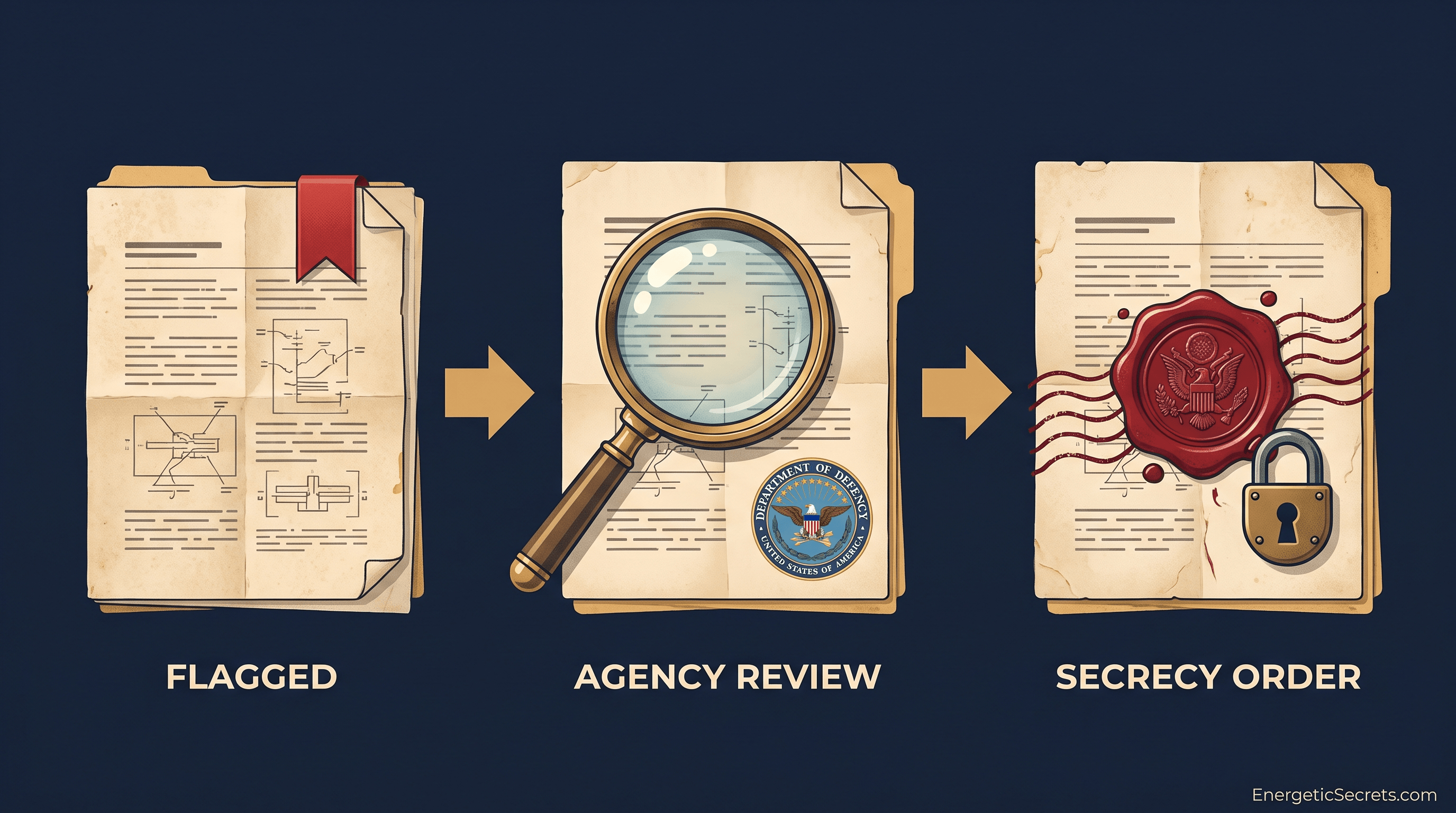 The PTO examines applications for subject matter that might touch national security or export-controlled technology. When an application is flagged, it is referred to the relevant defense agencies for review. On the military side, those referrals route through a single conduit: the Armed Services Patent Advisory Board, or ASPAB, which the USPTO's own 1991 program description calls the sole authority for secrecy order recommendations from the Department of Defense [4].
If the referring agency decides the disclosure standard is met, it recommends a secrecy order, and the Commissioner issues it. The Commissioner is the person who formally signs the order, but the substantive security judgment comes from the referring agency [4].
The USPTO sorts these orders into three types. A Type 1 order applies to applications containing technical data whose export is controlled under current export-control laws. A Type 2 order applies to data that is classified, or classifiable, where the applicant already holds a security agreement with the Department of Defense. A Type 3 order is the catch-all for every case where Type 1 and Type 2 do not fit [4]. In fiscal year 2025, the new Department of Defense orders broke down as 74 Type 1, three Type 2 classified orders, and 17 Type 3 [3].
What the Order Legally Gags
The most misunderstood feature of a secrecy order is its reach. It does not merely cover the paper application sitting in the PTO's files.
The order applies to the subject matter of the invention itself, not just to the patent application. That means it restricts disclosure or publication of the invention in any form. The inventor cannot describe it publicly, cannot publish it, and cannot hand the technical details to someone who was not already aware of them before the order. The restriction binds more than the named applicant. It runs to assignees and successors, and it reaches other patent applications, whether already filed or filed later, that contain any significant part of the same subject matter [4].
 In plain terms, a secrecy order is a gag on the idea, not on a piece of paperwork. The 1991 USPTO program description states this plainly: the order restricts disclosure of the invention in any form, and related applications fall within its scope [4].
Who Sits on the Review Panel
The agencies that make the recommendation are worth naming, with one important caveat about time. The 1991 USPTO program description lists the recommending agencies as the Army, Navy, Air Force, National Security Agency, Department of Energy, and National Aeronautics and Space Administration [4]. That roster is historical; it describes the structure as it existed three and a half decades ago, and it should not be read as the current composition.
The modern picture is different, and it comes from the fiscal year 2025 statistics. That year's new orders, by sponsoring agency, broke down as follows: Navy 63, Air Force 24, Army 3, Department of Energy 5, NSA 1, NASA and DARPA 3, other agencies 3, and the Defense Technology Security Administration 0. The table confirms what the 1991 roster suggested: the military services, especially the Navy and Air Force, dominate the list of sponsors. No health-device or consumer-technology sponsor appears anywhere in the table [3].
The Renewal Machinery
A secrecy order is not permanent by default. The statute caps any single order at one year [1]. But that cap is misleading, because the order can be renewed again and again.
 The Commissioner must renew an order for additional one-year periods whenever the agency that caused it certifies that an affirmative determination has been made that the national interest continues to require secrecy. There is no statutory limit on how many times an order can be renewed, which is how some orders stretch for decades [1]. Reporting from the Center for Investigative Reporting documented in 2013 that some secrecy orders had been in effect for decades [5]. No specific oldest order, and no specific age, is part of the verified record here.
Wartime and national emergencies change the clock. An order in effect during a time when the United States is at war remains in effect for the duration of hostilities plus one year. An order in effect during a national emergency declared by the President remains for the duration of the emergency plus six months [1].
Compensation Under Section 183
The law recognizes that suppressing an invention can cost its owner real money, and it provides a path to compensation. That path is narrow, and success on it is rare.
An applicant whose patent is withheld may apply to the head of the agency that caused the order for compensation for the damage caused by the secrecy order, for the government's use of the invention, or both [2]. The agency may settle the claim in full. If it does not settle, it may award a sum not exceeding 75 percent of what it considers just compensation. A claimant who disagrees with the award can then sue in the United States Court of Federal Claims or a district court. Government employees who made the invention in the course of full-time government service have no claim at all [2].
The 75 percent cap is the structural fact that matters most. Even a claimant who proves the full value of the invention through litigation is entitled, from the administrative agency, to no more than three quarters of what the agency itself decides is just [2].
Foreign Filing Under Sections 184 and 185
The secrecy system also reaches across borders. A person may not file a foreign patent application on an invention made in this country within six months of the United States filing without a foreign-filing license from the Commissioner. When the invention is under a secrecy order, the license requires the concurrence of the agency that caused the order [2].
The penalty for ignoring this is severe on the domestic side. A United States patent issued after an unauthorized foreign filing is invalid, unless the failure to obtain the license happened through error and the subject matter falls outside section 181. An inventor who files abroad without permission can thus forfeit the American patent entirely [2].
Penalties Under Sections 186 Through 188
The statute backs the secrecy order with criminal penalties. Willful and unauthorized disclosure of an invention under a secrecy order, or willful foreign filing in violation of section 184, is punishable on conviction by a fine of not more than $10,000, imprisonment of not more than two years, or both [2].
One number here deserves a caveat. The $10,000 figure is the statutory ceiling as enacted in 1952, and it has not been indexed or updated in the code. It should not be read as a modern-dollar amount. Section 187 carves out an exemption: government officers and agents acting within the scope of their authority are not subject to the penalty. Section 188 lets the relevant agencies issue rules and delegate their powers [2].
Documented Cases
The statute reads differently when attached to real people. A handful of cases are well documented, and they show how long a secrecy order can last and how unevenly its consequences fall.
 Robert Gold developed a wireless-communications advance that the Department of Defense concluded could threaten national security. A secrecy order was imposed in 2002, barring him from discussing his own work. His attorney succeeded in lifting the order five years later, but by then, Gold said, the window for commercializing the invention had passed [5]. Gold's research had been government-sponsored, and the government retained usage rights.
James Greer of Alabama filed in 2000 for technology that could detect objects including stealth aircraft. He lived under a secrecy order for eight years. His attorney argued that the order had lasted far too long and had blocked commercialization for both defense and civilian uses, including object tracking for smarter highways and next-generation communications [5].
James Constant filed in 1969 for radar technology to track shipping containers and packages on an assembly line. His secrecy order was lifted in 1971. He sought damages, but at trial in 1982 the court ruled against him, finding that his own lack of business experience, not the secrecy order, was what had held the invention back [5].
The compensation machinery has produced at least one modern settlement. Inventors Budimir and Desanka Damnjanovic filed a compensation complaint in 2014 over a secrecy order. After the Air Force's motion to dismiss was granted in part and denied in part in September 2015, the parties stipulated a $63,000 lump-sum settlement in December 2015, as reported in the Federation of American Scientists' index of the case documents [6].
The secrecy system's oldest roots are atomic. A 2017 Freedom of Information Act release, documented in the FAS invention-secrecy index, covers United States patents related to the Manhattan Project, showing how atomic-energy secrecy and the patent system were intertwined from the start [6].
What the Record Does Not Show
The energy technologies at the top of this article, and the inventors readers keep asking about, share one thing with Royal Raymond Rife: none of them appears anywhere in the secrecy-order record. This article exists, in part, because readers of HealthHarmonic asked whether the devices and inventors in the energy and alternative-health space, Rife chief among them, were ever silenced by an Invention Secrecy Act order [1]. The honest answer is that the records show no such thing, at least for Rife. Energy inventions on the other hand can't be ruled out, after all, unless rescinded they are secret.
No documented secrecy-order footprint exists for Rife or for Rife-adjacent energy or health inventors in any source consulted for this article. The same holds for LENR and magnet-motor work: the record shows public press conferences, public papers, public patents, and open government reviews, not secrecy orders [11][13][14]. But isn't that the point, it's secret?
Rife's patents were public. His work was written up in Popular Science in June 1931 and in the Smithsonian Institution's 1944 annual report, which is the opposite of what a secrecy order would permit [7]. The documented suppression narrative around Rife is medical, regulatory, and reputational, running through the American Medical Association, the Department of Public Health, and organized medicine, not through the USPTO secrecy-order mechanism [7].
Bottom line, there are plenty of other ways to suppress technology without a secrecy order.
That absence is itself the finding, and it is the anchor of this article's credibility. The secrecy orders that do exist, more than six thousand of them at the end of fiscal year 2025 [3], are overwhelmingly sponsored by military and defense agencies for export-controlled and classified technology. The quiet power of the Invention Secrecy Act is real, and it is exercised on real, documented cases. But the evidence does not place Rife, LENR, or any magnet motor under it, as if we would know if it did!
The Death Question in the New-Energy Field
Eugene Mallove (1947-2004) was an American scientist and science writer: editor and publisher of Infinite Energy magazine, founder of the nonprofit New Energy Foundation, and a leading proponent of cold fusion. He resigned as MIT's chief science writer in 1991 over the school's handling of cold fusion data. His book, "Fire from Ice" (1991), was nominated for a Pulitzer Prize. He had earlier worked at Hughes Research Laboratories, the Analytic Science Corporation, and MIT's Lincoln Laboratory [25].
Mallove was beaten to death in Norwich, Connecticut, on May 14, 2004. Police initially suspected a robbery in progress; the motive at trial was an eviction dispute, after Mallove cleared out belongings of tenants he had evicted the month before [23]. Two men arrested in 2005 had all charges dismissed in 2008 for insufficient evidence [24]. A 2010 re-investigation brought convictions: Chad Schaffer pleaded guilty in 2012 to manslaughter and accessory to third-degree robbery [20][21], and Mozzelle Brown was convicted in 2014 of murder and conspiracy [22]. In January 2025, the Connecticut Appellate Court overturned Brown's convictions over an undisclosed prosecutor agreement with a witness and ordered a new trial [17][18]; as of March 2026, state prosecutors were still weighing whether to retry him [19].
That reversal, two decades on, is part of why the case still unsettles the new-energy field. Mallove's work led to some conspiracy discussions about the homicide [25], and a list of supposedly suspicious researcher deaths circulates in that community as the field's own claim, without documentation; neither the record nor this article treats it as fact.
I knew Mallove personally from Tesla conferences and can attest to his commitment to cold fusion and LENR research, and to his role as a connector in an obscure field. The timing of his death is highly suspicious and I sincerely believe it set back the progress of "Cold Fusion" by decades before it reemerged as "LENR" (Low Energy Nuclear Reactions) and given all the drama in the court cases against the alleged murderers of Mallove, it's hard to deny there could have been some foul play involved.
References
1. 35 U.S.C. § 181, Secrecy of certain inventions and withholding of patent. United States Code, Title 35, Chapter 17. Legal Information Institute, Cornell Law School. https://www.law.cornell.edu/uscode/text/35/181
2. 35 U.S.C. §§ 182–188, Abandonment; compensation; foreign filing; patent barred; penalty; nonapplicability; rules and delegation. United States Code, Title 35, Chapter 17 (2024 edition), prepared by the Office of the Law Revision Counsel, U.S. House of Representatives. U.S. Government Publishing Office. https://www.govinfo.gov/content/pkg/USCODE-2024-title35/html/USCODE-2024-title35-partII-chap17.htm
3. Federation of American Scientists, "Invention Secrecy Activity (as reported by the Patent & Trademark Office)," FY2021–FY2025. FAS Project on Government Secrecy. https://sgp.fas.org/othergov/invention/stats.html
4. "The Secrecy Order Program in the U.S. Patent & Trademark Office" (Rev. 6/27/91). U.S. Patent and Trademark Office, republished by the Federation of American Scientists. https://sgp.fas.org/othergov/invention/program.html
5. G.W. Schulz, "Government secrecy orders on patents keep lid on inventions," Center for Investigative Reporting, April 16, 2013. Via Internet Archive Wayback Machine capture (May 2, 2013). https://web.archive.org/web/20130502175955/https://cironline.org/reports/government-secrecy-orders-patents-keep-lid-inventions-4349
6. Federation of American Scientists, "Invention Secrecy" index page. FAS Project on Government Secrecy. https://sgp.fas.org/othergov/invention/index.html
7. "Royal Rife." Wikipedia (secondary/tertiary source, used only for historical and regulatory framing). https://en.wikipedia.org/wiki/Royal_Rife
8. Fleischmann, Martin, and Pons, Stanley. "Electrochemically induced nuclear fusion of deuterium." Journal of Electroanalytical Chemistry and Interfacial Electrochemistry, 261 (2A): 301-308 (1989). DOI 10.1016/0022-0728(89)80006-3. Bibliographic details retrieved via Wikipedia, "Cold fusion," fetched 2026-10-06; the journal original is paywalled and was not directly retrieved.
9. "Report of the Cold Fusion Panel to the Energy Research Advisory Board" (1989). U.S. Department of Energy, Energy Research Advisory Board. Text retrieved via the lenr-canr.org archive mirror, https://lenr-canr.org/acrobat/ERABreportofth.pdf
10. "Report of the Review of Low Energy Nuclear Reactions." U.S. Department of Energy, Office of Science, December 1, 2004. Text retrieved via the lenr-canr.org archive mirror, https://lenr-canr.org/acrobat/DOEreportofth.pdf. Canonical OSTI identifier DOI 10.2172/1159285.
11. Forsley, L. P., and Benyo, T. L. "Low and High Temperature Non-Thermonuclear Fusion Approaches to Energy Production." NASA Technical Reports Server, Document ID 20210014856, April 30, 2021. Glenn Research Center, White Paper. https://ntrs.nasa.gov/citations/20210014856
12. Benyo, T. L., et al. "LENR Products: Lattice Confinement Fusion (LCF), Fission, or Both?" NASA Technical Reports Server, Document ID 20230012003, 2023. Glenn Research Center. https://ntrs.nasa.gov/citations/20230012003
13. "Low-Energy Nuclear Reactions Workshop." Advanced Research Projects Agency-Energy, October 21, 2021. https://arpa-e.energy.gov/events/low-energy-nuclear-reactions-workshop
14. U.S. Patent 6,764,561 B1. "Palladium-boron alloys and methods for making and using such alloys." United States Patent and Trademark Office. https://patents.google.com/patent/US6764561B1/en
15. "Cold fusion." Wikipedia (secondary/tertiary, framing only). https://en.wikipedia.org/wiki/Cold_fusion. Used only for the March 23, 1989 announcement, the 1989 paper's bibliographic details, and the list of cold-fusion-related patents.
16. "Perpetual motion." Wikipedia (secondary/tertiary, framing only). https://en.wikipedia.org/wiki/Perpetual_motion. Used only for the USPTO working-model requirement on perpetual-motion patents and the fraud-history framing of over-unity claims.
17. Brown v. Commissioner of Correction, AC 46658, Connecticut Appellate Court, officially released January 28, 2025. 229 Conn. App. ___, 330 A.3d 134 (2025). Panel: Suarez, Clark and Lavine, Js. Official advance-release PDF: https://jud.ct.gov/external/supapp/Cases/AROap/AP230/AP230.93.pdf, via the Connecticut Judicial Branch news log (https://www.jud.ct.gov/LegalResources/NewsLog/Post?id=6178). Holds that the state's failure to disclose an agreement with a cooperating witness entitled Brown to a new trial, and directs the habeas court to vacate the murder and conspiracy convictions.
18. Connecticut Judicial Branch, Supreme/Appellate Case Look-up, case CRN 79360 (AC 46658). http://appellateinquiry.jud.ct.gov/CaseDetail.aspx?CRN=79360. Docket record of the January 28, 2025 disposition and the Commissioner of Correction's subsequent petition for certification to the Connecticut Supreme Court.
19. "State considers new trial in 2004 Norwich murder case." The Day, March 8, 2026. https://theday.com/news/855893/state-considers-new-trial-in-2004-norwich-murder-case/, via article.wn.com. Source for the post-appeal status that prosecutors were weighing a retrial as of March 2026.
20. Smith, Greg. "Schaffer accepts plea deal in Mallove murder trial." Norwich Bulletin, April 20, 2012. https://www.norwichbulletin.com/story/news/crime/2012/04/21/schaffer-accepts-plea-deal-in/65030082007/. Source for Chad Schaffer's mid-trial guilty plea to first-degree manslaughter and accessory to third-degree robbery, and his 16-year sentence.
21. "Man Gets 16 Years in Prison for Killing Scientist." NBC Connecticut / Associated Press, June 28, 2012. https://www.nbcconnecticut.com/news/local/man-gets-16-years-in-prison-for-killing-scientist/1906691/. Source for Schaffer's sentence and the eviction of his family from Mallove's property.
22. "Convicted Mallove killer sentenced to 58 years in prison." Norwich Bulletin, January 6, 2015. https://www.norwichbulletin.com/story/news/courts/2015/01/06/convicted-mallove-killer-sentenced-to/35580646007/. Source for Mozzelle Brown's October 2014 conviction and his 58-year sentence.
23. "Accused accomplice in 2004 Eugene Mallove slaying sentenced to probation." Norwich Bulletin, May 27, 2015. https://www.norwichbulletin.com/story/news/courts/2015/05/27/accused-accomplice-in-2004-eugene/34468607007/. Source for Candace Foster's testimony and the eviction-dispute motive.
24. "Judge dismisses charges in Mallove murder." Norwich Bulletin, November 6, 2008. https://www.norwichbulletin.com/story/news/crime/2008/11/06/judge-dismisses-charges-in-mallove/64946934007/. Source for the 2008 dismissal of the 2005 charges against Gary McAvoy and Joseph Reilly.
25. "Eugene Mallove." Wikipedia (secondary/tertiary, framing only). https://en.wikipedia.org/wiki/Eugene_Mallove. Used for biography, case chronology, and the ceiling wording that Mallove's work "led to some conspiracy theories regarding the homicide."
26. U.S. Patent 4,151,431 A, "Permanent magnet motor." Inventor Howard R. Johnson. Filed December 6, 1973; granted April 24, 1979. United States Patent and Trademark Office, via Google Patents. https://patents.google.com/patent/US4151431A/en
27. "Patents: Motor Run Solely by Magnets." The New York Times, April 28, 1979, page 32. Retrieved via the Internet Archive Wayback Machine capture of June 7, 2021. https://web.archive.org/web/20210607194407/https://www.nytimes.com/1979/04/28/archives/patents-motor-run-solely-by-magnets.html. Source for the 1973 filing, the examiner's "perpetual motion device" rejection, and the Board of Appeals reversal.
28. Bearden, Tom. "Howard R. Johnson, June 1, 1919 to January 2, 2008, In Memoriam." March 29, 2008. Mirrored at https://billstclair.com/www.cheniere.org/misc/howardjohnson/obituary_teb.htm (original: cheniere.org). Advocacy-site memorial reproducing obituary biographical facts; used only for birth and death dates and places, not for any technical or break-in claim.
29. Duarte, J. L. "Howard Johnson magnet motor reexamined." Eindhoven University of Technology, published December 24, 2024. Submitted-manuscript version via the TU Eindhoven Pure portal. https://research.tue.nl/en/publications/howard-johnson-magnet-motor-reexamined/. A two-page theoretical analysis note, not an experiment or replication; concludes the motor's development was abandoned after 1980 and that academic institutions did not pursue further research. |



2 Comments
Join the conversation
That 75 percent cap seems backwards to me. The government decides what your invention is worth and then only pays three quarters of its own number? Who would ever agree to that.
6,543 secrecy orders still active is the number that got me. Everybody argues about cold fusion but nobody talks about the thousands of patents sitting in a drawer right now.