
Frequency Weapons and Mind Control - Behavioral Modification Through EM Fields |
An investigation into electromagnetic mind effects, military research programs, and the documented science of behavioral modification through EM fields |
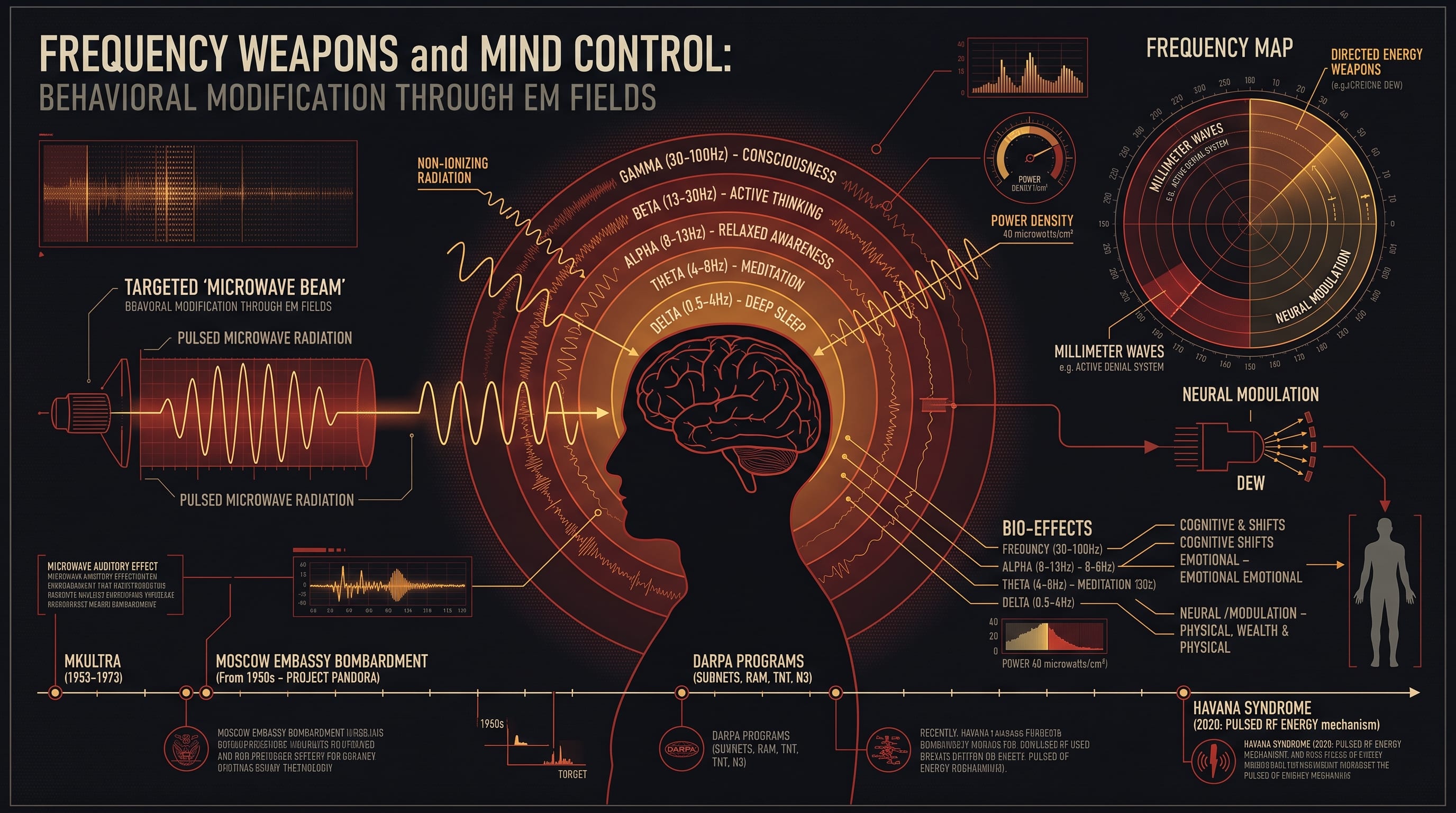
When the US State Department began reporting in 2016 that diplomats in Havana were experiencing unexplained neurological symptoms: headaches, cognitive impairment, tinnitus, and memory disruption, the immediate assumption was sonic attack.
Investigators quickly found the acoustics didn't add up. Four years later, a panel of senior scientists convened by the National Academies reached a different conclusion. The most plausible cause, they wrote, was "directed, pulsed radiofrequency energy."
That finding brought to public attention a body of research that defense establishments have been quietly accumulating for decades: the study of how electromagnetic frequencies interact with the human body, and whether those interactions can be weaponized. Those of us that have studied this subject for decades of course knew how old this technology actually was.
This article traces that history from the laboratory to the battlefield, and examines what the peer-reviewed evidence actually supports, where claims outrun the data (redacted in gov't documents), and why the regulatory and ethical debates around these technologies are only beginning.
The Science Came Before the Weapons
The starting point is not a weapons program. It is a 1962 paper by American biophysicist Allan Frey.
Frey had been studying the effects of radar on biological tissue when he made an unexpected observation: certain people could perceive pulsed microwave radiation as sound. This was not a metaphor. Subjects reported hearing clicking, buzzing, or hissing that corresponded precisely to the pulse frequency of microwave emitters, even when the signal was below the threshold of any known thermal effect.
His paper, published in the Journal of Applied Physiology in July 1962, established what became known as the Frey effect or microwave auditory effect. The mechanism, later refined by researchers, involves thermoelastic expansion: rapid heating of tissue in the cochlea generates pressure waves that travel to the auditory nerve without passing through the outer ear. There is no speaker. There is no conventional sound. The signal bypasses the normal acoustic pathway entirely.
This finding attracted military interest almost immediately. Project Pandora and the Moscow Signal
Through the 1960s and into the 1970s, the Soviet Union was directing microwave radiation at the US Embassy in Moscow at low, non-thermal intensities. The purpose, and indeed the precise nature of what the signal was intended to do, remains disputed. What is known is that the US government launched a classified investigation: Project Pandora, a CIA and Department of Defense program that examined whether non-thermal microwave exposure could produce measurable biological or psychological effects in humans.
Declassified documents from Project Pandora are available via the CIA FOIA Reading Room (cia.gov/readingroom), though the collection is fragmentary and many records remain redacted. The program ran across multiple agencies and produced findings that were, to put it carefully, inconclusive in public and reportedly more concerning in classified form.
The program exists within a broader documented history of US government interest in using external stimuli to alter cognition. The 1977 Senate Select Committee on Intelligence held public hearings on Project MKULTRA, the CIA's multi-decade program of research into behavioral modification. The published Senate record is explicit: the program tested drugs, hypnosis, sensory manipulation, and other techniques on subjects, often without consent. The MKULTRA record is significant here not because it directly involved electromagnetic weapons but because it establishes institutional appetite for the category of research.
How Electromagnetic Fields Affect Biology
Understanding whether frequency-based weapons are plausible requires first understanding the biological mechanisms that make electromagnetic exposure consequential.
The most significant mechanism identified in recent peer-reviewed research concerns voltage-gated calcium channels (VGCCs): protein structures in cell membranes that regulate calcium ion flow and, by extension, a cascade of downstream signaling processes.
In a 2013 review published in the Journal of Cellular and Molecular Medicine, Washington State University biochemist Martin Pall synthesized 23 studies showing that VGCC activation could be triggered by electromagnetic field exposure at both extremely low frequencies and microwave frequencies, producing biological effects through non-thermal pathways.
The significance of the Pall paper (PMID 23802593) is not that it demonstrates weaponizable harm. It demonstrates a mechanism through which low-intensity fields can produce biological effects at all. That had been the central contested question in the field for decades: the prevailing regulatory assumption was that non-ionising radiation below thermal thresholds was biologically inert. VGCC research challenges that assumption at the cellular level.
The BioInitiative Working Group's 2012 report (bioinitiative.org) compiled an extensive body of peer-reviewed studies documenting biological effects at non-thermal exposure levels. The report has been criticised by some mainstream scientific bodies for overstating conclusions, and the field remains genuinely contested. What is not contested is that a substantial scientific literature exists documenting non-thermal biological effects, even if the public health and weaponization implications remain debated in the scientific literature.
The clinical applications of this knowledge are already in widespread use. Transcranial magnetic stimulation (TMS) uses precisely targeted magnetic pulses to modulate neuronal firing; it is approved in multiple countries for treatment-resistant depression.
Transcranial direct current stimulation (tDCS) applies low-level electrical current across the scalp to enhance or inhibit specific brain regions.
Neither involves implants. Both work by externally altering the electrical environment of neurons. They are, in the most literal sense, devices that change what the brain does using fields delivered from outside the skull.
Military Programmes: What Is Documented
The transition from laboratory research to military application follows a documented trail.
The Active Denial System (ADS), developed by the US Air Force and fielded from the mid-2000s, uses millimeter-wave radiation at 95 GHz to produce an intense burning sensation in targeted individuals by heating the water molecules in the skin's outer layer.
It is considered a "non-lethal" crowd control device and one of the few acknowledged directed-energy weapons to have moved from classified research to public deployment. The mechanism is thermal, but the ADS demonstrates that the general class of directed-energy weapons based on electromagnetic frequencies is not theoretical.
DARPA, the US military's advanced research agency, has funded a series of neurotechnology programs that operate in the adjacent space.
Four are publicly documented:
None of these programs is secret. DARPA publishes program summaries, holds open solicitations, and funds university researchers who publish their findings. The trajectory, however, is notable: each program extends the principle of externally modifying cognition, perception, or memory through technology delivered without surgery.
The Air Force Research Laboratory document catalogued by the Defense Technical Information Center (DTIC ADA329659) from the mid-1990s lists "microwave hearing" explicitly as a non-lethal weapon concept, confirming that the Frey effect had been formally incorporated into defense thinking by that point.
Russian and Chinese Research
The Moscow Signal affair was not the only indication that electromagnetic effects on the brain attracted adversarial attention. Russian bioelectromagnetics research has a longer institutional history than its Western counterpart, partly because Soviet science did not compartmentalize "thermal vs non-thermal" effects in the same regulatory framework.
Academic papers from Russian research institutes documented a range of neurological and physiological responses to low-intensity fields through the Soviet period and beyond. The specific details of any active Russian weapons program in this domain remain classified or alleged; what the open literature supports is an extended research tradition.
Chinese military and academic publications have increasingly engaged with cognitive warfare as a domain. References to "brain control" and "cognitive confrontation" appear in People's Liberation Army academic journals, though translation and context are important: not every reference to cognitive influence implies a directed-energy weapons program. The broader frame is information warfare and perception management as much as any specific electromagnetic weapon.
Voice-to-Skull and the "Synthetic Telepathy" Problem
One of the more contentious areas in this field concerns what the US Army patented in 2002 under the term "Modulation of Nervous System by Applying Acoustic Signals" (US Patent 6,470,214) and what researchers and defense documents refer to as "voice-to-skull" (V2K) technology: the theoretical ability to transmit intelligible speech directly to a specific individual's auditory cortex using modulated microwave signals.
The Frey effect demonstrates that pulsed microwaves can generate perceived sound. Whether that mechanism can be made precise enough to transmit intelligible speech to a specific individual at operational distances is a separate, much harder engineering problem. The patent exists. The concept is documented in Air Force non-lethal weapons literature. Confirmed operational deployment is not publicly evidenced.
This matters because the "voice-to-skull" concept sits at the intersection of genuine documented science and a much larger set of unverifiable claims. The technology is plausible as a direction of research. Whether it is deployed, and at what capability level, is unknown but a lot of us believe strongly that this has been in deployment and actively refined for decades now, while consistently redacted in government documents that have been released.
Havana Syndrome: Where the Evidence Stands
The National Academies' 2020 report on illness in US government employees at overseas embassies is the most authoritative public assessment of what has become known as Havana Syndrome. The committee, chaired by Stanford's David Relman and comprising 19 specialists across neurology, epidemiology, physics, and related fields, assessed four hypothetical mechanisms: infection, chemicals, psychological factors, and directed energy.
Their conclusion was careful. "Directed, pulsed radiofrequency energy" was identified as "the most plausible mechanism" consistent with the clinical evidence. The committee was explicit that this was not a determination of cause, still less of attribution. It was an assessment of which mechanism best fit the observed symptom pattern (acute onset of directional pressure or sound, followed by persistent cognitive effects in personnel who had been in specific locations or rooms) given current scientific understanding.
That finding has not resolved the political or intelligence debate. Subsequent US government assessments have produced conflicting conclusions about the scale and nature of what occurred. The science of pulsed-RF biological effects and the question of whether a state actor deployed such technology are distinct questions, and conflating them undermines both.
What the 2020 National Academies report establishes is that the mechanism is scientifically coherent. That is significant.
Cognitive Warfare: The Expanding Frame
Military and security establishments have moved beyond individual weapons to a broader concept. In a 2020 paper commissioned by the NATO Allied Command Transformation Innovation Hub, researcher François du Cluzel framed cognitive warfare as targeting "the human brain" as the battlefield of the 21st century: a domain that encompasses information operations, social media manipulation, psychological operations, and potentially direct neurological intervention as distinct but related tools.
The Royal Society's Brain Waves Module 3 report (2012), which examined neuroscience and conflict, similarly identified the dual-use nature of emerging neuroscience as a security concern: the same research that produces treatments for neurological conditions can inform methods for degrading cognition or manipulating behavior in adversarial contexts.
The ethical questions this raises have begun to attract formal academic attention. Legal philosopher Wrye Sententia, writing in American Journal of Bioethics, introduced the concept of "cognitive liberty": the right of individuals to mental self-determination, free from non-consensual alteration of cognition.
Whether existing human rights frameworks are adequate to address technologies that operate on the brain from the outside is a question that international law has not yet answered. What to Make of All This
Several things are simultaneously true here, and keeping them separate matters.
The science of non-thermal electromagnetic biological effects is real and documented. Frey's 1962 discovery, the VGCC research of Pall and others, and the clinical applications of TMS and tDCS all confirm that externally applied fields can produce neurological effects. This is not fringe science.
Military interest in applying this science is documented. Project Pandora, the ADS, DARPA's neurotechnology programs, Air Force non-lethal weapons research, and the historical Moscow Signal (woodpecker) all provide a documented record of institutional interest across multiple decades and nations. None of this required inventing evidence.
The gap between laboratory effects and operational weapons is significant. The precision, range, targeting capability, and power requirements for a device that could reliably produce specific cognitive effects in a specific individual from operational distances are formidable engineering challenges. Documented research interest is not the same as confirmed operational capability. That being said, after studying this subject for the last two decades I sincerely believe this technology is fully operational.
Attribution is the hardest problem. Even if a directed-energy weapon capable of producing the Havana Syndrome symptom pattern exists, determining who used it, when, and on whom requires intelligence evidence that remains classified, contested, or absent.
The regulatory framework has not kept pace. Existing electromagnetic safety standards were designed around thermal effects. If non-thermal biological effects are real at the scale the VGCC research suggests, those standards require revision. That debate is ongoing in the scientific community and largely absent from public policy. It's quite clear at this point that many regulatory agencies, including the FCC, are agencies captured by the industries they are supposed to be policing.
The question of frequency weapons is not whether the underlying science exists. It does. The questions that remain unanswered are harder: what has been built, by whom, to what capability, and with what ethical constraints.
Those answers are still classified, if they exist at all.
Do you have thoughts on this? Share them in the comments below. References:
|




5 Comments
Join the conversation
What I keep coming back to is the Havana Syndrome section. 19 specialists across neurology, physics, epidemiology — not exactly a fringe panel — and 'directed pulsed radiofrequency energy' is their best fit for the symptom pattern. That conclusion got very little sustained media attention considering what it actually implies.
The part about the FCC being a captured agency really needed to be said. The thermal-only standard for RF exposure hasn't been meaningfully updated in decades and the VGCC research alone should have prompted a review by now. It hasn't, and the reason isn't scientific uncertainty.
Appreciate the references being included but I'd push back a little on the framing around V2K. The Frey effect producing clicks and buzzing is a long way from transmitting intelligible speech to a specific person across a room, let alone at 'operational distances.' The patent existing doesn't mean the engineering problem is solved. Those are very different claims.
I had TMS for depression a few years back and it genuinely works — sitting there with a magnetic coil held to your head and it changes how you feel within weeks. So when people act like externally influencing the brain is some wild conspiracy theory, I always think back to that chair in my neurologist's office. It's already medicine.
The Frey effect being documented back in 1962 is what gets me. That's over 60 years ago. Whatever they've managed to engineer since then is almost impossible to imagine. The gap between what's declassified and what's actually operational has to be enormous.