
Is Weedkiller Destroying Your Gut? The Shocking Truth About Glyphosate |
The Glyphosate Paradox: How the World's Most Used Herbicide May Be Reshaping the Human Microbiome |
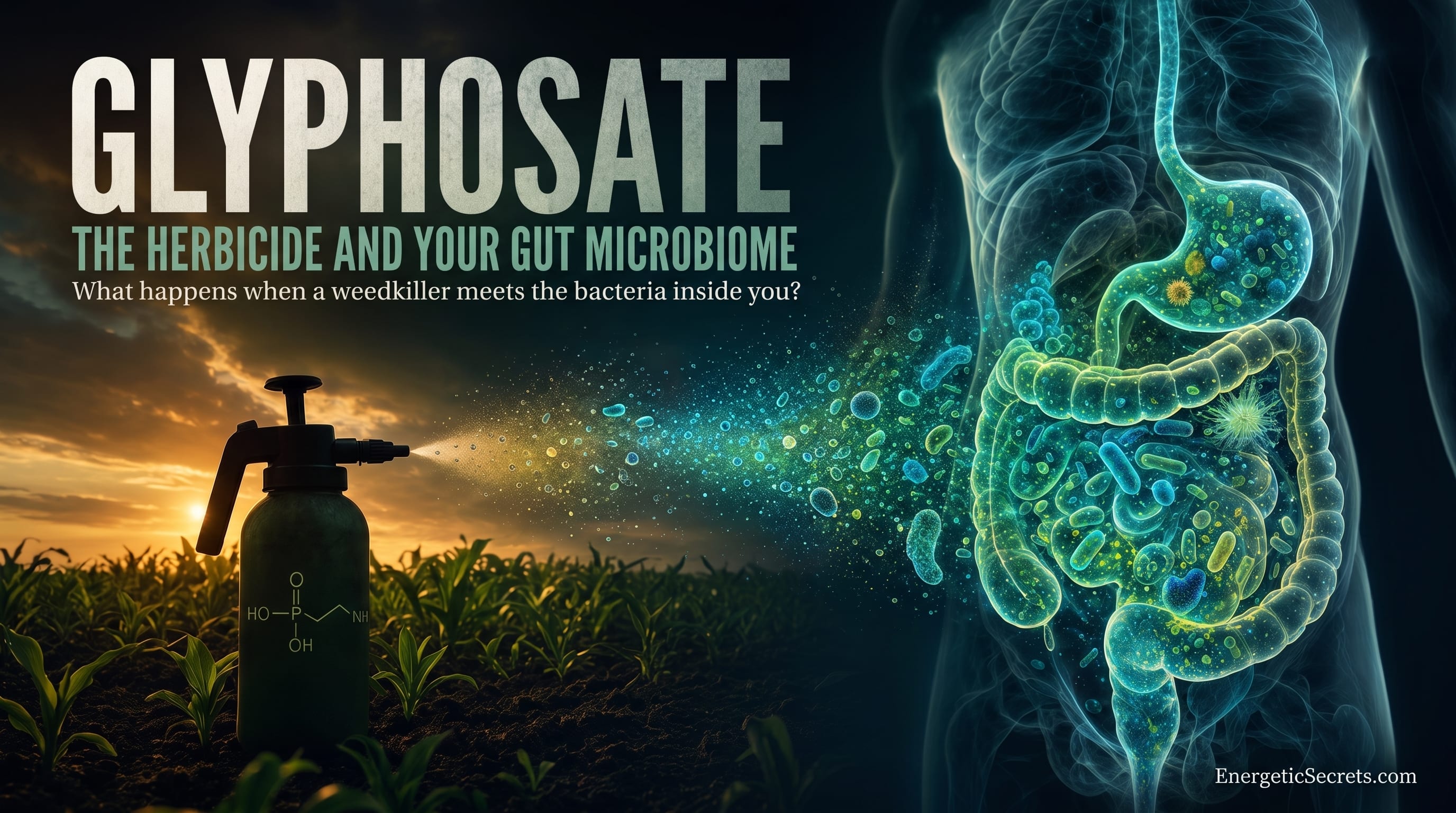
Glyphosate is the most widely used herbicide in history. Since its introduction in 1974, farmers have sprayed billions of pounds across the world's croplands. It is the active ingredient in Roundup, and it is so ubiquitous that residues have been detected in oats, wheat, soy, corn, and other staple foods. [17]
For decades, regulators considered glyphosate safe for humans on the strength of a single biochemical fact: the enzyme it targets does not exist in human cells. That fact is still true. But a growing body of evidence suggests the safety picture is more complicated than the original framework accounted for. The complication is the microbiome.
The Shikimate Pathway: Why Regulators Thought Glyphosate Was Safe
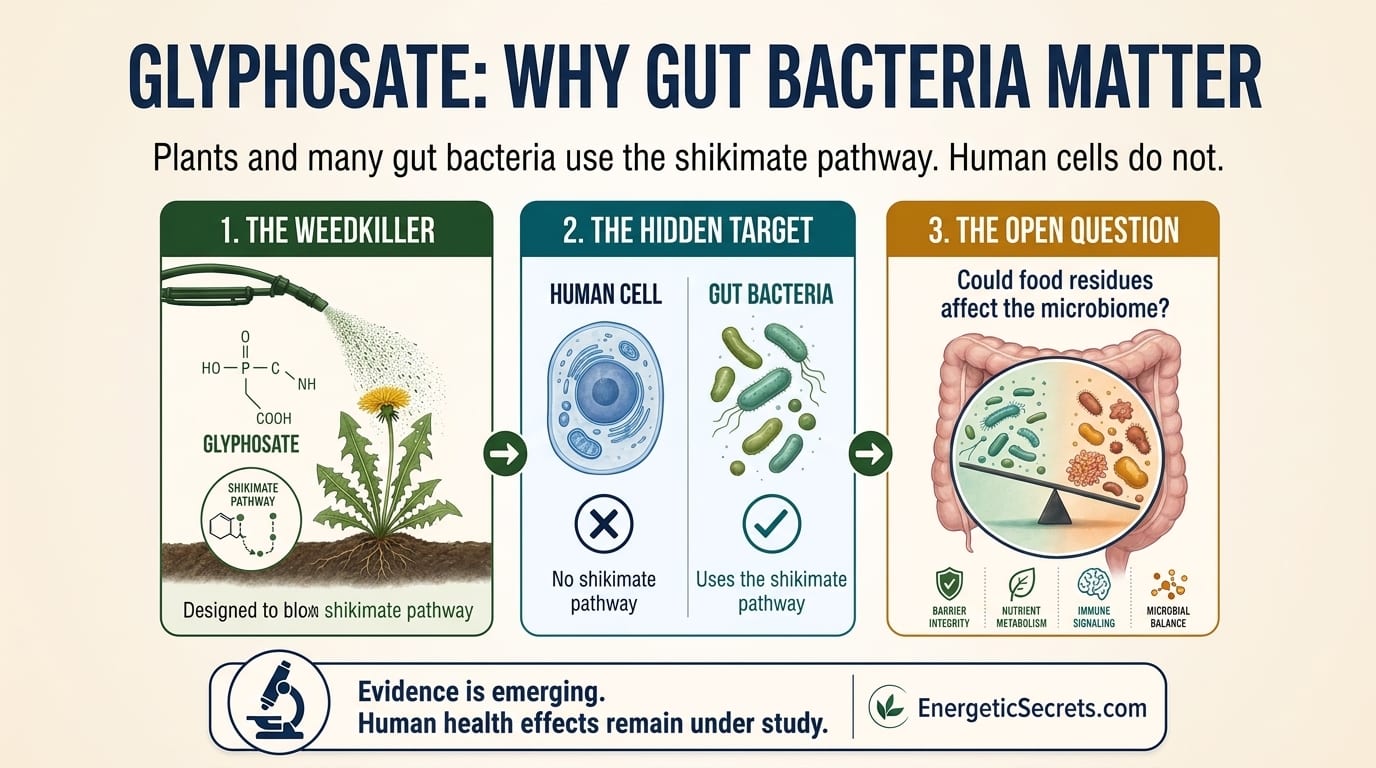
Glyphosate works by inhibiting an enzyme called 5-enolpyruvylshikimate-3-phosphate synthase, or EPSPS. This enzyme is a critical component of the shikimate pathway, a metabolic route that plants, fungi, and bacteria use to produce three essential aromatic amino acids: phenylalanine, tyrosine, and tryptophan. Without these amino acids, the organism cannot synthesize proteins and dies. [1]
The shikimate pathway is found across bacteria, archaea, fungi, algae, some protozoans, and plants. It is not found in animals. Humans, like all animals, must obtain aromatic amino acids from their diet. This fundamental difference is what made EPSPS such an attractive target for herbicide development: a chemical that blocks the shikimate pathway would kill weeds but leave human cells untouched. [2]
This logic formed the foundation of glyphosate's regulatory approval. If the target enzyme does not exist in human cells, the reasoning went, the herbicide cannot harm us through that mechanism. It was a clean, elegant argument, and it held for decades.
The Missing Piece: Your Gut Bacteria Have the Shikimate Pathway
What the original regulatory framework did not fully consider is that the human body is not a collection of isolated human cells. It is a complex ecosystem. The human gut microbiome contains trillions of bacteria, and many of those bacteria possess the shikimate pathway.
Beneficial genera including Lactobacillus and Bifidobacterium carry the EPSPS enzyme. So does Escherichia coli, one of the most abundant and well-studied residents of the human gut. Aldehoff et al. (2025) confirmed that E. coli possesses a glyphosate-sensitive class I EPSPS, making it vulnerable to the herbicide's effects at the molecular level. [9]
This means that when glyphosate residues enter the digestive tract, they encounter bacteria that have exactly the biochemical pathway the herbicide was designed to disrupt. The question is not whether glyphosate can affect these bacteria in principle. The question is whether it does so at the levels found in food.
Evidence That Glyphosate Disrupts Beneficial Gut Bacteria
The first study to connect glyphosate to gut microbiome disruption was published by Samsel and Seneff in 2013. The paper, published in the journal Entropy, proposed that glyphosate's inhibition of cytochrome P450 enzymes, combined with its disruption of aromatic amino acid biosynthesis by gut bacteria, could contribute to a range of Western diet-associated diseases. [4]
The paper was controversial and has been criticized for overreach, particularly in its broad disease claims. But it opened a line of inquiry that other researchers have since pursued with more focused experimental methods.
Shehata et al. (2013), published in Current Microbiology, provided some of the first experimental evidence. The researchers tested glyphosate against poultry gut bacteria in vitro and found a striking pattern: highly pathogenic bacteria including Salmonella Enteritidis, Salmonella Gallinarum, Clostridium perfringens, and Clostridium botulinum were resistant to glyphosate, while most beneficial bacteria including Enterococcus faecalis, Bifidobacterium adolescentis, and Lactobacillus species were susceptible. [3]
The pattern is significant. If glyphosate selectively inhibits beneficial bacteria while leaving pathogens unharmed, it could shift the microbial balance of the gut in ways that favor disease-causing organisms.
Walsh et al. (2023), in a comprehensive review published in Gut Microbes, confirmed the mechanism: glyphosate inhibits EPSPS in gut bacteria that possess the shikimate pathway, altering gut microbiome composition. The review synthesized the growing body of evidence that the microbiome is a legitimate target for glyphosate's effects. [7]
Mendler et al. (2020) took the research a step further, showing that glyphosate-treated commensal gut bacteria altered the activation of mucosal-associated invariant T-cells (MAIT cells), a type of immune cell that responds to bacterial metabolites. This suggested a specific mechanism by which glyphosate could modulate immune function through the microbiome. [8]
Animal Studies at Regulatory "Safe" Levels
Perhaps the most striking recent evidence comes from animal studies showing effects at or below the regulatory reference doses that agencies consider safe.
Liu et al. (2025) found that glyphosate at levels below the no-observed-adverse-effect level (NOAEL) disrupted gut microbiota and exacerbated fatty liver hemorrhagic syndrome in laying hens. Critically, the researchers used fecal microbiota transplant experiments to confirm that the gut microbiome was the causal pathway. [10]
Matsuzaki et al. (2026), published in Molecular Psychiatry (Nature), exposed mice to glyphosate at regulatory reference doses via drinking water for seven weeks. The herbicide disrupted behavior through the microbiota-gut-brain axis, suggesting effects that reach beyond the digestive system. [11]
Liu JB et al. (2026) found that dietary glyphosate at the regulatory "safe" level worsened colitis in mice through a gut microbiota-derived palmitic acid-JAK-STAT pathway. The study was published in the Journal of Agricultural and Food Chemistry. [12]
These studies share a common thread: they used doses that regulatory agencies have deemed safe, and they found measurable biological effects mediated through the gut microbiome. The human relevance of these findings is not yet established, but the pattern is consistent enough to warrant attention.
The IARC Classification: A Global Regulatory Battle
In March 2015, the International Agency for Research on Cancer (IARC), a branch of the World Health Organization, classified glyphosate as "probably carcinogenic to humans" (Group 2A). The classification was based on limited evidence of cancer in humans and sufficient evidence of cancer in experimental animals. IARC also concluded there was strong evidence for genotoxicity for both pure glyphosate and glyphosate formulations. [5]
The decision triggered a global regulatory battle that continues today. The EPA, the European Food Safety Authority (EFSA), and the FAO all subsequently concluded that glyphosate was unlikely to pose a carcinogenic risk at real-world exposure levels, directly contradicting IARC's classification. [6, 15]
The key to understanding this split is that IARC and the regulatory agencies answer different questions. IARC performs hazard identification: it asks whether a substance has the potential to cause cancer under any exposure scenario. The EPA performs risk assessment: it asks how likely a substance is to cause cancer at the levels people actually encounter. Both positions can be correct simultaneously. [6]
Smith-Roe et al. (2026), in a direct comparison study published in Toxicological Sciences, examined the evidence bases behind both positions. The study confirmed that the EPA and IARC reached different conclusions because they evaluated different evidence using different frameworks. [15]
Glyphosate Residues in Food and the Legal Landscape
Glyphosate residues have been detected in a wide range of common foods. Independent testing by the Environmental Working Group has found glyphosate in oat-based foods, and government monitoring programs have detected residues in wheat, soy, and corn. [17]
The legal landscape has been shaped by thousands of lawsuits claiming that glyphosate exposure caused non-Hodgkin lymphoma. In 2020, Bayer (which acquired Monsanto in 2018) agreed to pay approximately $10.9 billion to settle a large portion of these cases, with additional settlements in subsequent years. [16]
It is important to note that legal settlements are commercial decisions, not scientific conclusions. They do not prove that glyphosate causes cancer. But they reflect the scale of the public health dispute and the pressure it has placed on the regulatory system.
Emerging Concerns: Antibiotic Resistance and Metabolic Effects
Two additional areas of research are worth watching. The first is the potential for glyphosate to contribute to antimicrobial resistance. Because glyphosate exerts selective pressure on bacterial communities, it may co-select for antibiotic resistance genes. A 2022 study in mSystems found that glyphosate has the potential to indirectly select for antibiotic-resistant bacteria. [18] A 2026 study in Frontiers in Microbiology confirmed that glyphosate, which targets the shikimate pathway, may co-select for antibiotic resistance genes, posing a potential driver for antimicrobial resistance spread. [19]
The second area is metabolic health. A 2026 scoping review by Otaru and Carpenter, published in Environmental Research, mapped the emerging evidence linking glyphosate exposure to metabolic syndrome and type 2 diabetes. The review found that chronic glyphosate exposure may impair metabolic health, though it emphasized that the evidence is still emerging and does not establish causation. [13]
Klátyik et al. (2025), in a comprehensive toxicology review covering 2010 to 2025 published in Archives of Toxicology, confirmed that glyphosate has become a frequent contaminant in drinking water and food chains, and that human exposures have been associated with numerous adverse health outcomes including carcinogenicity, metabolic syndrome, and reproductive and endocrine-system effects. The review also noted that conflicting evidence and regulatory disagreements persist. [14]
What This Means
The glyphosate story is not a simple one. The original safety framework was built on sound biochemistry: the herbicide's target enzyme does not exist in human cells. That fact has not changed. What has changed is our understanding of the human body as a microbial ecosystem.
The emerging evidence suggests that the regulatory consensus on glyphosate safety was built on a framework that did not consider the microbiome. The shikimate pathway is present in the gut bacteria that play essential roles in immune function, metabolism, and overall health. Multiple studies now show that glyphosate can disrupt these bacteria at levels regulators have considered safe.
The IARC classification and the regulatory split that followed have added another layer of complexity. The question of whether glyphosate poses a cancer risk at real-world exposure levels remains unresolved, with reputable agencies reaching different conclusions based on different methodologies.
So which of these regulatory agencies may be considered "captured" by the industry they are regulating?
What is clear is that the evidence base has moved beyond the original framework. The microbiome angle is biologically plausible, supported by in vitro and animal model evidence, and represents a genuine gap in the original safety assessment. Whether these findings translate to meaningful human health effects at real-world exposure levels is the question that will define the next chapter of this story.
Or is the real story just how long the regulators can keep up the charade they play pretending to "act in your best interest" while they take corporate bribes to drag out the lawsuits for more decades while reaping massive profits? Just a simple question...
References[1] EPSP synthase. Wikipedia. https://en.wikipedia.org/wiki/EPSP\_synthase [2] The shikimate pathway: distribution across domains of life. PMC. https://pmc.ncbi.nlm.nih.gov/articles/PMC11043010/ [3] Shehata AA, et al. The effect of glyphosate on potential pathogens and beneficial members of poultry microbiota in vitro. Current Microbiology. 2013;66(4):350-358. PMID: 23224412. https://link.springer.com/article/10.1007/s00284-012-0277-2 [4] Samsel A, Seneff S. Glyphosate's suppression of cytochrome P450 enzymes and amino acid biosynthesis by the gut microbiome: pathways to modern diseases. Entropy. 2013;15(4):1416-1463. https://www.mdpi.com/1099-4300/15/4/1416 [5] IARC Monograph Volume 112: Some organophosphate insecticides and herbicides. IARC, 2015. https://www.iarc.who.int/featured-news/media-centre-iarc-news-glyphosate/ [6] EPA glyphosate report. Regulations.gov. https://www.regulations.gov/document/EPA-HQ-OPP-2016-0385-0094 [7] Walsh L, et al. Glyphosate and the gut microbiome: a comprehensive review. Gut Microbes. 2023. PMID: 38099711. https://pubmed.ncbi.nlm.nih.gov/38099711/ [8] Mendler A, et al. Glyphosate-treated commensal bacteria alter MAIT cell activation. Journal of Immunotoxicology. 2020. PMID: 31909636. https://pubmed.ncbi.nlm.nih.gov/31909636/ [9] Aldehoff F, et al. Glyphosate interactions in E. coli. Environment International. 2025. PMID: 39733591. https://pubmed.ncbi.nlm.nih.gov/39733591/ [10] Liu Y, et al. Glyphosate below NOAEL exacerbates fatty liver via gut microbiome in laying hens. Poultry Science. 2025. PMID: 40974996. https://pubmed.ncbi.nlm.nih.gov/40974996/ [11] Matsuzaki K, et al. Glyphosate disrupts behavior via microbiota-gut-brain axis. Molecular Psychiatry. 2026. PMID: 42380611. https://pubmed.ncbi.nlm.nih.gov/42380611/ [12] Liu JB, et al. Glyphosate at regulatory safe level worsens colitis via gut microbiota. Journal of Agricultural and Food Chemistry. 2026. PMID: 41924941. https://pubmed.ncbi.nlm.nih.gov/41924941/ [13] Otaru N, Carpenter DO. Glyphosate and metabolic syndrome: a scoping review. Environmental Research. 2026. PMID: 41662935. https://pubmed.ncbi.nlm.nih.gov/41662935/ [14] Klátyik S, et al. Glyphosate toxicology: a comprehensive review 2010-2025. Archives of Toxicology. 2025. PMID: 40418353. https://pubmed.ncbi.nlm.nih.gov/40418353/ [15] Smith-Roe SL, et al. Comparison of EPA and IARC glyphosate assessments. Toxicological Sciences. 2026. PMID: 41830163. https://pubmed.ncbi.nlm.nih.gov/41830163/ [16] Glyphosate lawsuits claiming liability for cancer. Wikipedia. https://en.wikipedia.org/wiki/Glyphosate#Lawsuits\_claiming\_liability\_for\_cancer [17] Glyphosate residues in food products. Wikipedia. https://en.wikipedia.org/wiki/Glyphosate#Residues\_in\_food\_products [18] Liao H, et al. Glyphosate cross-selects for antibiotic resistance genes. mSystems. 2022. PMID: 35266795. https://pubmed.ncbi.nlm.nih.gov/35266795/ [19] Glyphosate resistance as driver for multidrug-resistant clinical strains. Frontiers in Microbiology. 2026. PMID: 41953436. https://pubmed.ncbi.nlm.nih.gov/41953436/ |
 |


4 Comments
Join the conversation
$10.9 billion settlement and they still don't have to admit it causes cancer. what a system lol
The EPA vs IARC distinction is actually a fair point though — one is saying it CAN cause harm, the other is saying it probably WON'T at normal doses. People mix those up constantly and it muddies the whole debate.
I've been using Roundup on my property for 20 years. Never thought twice about it. The gut bacteria angle is genuinely new to me and honestly kind of unsettling.
The part about Lactobacillus and Bifidobacterium being sensitive while Salmonella is resistant really got me. So it's basically doing the opposite of what you'd want in your gut. That's not nothing.