
A Flesh-Eating Maggot Is Back in the US for the First Time in 60 Years |
It slipped past a barrier that held for six decades. Now it's in Texas, and the only fix is 500 million sterile flies a week. |
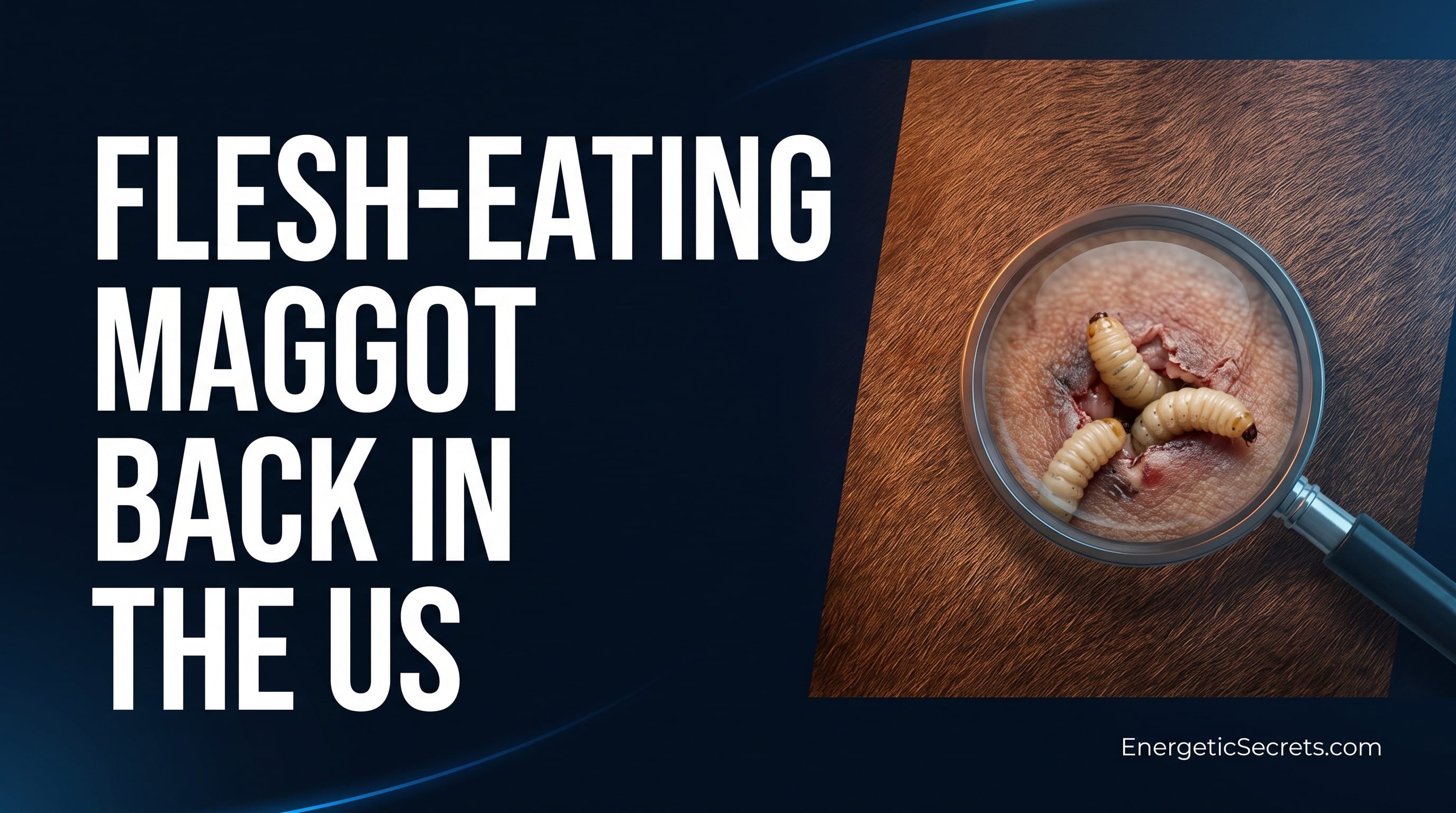
The New World screwworm is back inside the United States for the first time in six decades. On June 3, 2026, the Texas Animal Health Commission confirmed the parasite in a calf in Zavala County, Texas, the first detection of the pest on US soil since it was eradicated in 1966. The confirmation ended a long, anxious wait that began when the fly slipped past the sterile-insect barrier at the Darien Gap and marched north through Central America and Mexico. For American cattle producers, the return of Cochliomyia hominivorax is not an abstract biosecurity concern. It is a wound-feeding maggot that can kill a full-grown animal in about a week, and it has already reshaped the economics of the US beef supply.
What the screwworm is
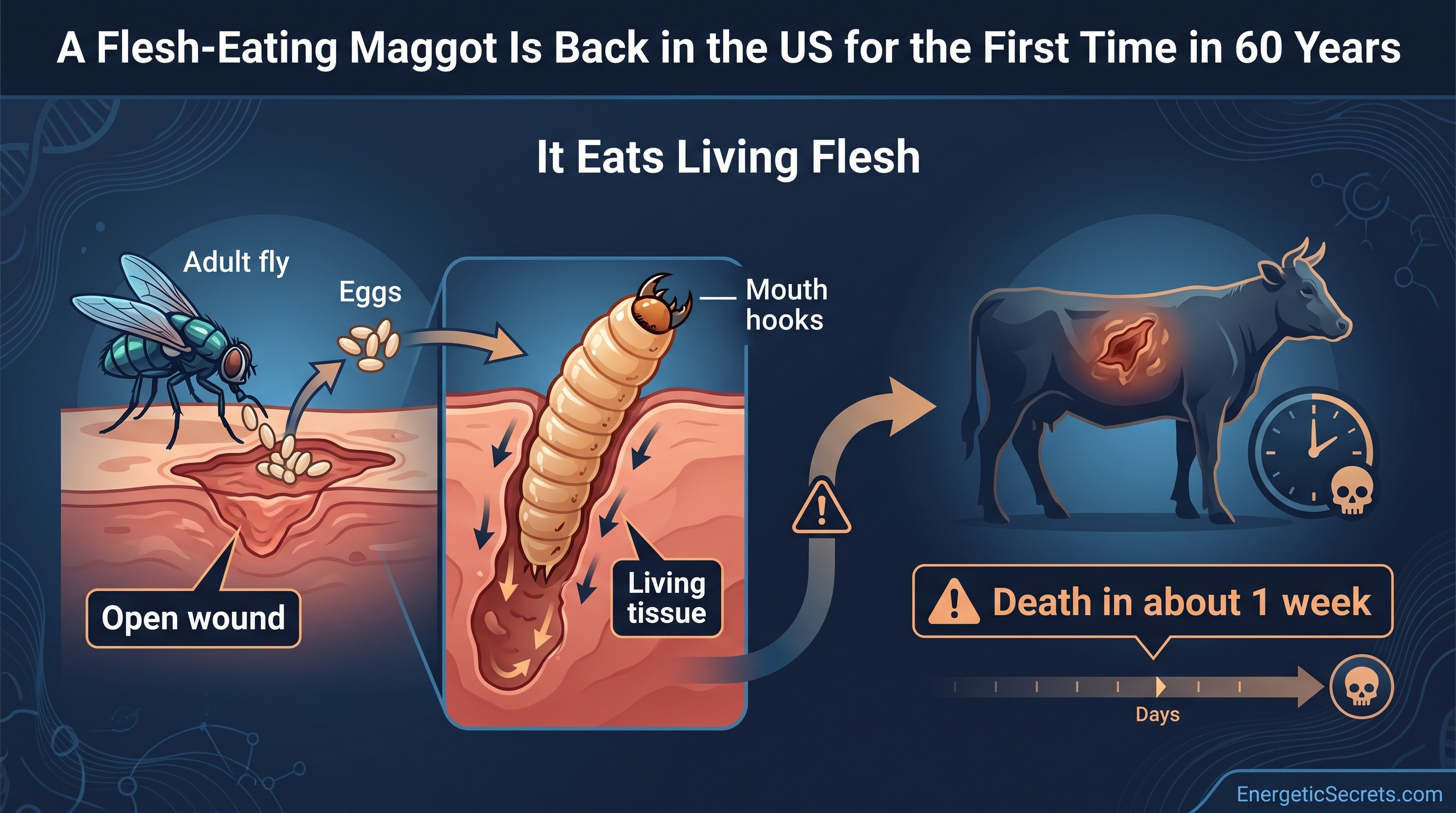
The New World screwworm is the larval stage of a parasitic fly, Cochliomyia hominivorax. The species name reflects its appetite for living flesh. The adult female fly lays her eggs in the open wounds or body orifices of living, warm-blooded animals. When the eggs hatch, the larvae burrow into the flesh with sharp mouth hooks and feed on living tissue. This is what separates the screwworm from ordinary wound flies, which feed on dead or decaying tissue. The screwworm actively consumes healthy flesh, and as it feeds, the wound enlarges and deepens.
The resulting condition is called myiasis. It is painful, progressive, and, left untreated, frequently fatal. The Texas Animal Health Commission states that an infested animal can die within one week. The New Mexico Livestock Board puts the window at seven to ten days. The fly does not discriminate much by species. Cattle, horses, sheep, goats, and swine are the primary livestock hosts, but the screwworm also infests other mammals, birds, and, in rare but serious cases, people.
The danger is compounded by how quietly an infestation can begin. A female fly needs only a small opening: a tick bite, a barbed-wire scratch, a branding wound, a newborn's navel. She deposits her eggs there, and the larvae that hatch begin feeding almost immediately. Because the wound is living tissue, the animal's own immune response cannot clear the maggots the way it might clear a surface infection. The infestation instead grows, and the animal's condition deteriorates as the wound deepens and secondary infection sets in.
The biology matters because it dictates the only control strategy that has ever worked. Because the larvae feed on living tissue, they are not reached by the ordinary wound treatments that clear dead-tissue maggots. And because the adult female mates only once in her lifetime, the entire population can be driven down by flooding the environment with sterile males.
The sterile insect technique
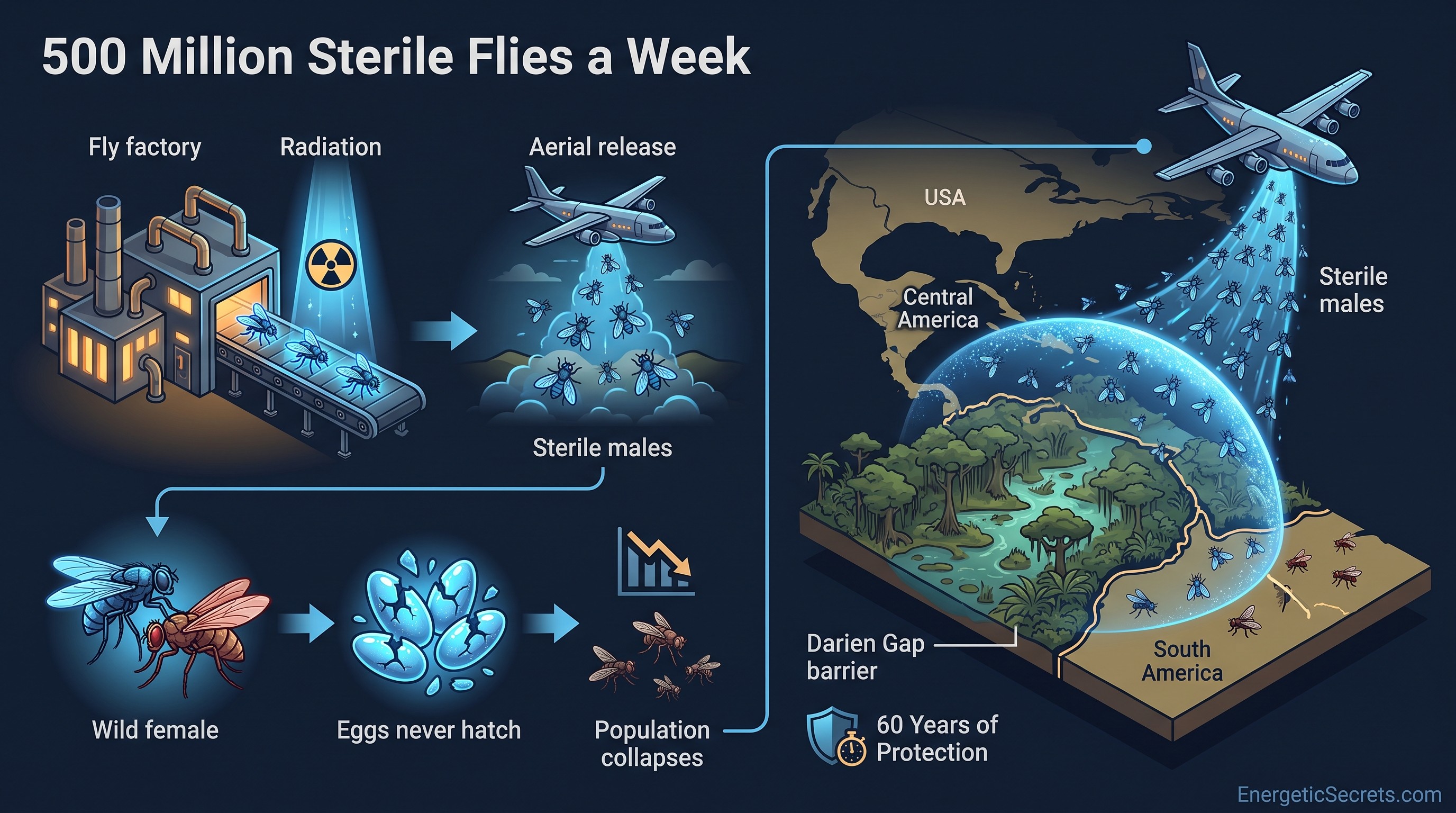
The sterile insect technique, or SIT, is the tool that eradicated the screwworm from the United States in 1966. The method is elegant in principle and industrial in practice. Facilities rear enormous numbers of screwworm flies, sterilize the males with radiation, and release them by air over infested regions. A wild female that mates with a sterile male produces eggs that never hatch. Because she mates only once, that single sterile mating removes her from the reproductive pool entirely. Over successive generations, the wild population collapses.
SIT is not a one-time fix. It requires continuous production and continuous release, because the moment the sterile flies stop arriving, any surviving wild population can rebuild. The scale is industrial: the program that eradicated the pest from the United States relied on rearing and releasing hundreds of millions of flies every week. That is why the United States did not simply declare victory in 1966 and walk away. It built a permanent barrier.
The Darien Gap barrier
The barrier was anchored at the Darien Gap, the roadless, swampy stretch of jungle between Panama and Colombia. The screwworm is endemic in South America, and the Darien Gap is the natural choke point on the route north. For decades, a joint program run by the Panama–United States Commission for the Eradication and Prevention of Screwworm, known as COPEG, released sterile flies there to keep the pest from re-entering Central America and, beyond it, North America.
The barrier held for a long time. It was not perfect: a large outbreak in the southwestern United States in 1972 was traced to screwworms arriving on livestock from Mexico, a reminder that the fly can ride north on the very animals the cattle trade moves across the border. But the system worked well enough that the fly stayed out of the United States for sixty years. The value of that protection was enormous. The eradication campaign has been estimated to be worth roughly $2.3 billion per year to the US cattle industry, a figure that helps explain why the United States invested in a permanent barrier in the first place.
That protection is now gone. The barrier was breached in the early 2020s, and the fly has been moving north ever since.
The breach and the northward march
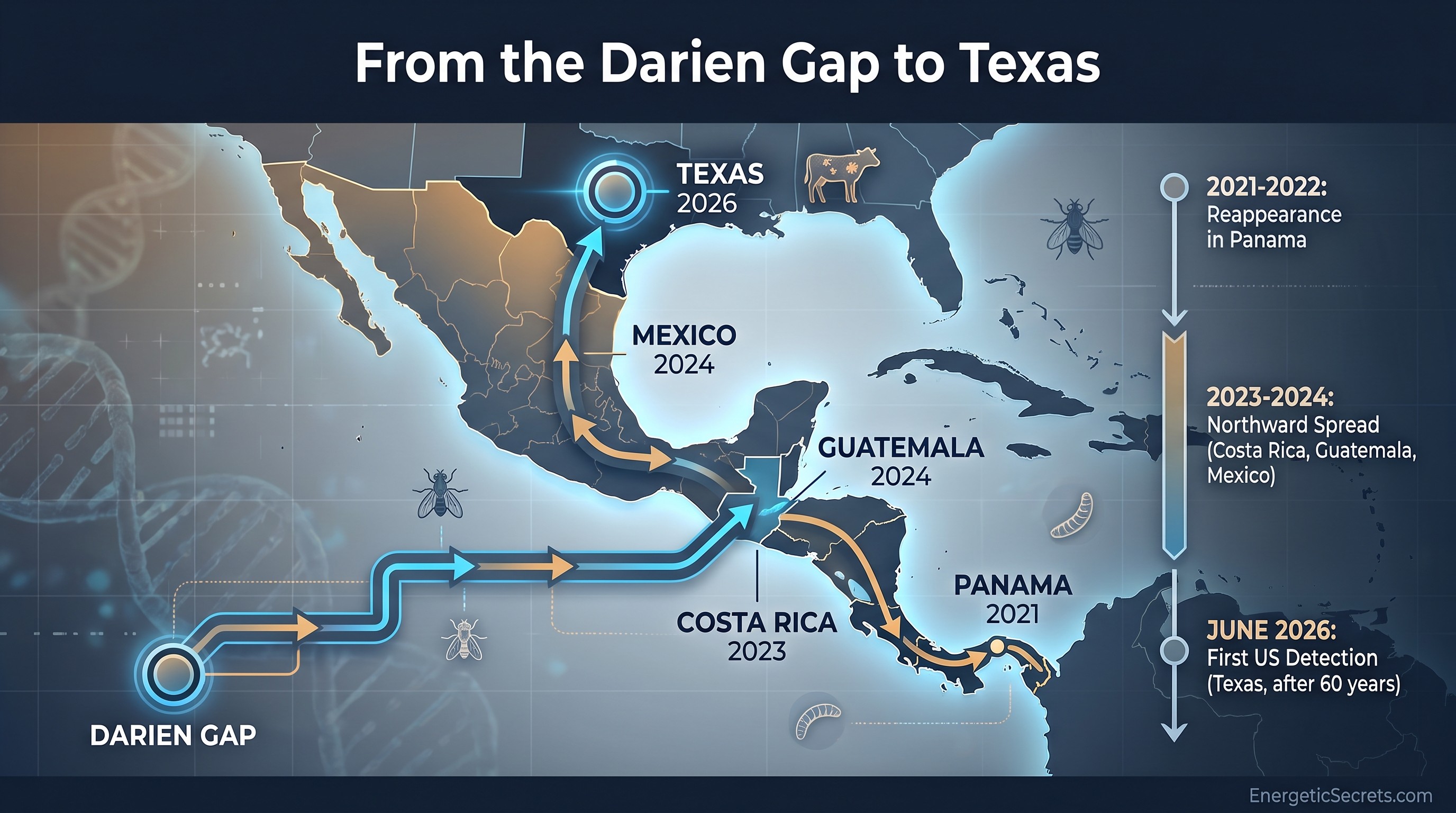
The first sign of trouble came in Panama. The New World screwworm reappeared there in 2021–2022, and the US Department of Agriculture's Animal and Plant Health Inspection Service added Panama to its list of regions affected with screwworm effective July 12, 2021, following a report to the World Organisation for Animal Health. From Panama, the fly spread steadily north.
Costa Rica reported a detection in a dog in July 2023, and APHIS added Costa Rica to the affected-regions list in August 2023. Honduras reported the pest in illegally imported horses in September 2024, and Guatemala reported it in cattle with no recent import history in October 2024. APHIS added both countries to its list in late 2024. El Salvador and Belize followed, with APHIS adding them to the affected-regions list in December 2024 and January 2025.
The most consequential step came in November 2024, when the screwworm was detected in a cow at an inspection checkpoint in Chiapas, Mexico. That was the first detection in Mexico, and it put the fly on a direct path toward the US border. By May 2025, new detections had appeared in Oaxaca and Veracruz, less than 700 miles from the United States.
The US response: ports, drugs, and flies
The United States responded on multiple fronts at once. On May 11, 2025, the USDA suspended imports of live cattle, bison, and equines from Mexico and closed the southern livestock ports. The agency announced a phased reopening on June 30, 2025, but reversed course on July 9, 2025, after a new case was reported in Ixhuatlan de Madero, Veracruz, roughly 160 miles north of the dispersal grid and about 370 miles south of the border. Secretary Rollins re-closed the southern ports to livestock trade that same day.
On August 18, 2025, the Secretary of Health and Human Services determined that there was a significant potential for a public health emergency involving the screwworm and declared circumstances justifying emergency use authorizations for animal drugs. The Food and Drug Administration has since issued a series of emergency use authorizations for screwworm treatments, including products from Zoetis, Elanco, Boehringer Ingelheim, Felix Pharmaceuticals, Alberta Vet Labs, and Health and Hygiene. In August 2026, the FDA authorized CLiK Extra, a dicyclanil wound spray, for use across multiple livestock and wildlife species.
The centerpiece of the response, however, is the same tool that worked in 1966: sterile flies. The USDA is ramping production toward roughly 500 million sterile flies per week, the volume used to eradicate the pest from the United States decades ago. Mexico's Metapa facility was being renovated to produce 60 to 100 million sterile flies per week by July 2026, with a longer-term goal of 400 to 500 million per week to re-establish the barrier at the Darien Gap. A new sterile fly dispersal facility opened in Texas on February 9, 2026, and ground was broken on a Texas production facility in April 2026.
The USDA is also pursuing a genetically engineered tool. NovoFly is a male-only strain of the screwworm designed for sterile release. In March 2026, the USDA applied to the Environmental Protection Agency to register NovoFly and to obtain a Section 18 quarantine emergency exemption, describing the product as a way to maintain broad suppression of the pest and help prevent it from moving further north from Mexico toward the United States.
Surveillance is the other half of the response. Because the fly can arrive on a single infested animal, inspectors at ports and checkpoints look for the telltale wounds and larvae, and producers are urged to report any suspicious wound immediately. The speed of detection matters enormously: an infestation caught in one animal can be contained with treatment and movement controls, while one that goes unnoticed for a week can seed a local population that then has to be pushed back with sterile releases.
The Texas detection
The containment effort could not hold the line. On June 3, 2026, the Texas Animal Health Commission confirmed New World screwworm in a calf in Zavala County, Texas. The calf has since recovered, and that individual case is now considered inactive. But the confirmation marked the first detection of the pest in Texas, and the first inside the United States in this outbreak.
The response in Texas has been methodical. Executive Director Orders establishing and releasing infested zones were issued from June 24, 2026 through September 4, 2026. As of early September 2026, movement restrictions were in place in parts of fifteen Texas counties: Bandera, Brewster, Crockett, Edwards, Jim Hogg, Medina, Pecos, Presidio, Schleicher, Starr, Sutton, Terrell, Uvalde, Val Verde, and Zapata. New Mexico had one infested zone, which was released on August 30, 2026.
The port closures have also continued to evolve. On July 24, 2026, the USDA announced another phased reopening, with the Douglas, Arizona port reopening to livestock trade on August 24, 2026, and Santa Teresa and Columbus, New Mexico to follow.
The economic shock
The screwworm's return has collided with a US cattle market that was already under strain. The national cattle inventory stood at 94.2 million head as of July 2025, including 28.7 million beef cows, down one percent from July 2023. The herd has since fallen to its lowest level in 75 years. Ground beef averaged $6.69 per pound in December 2025, the highest since federal tracking began in the 1980s. The United States imported a record 4.64 billion pounds of beef in 2024, up more than 24 percent from the prior year.
Into that tight market, the screwworm injected a supply shock. The suspension of Mexican cattle imports removed a major source of feeder cattle, and the federal government has moved to offset the loss with imported beef. Proclamation 11010, issued February 6, 2026, increased the beef tariff-rate quota by 80,000 metric tons of lean beef trimmings, allocated to Argentina. Proclamation 11059, issued August 26, 2026, added a further 300,000 metric tons, allocated to other countries or areas. The stated purpose of both proclamations was to keep beef affordable for American consumers at a moment when domestic supply was already stretched thin.
The USDA has also put money behind the science. In January 2026, the agency announced the New World Screwworm Grand Challenge, a funding opportunity of up to $100 million aimed at accelerating solutions to the outbreak.
What comes next
The screwworm is not a problem that can be solved with a single intervention. It is a biological system that must be pushed back the same way it was pushed back before: with continuous sterile fly releases, aggressive surveillance, and movement controls that keep infested animals from carrying the pest into clean territory. The tools are proven. The question is whether the production capacity and the political will can be sustained long enough to re-establish the barrier that held for sixty years.
The geography of the response is also a reminder of how far the fly has already traveled. The barrier that once stopped it at the Darien Gap is now thousands of miles behind the front line, and the sterile fly facilities that must hold the line in Texas and New Mexico are being built and expanded in real time. Every week of production shortfall is a week the wild population can exploit.
For American cattle producers, the stakes are concrete. A single infested animal can seed a local outbreak, and a local outbreak can trigger movement restrictions that ripple through the market. The calf in Zavala County recovered. The industry's recovery will take considerably longer.
References
1. Texas Animal Health Commission. "New World Screwworm." https://www.tahc.texas.gov/emergency/nws.html (accessed September 7, 2026).
2. Texas Animal Health Commission. "New World Screwworm Confirmed in Zavala County Calf." News release, June 3, 2026. https://www.tahc.texas.gov/news/2026/2026-06-03_NWS_InitialCase.pdf
3. U.S. Department of Agriculture, Animal and Plant Health Inspection Service. "Current Status of New World Screwworm." https://www.aphis.usda.gov/animals/animal-health/livestock-and-poultry-disease/stop-screwworm/current-status (archived August 17, 2026).
4. U.S. Department of Agriculture, Animal and Plant Health Inspection Service. "Confirmed Detections of New World Screwworm." https://www.aphis.usda.gov/animals/animal-health/livestock-and-poultry-disease/stop-screwworm/current-status/confirmed (archived August 6, 2026).
5. U.S. Department of Agriculture, Animal and Plant Health Inspection Service. "Unified Government Response To Protect the United States" (stop-screwworm landing page). https://www.aphis.usda.gov/animals/animal-health/livestock-and-poultry-disease/stop-screwworm (archived June 3, 2026).
6. U.S. Department of Agriculture. "Secretary Rollins Takes Decisive Action and Shuts Down U.S. Southern Border Ports to Livestock Trade due to further Northward Spread of New World Screwworm in Mexico." Press release, July 9, 2025. https://www.usda.gov/about-usda/news/press-releases/2025/07/09/secretary-rollins-takes-decisive-action-and-shuts-down-us-southern-border-ports-livestock-trade-due
7. U.S. Department of Agriculture. "USDA Announces the Phased Reopening of Southern Ports for Livestock Trade." Press release, June 30, 2025. https://www.usda.gov/about-usda/news/press-releases/2025/06/30/usda-announces-phased-reopening-southern-ports-livestock-trade
8. U.S. Department of Agriculture, Animal and Plant Health Inspection Service. "USDA Announces Phased Reopening of Southern Ports for Livestock Trade." Agency announcement, July 24, 2026. https://www.aphis.usda.gov/news/agency-announcements/usda-announces-phased-reopening-southern-ports-livestock-trade-0
9. Federal Register. "Declaration of Emergency Pursuant to the Federal Food, Drug, and Cosmetic Act for New World Screwworm." 90 FR (August 20, 2025), Doc. 2025-15918. https://www.federalregister.gov/documents/2025/08/20/2025-15918/declaration-of-emergency-pursuant-to-the-federal-food-drug-and-cosmetic-act-for-new-world-screwworm
10. Federal Register. "Addition of Panama and Costa Rica to the List of Regions Affected With Screwworm." 90 FR (January 16, 2025), Doc. 2025-00995. https://www.federalregister.gov/documents/2025/01/16/2025-00995/addition-of-panama-and-costa-rica-to-the-list-of-regions-affected-with-screwworm
11. Federal Register. "Addition of Guatemala and Honduras to the List of Regions Affected With Screwworm." 90 FR (January 16, 2025), Doc. 2025-00939. https://www.federalregister.gov/documents/2025/01/16/2025-00939/addition-of-guatemala-and-honduras-to-the-list-of-regions-affected-with-screwworm
12. Federal Register. "Addition of El Salvador and Belize to the List of Regions Affected With Screwworm." 90 FR (June 13, 2025), Doc. 2025-10802. https://www.federalregister.gov/documents/2025/06/13/2025-10802/addition-of-el-salvador-and-belize-to-the-list-of-regions-affected-with-screwworm
13. Federal Register. "Pesticide Product Registration; Emergency Exemption Request and Application for a New Active Ingredient" (NovoFly). 91 FR (March 27, 2026), Doc. 2026-05998. https://www.federalregister.gov/documents/2026/03/27/2026-05998/pesticide-product-registration-emergency-exemption-request-and-application-for-a-new-active
14. Federal Register. "Clean Water Act Effluent Limitations Guidelines and Standards for the Meat and Poultry Products Point Source Category" (withdrawal; contains NWS eradication value). 90 FR (September 3, 2025), Doc. 2025-16868. https://www.federalregister.gov/documents/2025/09/03/2025-16868/clean-water-act-effluent-limitations-guidelines-and-standards-for-the-meat-and-poultry-products
15. Federal Register. "Ensuring Affordable Beef for the American Consumer" (Proclamation 11010). 91 FR (February 13, 2026), Doc. 2026-03050. https://www.govinfo.gov/content/pkg/FR-2026-02-13/pdf/2026-03050.pdf
16. Federal Register. "Further Ensuring Affordable Beef for the American Consumer" (Proclamation 11059). 91 FR (August 31, 2026), Doc. 2026-17842. https://www.federalregister.gov/documents/2026/08/31/2026-17842/further-ensuring-affordable-beef-for-the-american-consumer
17. Federal Register. "Authorization of Emergency Use for Three Animal Drugs for the Prevention and Treatment of New World Screwworm; Availability." 91 FR (August 31, 2026), Doc. 2026-17719. https://www.federalregister.gov/documents/2026/08/31/2026-17719/authorization-of-emergency-use-for-three-animal-drugs-for-the-prevention-and-treatment-of-new-world
18. Federal Register. "Importation of Horses, Ruminants, Swine, and Dogs; Remove Panama From Lists of Regions Where Screwworm Is Considered To Exist." 73 FR (May 16, 2008), Doc. E8-10918. https://www.federalregister.gov/documents/2008/05/16/E8-10918/importation-of-horses-ruminants-swine-and-dogs-remove-panama-from-lists-of-regions-where-screwworm
19. New Mexico Livestock Board. "New World Screwworm Awareness." https://screwwormnm.org/ (accessed September 7, 2026).
20. Federal Register. "Authorization of Emergency Use for Two Animal Drugs for the Treatment of New World Screwworm; Availability." 90 FR (December 29, 2025), Doc. 2025-23914. https://www.federalregister.gov/documents/2025/12/29/2025-23914/authorization-of-emergency-use-for-two-animal-drugs-for-the-treatment-of-new-world-screwworm
21. Federal Register. "Authorization of Emergency Use for Four Animal Drugs for the Treatment of New World Screwworm; Availability." 91 FR (April 17, 2026), Doc. 2026-07509. https://www.federalregister.gov/documents/2026/04/17/2026-07509/authorization-of-emergency-use-for-four-animal-drugs-for-the-treatment-of-new-world-screwworm
22. Federal Register. "Authorization of Emergency Use for Two Animal Drugs for the Prevention and Treatment of New World Screwworm; Availability." 91 FR (June 18, 2026), Doc. 2026-12245. https://www.federalregister.gov/documents/2026/06/18/2026-12245/authorization-of-emergency-use-for-two-animal-drugs-for-the-prevention-and-treatment-of-new-world |




10 Comments
Join the conversation
So we shut down cattle imports from Mexico and then invite 300000 tons of beef from other countries. Feels like we are just shuffling the problem around.
People forget this can infect humans too in rare cases. Any open wound and a warm blooded body is fair game. Keep your dogs checked.
The barrier held sixty years and we let it slip in the early 2020s. Somebody dropped the ball at the Darien Gap and now the whole country pays for it.
Not sure how I feel about releasing genetically engineered flies into the wild. NovoFly sounds like a movie that ends badly.
My uncle raises goats down near Uvalde and he already had inspectors come check his herd. He said everyone is on edge about any little cut or scratch on the animals.
Zavala County is not that far from us. Anybody know if the movement restrictions are affecting local auctions yet?
So thats why ground beef is almost seven bucks a pound now. I kept blaming inflation but the herd is at a 75 year low.
The sterile fly thing is actually pretty clever when you think about it. Flood the area with males that cant produce and the whole population collapses. Wild that it works.
A maggot that eats living flesh and can kill a full grown cow in a week? I did not need to read that before lunch honestly.
Grew up on a cattle ranch and my grandpa used to talk about the screwworm days like it was a nightmare. Cannot believe its back after 60 years.