
Juries Said Billions. The EPA Said Safe - Now the Label Has the Last Word |
The court just decided who gets the last word. It didn’t decide whether Glyphosate is safe... |
Juries have extracted billions from Bayer over Roundup while the EPA keeps calling glyphosate "not likely to be carcinogenic to humans." In June 2026, the Supreme Court tipped the balance: the label, not the jury, gets the final word.
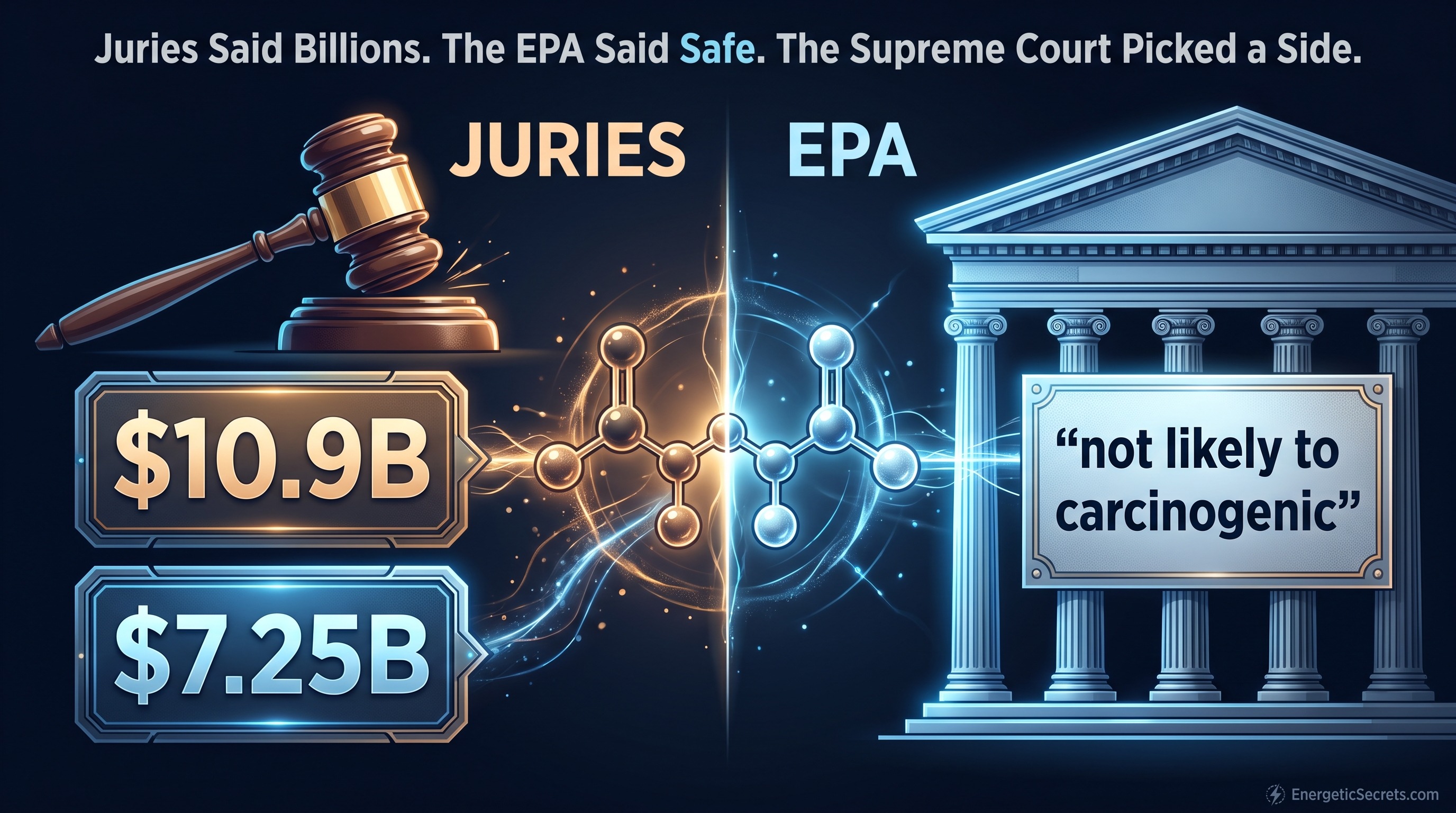
There is a strange thing happening with glyphosate, the active ingredient in Roundup. In one room, juries keep handing Bayer enormous bills. In another room, the Environmental Protection Agency keeps saying the same chemical is "not likely to be carcinogenic to humans." Both rooms are looking at the same molecule. They have reached opposite conclusions, and in June 2026 the United States Supreme Court stepped in to decide which room gets the final word.
That is the story I want to walk you through today. Not "is glyphosate safe," because that question has been argued to death and the answer depends entirely on who you ask. The more interesting question is who gets to decide. The courtroom, the regulator, or the label on the bottle. And the answer has shifted sharply in just the last four years.
I should be honest about where I am coming from. My father is a mainstream doctor, and I grew up learning to distrust the official line on chemicals and health. So when I see a regulator and a jury looking at the same evidence and reaching opposite conclusions, I do not assume the regulator is the one who got it right. I assume somebody is not telling the whole story.
Let me start with the science, because you cannot understand the legal fight without it.
The Molecule and the Disagreement
Glyphosate is a broad-spectrum herbicide. It kills weeds by blocking an enzyme that plants need to build certain amino acids. That enzyme, and the pathway it sits in, does not exist in human cells, which is the core of the argument that the chemical is safe for people. I am simplifying here, but that is the honest version of the industry's position. To dig deeper into the science on this check out our previous article Is Weedkiller Destroying Your Gut? The Shocking Truth About Glyphosate
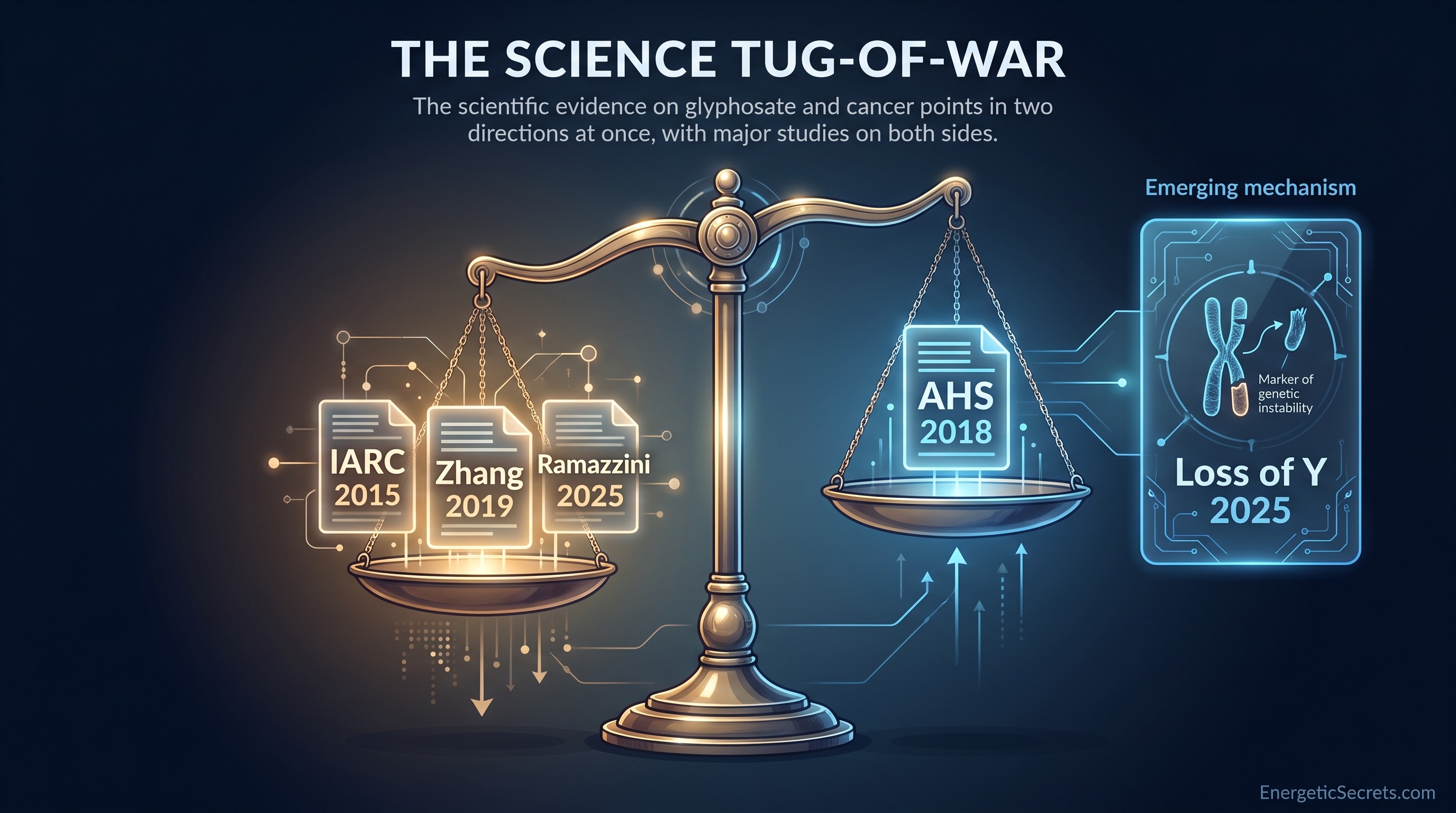
The disagreement starts with how you read the evidence. In 2015, the International Agency for Research on Cancer, the World Health Organization's cancer arm, classified glyphosate as "probably carcinogenic to humans," its Group 2A category (1). That is not a finding that glyphosate causes cancer. It is a finding that the evidence is strong enough to worry about.
The EPA looked at much of the same evidence and reached the opposite conclusion. In its February 3, 2020 interim registration review decision, the agency found no human-health risks of concern from glyphosate exposure, while flagging potential ecological risks (9, 10). The agency has repeated its "not likely to be carcinogenic to humans" position ever since, even as its own process has been knocked around by the courts.
What the Studies Actually Show
Here is where it gets uncomfortable, because the honest answer is that the science is genuinely mixed, and both sides cherry-pick.
On one side, a 2019 meta-analysis pooled the epidemiology and reported a statistically significant association between exposure to glyphosate-based herbicides and an increased risk of non-Hodgkin lymphoma (6). A meta-analysis is not a smoking gun, but it is the kind of evidence that makes a jury sit up.
On the other side sits the Agricultural Health Study, the largest prospective cohort of pesticide applicators. Its 2018 analysis found no statistically significant association between glyphosate use and most cancers, though the authors reported a possible, but not statistically significant, elevated risk of acute myeloid leukemia in the highest-exposure group (5). That largely null result is the single strongest counterweight to the cancer narrative, and it is the study the EPA leans on hardest.
Then there is the animal work. The Ramazzini Institute in Italy, a respected independent lab, ran a long-term study exposing rats to glyphosate and glyphosate-based herbicides from prenatal life onward. The pilot phase reported carcinogenic effects in Sprague-Dawley rats (2). A companion commentary summarized what the authors called "new evidence on carcinogenic effects of glyphosate and glyphosate-based pesticides" (3). The earlier 13-week pilot had established the study design and first in-life endpoints at a human-equivalent dose (4).
And there is a newer, stranger finding. A 2025 analysis of the Agricultural Health Study reported an association between glyphosate use and mosaic loss of chromosome Y in buccal samples from male pesticide applicators (7). Mosaic loss of Y is a marker of genetic instability. It is not a cancer endpoint. It is emerging mechanistic evidence, a hint that glyphosate might be doing something to chromosomes that we are only beginning to measure. Regarding chromosomes you may want to review our article on aneuploidy. A separate 2024 study confirmed that glyphosate shows up in the urine of farmers and nonfarmers alike, which tells us exposure is widespread (8).
I do not know which of these findings will hold up. Nobody does. What I can tell you is that the evidence is not the clean, settled picture either side pretends it is.
The Courtroom: Billions and Billions
The legal story is where the money is, and it is enormous.
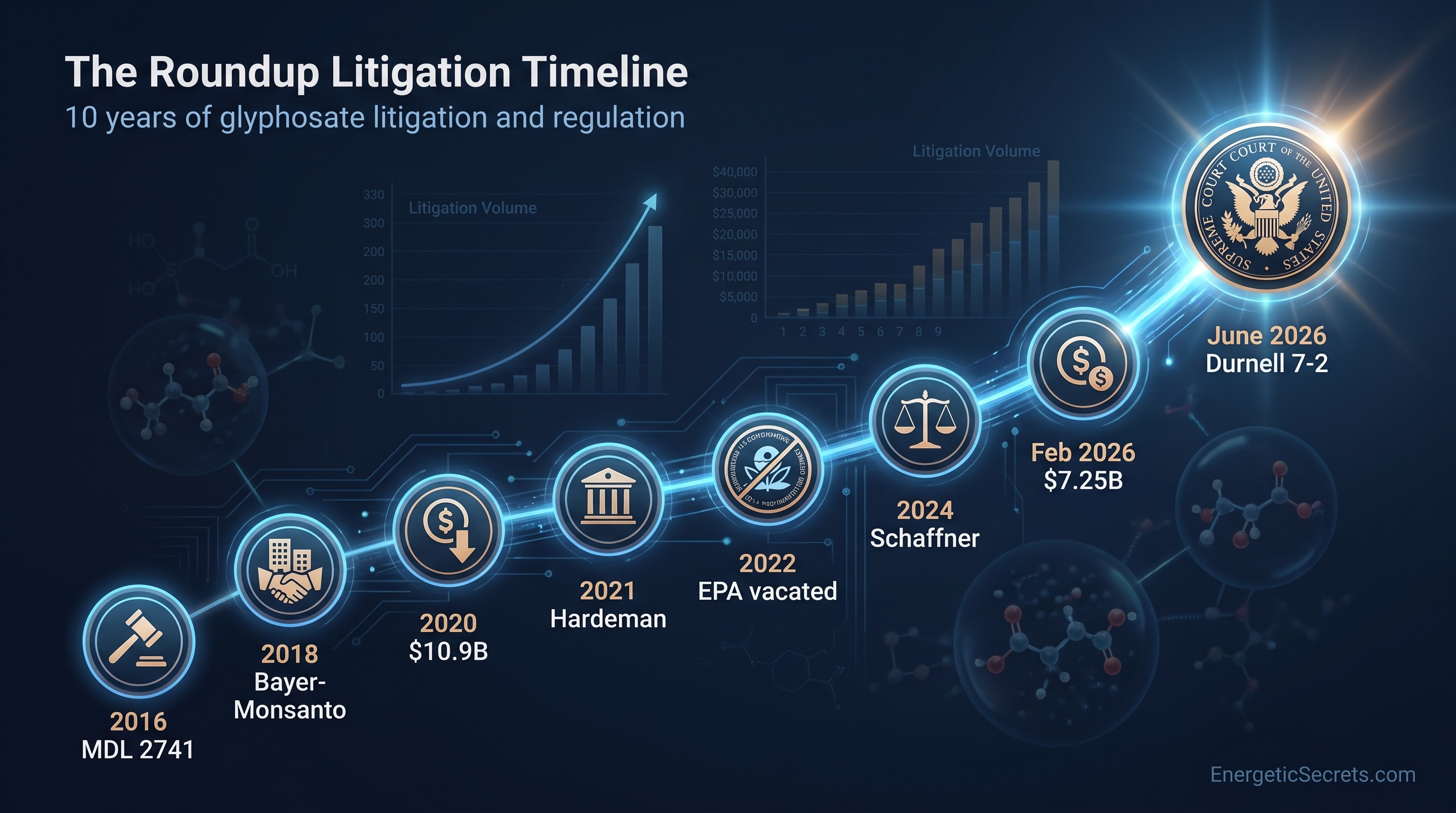
In June 2020, Bayer announced it would pay up to $10.9 billion to resolve the bulk of U.S. Roundup litigation, covering roughly 75% of the then-current 125,000 filed and unfiled claims, plus up to $1.22 billion for two further matters involving PCB water contamination and dicamba drift (18). Keep in mind, that $10.9 billion was an announcement, not a final court-approved amount. The deal was subject to approval by Judge Vince Chhabria of the Northern District of California.
The first federal bellwether trial, Hardeman, ended with a jury awarding $5,267,634.10 in compensatory damages and $75 million in punitive damages. The district court cut the punitive award to $20 million, and the Ninth Circuit affirmed in May 2021 (13). That same Ninth Circuit panel held that Hardeman's state failure-to-warn claims were not preempted by federal pesticide law, a holding that would later be turned on its head.
The cases were consolidated into a single federal docket, In re: Roundup Products Liability Litigation, MDL No. 2741, in the Northern District of California, assigned to Judge Chhabria and created by the Judicial Panel on Multidistrict Litigation on October 3, 2016 (17). Bayer has faced more than 100,000 lawsuits since acquiring Monsanto in 2018, a figure that comes from Bayer's own reporting as carried by The Guardian, not from a court docket (19, 20).
The latest chapter is still being written. In February 2026, Bayer proposed a $7.25 billion class-action settlement, with per-claimant payments ranging from $10,000 to $165,000 for non-Hodgkin lymphoma claimants (19). A group of 14 law firms representing nearly 20,000 plaintiffs moved to intervene and challenge the deal. That $7.25 billion is a proposal, not a done deal, and it is being fought.
The Regulator: A Position That Will Not Move
While juries were writing checks, the EPA was holding its line.
The February 3, 2020 interim decision found no human-health risks of concern (9). But in June 2022, the Ninth Circuit vacated the human-health portion of that decision, holding that the EPA's "not likely to be carcinogenic" conclusion was not supported by substantial evidence, and remanded for further analysis (12). That was a real blow to the agency's position, and it came from a court, not a jury.
The EPA's response was telling. On September 23, 2022, the agency withdrew all remaining portions of the interim decision, while insisting that its underlying scientific finding that glyphosate is "not likely to be carcinogenic to humans" remained unchanged (10). The agency also made clear that glyphosate products "continue to remain on the market and be used according to the product label and are unaffected by this action" (10). In other words, the agency pulled its own decision off the table rather than defend it, but kept the product on the market and kept its safety conclusion.
The story is not over. As of August 25, 2026, the EPA published a notice of availability of its "open literature search" to inform an updated glyphosate human health risk assessment, "currently scheduled to be completed in late 2026," and opened a comment period (11). So the regulator is, at long last, going back to the evidence. Whether that reassessment changes anything is an open question.
The Supreme Court: The Label Wins
The decisive event came on June 25, 2026.
In Monsanto v. Durnell, the Supreme Court held 7 to 2 that federal pesticide law expressly preempts a state-law failure-to-warn claim that would require a cancer warning on Roundup's label (15, 20). The case began when a jury awarded Durnell more than $1 million on a failure-to-warn theory. The Missouri Court of Appeals affirmed. The Supreme Court reversed.
The reasoning matters. Federal law, the Federal Insecticide, Fungicide, and Rodenticide Act, sets the rules for what a pesticide label must say. The Court held that a state law requiring a cancer warning would impose requirements different from, or in addition to, what federal law requires, and so it is preempted. Justice Kavanaugh wrote the majority, joined by Chief Justice Roberts and Justices Thomas, Alito, Sotomayor, Kagan, and Barrett. Justice Jackson dissented, joined by Justice Gorsuch (15).
This was not the first time a court had reached that conclusion. The Third Circuit, in Schaffner v. Monsanto in August 2024, held that a Pennsylvania duty to add a cancer warning to Roundup's label was preempted by federal law, reversing a stipulated judgment for the plaintiffs (14). And in November 2023, the Ninth Circuit affirmed a permanent injunction barring California from enforcing Proposition 65's carcinogen-warning requirement for glyphosate, holding that the compelled warning violated the First Amendment (16). That opinion also noted that IARC had identified glyphosate as "probably carcinogenic" in 2015 (16).
So the courts have now split into two camps. Juries and trial courts have, in many cases, sided with plaintiffs and awarded billions. But the appellate courts, and now the Supreme Court, have increasingly held that the label itself is a federal matter, and that states cannot force a cancer warning onto it.
Who Gets to Decide
The thing is, the regulatory and judicial systems have diverged, and the June 2026 Durnell decision is the event that tips the balance.
The EPA says glyphosate is not likely to be carcinogenic. IARC says it probably is. Juries have awarded billions. The Supreme Court has now said that, whatever the truth of the science, a state cannot force Bayer to put a cancer warning on the label, because the label is the federal government's to control.
I do not know whether glyphosate causes cancer, but from reading all these stories I'm quite suspicious it does. What I can tell you decisively is that the question of who gets to decide has been answered, at least for now, and the answer is the regulator and the label, not the jury.
For the record, I don't trust any of the bureaucrats. Study a bit of alternative history and you might come to the same conclusion that I do in this post Epstein era, I think they're all blackmailed or paid off by the industry they pretend to regulate.
So of course, that does not settle the science. The EPA's own updated risk assessment is due in late 2026, and the Ramazzini Institute's full Global Glyphosate Study is still unfolding. The mosaic-loss-of-Y finding suggests there may be mechanisms we have not yet fully mapped. The story is far from over.
There is a deeper question underneath all of this, and it is the one I keep coming back to. The whole glyphosate fight assumes that a single chemical can be judged safe or unsafe in isolation, the way a regulator tests it in a lab. But the terrain view, the one I have come to trust, says the internal environment matters more than any single exposure. A chemical that looks harmless on its own can behave differently inside a body that is already inflamed, already toxic, already struggling with a compromised microbiome. I do not know all the answers to that, but it sure seems like the regulators are not asking all the right questions.
After all, if the science were truly "settled", there would be no billion-dollar settlements, no split juries, and no Supreme Court case. The fact that all three exist tells you the science is anything but settled.
If you have been following this saga, the takeaway is this. The courtroom and the regulator have been telling two different stories about the same molecule, and in June 2026 the highest court in the land picked a side. Whether the science ever catches up to the money is the part nobody can predict.
In closing, I would love to hear what you think. Do you trust the regulator or the jury on this one? Share this with anyone you feel would benefit from reading it, and if you want more of this kind of digging, subscribe to this newsletter here at EnergeticSecrets.com.
References
1. Guyton KZ, Loomis D, Grosse Y, El Ghissassi F, Benbrahim-Tallaa L, Guha N, Scoccianti C, Mattock H, Straif K; International Agency for Research on Cancer Monograph Working Group. Carcinogenicity of tetrachlorvinphos, parathion, malathion, diazinon, and glyphosate. Lancet Oncol. 2015;16(5):490-1. PMID 25801782. DOI 10.1016/S1470-2045(15)70134-8.
2. Panzacchi S, Tibaldi E, De Angelis L, Falcioni L, Giovannini R, Gnudi F, Iuliani M, Manservigi M, Manservisi F, Manzoli I, Menghetti I, Montella R, Noferini R, Sgargi D, Strollo V, Truzzi F, Antoniou MN, Chen J, Dinelli G, Lorenzetti S, Mantovani A, Mesnage R, Perry MJ, Vornoli A, Landrigan PJ, Belpoggi F, Mandrioli D. Carcinogenic effects of long-term exposure from prenatal life to glyphosate and glyphosate-based herbicides in Sprague-Dawley rats. Environ Health. 2025;24(1):36. PMID 40490737. DOI 10.1186/s12940-025-01187-2.
3. Mandrioli D, Panzacchi S. [Global Glyphosate Study: new evidence on carcinogenic effects of glyphosate and glyphosate-based pesticides]. Epidemiol Prev. 2025;49(4):252-253. PMID 41399882. DOI 10.19191/EP25.4.069.
4. Panzacchi S, Mandrioli D, Manservisi F, Bua L, Falcioni L, Spinaci M, Galeati G, Dinelli G, Miglio R, Mantovani A, Lorenzetti S, Hu J, Chen J, Perry MJ, Landrigan PJ, Belpoggi F. The Ramazzini Institute 13-week study on glyphosate-based herbicides at human-equivalent dose in Sprague Dawley rats: study design and first in-life endpoints evaluation. Environ Health. 2018;17(1):52. PMID 29843719. DOI 10.1186/s12940-018-0393-y.
5. Andreotti G, Koutros S, Hofmann JN, Sandler DP, Lubin JH, Lynch CF, Lerro CC, De Roos AJ, Parks CG, Alavanja MC, Silverman DT, Beane Freeman LE. Glyphosate Use and Cancer Incidence in the Agricultural Health Study. J Natl Cancer Inst. 2018;110(5):509-516. PMID 29136183. DOI 10.1093/jnci/djx233.
6. Zhang L, Rana I, Shaffer RM, Taioli E, Sheppard L. Exposure to glyphosate-based herbicides and risk for non-Hodgkin lymphoma: A meta-analysis and supporting evidence. Mutat Res Rev Mutat Res. 2019;781:186-206. PMID 31342895. DOI 10.1016/j.mrrev.2019.02.001.
7. Chang VC, Koutros S, Hurwitz LM, Zhou W, Andreotti G, Parks CG, Sandler DP, Rothman N, Machiela MJ, Beane Freeman LE, Hofmann JN, Berndt SI. The association between glyphosate use and mosaic loss of chromosome Y in buccal samples among male pesticide applicators in the Agricultural Health Study. Environ Int. 2025;203:109755. PMID 40914106. DOI 10.1016/j.envint.2025.109755.
8. Chang VC, Ospina M, Xie S, Andreotti G, Parks CG, Liu D, Madrigal JM, Ward MH, Rothman N, Silverman DT, Sandler DP, Friesen MC, Beane Freeman LE, Calafat AM, Hofmann JN. Urinary biomonitoring of glyphosate exposure among male farmers and nonfarmers in the Biomarkers of Exposure and Effect in Agriculture (BEEA) study. Environ Int. 2024;187:108644. PMID 38636272. DOI 10.1016/j.envint.2024.108644.
9. U.S. EPA. Pesticide Registration Review; Interim Decision for Glyphosate; Notice of Availability. 85 FR 5957 (Feb. 3, 2020). Document 2020-01935. Docket EPA-HQ-OPP-2017-0751. Federal Register
10. U.S. EPA. EPA Withdraws Glyphosate Interim Decision. Released Sept 23, 2022. EPA.gov
11. U.S. EPA. Glyphosate Open Literature Search To Inform Human Health Risk Assessment; Notice of Availability. 91 FR 54870 (Aug. 25, 2026). Document 2026-17301. Docket EPA-HQ-OPP-2009-0361. Federal Register
12. NRDC v. U.S. EPA, No. 20-70787 (9th Cir. June 17, 2022). Opinion PDF
13. Hardeman v. Monsanto Co., Nos. 19-16636, 19-16708 (9th Cir. May 14, 2021). Opinion PDF
14. Schaffner v. Monsanto Corp., No. 22-3075 (3d Cir. Aug. 15, 2024). Opinion PDF
15. Monsanto Co. v. Durnell, No. 24-1068, 609 U.S. ___ (2026). Slip opinion PDF
16. National Association of Wheat Growers v. Bonta, No. 20-16758 (9th Cir. Nov. 7, 2023). Opinion PDF
17. In re Roundup Products Liability Litigation, MDL No. 2741 (J.P.M.L. Oct. 3, 2016). CourtListener record
18. The Guardian. Bayer agrees to $10.9bn settlement over Monsanto's weedkiller Roundup. June 24, 2020. Article
19. The Guardian. Lawyers for US cancer sufferers challenge Bayer's $7.25bn Roundup settlement deal. Feb 25, 2026. Article
20. The Guardian. US supreme court blocks thousands of lawsuits over Roundup maker's pesticide warning labels. June 25, 2026. Article
Disclaimer: I am not a health professional of any kind and make no medical claims. I am just a researcher who likes to dig deep on effective methods to keep them from being lost to the dust bin of history. And I like to write about what I learn. So please do your own research. Nothing in this article should be considered medical advice. None of the statements have been evaluated by the FDA. Not intended to diagnose, treat, cure or prevent any disease. If you have a medical condition seek professional help. |



9 Comments
Join the conversation
I switched to pulling weeds by hand years ago. More work but at least I'm not spraying mystery chemicals near my garden.
IARC says probably carcinogenic, EPA says probably not. Same molecule same evidence. How does that even happen.
Juries handing out billions while the regulator says its fine. Somebody is wrong and I don't think its the people who got cancer.
That mosaic loss of Y finding is the part that jumped out at me. We might be measuring stuff we didn't even know to look for before.
My uncle was a farmer his whole life used Roundup constantly and got non Hodgkin lymphoma. Make of that what you will.
7 to 2 is not close. The Supreme Court pretty clearly decided the label is federal and that is that.
The EPA saying its not likely carcinogenic while pulling their own decision off the table is wild to me. If you were confident you would defend it.
I sprayed that stuff for years on my property and never thought twice about it. Now I'm reading this and feeling a little uneasy.
So the label wins but the science is still up in the air? Sounds like a win for Bayer's lawyers and nobody else honestly.