
Shocking Truth: Your "Healthy Avocado Oil" May Be Industrial Seed Oil |
When the bottle is really canola, safflower, or soybean oil, you're paying avocado prices for crappy oxidized seed oils you didn't sign up for. #Avogate |
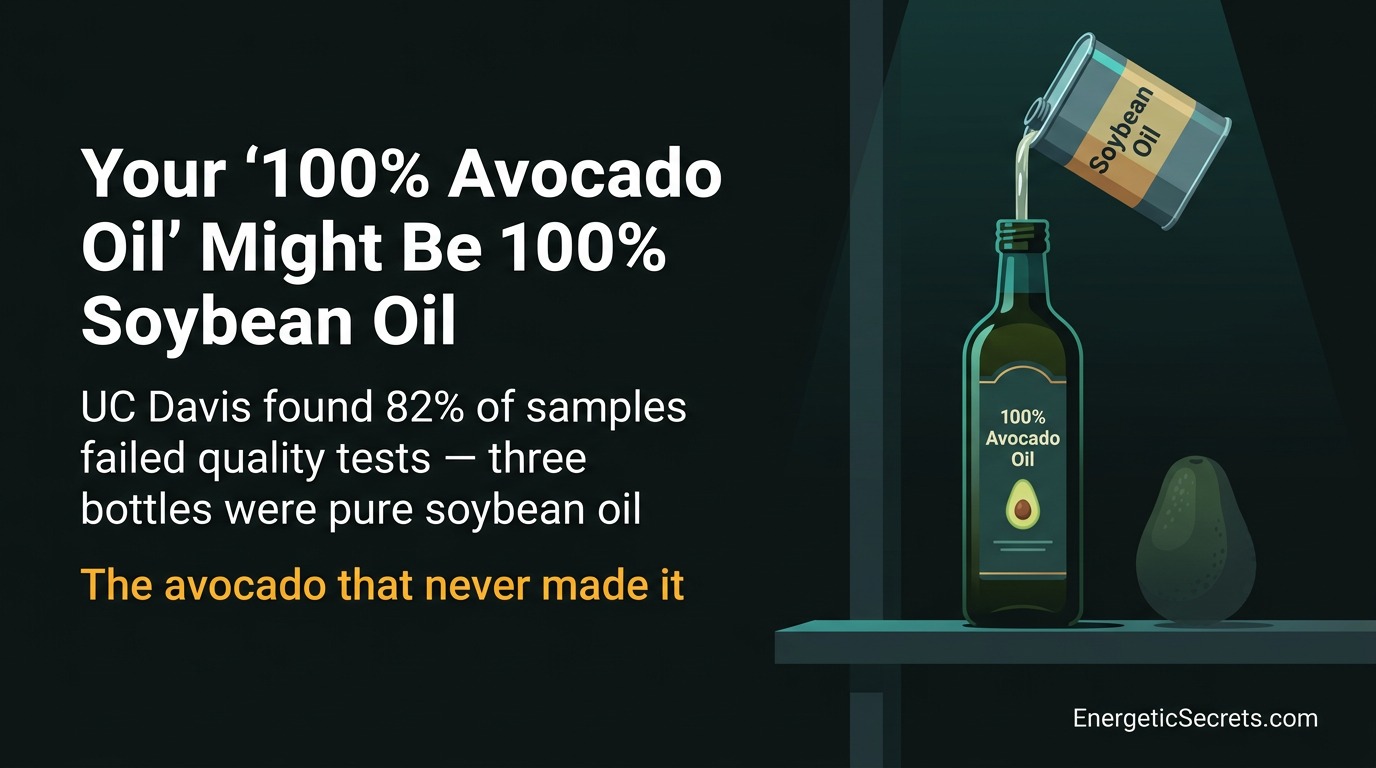
Quick summary: UC Davis researchers found that 82% of avocado oil samples failed quality tests, and three of the 22 bottles they bought were 100% soybean oil. Five years later, only 40% of commercial samples pass basic purity checks, and no federal standard of identity exists to stop the fraud. Here is what the studies actually found, why the substitutes matter for your health, and what you can do about it.
You paid twelve dollars for that bottle of "100% pure avocado oil." The label shows a sun-drenched avocado grove with mountains in the background. The glass is dark green, premium-feeling, the kind of bottle that looks right next to your olive oil and your small-batch vinegar. You have been using it for everything: searing steaks, roasting vegetables, dressing salads. It has a high smoke point, after all, and it is supposed to be one of the healthiest oils you can buy.
I've always been skeptical of all that because you'll rarely see "unrefined" avocado oil..
But even more importantly, there is a decent chance that bottle contains no avocado oil at all.
Not "low quality" avocado oil. Not "cut with something cheaper to stretch the margins." Zero. As in, the liquid you have been pouring into your hot pan is industrially refined soybean oil that was dyed greenish and poured into a bottle with an avocado on the label. You paid a premium for it. You felt good about the choice. And what you actually bought was the same industrial seed oil that the health-conscious consumer is specifically trying to avoid.
This is not speculation and it is not a fringe blog theory. Researchers at the University of California, Davis have been systematically documenting this fraud for over half a decade, and their latest findings, published recently in 2026, confirm what the earlier studies first revealed: the avocado oil market is one of the most comprehensively fraudulent food categories in the American grocery store (1, 2).
The Numbers Are Worse Than You Think
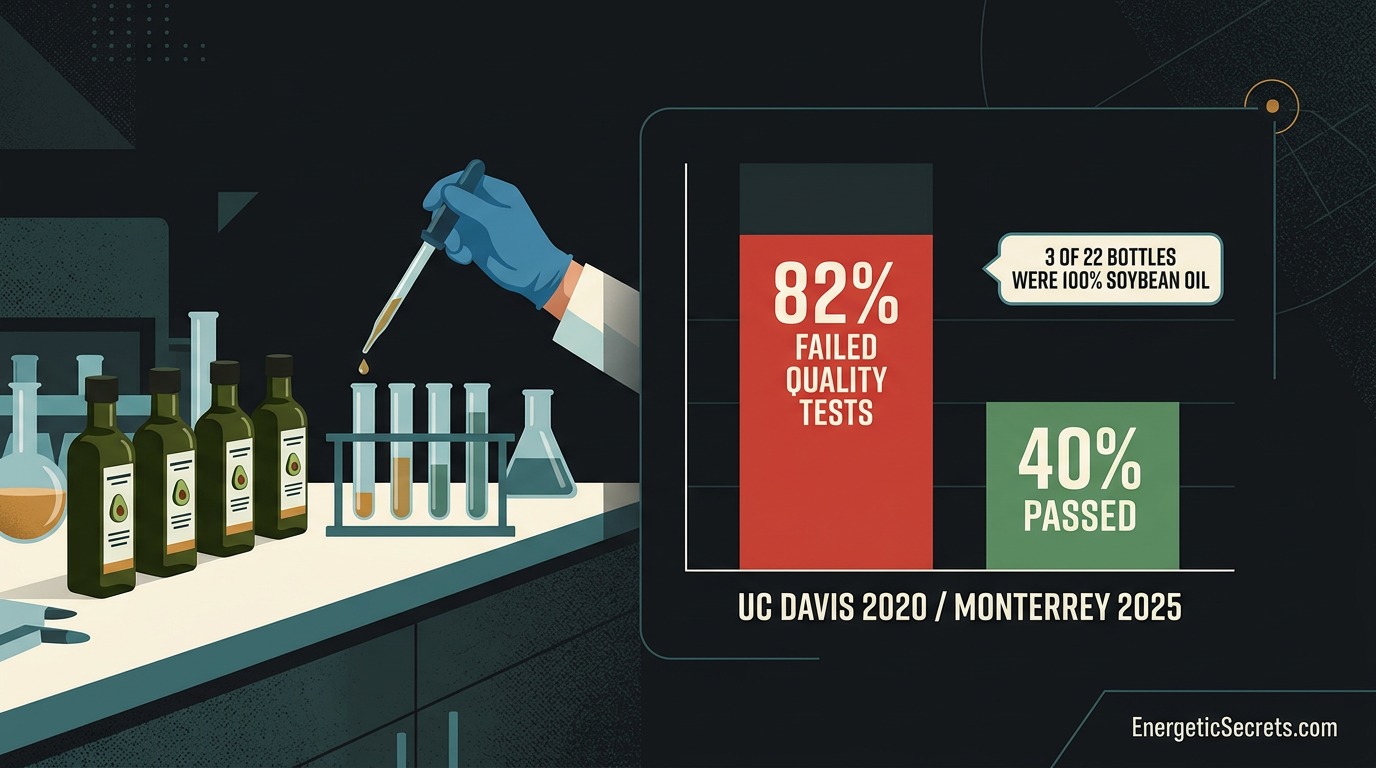
The UC Davis Olive Center dropped its first avocado oil quality report in 2020, and the results were genuinely staggering. The UC Davis Olive Center research team tested 22 commercially available avocado oil samples purchased off the shelf. Eighty-two percent were either stale, adulterated with other oils, or both. Three of the 22 samples, products sold in major retailers with "100% avocado oil" printed right on the label, were 100% soybean oil (2).
One hundred percent soybean oil. The avocado never made it into the bottle: someone took industrial soybean oil, put it in a bottle with an avocado on the front, and sold it at a premium.
If you assumed the industry cleaned itself up after that report made headlines in Consumer Reports and Food Navigator, you assumed wrong. A 2025 study out of Tecnológico de Monterrey in Mexico, published in Food Chemistry X, analyzed commercial avocado oil samples against established fatty acid standards. Only 40% passed (3). That means six out of every ten bottles on the shelf failed basic purity tests, five full years after the problem was first exposed.
Next week I will break down the newest UC Davis study in full. The short version: researchers extracted oil from 74 chips, mayonnaises, and salad dressings labeled as containing avocado oil or olive oil, and 89% of the avocado-oil-labeled products failed authenticity testing. The study is open access, not paywalled, but it sits behind a bot-wall that blocks automated readers, which is why I could not pull it earlier. I have the full text now, and the details are worth their own article.
What Is Actually in the Bottle
So if it is not avocado oil, what is it?
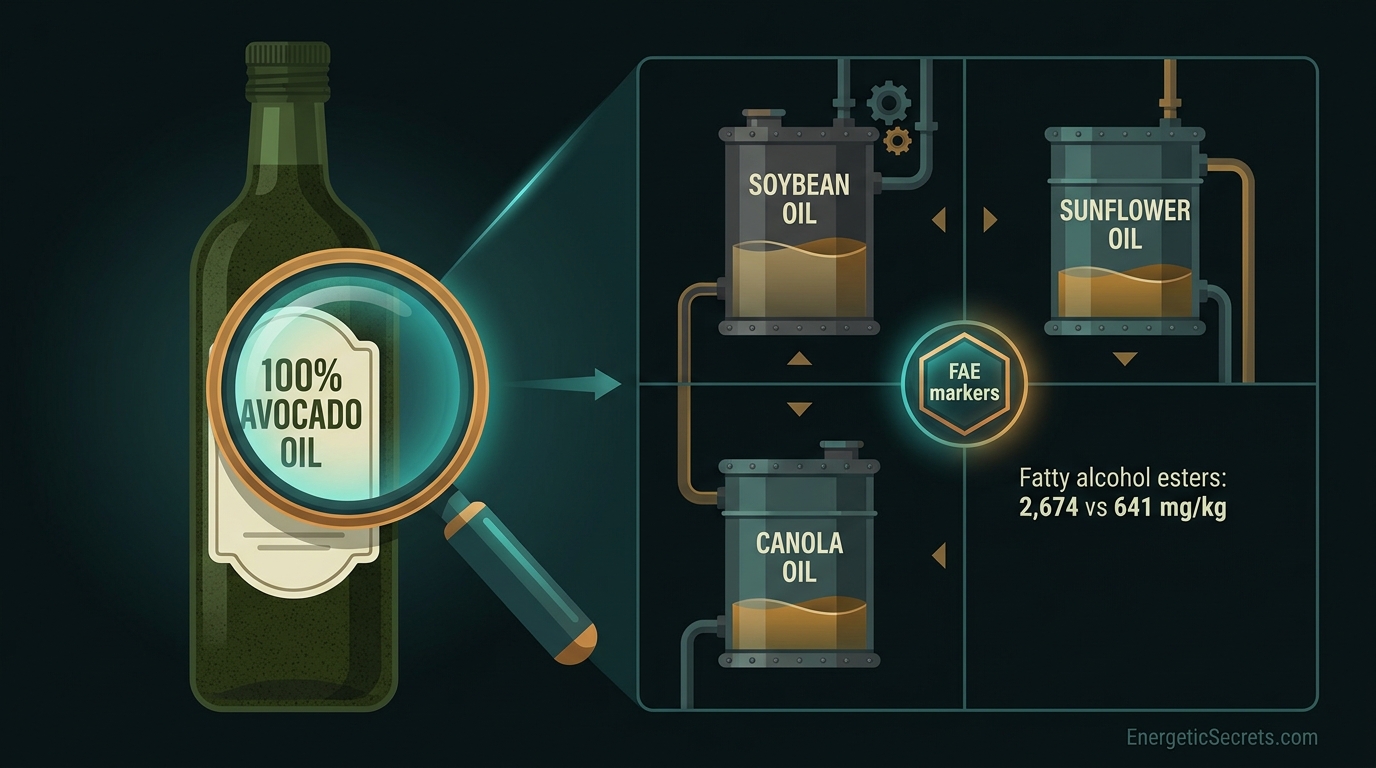
The Marín-Obispo research team used a clever analytical approach to answer exactly that question. They looked at fatty alcohol esters, or FAEs, compounds that differ dramatically between genuinely extra virgin avocado oil and industrially refined seed oils. Extra virgin samples showed FAE concentrations around 2,674 milligrams per kilogram. Refined samples came in at roughly 641 milligrams per kilogram, a fourfold difference (3). That gap is not subtle. It is a chemical signature that is very hard to fake.
Then they ran a canonical discriminant analysis, a statistical method that clusters samples by their chemical fingerprint, and the results were damning. The "allegedly pure" commercial samples that failed the fatty acid standards did not scatter randomly across the chart. They clustered tightly with known blends of canola and safflower oils. The statistical signal was unambiguous (p < 0.0001, for those who care about the numbers): the primary adulterants are canola and safflower oil, with soybean oil also appearing prominently in the earlier UC Davis work (2, 3).
Canola, safflower, and soybean oil are industrial seed oils: refined, deodorized, bleached, and sometimes winterized into something that looks and pours like a premium culinary oil. They cost a fraction of what real avocado oil costs to produce, and they are loaded with oxidized linoleic acid.
A separate 2023 study demonstrated that adulteration can be detected at shockingly low concentrations: deep learning algorithms achieved roughly 95% accuracy detecting refined olive oil mixed into avocado oil at concentrations as low as 1% by volume (4). The technology exists. It is sitting in academic labs while the bottles on grocery store shelves go unchecked.
The Health Cost Nobody Talks About
The fraud is not just economic. It is not just that you overpaid for a bottle of canola oil with an avocado on the label, though that is irritating enough. The health implications are where this story gets genuinely concerning, and they are almost never discussed in the news coverage of these studies.
Real avocado oil is predominantly monounsaturated fat, mostly oleic acid, the same heart-healthy fat that gives extra virgin olive oil its reputation. It is low in linoleic acid, the omega-6 polyunsaturated fat (PUFA) that dominates the highly oxidized industrial seed oils. When you buy avocado oil, you are buying a low-linoleic, high-oleic cooking fat. That is the whole point.
When someone in the supply chain swaps in canola or soybean oil, they are swapping in a product that is roughly 20 to 50 percent linoleic acid (7, 12). That is not a trivial substitution. Linoleic acid is the primary dietary omega-6 fatty acid, and the evidence that excessive intake drives harm has been accumulating for decades, much of it buried in plain sight.
The Minnesota Coronary Experiment, re-analyzed and published in the BMJ in 2016 by Ramsden and colleagues, is one of the landmark studies here. Researchers replaced saturated fat with corn oil (high in linoleic acid) in a controlled trial of over 9,000 participants. Serum cholesterol dropped, exactly as the diet-heart hypothesis predicted. Mortality did not. In fact, for every 30 mg/dL reduction in serum cholesterol, the risk of death increased by 22 percent (5). The Sydney Diet Heart Study, re-analyzed by the same team in 2013, found the same pattern: replacing saturated fats with linoleic acid-rich oils (note the garbage corn oil they used) increased all-cause mortality, coronary heart disease, and cardiovascular death (6).
The mechanism is not mysterious, and it is not new science. Linoleic acid is highly susceptible to oxidation. When it oxidizes, either during the high-heat industrial processing that turns seeds into clear, neutral oil, or inside the human body after consumption, it forms a family of compounds called oxidized linoleic acid metabolites, or OXLAMs (7). These are not benign byproducts that the body simply clears. OXLAMs have been shown to induce mitochondrial dysfunction in liver cells, and their concentrations correlate with the severity of non-alcoholic steatohepatitis, or NASH, in human patients (8).
Just picture your fatty acid membranes (both cellular and mitochondrial) replaced with highly oxidized fatty acids instead of the clean, saturated fats they need. Bad membranes are like bad brains, they let bad stuff into and out of the cells causing metabolic problems.
One of the most damaging OXLAMs is 4-hydroxynonenal, or 4-HNE. It is the most bioactive aldehyde produced during lipid peroxidation, and it damages proteins, DNA, and mitochondrial membranes with a promiscuity that makes it a central player in oxidative stress pathology (9). 4-HNE is also generated exogenously, meaning outside the body, when linoleic acid-rich oils are heated to frying temperatures (10). So the very act of cooking with a seed oil, the high-heat searing that avocado oil's smoke point is specifically marketed for, generates the compound you are trying to avoid.
Keep in mind what is actually happening here. The bottle on your shelf says "avocado oil." It says "high smoke point, perfect for searing." If that bottle actually contains canola or soybean oil, you are heating a high-linoleic industrial fat to temperatures that generate 4-HNE, and you are doing it believing you made the healthy choice. You paid extra for the privilege.
The body does not just excrete these compounds harmlessly, either. A 2021 study in BBA Molecular and Cell Biology of Lipids demonstrated that pre-formed OXLAMs from food processing are absorbed and incorporated into rat tissues (11). What is in the bottle ends up in you. The inflammatory cascade that follows, driven by an imbalanced omega-6 to omega-3 ratio, has been linked to autoimmune dysfunction, metabolic disease, and chronic inflammation (12).
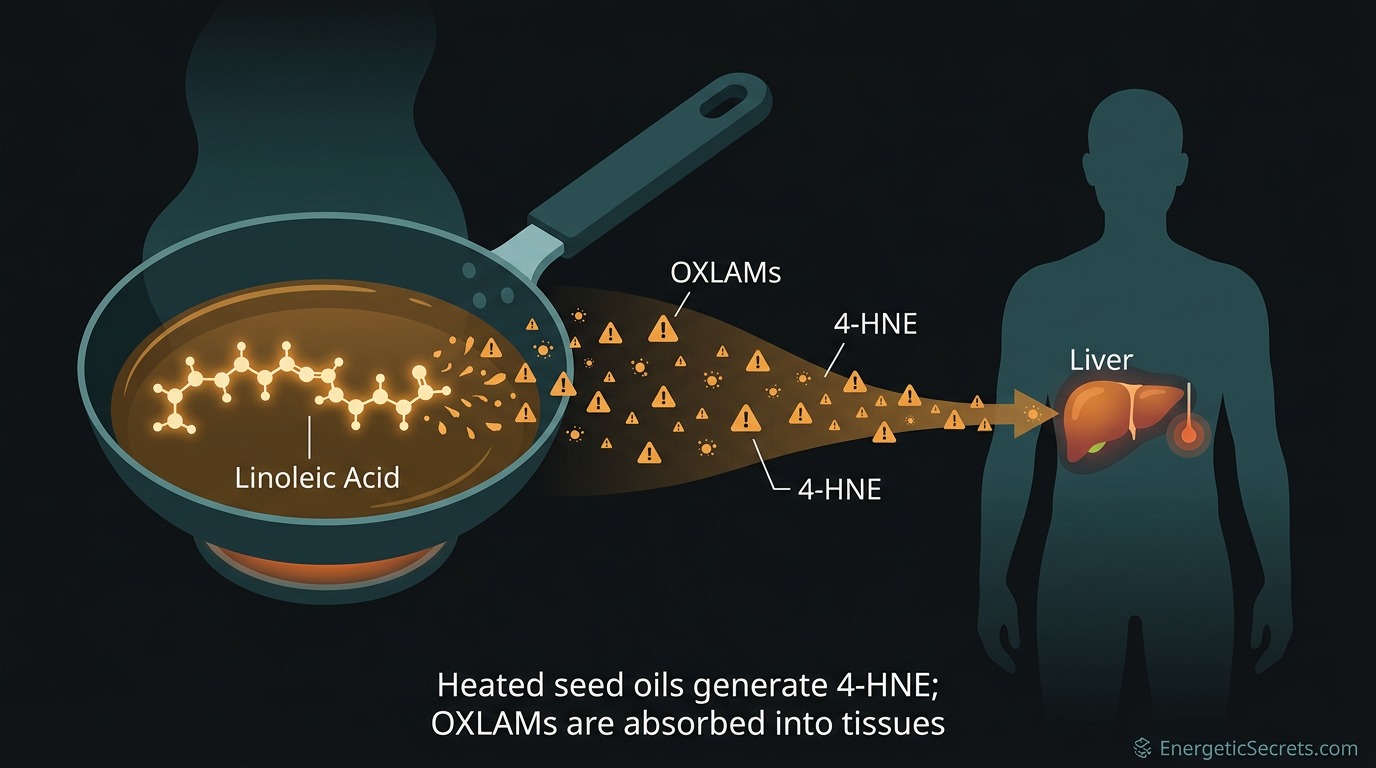
The studies do not show that consuming adulterated avocado oil causes a specific disease. What they show is that the oils being substituted into your bottle are the same industrial seed oils mechanistically linked to oxidative stress, mitochondrial damage, and chronic inflammation. The fraud creates a health exposure the consumer did not consent to and cannot detect.
Why Is This Legal?
The short answer: because nobody is enforcing anything.
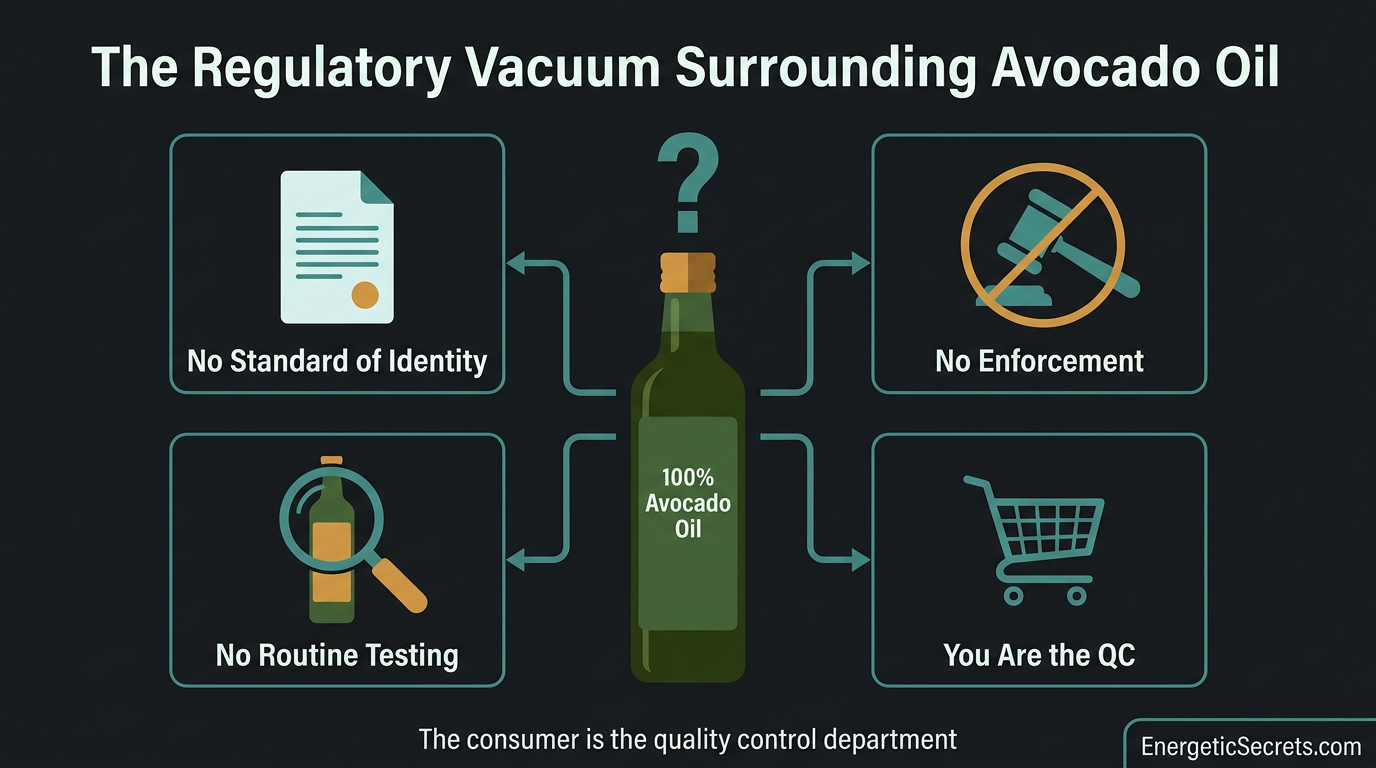
Avocado oil has no federal standard of identity in the United States. The FDA has not established what "avocado oil" must contain, chemically speaking, to earn that label. The Codex Alimentarius, the international food standards body, has proposed purity standards for avocado oil, but a 2023 evaluation published in Food Control by Green and Wang found those proposed standards to be inadequate, and most commercial samples failed even those weak parameters (13).
There is no routine testing. No enforcement action. No meaningful penalty. A company can fill a bottle with refined soybean oil, add some green coloring, slap an avocado on the label, and sell it at a premium. Nobody is checking. The Marín-Obispo paper states it plainly in the introduction: "The lack of regulations on avocado oil authenticity enabled producers to blend it with cheaper oils without declaring it on the label" (3). That sentence, in a peer-reviewed food chemistry journal, is about as close to an indictment as academic prose gets.
Whether it is corruption, incompetence, or a regulatory system that was never designed to keep up with a globalized food supply, the result is the same: you are the quality control department, and you do not have a mass spectrometer in your kitchen.
I grew up trusting the system but it didn't last very long. My father is a mainstream doctor but in his semi-retirement phase now he appears to be trusting it less and less by the year. It took years to realize that the system was never designed to protect consumers from this kind of fraud. It reacts to crises after they happen, and a bottle of fake avocado oil does not create a crisis. It creates a slow, invisible exposure nobody tracks.
This Is Not Just Avocado Oil
If this were an isolated problem, it would be bad enough. It is not isolated.
Olive oil has been plagued by adulteration for decades. The 1981 toxic oil syndrome in Spain, where adulterated rapeseed oil killed over 300 people and injured thousands more, was an extreme case, but routine olive oil fraud, cutting extra virgin with refined or seed oils, is so well documented that it has its own academic subfield. Honey is routinely cut with sugar syrups. Fish is mislabeled at rates that would shock most consumers (that red snapper you ordered? There is a good chance it is tilapia). Spices are bulked with everything from brick dust to lead chromate. A 2021 review in Trends in Food Science and Technology catalogued the global scope of economically motivated adulteration, and high-value oils are among the most frequently targeted products (14).
The pattern is the same every time: a premium product with a price premium, a cheaper substitute that is hard to detect without laboratory equipment, and a regulatory system that is either absent or asleep. The incentive to cheat is enormous. The risk of getting caught is near zero.
When was the last time you heard of an avocado oil company being fined for selling fake product? I cannot name a single case, and I have been following this story since 2020.
The global avocado oil market has been growing rapidly, driven by the same health-conscious consumers who are trying to avoid industrial seed oils (15). That growth creates exactly the conditions that attract fraud. A 2025 bibliometric review confirmed that authentication and adulteration detection have become major research themes in the avocado oil literature, which tells you everything you need to know about how widespread the problem is (16). Researchers do not build deep learning models to detect 1% adulteration (4) or develop novel fatty alcohol ester markers (3) for a problem that is rare.
What You Can Actually Do
I am not going to tell you to buy a specific brand. The studies do not name brands (the 2020 UC Davis report did, but the 2023 and 2025 follow-ups did not, and I have not been able to access the full 2026 paper to see the brand names it apparently reveals, but will do a follow up article when I do). Even if I could, the brand that tested clean last year might have changed suppliers this year. That is how supply chains work when nobody is watching.
What I can tell you is this: the only way to be certain about what is in your food is to eat food that does not come in a bottle with a label.
The whole foods that do not need an ingredients list, the ones your great-grandmother would have recognized as food, are the ones that cannot be counterfeited. An avocado is an avocado. A steak is a steak. An egg is an egg. Nobody is cutting your ribeye with soy protein and hoping you will not notice. Nobody is adulterating a sweet potato. At least not yet, they are sure trying so stay away from Bill Gates "fake foods".
The moment something is processed, extracted, refined, and poured into a bottle, you are trusting someone. And as the avocado oil story makes clear, that trust is being exploited at industrial scale.
If you need a cooking fat, there are options that are harder to fake. Butter, ghee, tallow, and coconut oil are solid at room temperature and have distinctive flavors and textures that make adulteration more difficult and more detectable. Extra virgin olive oil has its own fraud problems, but buying from a producer you can verify, ideally one that publishes batch test results, is a better bet than grabbing a random bottle off the shelf.
Suffice it to say, the avocado oil in your pantry might be exactly what it claims to be. The 40% of samples that passed the Marín-Obispo team's tests prove that real avocado oil does exist on the market, but rarely are they unrefined. But the odds are not in your favor, and until there is meaningful enforcement, they will not be.
In closing, I will leave you with the simplest rule I know: do not eat processed foods. If it comes in a bottle with a label and a marketing story, someone had the opportunity to lie to you. And if the last six years of avocado oil research have taught us anything, it is that plenty of them are taking that opportunity.
Maybe you'll choose to live like me, eating nearly one actual avocado each day. A bit excessive, maybe, but my skin and gut loves me for it.
References
1. Wang S, Green H. Avocado oil adulteration: a 2026 follow-up study. ScienceDirect. 2026.
2. Green HS, Wang SC. First report on quality and purity evaluations of avocado oil sold in the US. Food Control. 2020;116:107328. DOI: 10.1016/j.foodcont.2020.107328.
3. Marín-Obispo LM, et al. Fatty acids and fatty alcohol esters as innovative markers of avocado oil purity and extraction method. Food Chem X. 2025. PubMed PMID: 40290469.
4. Pérez-Calabuig AM, et al. Deep quantification of a refined adulterant in avocado oil. Food Chem. 2023. PubMed PMID: 36244061.
5. Ramsden CE, et al. Re-evaluation of the traditional diet-heart hypothesis: analysis of recovered data from the Minnesota Coronary Experiment (1968-73). BMJ. 2016. PubMed PMID: 27071971.
6. Ramsden CE, et al. Use of dietary linoleic acid for secondary prevention of coronary heart disease and death: evaluation of recovered data from the Sydney Diet Heart Study. BMJ. 2013. PubMed PMID: 23386268.
7. Mercola J, D'Adamo CR. Linoleic acid: a narrative review of the effects of increased intake in the standard American diet. Nutrients. 2023. PubMed PMID: 37513547.
8. Schuster S, et al. Oxidized linoleic acid metabolites induce liver mitochondrial dysfunction and apoptosis. J Lipid Res. 2018. PubMed PMID: 30084831.
9. Sharma S, et al. 4-Hydroxynonenal mediated signaling and mitochondrial dysfunction. Biomolecules. 2022. PubMed PMID: 36358905.
10. Yamashima T, et al. Cooking oil peroxidation and Alzheimer's disease. Front Aging Neurosci. 2023. PubMed PMID: 37693644.
11. Zhang X, et al. 13-HODE is absorbed and incorporated into rat tissues. BBA Mol Cell Biol Lipids. 2021. PubMed PMID: 33340768.
12. DiNicolantonio JJ, O'Keefe JH. Omega-6/omega-3 ratio and autoimmune disease. Mo Med. 2021. PubMed PMID: 34658440.
13. Green HS, Wang SC. Evaluation of proposed CODEX purity standards for avocado oil. Food Control. 2023;143:109277. DOI: 10.1016/j.foodcont.2022.109277.
14. Visciano P, Schirone M. Food frauds: global incidents and misleading situations. Trends Food Sci Technol. 2021. DOI: 10.1016/j.tifs.2021.06.010.
15. Cervantes-Paz B, Yahia EM. Avocado oil: production and market demand, bioactive components, implications in health, and tendencies and potential uses. Compr Rev Food Sci Food Saf. 2021. PubMed PMID: 34146454.
16. Aras S, Rohman A. Global research trends on avocado oil and its fatty acid composition: a bibliometric review. J Food Drug Anal. 2025. PubMed PMID: 41066742.
Disclaimer: I am not a health professional of any kind and make no medical claims. Please do your own research. Nothing in this article should be considered medical advice. None of the statements have been evaluated by the FDA. Not intended to diagnose, treat, cure or prevent any disease. If you have a medical condition seek professional help. |




11 Comments
Join the conversation
Reminds me of the olive oil scandals. Same story every time, premium price, cheap substitute, nobody checking. When does it end.
An avocado a day is a bit much lol but honestly the point stands. Whole avocado toast it is.
Wait so heating the fake stuff makes 4-HNE while you think you picked the healthy oil? That is genuinely alarming if true.
The Bill Gates fake food line lost me a little but the actual studies are solid. UC Davis has been on this since 2020 and it keeps getting worse.
Look up how Bill Gates is buying up tons of farmland in the US under various subsidiaries and investing in fake meat companies. He's also been a big proponent of farming crickets for protein disregarding how bad their chitin protein is for your gut. Do you want to eat bugs?
Only 40% passing after five years of headlines tells you the FDA just does not care about this stuff. No standard of identity, no enforcement, nothing.
Switched to butter and tallow for cooking last year and never looked back. Way harder to fake a stick of butter.
The whole seed oil panic gets exaggerated but the fraud angle here is legit. If I pay for avocado oil I want avocado oil, simple as that.
I actually toured an avocado oil producer in Mexico a few years back and the real stuff is bright green and smells amazing. The clear stuff on shelves always looked off to me.
Just checked my pantry and my bottle doesn't say unrefined anywhere. Guess I got played for twelve bucks.
Three bottles were 100% soybean oil and nobody got fined? That is the part that gets me. How is that even legal to sell.