
StingRay's Grandchild: The $4.5 Million Machine That Impersonates a Cell Tower |
The FBI built it to catch America's most wanted hacker - Thirty years later, a Texas police department bought the same trick for $4.5 million and parked it in a Tahoe SUV |
Thirty years after the FBI used a device called Triggerfish to hunt the most wanted hacker in America, the same technology has shrunk into a backpack and landed in the trunk of a Texas police Tahoe. The paper trail shows exactly what was bought. It does not show who is being watched.
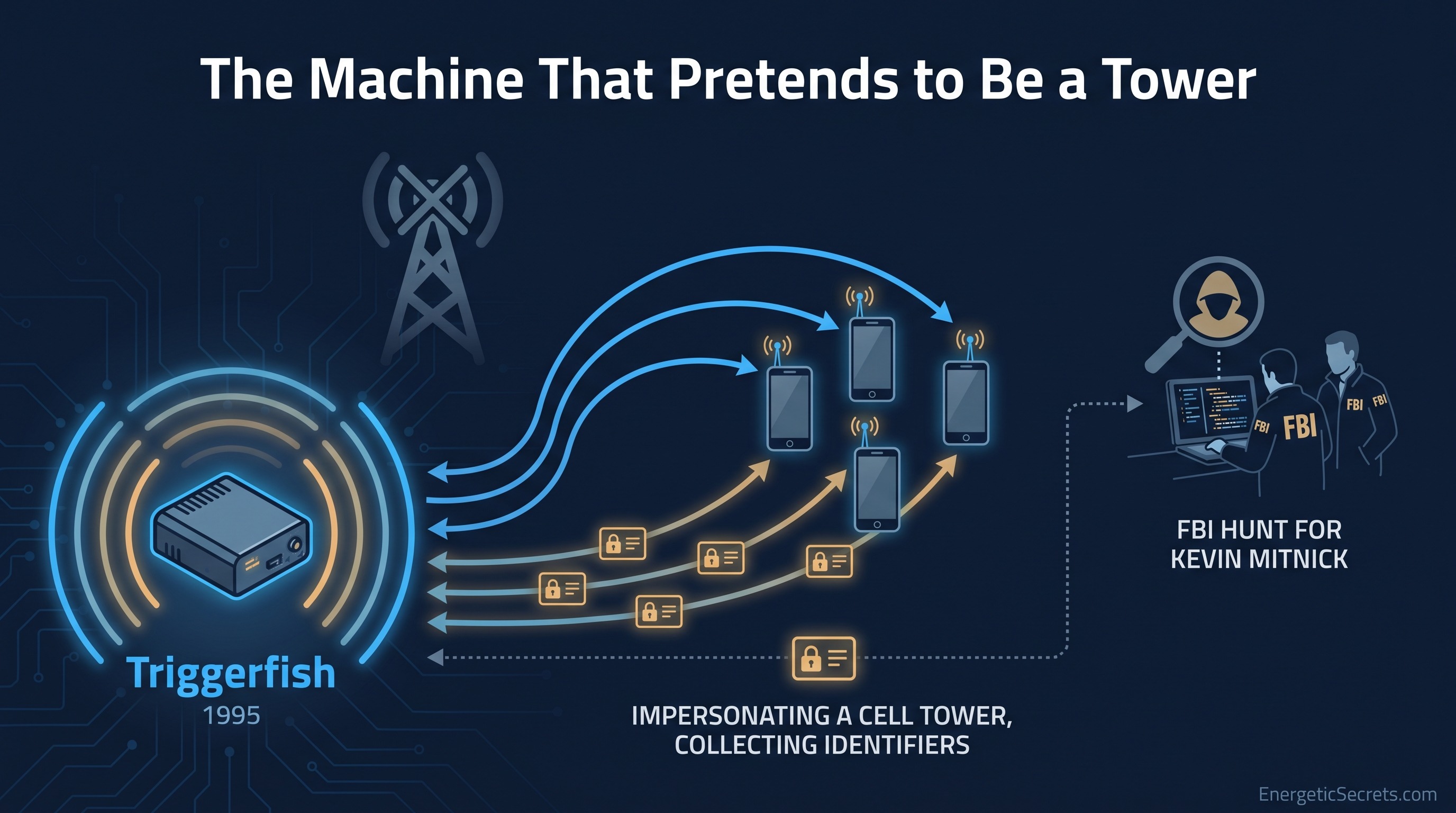
In 1995, federal agents closing in on Kevin Mitnick carried a piece of hardware that could do something most people did not believe was possible. It could pretend to be a cell phone tower.
The device was called Triggerfish, and it was built by Harris Corporation, the defense contractor now known as L3Harris. When the FBI switched it on, every phone in range quietly handed over its identifiers, believing it was talking to the network. The agents did not need the hacker's cooperation. They only needed him to carry a phone.
That was the moment the public first learned the name of a machine that had been hiding in plain sight for years. And it is the direct ancestor of the device at the center of this story.
The Machine That Pretends to Be a Tower
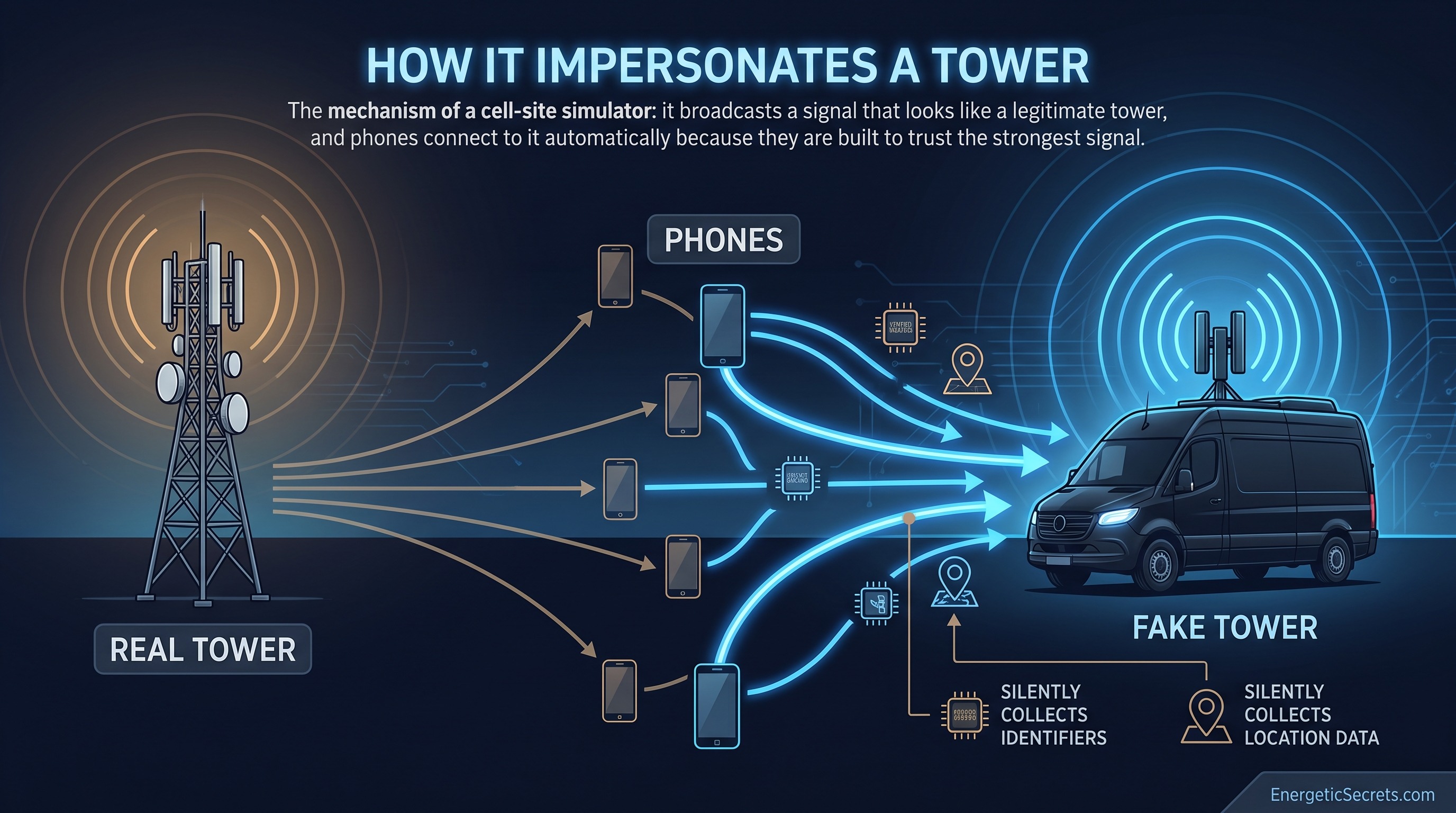
A cell-site simulator works by impersonation. It broadcasts a signal that looks like a legitimate mobile tower, and every phone in range, suspect or not, connects to it because phones are built to connect to the strongest available signal. Once connected, the device can collect the identifiers that make each phone unique and the location data that shows where it has been.
The most famous of these machines is the StingRay. Harris developed it in the early 1990s for the US military and intelligence community, brought it to the American market around 2000, and trademarked the name in 2003. The brand became so dominant that "StingRay" turned into the generic term for the entire class of device, the way "Kleenex" swallowed "tissue."
Forbes, reporting on the modern story, put the lineage in plain terms: FalcoNet is "the same technology as the infamous Stingray, one of the original cell-site simulators made by defense giant L3Harris" [3].
A Family Tree of Surveillance
StingRay was never a single product. It was a family.
Harris's full line included the StingRay and StingRay II, the KingFish, the Hailstorm, and the Triggerfish, alongside a menagerie of related systems with names that read like a naval fleet: Amberjack, Loggerhead, Gossamer, Harpoon, ArrowHead, Crossbow, and Stargrazer [27]. Boeing's Digital Receiver Technology built the airborne version, a device called the Dirtbox that could sweep identifiers from the sky.
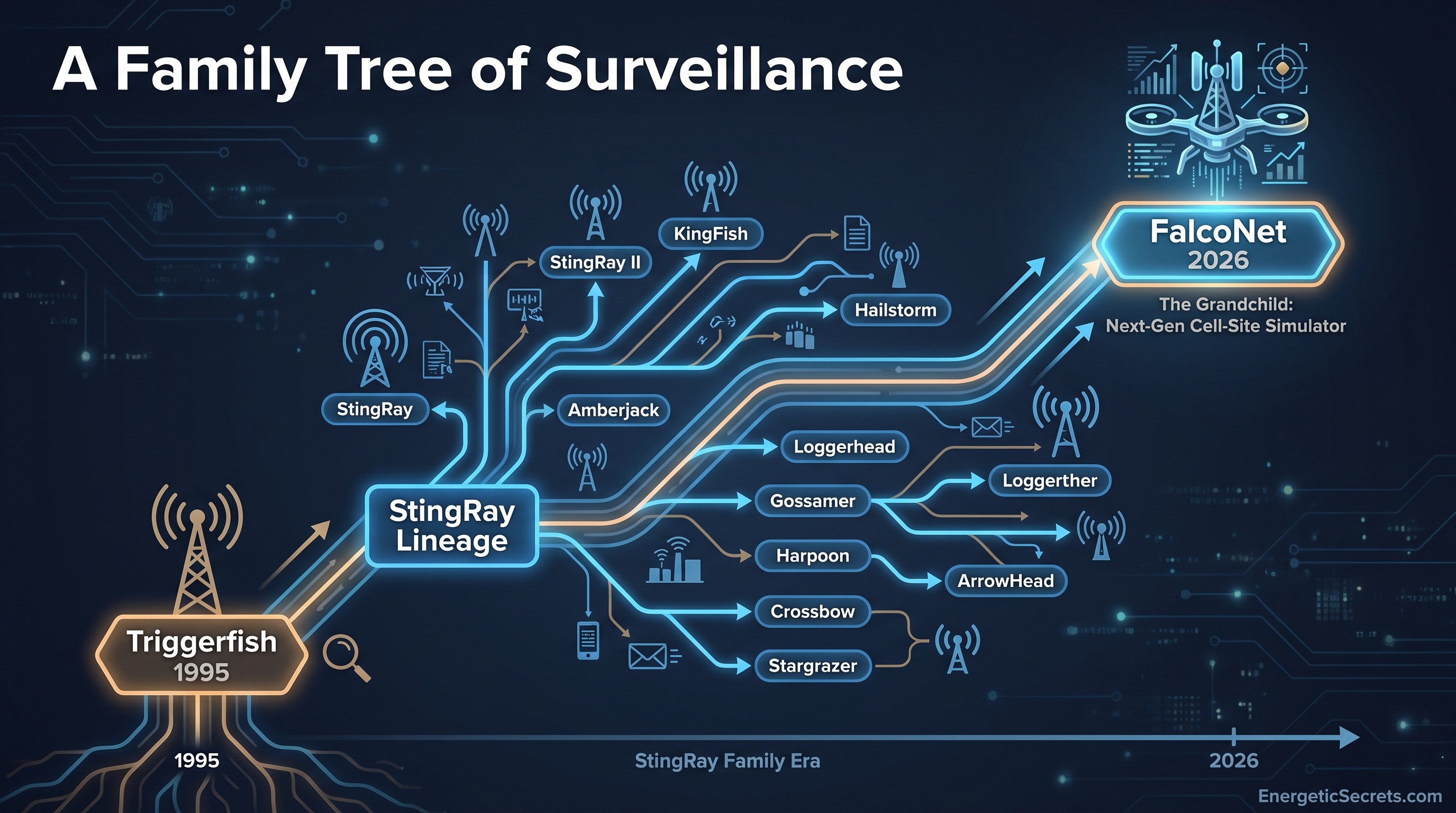
The Triggerfish holds a special place in the record. It is the earliest named Harris device to surface in public documents, and it surfaced because of Mitnick. The FBI's use of a Triggerfish to track the hacker in 1995 is the first time most Americans ever heard that such a machine existed [27].
The technology's origins sit squarely inside the US intelligence community. Harris's 1990s line was developed in close partnership with the National Security Agency (NSA) and the Defense Intelligence Agency (DIA) [27]. That is the part of the story the manufacturers never put in a brochure: the machine that now rides in a police Tahoe was born as a spy tool, and it carries that DNA.
The original commercial IMSI catcher predates even Harris. Rohde & Schwarz, the German electronics firm, built the GA 090/091 for German law enforcement, with a date of 1996 commonly cited for the device [26]. That 1996 date is likely correct but not firmly anchored in a primary source, so treat it as approximate. What is not in dispute is the sequence: the technique was invented for spies, sold to police, and then, decades later, miniaturized.
The Paper Trail the Government Tried to Redact
For years, the public knew almost nothing about these machines, because the government worked hard to keep it that way.
That changed on September 30, 2016, when the Federal Communications Commission answered a Freedom of Information Act request by releasing Harris's own user manuals for the StingRay, the Triggerfish, and the rest of the line [21]. The release was heavily redacted. The government cited trade-secret protections, law-enforcement-technique exemptions, and a statute covering intelligence sources and methods, 50 U.S.C. § 3024(i)(1) [21]. Even with the black bars, the manuals confirmed what researchers had long suspected: these were real, cataloged, commercially sold surveillance tools.
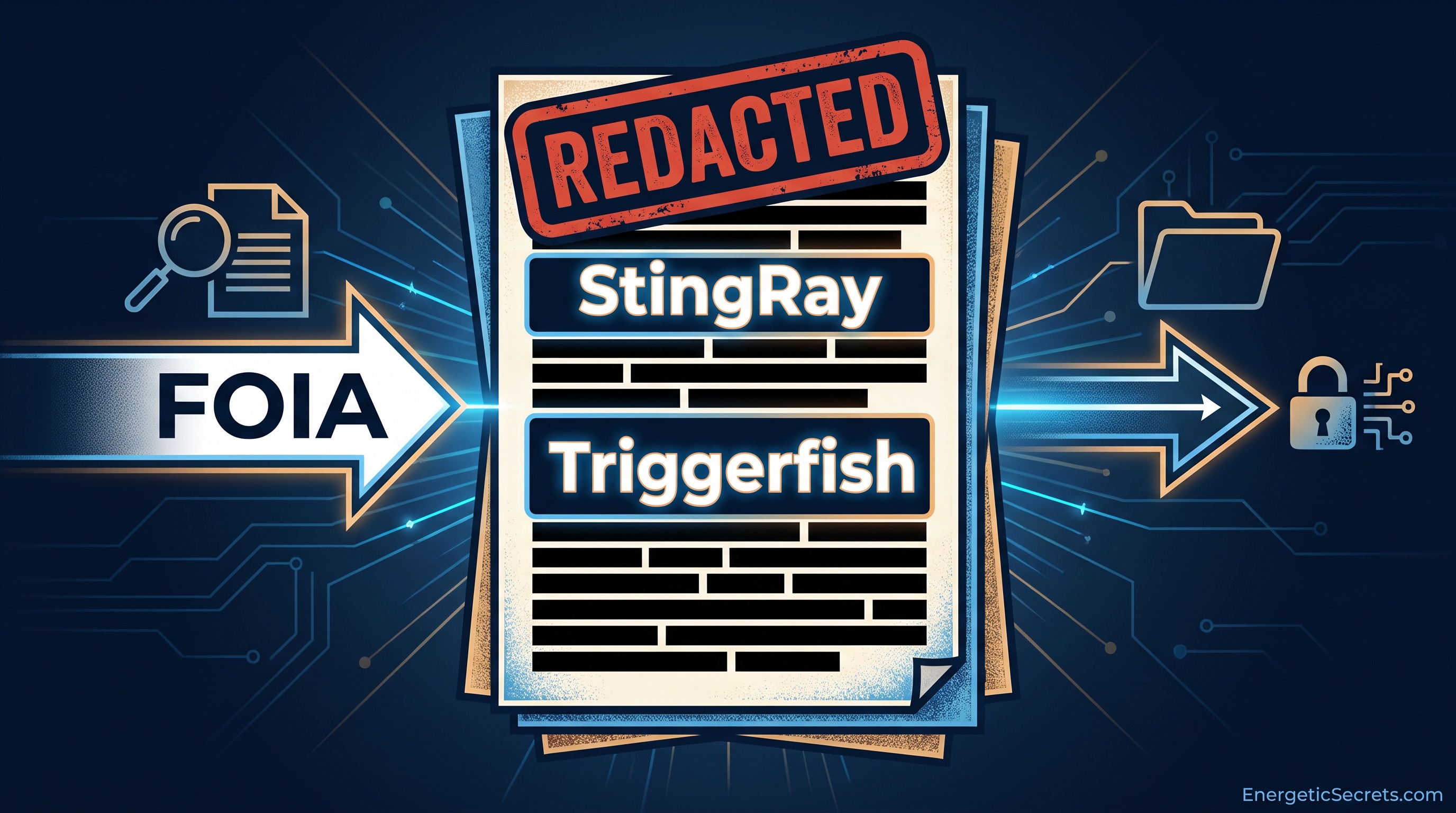
The FOIA fight was fought on several fronts at once. MuckRock, the transparency nonprofit, filed and published its own StingRay requests for the same Harris manuals [22]. The ACLU pursued records on how Immigration and Customs Enforcement and Customs and Border Protection used the devices [23]. The Electronic Privacy Information Center sued the FBI directly in EPIC v. FBI to force disclosure [24]. And The Intercept built a body of FOIA-derived reporting, starting with a secret catalogue of government spying gear in December 2015 and the long-secret StingRay manuals themselves in September 2016, that turned the StingRay from a rumor into a documented fact of American life [25][28].
The lesson of that decade of litigation is simple: the machines were never secret because they were rare. They were secret because the paperwork was buried.
StingRay's Grandchild Arrives in Texas
Now the grandchild has arrived, and this time the paperwork is public.
The machine is called FalcoNet, and it is made by Cognyte Software, an Israeli company spun out of the surveillance giant Verint Systems in 2021 [7]. In the summer of 2026, reporting by Forbes and The Drive revealed that Texas law enforcement had spent $4,487,500 on four of these systems, mounted inside 2026 Chevrolet Tahoes, along with a backpack variant built for on-foot missions [3][4].
The purchase order, obtained and published by The Drive, is the documentary spine of the story. It turns a rumor about modern spy vans and a history of deep intelligence use of secret spy tech into a line-item accounting of exactly what American police bought, down to the dollar [5].
What the FCC Filing Admits
The most concrete public record of FalcoNet is not a news article. It is a filing with the Federal Communications Commission.
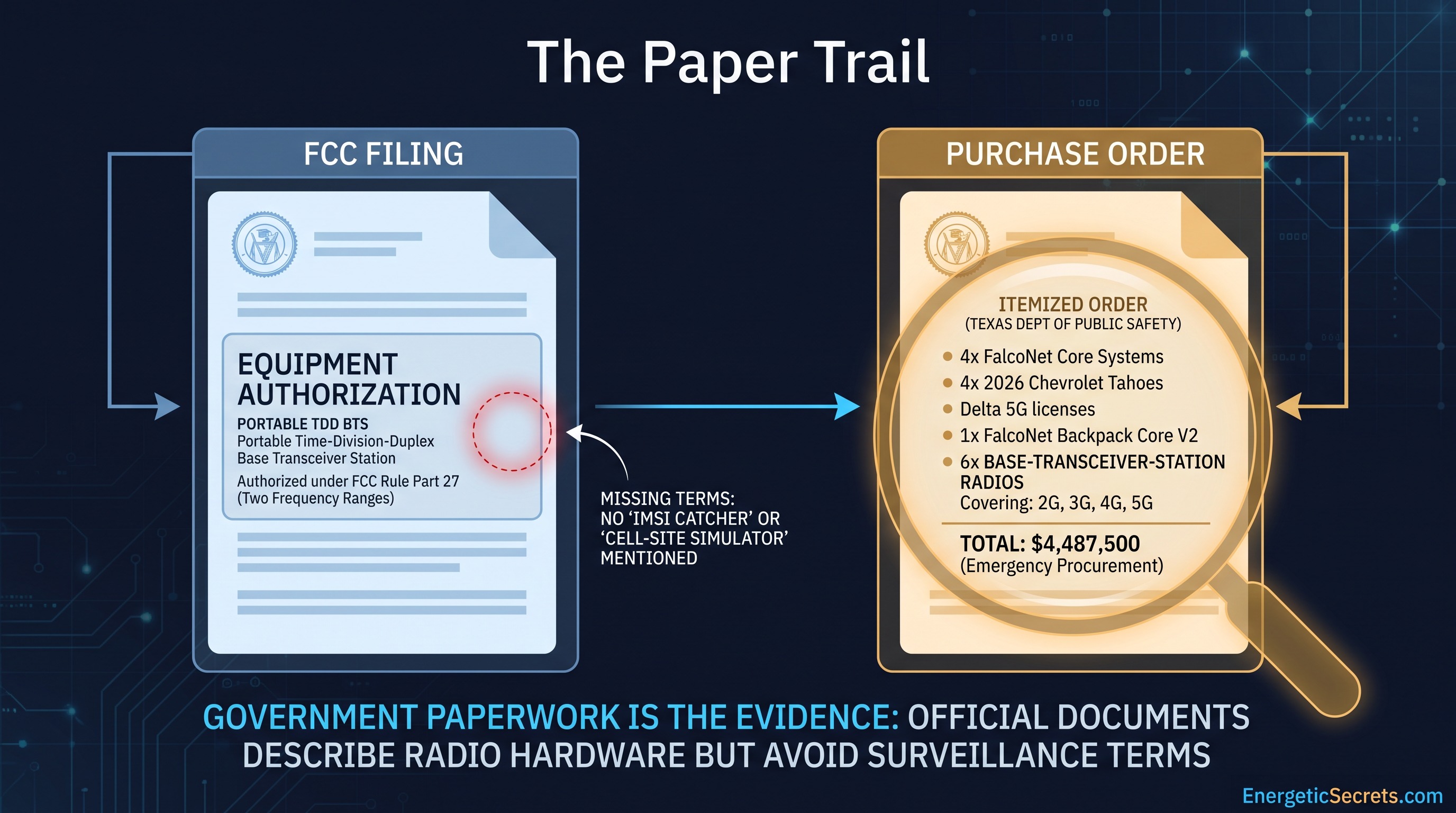
Under FCC ID 2A7A2-S2, the agency authorized a device described as a "PORTABLE TDD BTS," with the grantee listed as Cognyte Software LP of Melville, New York [1]. The grant was issued on December 30, 2022, and the equipment is classified as a "Licensed Non-Broadcast Station Transmitter" [1].
The filing is precise about the radio hardware. The device is authorized to transmit on two frequency ranges: 3460.8 to 3540 MHz and 3711.4 to 3789.1 MHz, both under FCC Rule Part 27 [1]. The emission designators are 18M5W7W and 18M4W7W, with conducted output power of 0.077 W and 0.771 W, a 2.5 ppm frequency tolerance, and a maximum antenna gain of 13 dBi [1]. The grant notes that "professional installation is required" and that the unit "supports LTE 20 MHz bandwidth modes" [1].
I know that's a bunch of technical jargon, but let's sort this out...
What the filing does not say is just as important as what it does. The words "IMSI catcher" and "cell-site simulator" appear nowhere in the authorization. The agency describes the hardware only as a portable time-division-duplex base transceiver station. The characterization of FalcoNet as an IMSI catcher comes from press reporting by Forbes and The Drive, and from Wikipedia, not from the FCC record itself [1][3][4]. That distinction matters, because it is the difference between what the government's own paperwork admits and what journalists concluded.
What Texas Actually Bought
The Texas Department of Public Safety purchase order, numbered PO26P0010314 and published by The Drive, itemizes the FalcoNet system down to the dollar. The total is $4,487,500 [5].
The largest line is four FalcoNet Core Systems at $2,850,000. On top of that, the order includes an unlicensed FalcoNet core system for $200,000, four Delta 5G perpetual licenses for FalcoNet V at $280,000, and four 2026 Chevrolet Tahoes at $600,000 [5].
The most revealing line item is the FalcoNet Backpack Core V2, described in the order as carrying "6 x BTS (2G/3G/4G/5G)" for $355,500, with an unlicensed version adding another $70,000 [5]. That single line is the documentary basis for the claim that the system spans multiple generations of cellular technology. Six base-transceiver-station radios covering 2G, 3G, 4G, and 5G, combined with the Delta 5G license, point to a device built to operate across the full modern cellular spectrum. The FCC filing's two authorized frequency ranges reinforce the same picture: this is hardware designed to work on more than one band [1][5].
The order also lists a "Flexable" antenna kit for $27,000 and a separate Cognyte product called the PA Ranger for $105,000 [5]. The PA Ranger is a distinct device, not part of FalcoNet, and its function is not documented in the sources gathered for this article. It should not be conflated with the cell-site simulator itself.
The purchase was made under an emergency procurement in March 2026, and The Drive also published the Texas Department of Public Safety's emergency decision memorandum alongside the purchase order [6]. The emergency designation is significant on its own: it is the mechanism that lets a state agency buy surveillance hardware quickly, outside the normal competitive-bidding process that would otherwise put the purchase in front of the public for longer.
A Machine That Fits in a Backpack
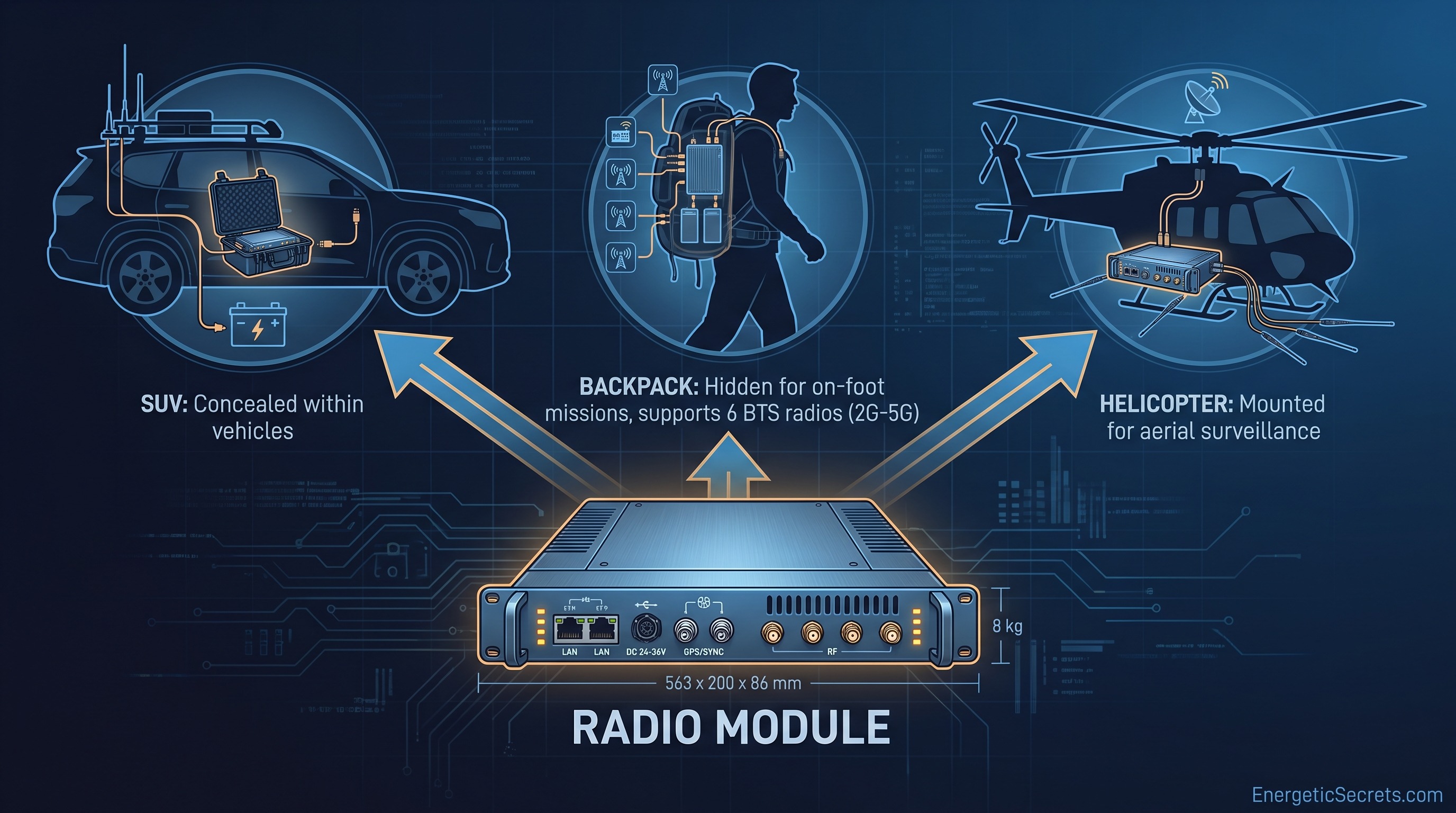
The physical form factor, drawn from the FalcoNet user guide filed with the FCC and summarized by The Drive, is unremarkable on purpose. The core module measures 563 by 200 by 86 millimeters and weighs 8 kilograms, designed as a 2U half-width 19-inch rack drawer [1][2]. It has RJ45 LAN ports, a four-way Amphenol power connector, SMA panel connectors for GPS and clock sync, and QN-Type connectors for RF input and antenna output [2]. It runs on 24 to 36 volts DC, drawing about 35 watts at idle and roughly 260 watts at full transmit [2].
Forbes, citing the Texas contract, reported that the simulator "can be concealed within the vehicles, hidden in a backpack for on-foot missions or attached to a helicopter" [3]. That is the deployment picture: a device small enough to ride in a Tahoe, light enough to carry, and modular enough to hang from an aircraft.
Cognyte's own marketing goes further. A brochure handed out at a border-policing expo in Arizona claimed the system "takes only three minutes to set up and can force thousands of devices to connect to it every minute" [3]. That is a vendor claim, reported by Forbes, and it has not been independently tested. It belongs to Cognyte's sales pitch, not to an established fact sheet.
The Company Behind the Hardware
Cognyte Software Limited is headquartered in Herzliya, Israel, and specializes in lawful-interception software. It was spun off from Verint Systems on February 1, 2021, and trades on Nasdaq under the ticker CGNT [7]. A great way to invest in the future of a slave surveillance society! (Full disclosure, the author of this article has NOT invested in said company lol.)
Forbes, drawing on SEC filings, put its market capitalization at roughly $560 million and its 2025 revenue at about $400 million, most of it from Israel and Europe [3]. US revenue has climbed from $10 million in 2023 to $15 million in 2025, and Forbes described the Texas deal as the company's biggest on record in the United States [3].
Cognyte positions itself as the "leading alternative" to Palantir, according to Forbes, and its chief executive, Elad Sharon, is a long-time Verint executive [3]. The company's pitch is that it sells the same kind of data-intelligence capability as its American rivals, but to a market that has grown wary of Silicon Valley's reach.
The Verint lineage matters because it is where the surveillance expertise comes from. Verint spent decades building lawful-interception and analytics systems for governments and intelligence agencies around the world, and Cognyte inherited that customer base, that engineering culture, and that patent portfolio when it was carved out. The spin-off was not a fresh start; it was a rebranding of an existing surveillance business under a new name and a new ticker [7].
A Quiet Spread Across American Law Enforcement
Texas is not the only buyer. Forbes reported that the US Department of War spent $400,000 on a FalcoNet backpack in the same month as the Texas deal [3]. The Florida Department of Law Enforcement paid $765,000 for FalcoNet in 2024 as part of "Operation Vigilant Sentry," a mission targeting mass migration through the Caribbean [3]. The Albuquerque Police Department in New Mexico and the New York State Police both operate surveillance vans, and a New York State Police spokesman told Forbes the van is used in emergencies without a warrant, under exigent circumstances such as an active kidnapping or child abduction [3].
Baltimore acquired a cell-site simulator from Cognyte in 2022 for $920,000, usable for up to 48 hours without a warrant for "serious" but unspecified crimes [3]. New Mexico's FalcoNet purchase undercut the nearest competitor, Jacobs Engineering, by $100,000 [3]. Florida separately signed a $2.1 million "data acquisition system" contract in 2024 whose details state records keep confidential [3]. The Muscogee County Sheriff's Office in Georgia spent $800,000 in late 2024 on Cognyte analytics software, which is a different product from FalcoNet and should not be lumped in with the simulator purchases [3].
The Patent Lineage
Cognyte and its predecessor Verint hold a deep patent portfolio around identifier extraction, rogue-base-station detection, and wireless-terminal location. None of these patents is titled or described as a "cell-site simulator," and none of them names FalcoNet. They matter for a different reason: they document that this company has spent years patenting the underlying techniques of IMSI extraction and location tracking.
The strongest examples are US9247216B2, granted to Verint in 2016, which describes "wireless interrogation devices" that query the IMSI of terminals in a coverage area [16], and US11432139B2, granted to Cognyte Technologies Israel in 2022, which covers combined network-side and off-air monitoring that correlates TMSI with IMSI [14]. Other patents in the portfolio cover fine-resolution mapping of cellular coverage by IMSI [9], accurate location of wireless terminals using IMSI, TMSI, and IMEI [12], and the extraction of identifiers from traffic [15].
The portfolio also includes the defensive side. US10117094B2 and US10091715B2, both granted to Verint in 2018, describe systems for identifying rogue base stations [10][11], and one of them explicitly mentions "IMSI catchers and other rogue base stations" [11]. Those patents show the company's deep familiarity with the technique from both directions: it knows how to build the capability, and it knows how to detect it.
Taken together, the patents tell a story that the marketing materials never would. A company does not accumulate a portfolio of IMSI-extraction, off-air-monitoring, and terminal-location patents by accident. Each one is a public, dated, government-issued document that records a specific technical capability. They are the closest thing to a confession the paper trail offers: not an admission of wrongdoing, but an admission of expertise.
The Legal Backdrop
The Fourth Amendment question hanging over all of this was sharpened in 2026 by Chatrie v. United States, No. 25-112 [8]. The Supreme Court held that a geofence warrant is a search under the Fourth Amendment, and that individuals have a reasonable expectation of privacy in location data that reveals their movements, even over short periods [8]. Chatrie is about Google location data and geofence warrants, not specifically about cell-site simulators, but The Drive and Cybernews invoke it as the governing privacy precedent for FalcoNet [4][20]. It is the legal backdrop against which a device that sweeps up every phone in range must be judged.
Forbes also reported that an Ohio judge rejected a law-enforcement canvassing warrant earlier in July 2026, on the grounds that it would have allowed police to grab phone data from "thousands of uninvolved, unsuspecting individuals" and given officers "unbridled discretion to examine the movements of private citizens at all times for thirty days" [3]. Forbes did not name the court, the docket number, or the judge, and the underlying order could not be independently located. It should be treated as a reported ruling attributed to Forbes, not as a citable case.
A Human-Rights Record That Follows the Product
The company's international record is the reason the Texas purchase drew attention in the first place. Reuters reported in January 2023 that Cognyte won a tender to supply intercept spyware to Myanma Posts and Telecommunications shortly before the February 2021 coup [19]. In Brazil, Wikipedia, citing O Globo, reported that the country's intelligence agency used Cognyte's FirstMile technology to spy on political opponents of Jair Bolsonaro [7]. Norway's sovereign wealth fund excluded Cognyte in December 2022 over human-rights concerns [7]. Meta removed roughly 100 accounts attributed to Cognyte in December 2021, saying its tools could run fake-account networks targeting journalists and politicians [7]. And Verint, the predecessor company, sold interception technology in South Sudan that Forbes reported Amnesty International accused of being used to "terrorize" journalists and activists [3].
The Mechanism Is the Point
Strip away the procurement documents and the corporate history, and what remains is a simple mechanism. A cell-site simulator impersonates a tower. Phones connect to it because they are built to connect to the strongest available signal. Once connected, the device can collect the identifiers that make each phone unique and the location data that shows where it has been.
The Texas purchase order proves the hardware exists and what it cost. The FCC filing proves the radio is real and authorized. The patents prove the company knows exactly how the technique works. The FOIA record proves the government spent years trying to keep the whole class of device out of public view. The only thing the paper trail cannot prove is how often the switch gets flipped, and against whom.
That is the uncomfortable center of the story. The documents tell you what was bought. They do not tell you who is being watched.
References
1. FCC Equipment Authorization, FCC ID 2A7A2-S2, "PORTABLE TDD BTS," Cognyte Software LP, grant dated 2022-12-30. https://fccid.io/2A7A2-S2
2. Cognyte Software LP, "Series02 User Guide v1.3" (FCC exhibit 6277069). https://fccid.io/2A7A2-S2/User-Manual/Series02-User-Guide-Cognyte-v1-3-6277069
3. Thomas Brewster, "Israel's Palantir Rival Is Selling $1 Million Spy Vans To U.S. Cops," Forbes, 2026-07-13. https://www.forbes.com/sites/thomasbrewster/2026/07/13/israels-palantir-rival-is-selling-1-million-spy-vans-to-us-cops/
4. Andrew P. Collins, "How Texas Police Spent $4.5 Million on Four Chevy Tahoes," The Drive, 2026-07-14. https://www.thedrive.com/news/how-texas-police-spent-4-5-million-on-four-chevy-tahoes
5. Texas DPS Purchase Order PO26P0010314 (BU40500), via The Drive. https://www.thedrive.com/wp-content/uploads/2026/07/Texas-DPS-BU40500-PO26P0010314.pdf
6. Texas DPS Emergency Decision Memorandum, via The Drive. https://www.thedrive.com/wp-content/uploads/2026/07/Texas-Department-of-Public-Safety-Procurement-and-Contract-Services-Emergency-Decision-Memorandum.pdf
7. "Cognyte," Wikipedia. https://en.wikipedia.org/wiki/Cognyte
8. Chatrie v. United States, No. 25-112, 609 U.S. ___ (2026). https://www.supremecourt.gov/opinions/25pdf/25-112_0am4.pdf
9. US9426777B2, "System and method for fine-resolution mapping of cellular network coverage and capacity," Verint Systems Ltd., granted 2016-08-23. https://patents.google.com/patent/US9426777B2
10. US10117094B2, "Systems and methods for identifying rogue base stations," Verint Systems Ltd., granted 2018-10-30. https://patents.google.com/patent/US10117094B2
11. US10091715B2, "Systems and methods for protocol-based identification of rogue base stations," Verint Systems Ltd., granted 2018-10-02. https://patents.google.com/patent/US10091715B2
12. US10271169B2, "System and method for accurate location of wireless terminals using mobile interrogation device," Verint Systems Ltd., granted 2019-04-23. https://patents.google.com/patent/US10271169B2
13. US11019108B2, "System and method for interception of IP traffic based on image processing," Verint Systems Ltd., granted 2021-05-25. https://patents.google.com/patent/US11019108B2
14. US11432139B2, "System and method for combined network-side and off-air monitoring of wireless networks," Cognyte Technologies Israel Ltd., granted 2022-08-30. https://patents.google.com/patent/US11432139B2
15. US20230224232A1, "System and method for extracting identifiers from traffic of an unknown protocol," Cognyte Technologies Israel Ltd., published 2023-07-13. https://patents.google.com/patent/US20230224232A1
16. US9247216B2, "Systems and methods for video- and position-based identification," Verint Systems Ltd., granted 2016-01-26. https://patents.google.com/patent/US9247216B2
17. US9154640B2, "Methods and systems for mass link analysis using rule engines," Verint Systems Ltd., granted 2015-10-06. https://patents.google.com/patent/US9154640B2
18. US7882217B2, "Network identity clustering," Verint Systems Inc., granted 2011-02-01. https://patents.google.com/patent/US7882217B2
19. Fanny Potkin and Poppy McPherson, "Israel's Cognyte won tender to sell intercept spyware to Myanmar before coup, documents," Reuters, 2023-01-18. https://www.reuters.com/technology/israels-cognyte-won-tender-sell-intercept-spyware-myanmar-before-coup-documents-2023-01-15/
20. "Israeli spyware vans infiltrate American streets and your phones," Cybernews, 2026-07-14. https://cybernews.com/privacy/us-police-israeli-spy-vans-falconet-cognyte/
21. FCC Memorandum Opinion and Order, FCC 16-131, on the Keys and Musgrave applications for review of the Harris StingRay/KingFish/StingRay II/Triggerfish manual FOIA redactions (adopted 2016-09-29, released 2016-09-30). https://docs.fcc.gov/public/attachments/FCC-16-131A1.pdf
22. MuckRock, "Harris Corporation manuals submitted to FCC." https://www.muckrock.com/foi/united-states-of-america-10/harris-corporation-manuals-submitted-to-fcc-19903/
23. American Civil Liberties Union, ICE/CBP Stingray FOIA records. https://www.aclu.org/sites/default/files/field_document/ice-cbp_stingray_foia.pdf
24. Electronic Privacy Information Center, EPIC v. FBI, Stingray / Cell Site Simulator. https://epic.org/documents/epic-v-fbi-stingray-cell-site-simulator/
25. Ryan Gallagher and Henrik Moltke, "A Secret Catalogue of Government Gear for Spying on Your Cellphone," The Intercept, 2015-12-16. https://theintercept.com/2015/12/16/a-secret-catalogue-of-government-gear-for-spying-on-your-cellphone/
26. "IMSI-catcher," Wikipedia. https://en.wikipedia.org/wiki/IMSI-catcher
27. "Stingray phone tracker," Wikipedia. https://en.wikipedia.org/wiki/Stingray_phone_tracker
28. Sam Biddle, "Long-Secret Stingray Manuals Detail How Police Can Spy on Phones," The Intercept, 2016-09-12. https://theintercept.com/2016/09/12/long-secret-stingray-manuals-detail-how-police-can-spy-on-phones/
Disclaimer: I am not a health professional of any kind and make no medical claims. I am just a researcher who likes to dig deep on effective methods to keep them from being lost to the dust bin of history. And I like to write about what I learn. So please do your own research. Nothing in this article should be considered medical advice. None of the statements have been evaluated by the FDA. Not intended to diagnose, treat, cure or prevent any disease. If you have a medical condition seek professional help. |



11 Comments
Join the conversation
So the documents show what they bought but not who they are watching. Thats the whole problem right there and nobody in Austin is answering.
Three minutes to set up and force thousands of phones to connect every minute. Even if that is just a sales pitch that is a lot of innocent people getting swept up.
My son works in radio stuff and he said those frequency numbers are legit LTE bands. This isn't some conspiracy it's real hardware.
Norway kicked them out of their pension fund over human rights but Texas hands them 4.5 million. Says a lot about who is paying attention.
An Israeli company spun off from a surveillance giant selling spy vans to Texas cops. The whole thing reads like a movie.
The part that bugs me is the paperwork says portable base station and never says IMSI catcher. They word it that way on purpose so it sounds boring.
Everybody freaking out but they said New York uses it for active kidnappings and child abductions. That seems like a good thing to me.
Lol, yeah great excuse. I'm sure that's all they use it for.
I remember the Mitnick case back in 95 it was all over the news. Wild that the same tech is now riding around in a police truck near me.
So my phone will just connect to a fake tower without me knowing anything about it. That is terrifying honestly.
Four Tahoes for 4.5 million and they slid it through as an emergency purchase so nobody could ask questions. That emergency part is what gets me.