
The Amygdalin Story: History, Chemistry, and the Vitamin B17 Controversy |
From 19th-century French chemistry to modern molecular oncology—the compound they tried to bury |
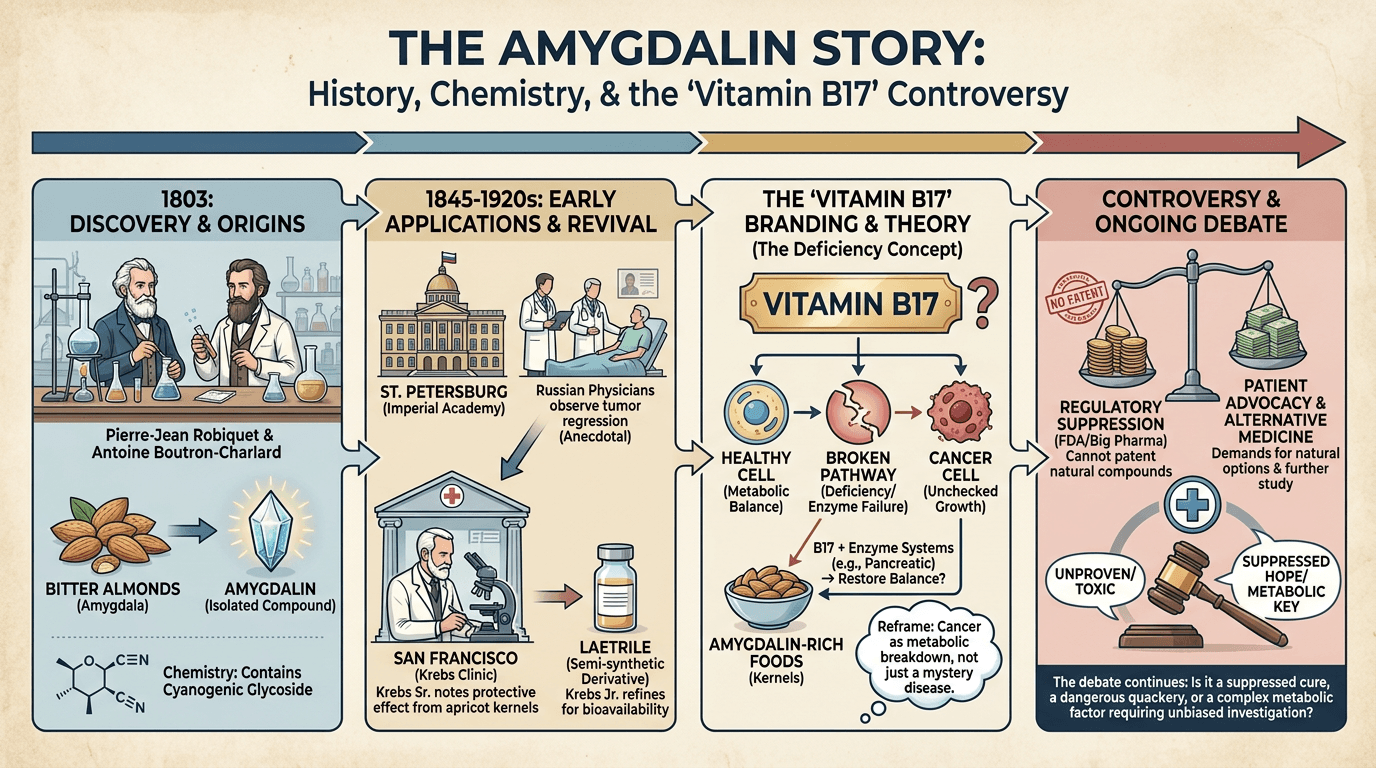
In 1803, two French chemists - Pierre-Jean Robiquet and Antoine Boutron-Charlard - isolated a crystalline compound from bitter almonds. They called it amygdalin, from the Greek amygdala, meaning almond. What they discovered would spark a medical controversy that rages to this day, challenging the very foundations of how we approach cancer treatment.
By 1845, Russian physicians were already using amygdalin to treat cancer patients at the Imperial Medical-Surgical Academy in Saint Petersburg. But they don't tell you that in medical school. The story gets buried beneath decades of regulatory suppression and what many call a systematic campaign to discredit a natural compound that pharmaceutical companies can't patent.
The Early Medical Applications
The first documented clinical use of amygdalin for cancer treatment appeared in Russian medical literature in the mid-19th century. Physicians observed that patients consuming amygdalin-rich apricot kernels exhibited tumor regression in certain cases. These early reports, largely anecdotal but intriguing, laid the groundwork for more systematic investigation.
Keep in mind, this was an era when cancer therapeutics barely existed. Surgery was crude, radiation therapy hadn't been invented, and chemotherapy was decades away. Physicians were desperate for any intervention that showed promise. Amygdalin offered hope - a natural substance with apparent selective toxicity against malignant cells.
Enter Ernst T. Krebs Sr. and the Birth of Laetrile
In the 1920s, American physician Ernst T. Krebs Sr. began investigating amygdalin's therapeutic potential at his clinic in San Francisco. His observations of cancer patients who consumed bitter almonds and apricot kernels suggested a protective effect. His son, Ernst T. Krebs Jr., a biochemist, would later refine the compound into what became known as laetrile - a semi-synthetic derivative designed for better bioavailability and reduced toxicity.
The Krebs team didn't just stumble onto this work. They were following clinical observations and epidemiological data suggesting that populations consuming amygdalin-rich foods - particularly in Hunza, Pakistan, and certain Mediterranean regions - showed remarkably lower cancer rates. Whether these correlations reflected causation remains scientifically contentious, but the pattern was compelling enough to warrant investigation.
Here's the rub: Ernst Krebs Jr. branded it "Vitamin B17," arguing that cancer was fundamentally a deficiency disease - a lack of this essential nutrient in the modern diet. The vitamin designation remains scientifically disputed (amygdalin may not meet strict criteria for an essential vitamin, but who is judging this criteria?), but the naming strategy was brilliant marketing that challenged the entire cancer-industrial complex. It reframed cancer from a mysterious disease requiring toxic interventions to a preventable metabolic disorder.
To be fully clear here what the propaganda missed was that the claim wasn't simply that cancer was a deficiency of one compound, but rather a breakdown of multiple metabolic pathways including enzyme systems of the body likely controlled by pancreatic function. So all this modern talk of new types of "diabetes" could also be precursors to this metabolic breakdown.
The Chemistry They Don't Want You Understanding
Amygdalin is a cyanogenic glycoside with the molecular formula C20H27NO11. That might sound like textbook jargon, but keep in mind what it actually means: this molecule contains two glucose units, a benzaldehyde group, and a cyanide group locked together in a remarkably stable configuration.
The compound exists in two stereoisomeric forms: R-amygdalin (the naturally occurring form found in plants) and S-neoamygdalin (an epimer that can form during extraction or processing). When amygdalin encounters the enzyme beta-glucosidase - produced in small amounts by gut bacteria and present in much higher concentrations in certain cancer cells - it breaks down sequentially: first into prunasin (a monosaccharide derivative), then into glucose, benzaldehyde, and hydrogen cyanide (HCN).
After all, that's where the controversy explodes into heated debate. Critics scream "cyanide poison!" pointing to documented cases of toxicity that arguably never happened. Proponents argue that cancer cells, which produce higher levels of beta-glucosidase and lower levels of the detoxifying enzyme rhodanese, selectively accumulate toxic HCN while normal cells - rich in rhodanese and deficient in beta-glucosidase - remain largely protected. It's a targeted kill mechanism, they say: nature's own chemotherapy with built-in selectivity.
The Sugiura Scandal at Sloan Kettering
No discussion of amygdalin history is complete without addressing one of the most controversial episodes in modern cancer research. In the 1970s, Dr. Kanematsu Sugiura, a highly respected researcher at Memorial Sloan Kettering Cancer Center with over 60 years of experience and already officially retired at the time, conducted meticulously controlled studies on laetrile's effects in mice.
Sugiura's findings were remarkable: laetrile stopped metastasis in his mouse models. His lab notebooks documented tumor regression, reduced metastatic spread to lungs, and improved survival in laetrile-treated mice compared to controls. While attempting to cover up his results by bringing additional doctors in who defrauded the statistics (as documented in the first hand account in the book "Doctored Results") Sugiura was asked about his results, he reportedly stated, "I stick to what I see."
But they don't tell you what happened next. Memorial Sloan Kettering publicly announced that laetrile was ineffective, directly contradicting Sugiura's documented findings. Internal documents later revealed that institutional leadership had decided to discredit laetrile regardless of Sugiura's data. The scandal became a rallying cry for medical freedom advocates and fueled decades of distrust in institutional cancer research.
Second Opinion Magazine, a health advocacy publication, investigated the discrepancy and published findings suggesting systematic suppression of positive results. The magazine was written by the head writer at Sloan Kettering, Ralph Moss who was fired for his role as a whistleblower of this misconduct. The episode damaged public trust in cancer research institutions for generations.
The FDA Ban and Regulatory Warfare
In 1987, the FDA officially banned laetrile in the United States, classifying it as an unapproved and unsafe drug. The official position: insufficient evidence of efficacy and unacceptable concerns over cyanide toxicity. But they don't tell you that thousands of patients were reporting subjective benefits, that Mexican clinics were documenting case series showing responses, or that clinical trials were systematically underfunded and undermined by regulatory obstacles.
The regulatory battle had begun years earlier. In 1977, the case United States v. Rutherford reached the Supreme Court, where cancer patients argued for their right to access laetrile under the doctrine of informed consent. The Court ruled against patients, establishing that even terminally ill individuals could not legally access unapproved therapies. The decision cemented FDA authority over experimental cancer treatments, regardless of patient autonomy or desperation.
Keep in mind, while amygdalin remains controversial for cancer treatment in the U.S., research hasn't stopped - it's gone global. Mexico, Germany, and other nations offer laetrile therapy in clinical settings. The scientific literature - far from dead - has exploded with new studies in the past five years alone, published in mainstream peer-reviewed journals.
The Moertel Trial and Its Limitations
The most frequently cited evidence against laetrile comes from the 1982 Moertel study published in the New England Journal of Medicine (PMID: 7033783). Dr. Charles Moertel and colleagues at the Mayo Clinic treated 178 advanced cancer patients with amygdalin plus a "metabolic therapy" program and concluded: "No substantive benefit was observed in terms of cure, improvement or stabilization of cancer."
Here's what the medical establishment won't acknowledge about this study: patients enrolled had end-stage, heavily pre-treated cancers with minimal remaining therapeutic options. Most had already failed conventional chemotherapy. The study design essentially asked whether laetrile could resurrect dying patients - not whether it had value in earlier-stage disease or as adjuvant therapy. It's like testing antibiotics on patients dying of septic shock and concluding antibiotics don't work.
Furthermore, the "metabolic therapy" program included dietary restrictions and enzyme supplements that weren't standardized or validated, introducing confounding variables. The study design made it nearly impossible to isolate amygdalin's specific effects, yet this trial became the definitive "proof" that laetrile doesn't work.
Nature's Richest Sources and Traditional Diets
Amygdalin concentrates in the seeds of the Rosaceae family: bitter almonds (Prunus dulcis var. amara), apricot kernels (Prunus armeniaca), peach pits, apple seeds, cherry pits, and plum seeds. Traditional diets in regions like Hunza Valley in Pakistan, certain Mediterranean communities, and parts of Central Asia included regular consumption of these seeds, often ground into pastes or consumed whole.
The highest concentrations appear in bitter apricot kernels, which can contain 2-5% amygdalin by weight. That's a potentially therapeutic dose in just a few kernels - or a stomach ache if consumed recklessly without understanding individual variation in gut microbiome composition and enzymatic detoxification capacity. The difference between medicine and poison lies in the dose, the individual's metabolic capacity, and the presence of detoxifying mechanisms like rhodanese.
Typically it's all about acllmating to a dose and when strong medicinal compounds like these, technically part of the nitriloside family of compounds, are systematically cut out of diets for generations it's important to start slow with them.
Keep in mind the Hunza people didn't just consume apricot kernels in isolation. Their entire diet - rich in whole foods, low in processed sugars, high in fermented foods supporting beneficial gut bacteria - likely contributed to their reported health and longevity. Isolating amygdalin from this dietary context may miss synergistic factors critical to its safe and effective use.
The Paradigm That Medical Schools Won't Teach
Here's what the establishment won't acknowledge: amygdalin research hasn't stopped - it's accelerating. Scientists like Jaszczak-Wilke and colleagues (2021) have published comprehensive reviews documenting both the anticancer activity and the sophisticated analytical methods for detecting and quantifying amygdalin in plant materials (Molecules, PMC8069783).
Tsaur et al. (2022) demonstrated amygdalin's effectiveness against taxane-resistant prostate cancer cells - the very cancers that conventional chemotherapy can't touch (Cancers, PMID: 35804889). When docetaxel and cabazitaxel fail, when resistance mechanisms have rendered standard therapies useless, amygdalin triggered apoptosis anyway. That's not alternative medicine - that's salvage therapy that deserves clinical investigation.
Makarević et al. (2014) demonstrated that amygdalin blocks bladder cancer cell growth by diminishing cyclin A and CDK2 - critical cell cycle regulators (PLoS One, PMID: 25136960). In companion studies, the same research group showed that amygdalin influences bladder cancer cell adhesion and invasion, reducing metastatic potential (PMID: 25333694).
The Historical Full Circle
We're witnessing a remarkable historical pattern: a therapy dismissed in the 1980s is being rehabilitated by 21st-century molecular biology. The mechanisms Krebs could only theorize about in the 1950s - selective enzymatic activation, differential rhodanese expression, apoptosis pathway modulation - are now being documented with precision in peer-reviewed literature.
The narrative is shifting. What was once dismissed as quackery is now the subject of sophisticated molecular studies exploring caspase activation, beta-glucosidase kinetics, nanoparticle delivery systems to enhance safety and efficacy, and combination strategies with conventional chemotherapy.
Keep in mind, science doesn't stand still - even when institutions try to freeze it in place to protect economic interests and established paradigms. The amygdalin story is far from over. It's just beginning to be written honestly, freed from the distortions of regulatory capture and pharmaceutical industry influence.
After all, every major medical breakthrough was once heresy. Handwashing was ridiculed. Germ theory was dismissed (maybe that one should have been). H. pylori as the cause of ulcers was laughed at until two Australian researchers proved it and won the Nobel Prize. The question isn't whether amygdalin deserves reconsideration - the molecular evidence has already answered that. The question is whether medicine has the courage to confront its own institutional failures and biases. I'm a bit skeptical the way it's been going in America these last few years, but at least the spirit is still alive internationally.
References
1. Jaszczak-Wilke E, Polkowska Ż, Koprowski M, Owczarek K, Balcerzak Ł, Kujawski R, Świątek Ł, Olszewska MA. Amygdalin: Toxicity, Anticancer Activity and Analytical Procedures for Its Determination in Plant Seeds. Molecules. 2021 Apr 15;26(8):2253. PMCID: PMC8069783. https://pubmed.ncbi.nlm.nih.gov/33924691/
2. Tsaur I, Makarević J, Hudak L, Juengel E, Kurosch M, Wiesner C, Bartsch G, Harder S, Haferkamp A, Blaheta RA. Amygdalin Exerts Antitumor Activity in Taxane-Resistant Prostate Cancer Cells. Cancers (Basel). 2022 Jun 23;14(13):3111. https://pubmed.ncbi.nlm.nih.gov/35804883/
3. Makarević J, Rutz J, Juengel E, Kaulfuss S, Reiter M, Tsaur I, Bartsch G, Haferkamp A, Blaheta RA. Amygdalin blocks bladder cancer cell growth in vitro by diminishing cyclin A and cdk2. PLoS One. 2014 Aug 19;9(8):e105590. PMID: 25136960; https://pubmed.ncbi.nlm.nih.gov/25136960/
4. Makarević J, Rutz J, Juengel E, Kaulfuss S, Tsaur I, Nelson K, Pfitzenmaier J, Haferkamp A, Blaheta RA. Amygdalin influences bladder cancer cell adhesion and invasion in vitro. PLoS One. 2014 Oct 15;9(10):e110244. PMID: 25333694; https://pubmed.ncbi.nlm.nih.gov/25333694/
5. Moertel CG, Fleming TR, Rubin J, Kvols LK, Sarna G, Koch R, Currie VE, Young CW, Jones SE, Davignon JP. A clinical trial of amygdalin (Laetrile) in the treatment of human cancer. N Engl J Med. 1982 Jan 28;306(4):201-6. PMID: 7033783. https://pubmed.ncbi.nlm.nih.gov/7033783/
6. Moertel CG, Ames MM, Kovach JS, Moyer TP, Rubin JR, Tinker JH. A pharmacologic and toxicological study of amygdalin. JAMA. 1981 Feb 13;245(6):591-4. PMID: 7005480. https://pubmed.ncbi.nlm.nih.gov/7005480/
7. Shi J, Chen Q, Xu M, Xia Q, Zheng T, Teng J, Li M, Fan L. Recent updates and future perspectives about amygdalin as a potential anticancer agent: A review. Cancer Med. 2019 Jun;8(6):3004-3011. PMID: 31066207; PMCID: PMC6558473. https://pubmed.ncbi.nlm.nih.gov/31066207/
8. Liczbiński P, Bukowska B. Molecular mechanism of amygdalin action in vitro: review of the latest research. Immunopharmacol Immunotoxicol. 2018 Jun;40(3):212-218. PMID: 29486614. https://pubmed.ncbi.nlm.nih.gov/29486614/
9. Historical references to Dr. Kanematsu Sugiura's research at Memorial Sloan Kettering Cancer Center and the institutional controversy surrounding laetrile studies (1970s). "Doctored Results" by Ralph Moss.
10. United States v. Rutherford, 442 U.S. 544 (1979). Supreme Court case establishing FDA authority over experimental cancer therapies. https://supreme.justia.com/cases/federal/us/442/544/
|



0 Comments
Join the conversation
Be the first to comment
Share your thoughts above.