
The Chemical Imbalance Collapse: How the Serotonin Theory of Depression Unraveled |
Decades of treatment built on a myth - what science now says about your brain |
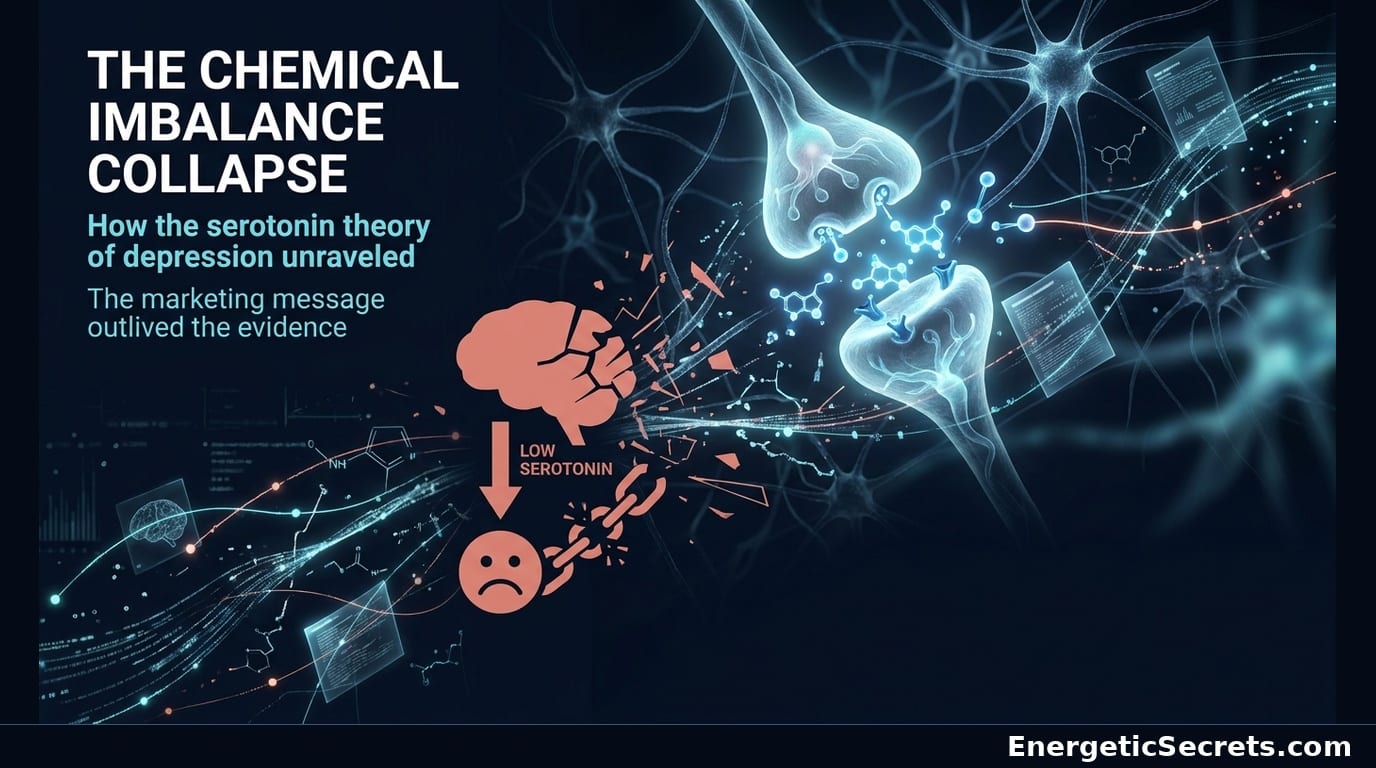
For more than three decades, the message has been remarkably consistent. Depression is caused by a chemical imbalance in the brain. Specifically, low levels of serotonin. Take this medication, the advertisements said, and it will correct that imbalance.
Surveys suggest that 80 percent or more of the general public now believe this is established science [1].
There is just one problem. The evidence never supported it.
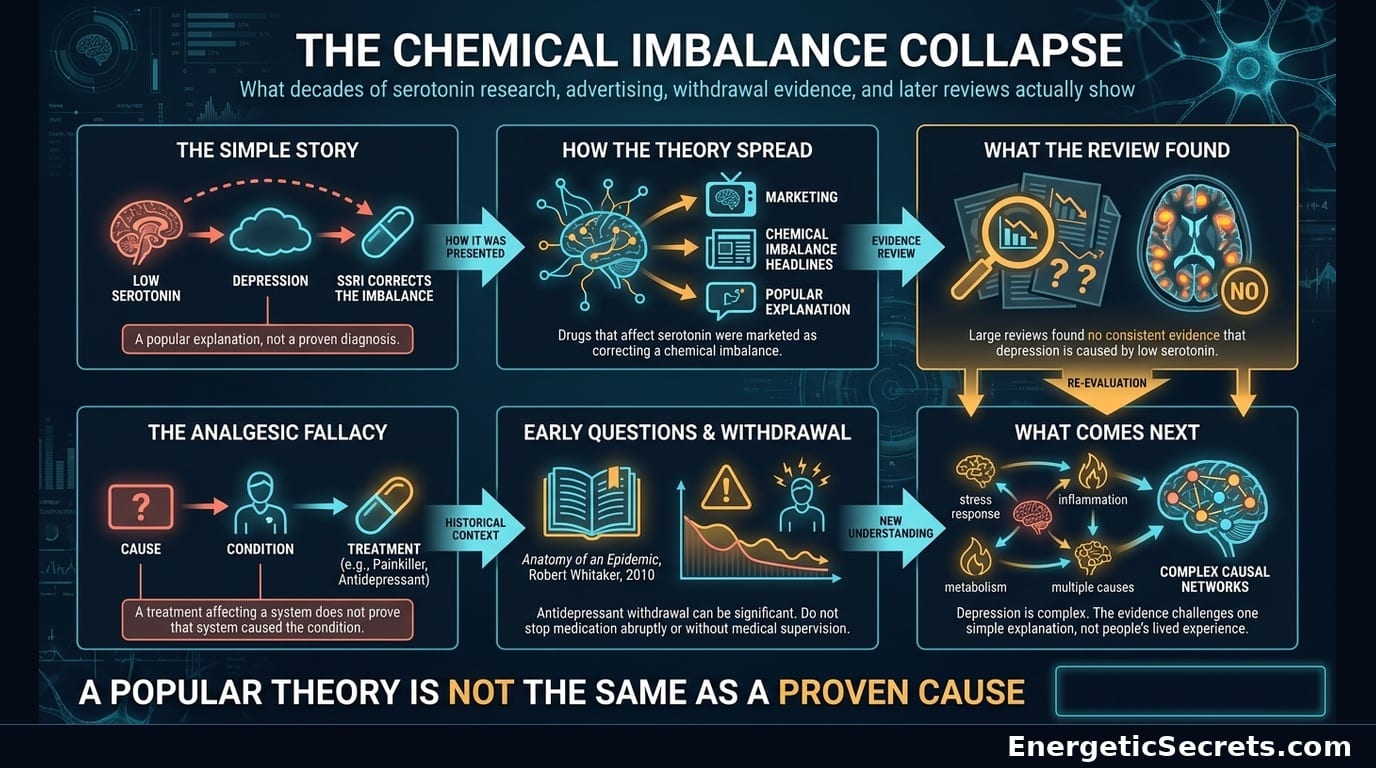
One of the earliest public challenges to the chemical-imbalance narrative came from an unexpected direction. Robert Whitaker, an investigative journalist and science writer, published Anatomy of an Epidemic in 2011 [4], a book that examined long-term outcome studies and questioned whether the widespread use of psychiatric medications might be contributing to, rather than solving, the epidemic of chronic mental illness. Appearing more than a decade before the Moncrieff review, Whitaker's work was an early investigative voice in a debate that the scientific literature would later take up in earnest.
I had the opportunity to meet him at a couple of his lectures when he was on this book tour for the Anatomy of an Epidemic and could tell he authentically wanted to get the truth out. It seems the rest of the media was quiet about it until this info was finally published in a peer reviewed journal about 11 years later.
In 2022, a team of researchers led by Dr. Joanna Moncrieff at University College London published a systematic umbrella review in the journal Molecular Psychiatry. They examined six decades of serotonin research across six major areas of study. Their conclusion was stark: there is no consistent evidence of an association between serotonin and depression, and no support for the hypothesis that depression is caused by lowered serotonin activity or concentrations [1].
The finding sent shockwaves through psychiatry. But for researchers who had been following the literature, it was less a bombshell and more a long-overdue confirmation of what the data had been saying all along.
The Origin of a Theory
The idea that depression might be linked to serotonin was first proposed in the 1960s, when researchers observed that certain drugs could alter mood by affecting brain chemicals [1]. The specific hypothesis that low serotonin causes depression was formally suggested in 1965.
For two decades, it remained a relatively obscure academic theory. That changed in the 1990s, when a new class of antidepressants called selective serotonin reuptake inhibitors, or SSRIs, entered the market. The first was fluoxetine, better known as Prozac, approved by the FDA in 1987. Others followed: sertraline (Zoloft), paroxetine (Paxil), citalopram (Celexa).
These drugs worked by increasing the availability of serotonin in the synapses between neurons. And with their arrival came a massive direct-to-consumer advertising campaign that would cement the chemical imbalance narrative in the public mind [1, 2].
What the Moncrieff Review Actually Found
The Moncrieff review was not a single study. It was an umbrella review, meaning it systematically analyzed the existing body of research across multiple areas of serotonin science. The team examined studies of serotonin metabolites, serotonin receptor function, serotonin transporter genes, and experiments that artificially lowered serotonin in volunteers.
The results were consistent across every area.
Studies of the serotonin metabolite 5-HIAA, measured in cerebrospinal fluid, showed no association with depression. The largest analysis included over 1,000 participants [1].
Studies of the serotonin transporter gene (SERT or 5-HTT) were even more definitive. One genetic association study included 115,257 participants. A collaborative meta-analysis included 43,165. Neither found any evidence of an association between the serotonin transporter gene and depression, nor any interaction between the gene, stress, and depression [1].
Studies of plasma serotonin showed no relationship with depression. In fact, the evidence suggested that lower serotonin concentration was associated with antidepressant use, not with depression itself [1].
Perhaps most striking was the finding that long-term antidepressant use may actually reduce serotonin concentration. This inverts the original theory entirely. If SSRIs work by increasing serotonin, but long-term use may lower it, the mechanism of action becomes far more complex than the simple chemical imbalance story suggests [1].
The Analgesic Fallacy
One of the most important conceptual points to emerge from this debate is what researchers call the analgesic fallacy. The term comes from a simple observation: the fact that aspirin cures headaches does not prove that headaches are caused by low levels of aspirin in the brain [2].
Yet this is precisely the logic that underpinned the chemical imbalance narrative. SSRIs increase serotonin. SSRIs can help some people with depression. Therefore, depression must be caused by low serotonin.
The flaw in this reasoning was pointed out years before the Moncrieff review. In a 2005 paper published in PLOS Medicine, researchers Jeffrey Lacasse and Jonathan Leo documented the growing disconnect between the scientific literature and the advertising campaigns for SSRI antidepressants [2].
They cited serotonin researchers from the U.S. National Institute of Mental Health who stated plainly: "The demonstrated efficacy of selective serotonin reuptake inhibitors cannot be used as primary evidence for serotonergic dysfunction in the pathophysiology of these disorders" [2].
In other words, the fact that a drug affects a system does not mean that system was broken in the first place. And biological psychiatry was just accepted nonetheless regardless of the real science.
Kind of an echo of what was to come later in vaccine science, but that's a story for another day.
How a Hypothesis Became a Marketing Message
The chemical imbalance story did not emerge from the scientific literature. It emerged from the marketing department.
Lacasse and Leo documented how pharmaceutical companies built their direct-to-consumer advertising campaigns around the chemical imbalance claim. Pfizer's television advertisements for Zoloft stated that depression is a serious medical condition that may be due to a chemical imbalance, and that "Zoloft works to correct this imbalance" [2].
By 2004, sertraline (Zoloft) was the sixth best-selling medication in the United States, with over $3 billion in annual sales [2]. The chemical imbalance message was extraordinarily effective. It simplified a complex and poorly understood condition into a straightforward biological problem with a straightforward pharmaceutical solution.
The problem, as Lacasse and Leo noted, is that "contemporary neuroscience research has failed to confirm any serotonergic lesion in any mental disorder, and has in fact provided significant counterevidence to the explanation of a simple neurotransmitter deficiency" [2].
There is no scientifically established ideal chemical balance of serotonin, let alone an identifiable pathological imbalance [2].
The Withdrawal Problem
One of the most clinically significant consequences of the chemical imbalance narrative has been the systematic understatement of antidepressant withdrawal.
For years, official guidelines in both the United Kingdom and the United States described antidepressant withdrawal as mild and self-limiting, typically lasting one to two weeks. The message to patients was straightforward: any discomfort you feel when stopping the medication will be brief and manageable.
The evidence tells a different story.
A 2019 systematic review by researchers James Davies and John Read examined 14 studies on antidepressant withdrawal. They found that withdrawal incidence rates ranged from 27 percent to 86 percent, with a weighted average of 56 percent. In other words, more than half of people who try to stop antidepressants experience withdrawal symptoms [3].
The severity data was equally concerning. Four large studies of withdrawal severity produced a weighted average of 46 percent of those experiencing withdrawal effects endorsing the most extreme severity rating available [3].
The duration of withdrawal also contradicted official guidelines. Seven of the ten studies providing data on duration found that a significant proportion of people experience withdrawal for more than two weeks, and that it is not uncommon for withdrawal to last several months [3].
Davies and Read recommended that U.K. and U.S. guidelines on antidepressant withdrawal be urgently updated, as they are "clearly at variance with the evidence" [3].
This is why it is critical that no one stops antidepressant medication abruptly or without medical supervision. Withdrawal from SSRIs can be severe, prolonged, and in some cases dangerous. The question is not whether people should stop taking antidepressants. The question is whether patients have been given accurate information about what they are taking and why.
A Contested Review, Acknowledged
It is important to note that the Moncrieff review has not gone unchallenged. Several published commentaries have raised methodological concerns, and some researchers argue that the review's conclusions overstate the absence of evidence [1].
The debate is ongoing, and it is a sign of healthy science. The serotonin hypothesis may not be entirely dead, but it has been seriously wounded by the weight of evidence. The paradigm is shifting, and the burden of proof now rests on those who would maintain that depression is simply a chemical imbalance.
What This Means Going Forward
If the chemical imbalance theory of depression is unsupported by the evidence, what comes next?
Some researchers are exploring alternative frameworks. Depression may involve inflammatory processes, metabolic dysfunction, or dysregulation of the stress response system. These emerging models are still in early stages, and they do not yet offer the simple, testable hypothesis that the serotonin theory once seemed to provide.
What they do offer is a more honest accounting of the complexity of depression. Depression is not one thing. It is a heterogeneous condition with multiple possible causes, and it likely requires multiple approaches to treatment.
For the millions of people who take antidepressants and find them helpful, none of this changes their lived experience. SSRIs can be effective for some people, even if the original theory behind them was wrong. The placebo-controlled effect is real, and for many patients, the benefits of medication outweigh the risks.
But the public deserves to know that the simple story they have been told for three decades is not supported by the evidence. Eighty percent of the public believes depression is caused by a chemical imbalance. That belief was manufactured, not discovered.
The collapse of the serotonin theory is not the end of effective depression treatment. It is the beginning of a more honest conversation about what depression actually is, and what it will take to truly understand it.
References
|
 |



5 Comments
Join the conversation
I read Whitaker's book years ago and tried to bring it up with my psychiatrist at the time. She basically laughed me out of the office. Curious how the tune changes once a big journal review says the same thing.
Pfizer making 3 billion a year off Zoloft alone and the whole thing was a marketing slogan. Should've known. Same playbook they use for everything.
Okay but if SSRIs don't do anything then why do millions of people feel better on them? Seems like this review is being used to tell people to just stop their meds, which is genuinely dangerous advice.
skeptical_sueThe article actually makes that exact point though — it specifically says SSRIs can be effective for some people even if the original theory behind them was wrong, and it even warns pretty clearly that nobody should stop their meds without medical supervision. I don't think the takeaway is "stop your meds," it's more like "the simple story you were sold wasn't accurate." Those are pretty different things.
I was on Zoloft for 11 years and when I tried to stop it took me almost 8 months to feel normal again. My doctor acted like I was being dramatic. Nice to see the actual numbers finally backing up what so many of us already lived through.