
The Hydrogel Matrix: Self-Assembling Bioscaffolds and Synthetic Biology |
Investigation into programmable hydrogel materials and synthetic biology |
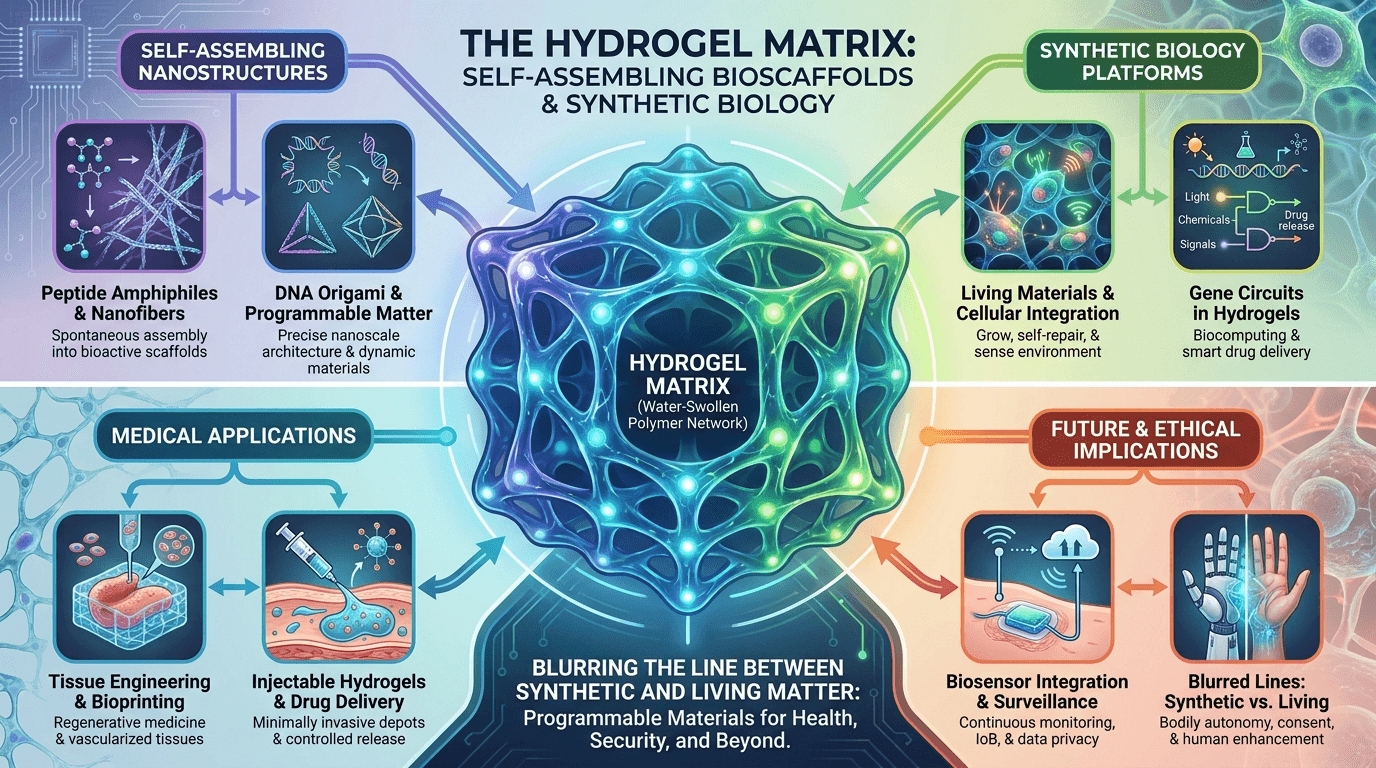
Introduction: The Living Scaffold
In the emerging landscape of biotechnology, few materials hold as much promise - and as much potential for misuse - as hydrogels. These water-absorbing polymer networks, capable of holding up to thousands of times their weight in water, have become foundational to advances in tissue engineering, drug delivery, and biosensing. But beneath the medical applications lies a more complex story: one of self-assembling nanostructures, synthetic biology platforms, and technologies that blur the line between synthetic and living matter.
Hydrogels are not merely passive materials. Modern formulations can respond to environmental stimuli, release payloads on demand, integrate with biological tissues, and even conduct electrical signals. When combined with advances in nanotechnology and synthetic biology, they form the basis for what some researchers call 'programmable matter' - materials that can be designed to perform complex biological functions.
This investigation examines the documented science behind hydrogel matrices, their integration with biosensors and nanotechnology, their military and surveillance applications, and the profound questions they raise about bodily autonomy, informed consent, and the future of human biology.
Understanding HydrogelsWhat Are Hydrogels?
Hydrogels are three-dimensional networks of hydrophilic polymers that can absorb and retain large amounts of water while maintaining their structure. They can be derived from natural sources (collagen, alginate, hyaluronic acid) or synthesized from artificial polymers (polyethylene glycol, polyvinyl alcohol, polyacrylamide).
Key properties include:
Medical Applications
Hydrogels have legitimate and transformative medical applications: Tissue engineering: Hydrogels serve as scaffolds for growing replacement tissues and organs. Companies like Prellis Biologics and Aspect Biosystems use hydrogel-based bioprinting to create vascularized tissues.
Drug delivery: Hydrogels can encapsulate drugs and release them slowly or in response to specific triggers. The global drug delivery market using hydrogels is projected to reach $408.97 billion by 2030.
Wound healing: Hydrogel dressings maintain moist environments conducive to healing while allowing gas exchange.
Contact lenses: Modern soft contact lenses are hydrogel-based, demonstrating long-term biocompatibility.
Injectable Hydrogels
Perhaps most relevant to surveillance concerns are injectable hydrogels - formulations that flow through needles before solidifying in the body. These can be delivered minimally invasively and conform to tissue spaces before setting.
Injectable hydrogels are used for:
Self-Assembling NanostructuresPeptide Amphiphiles and Molecular Self-Assembly
At the cutting edge of hydrogel research are self-assembling peptide systems. Peptide amphiphiles are molecules with peptide segments that spontaneously organize into nanofibers, which then entangle to form hydrogel networks.
Key researchers in this field include: Dr. Samuel Stupp at Northwestern University, who pioneered peptide amphiphile nanofibers; Dr. Shuguang Zhang at MIT, developer of designer self-assembling peptide nanofibers; Dr. Radislav Potyrailo at GE Research, working on self-assembling sensor platforms.
These systems can be designed to:
DNA Origami and Programmable Matter
DNA origami uses the base-pairing properties of DNA to create nanoscale structures with precise geometries. When combined with hydrogels, DNA origami can create:
A 2021 Nature Nanotechnology review described DNA-hydrogel hybrids as 'programmable living materials' capable of sensing, computing, and actuating.
The DARPA Connection
DARPA has invested heavily in self-assembling and programmable materials:
These programs demonstrate military interest in materials that bridge the synthetic-biological divide.
The Biosensor IntegrationProfusa's Lumee Platform
Profusa, a California-based company, has developed one of the most advanced implantable biosensor systems using hydrogel technology. The Lumee Oxygen Platform consists of:
The hydrogel is designed to integrate with surrounding tissue, becoming vascularized and establishing long-term biocompatibility. Once implanted, the sensor can function for years, continuously monitoring tissue oxygen levels.
DARPA's ElectRx and N3 Programs
DARPA's ElectRx program aims to develop 'ultraminiaturized devices' for precision neuromodulation. The technology uses injectable, wireless biosensors to monitor and stimulate specific nerves. Nothing nefarious there, right?
The Next-Generation Nonsurgical Neurotechnology (N3) program seeks to develop high-bandwidth brain-computer interfaces without surgery. Hydrogel-based electrode arrays are among the approaches being developed.
Continuous Glucose Monitoring Evolution
Next-generation continuous glucose monitors are moving toward implantable, long-term sensors using hydrogel matrices. Companies like Know Labs and Profusa are developing sensors that could last years without replacement.
The convergence of: Long-lasting implantable sensors; Wireless data transmission; Artificial intelligence analysis; Cloud-based health monitoring - creates infrastructure for comprehensive, continuous biological surveillance. Is this what you want?
Synthetic Biology PlatformsLiving Materials
The field of 'living materials' combines synthetic biology with materials science to create structures that grow, self-repair, and respond to environment. Hydrogels provide the scaffold for these living systems.
A 2019 Nature Materials paper from MIT demonstrated bacterial cells embedded in hydrogels that could sense chemicals and produce visible signals - essentially, living sensors.
Applications include:
The iGEM Competition and DIY BiologyThe International Genetically Engineered Machine (iGEM) competition has thousands of students worldwide engineering biological systems. Many projects involve hydrogel-based platforms, democratizing access to synthetic biology tools.
While this democratization drives innovation, it also raises concerns about: Dual-use research of concern; Lack of oversight for DIY biology; Potential for accidental or intentional harm; Diffusion of powerful technologies beyond regulatory reach.
Gene Circuits in Hydrogels
Synthetic biologists are developing 'gene circuits' - genetic programs that function like electronic circuits, with inputs, logic operations, and outputs. When embedded in hydrogels, these circuits can create:
A 2020 Science review described cell-free gene circuits in hydrogels as 'the next generation of biotechnological tools.'
Military and Security ApplicationsInjectable Tracking and Monitoring
The same technologies enabling medical monitoring can enable surveillance: Location tracking: Implanted devices with unique identifiers could be tracked via RFID or other wireless protocols. Biometric monitoring: Continuous measurement of physiological parameters could reveal location, activity, stress levels, and health status. Chemical detection: Implanted sensors could detect drug use, alcohol consumption, or exposure to specific substances. Behavioral inference: Patterns in biometric data can reveal sleep patterns, physical activity, and potentially emotional states.
The Weaponization Potential
Hydrogel-based systems could theoretically be weaponized:
While these applications remain largely theoretical, the underlying technologies exist and are rapidly advancing.
DARPA's Biological Technologies Office
DARPA's Biological Technologies Office (BTO) oversees programs that develop hydrogel and synthetic biology applications for national security:
The convergence of these programs with surveillance technologies raises questions about the boundaries between medical and military applications.
The Internet of BodiesConnected Implants
The concept of the Internet of Bodies (IoB) - networked devices implanted in or on the human body - is becoming reality through hydrogel-based sensors: Continuous monitoring of multiple physiological parameters; Cloud-based data storage and analysis; AI-driven health insights and predictions; Integration with healthcare systems and insurance.
A 2020 RAND Corporation report warned that 'the Internet of Bodies represents a new frontier in surveillance, with implications that are only beginning to be understood.'
Data Ownership and Privacy
Who owns the data generated by implanted biosensors? Current frameworks are inadequate: Device manufacturers typically claim data rights through user agreements; Healthcare providers access data for treatment purposes; Insurance companies increasingly demand monitoring data; Employers may require biosensor use as condition of employment; Governments can subpoena or mandate data collection.
The Health Insurance Portability and Accountability Act (HIPAA) provides limited protections that do not address continuous monitoring by implantable devices.
The Surveillance Infrastructure
Hydrogel biosensors integrate into broader surveillance systems:
The Electronic Frontier Foundation has warned that 'continuous biometric monitoring threatens to eliminate the last refuge of privacy - the interior of our own bodies.'
Ethical and Regulatory ChallengesInformed Consent
Truly informed consent for implantable biosensors requires understanding:
Current consent processes for medical devices often fail to address these comprehensively.
The Irreversibility Problem
Some hydrogel formulations are designed to be permanent, integrating with tissue and becoming impossible to remove. This raises questions about:
Current regulatory frameworks struggle to keep pace with converging technologies:
The National Academies of Sciences has called for 'new governance frameworks' for converging technologies, but implementation lags behind innovation.
The Future: Integration and ControlBrain-Computer Interfaces
The ultimate frontier for hydrogel-based technology is direct neural interfacing. Companies like Neuralink, Kernel, and Synchron are developing devices to read and potentially write neural activity.
Hydrogel electrodes offer advantages for neural interfaces:
The implications of connected, implantable brain interfaces extend far beyond medical applications into realms of thought monitoring, cognitive enhancement, and neural manipulation.
The Convergence of Technologies
Hydrogel matrices represent a convergence point for multiple transformative technologies:
This convergence creates capabilities greater than the sum of parts - capabilities that challenge existing ethical, legal, and social frameworks.
The Choice Before Us
We stand at a crossroads. Hydrogel-based technologies offer genuine benefits for medicine, environmental monitoring, and human performance. But they also enable unprecedented surveillance and control.
The question is not whether these technologies will be developed - they already are. The question is who will control them, how they will be governed, and what safeguards will protect human autonomy.
Without deliberate, democratic decision-making about these technologies, we risk sleepwalking into a future where the boundary between human biology and technological control dissolves - where the body becomes just another node in the surveillance network, monitored, analyzed, and potentially controlled by forces beyond individual comprehension or consent.
Conclusion: The Body as Platform
Hydrogel matrices represent more than a materials innovation. They embody a vision of the human body as a platform for technological integration - continuously monitored, perpetually connected, and potentially programmable.
The self-assembling, biocompatible, responsive nature of modern hydrogels makes them ideal substrates for biosensors, drug delivery, and synthetic biology applications. These same properties make them powerful tools for surveillance and control.
As we integrate these materials into our bodies, we must ask: Are we enhancing human capabilities, or creating new vulnerabilities? Are we empowering individuals, or enabling new forms of coercion? Are we expanding human freedom, or constructing digital prisons at the cellular level?
The hydrogel matrix is not merely a medical technology. It is a metaphor for the future we are building - a future where the distinction between the biological and the technological, the natural and the artificial, the self and the system, becomes increasingly difficult to discern.
Some say we are living in a post-human reality, but I reject that notion because that is accepting this dystopian future that only a few globalist technocrats are trying to force on humanity.
Within that the body is the last frontier of privacy. The technologies described in this investigation are crossing a frontier which may end humanity as we know it. Let's think hard about what we accept for our future and push back against it while we still have a chance.
References1. Drury & Mooney, Biomaterials (2003) - Hydrogels for tissue engineering - https://pubmed.ncbi.nlm.nih.gov/12922147/
2. Slaughter et al., Advanced Materials (2009) - Hydrogels in regenerative medicine - https://pubmed.ncbi.nlm.nih.gov/20882499/
3. Kopecek & Yang (2012) - Smart self-assembled hybrid hydrogel biomaterials - https://pubmed.ncbi.nlm.nih.gov/22806947/
4. Seliktar, Science (2012) - Designing cell-compatible hydrogels - https://pubmed.ncbi.nlm.nih.gov/22654050/
8. Wikipedia: Synthetic biology - https://en.wikipedia.org/wiki/Synthetic_biology
15. Wikipedia: Regenerative medicine - https://en.wikipedia.org/wiki/Regenerative_medicine
|




0 Comments
Join the conversation
Be the first to comment
Share your thoughts above.