
The Plastic Within: How Microplastics Are Invading Every Human Tissue |
Scientists find microplastics in blood, lungs, and brain - and the health toll is just emerging. |
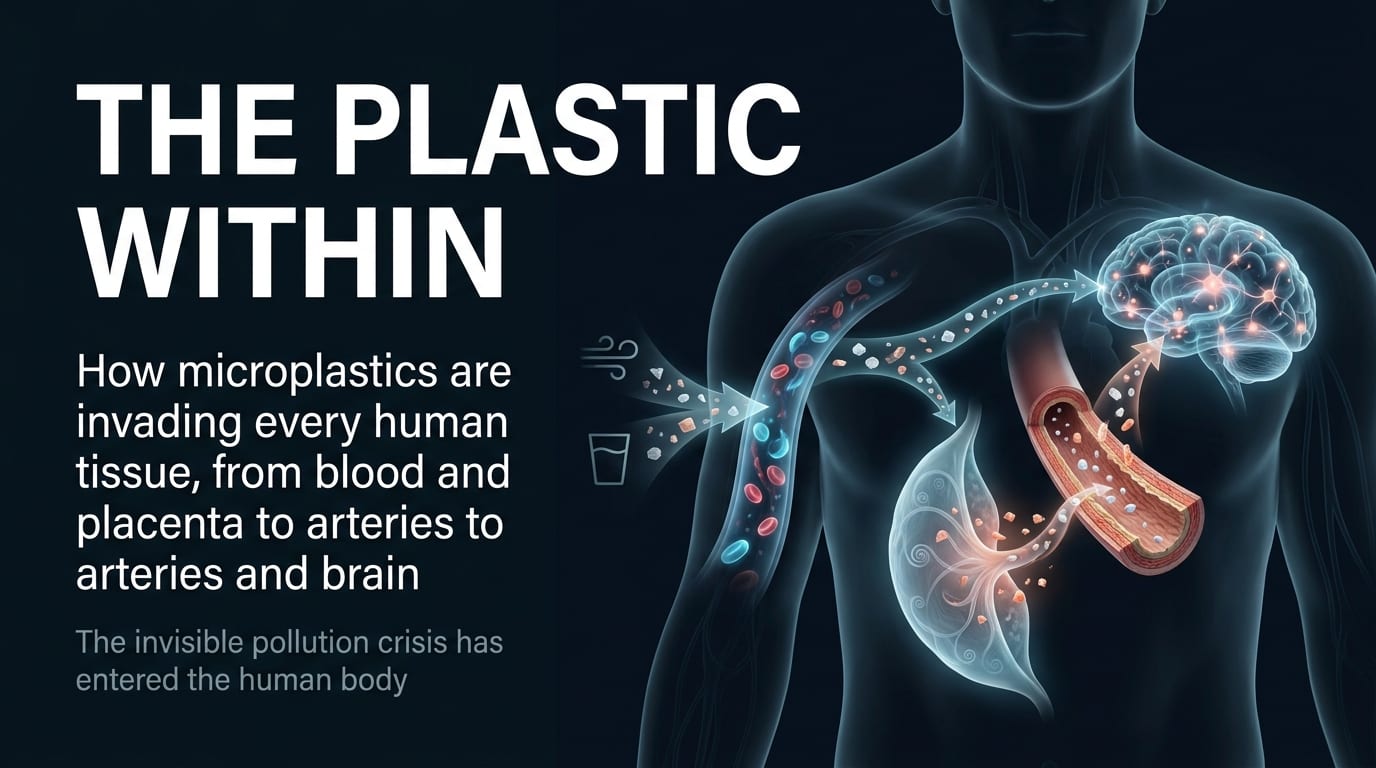
Every year, the world produces more than 400 million tons of plastic. Roughly half of it is designed for single use - a water bottle, a takeout container, a wrapper that exists for minutes and persists for centuries. Over decades, sunlight, heat, and mechanical abrasion break these materials down into ever-smaller fragments.
Microplastics - particles smaller than five millimeters - and nanoplastics - particles measured in billionths of a meter - have been found everywhere scientists have looked: in the deepest ocean trenches, in Arctic ice, in the air we breathe, in the rain that falls from the sky.
Now they have been found inside the human body. Not just in the digestive tract, where ingested particles might be expected to pass through, but in the bloodstream, in the placenta of unborn babies, in the fatty plaque that clogs arteries, and most disturbingly, in the tissue of the human brain.
This is not speculation. It is the conclusion of a cascade of peer-reviewed studies published between 2020 and 2025 in some of the most respected journals in medicine and environmental science. And the picture they paint is one of an invisible, ongoing invasion - one whose long-term consequences we are only beginning to understand.
The First Evidence: Plastic in Human Blood
In 2022, a team of Dutch researchers led by Dr. Heather Leslie published a landmark study in the journal Environment International. They had set out to answer a simple question: could plastic particles be detected in the bloodstream of healthy human beings? [1]
The answer was yes. Using a technique called double-shot pyrolysis-gas chromatography/mass spectrometry, the researchers analyzed blood samples from 22 healthy volunteers. They identified and quantified four types of high-production-volume polymers: polyethylene terephthalate (PET), used in beverage bottles and food containers; polyethylene (PE), the most common plastic in the world, used in bags and packaging; polymers of styrene, used in foam products and insulation; and poly(methyl methacrylate), or acrylic glass. [1]
The mean concentration of plastic particles in the blood was 1.6 micrograms per milliliter. This was the first human biomonitoring study to demonstrate that plastic particles are bioavailable - meaning they are small enough to be taken up from the environment into the human bloodstream and transported throughout the body. [1]
The implications were immediate and profound. If plastic particles could circulate in the blood, they could reach every organ in the body.
The Unborn Are Not Spared: Microplastics in the Placenta
The same year, a separate research group in Italy published findings that pushed the concern even further. Dr. Antonio Ragusa and his team at the San Giovanni Calibita Fatebenefratelli Hospital in Rome examined six placentas from women with uncomplicated, physiological pregnancies. In four of the six - 67 percent - they found microplastic fragments. [2]
The particles ranged from 5 to 10 micrometers in size, with spherical or irregular shapes. They were found on both the fetal and maternal sides of the placenta, as well as in the chorioamniotic membranes. Three of the fragments were identified as stained polypropylene; the remaining nine could be identified only by their pigments. [2] This was the first evidence that microplastics could cross the placental barrier, meaning fetal exposure begins before birth. A follow-up study published by the same group in the same year went further. Using scanning and transmission electron microscopy, the researchers examined ten placentas and localized microplastic fragments within the cellular compartment itself - inside the syncytiotrophoblast, the cytotrophoblast, fetal capillary endothelial cells, and pericytes. [3]
The cellular changes they observed had never been reported in normal, healthy term pregnancies before. The researchers described dilated endoplasmic reticulum, swollen mitochondria, whorled membranous bodies, and autolysosomes - structural alterations they interpreted as evidence of the tissue's attempt to remove and destroy the plastic particles. [3]
The authors wrote that the presence of virtually indestructible particles in term human placenta could contribute to the activation of pathological traits, such as oxidative stress, apoptosis, and inflammation. [3]
The Cardiovascular Connection: Plastic in Arterial Plaque
If microplastics could reach the bloodstream and cross the placental barrier, could they also accumulate in the walls of arteries? In 2024, a team of Italian researchers published a study in the New England Journal of Medicine that provided a stark answer.
Dr. Raffaele Marfella and his colleagues enrolled 304 patients undergoing carotid endarterectomy - a surgical procedure to remove plaque from the carotid artery. They analyzed the removed plaque for the presence of microplastics and nanoplastics. [4]
The results were striking. Polyethylene was detected in the carotid artery plaque of 150 patients - 58.4 percent - at a mean level of 21.7 micrograms per milligram of plaque. Thirty-one patients (12.1 percent) also had measurable amounts of polyvinyl chloride (PVC). Under electron microscopy, the researchers observed jagged-edged foreign particles embedded among plaque macrophages. [4]
Then came the clinical follow-up. Over a median of 33.7 months, patients in whom microplastics and nanoplastics were detected within the atheroma were at significantly higher risk for a primary end-point event - a composite of heart attack, stroke, or death from any cause - compared to those in whom no particles were found. The hazard ratio was 4.53 (95 percent confidence interval, 2.00 to 10.27; P<0.001). [4]
A four-and-a-half-fold increase in risk is not a subtle signal. The authors were careful to note that this was an observational study, meaning it demonstrates association, not proven causation. But the strength of the association, combined with the biological plausibility of particle-driven inflammation in the arterial wall, makes this one of the most important public health findings of the decade.
The Most Alarming Finding: Nanoplastics in the Human Brain
If there is a single study that should command the world's attention, it is the one published in Nature Medicine in April 2025.
Dr. Alexander J. Nihart and a team of researchers at the University of New Mexico analyzed tissue samples from decedent human brains, livers, and kidneys collected in 2016 and again in 2024. They found microplastics and nanoplastics in all three organs. But the brain was different. [5]
The brain tissues harbored significantly higher proportions of polyethylene compared to the liver or kidney (P<0.0001, two-way ANOVA). Under electron microscopy, the particles appeared largely as nanoscale shard-like fragments - sharp-edged, irregular, and small enough to have crossed the blood-brain barrier. [5]
Even more concerning, the concentrations were not static. When the researchers compared samples from 2016 to those from 2024, they found a significant increase over time in both liver and brain tissue (P=0.01). The overall linear regression was highly significant (P<0.0001, R²=0.3982). In other words, the amount of plastic accumulating in human tissues appears to be rising year over year, mirroring the increase in global plastic production. [5]
The study also examined a cohort of decedent brains with a documented dementia diagnosis. These brains showed "far greater" microplastic and nanoplastic concentrations, with notable deposition in cerebrovascular walls and immune cells. [5]
This finding is preliminary - the dementia cohort was small - but it opens a door that cannot be closed. If plastic particles accumulate preferentially in the brains of individuals with dementia, and if those particles contribute to neuroinflammation or vascular damage, the implications for an aging global population are profound.
How Plastic Gets Into the Brain: The Blood-Brain Barrier
The blood-brain barrier is one of the body's most sophisticated defense systems. It is a tightly sealed layer of cells that lines the blood vessels in the brain, designed to keep pathogens, toxins, and large molecules out of the central nervous system. For a plastic particle to reach brain tissue, it must find a way through.
A 2024 study published in the Journal of Hazardous Materials by Dr. Xie and colleagues provided the first human evidence of how this happens. The researchers analyzed 28 cerebrospinal fluid samples from patients with and without central nervous system infection. They found that four types of plastic - polystyrene, polyethylene, polypropylene, and polyvinyl chloride - were capable of selectively entering the human central nervous system. [6]
The key finding was a positive correlation between the concentration of polypropylene and polyethylene in the cerebrospinal fluid and the CSF albumin index - a marker of blood-brain barrier integrity. This suggests that damage or impairment to the blood-brain barrier accelerates the entry of plastic particles into the brain. [6]
Importantly, the study also found that the presence of microplastics and nanoplastics in the CSF did not significantly correlate with levels of the inflammatory markers IL-6 or IL-8. This means the particles may not directly cause inflammation in the central nervous system - at least not through the pathways measured. The mechanism of harm, if any, remains an open question. [6]
The Scale of Exposure: How Much Plastic Are We Consuming?
Quantifying the total amount of plastic entering the human body is difficult, but estimates provide a sobering frame of reference. A 2019 analysis published in Environmental Science and Technology, drawing on 26 prior studies, estimated that the average adult consumes at least 50,000 microplastic particles per year through food and drink alone, with a similar quantity inhaled. Children consume approximately 40,000 particles per year. [7]
The true number is likely much higher. The analysis covered only a small fraction of foods and beverages. Bottled water drinkers, for example, ingest significantly more particles than those who drink tap water. And the estimate does not account for nanoplastics - the smallest, most biologically mobile fraction - which are orders of magnitude more numerous than microplastics but far harder to detect and quantify. [7]
What the Evidence Does and Does Not Tell Us
It is important to be precise about what this body of research has established - and what it has not.
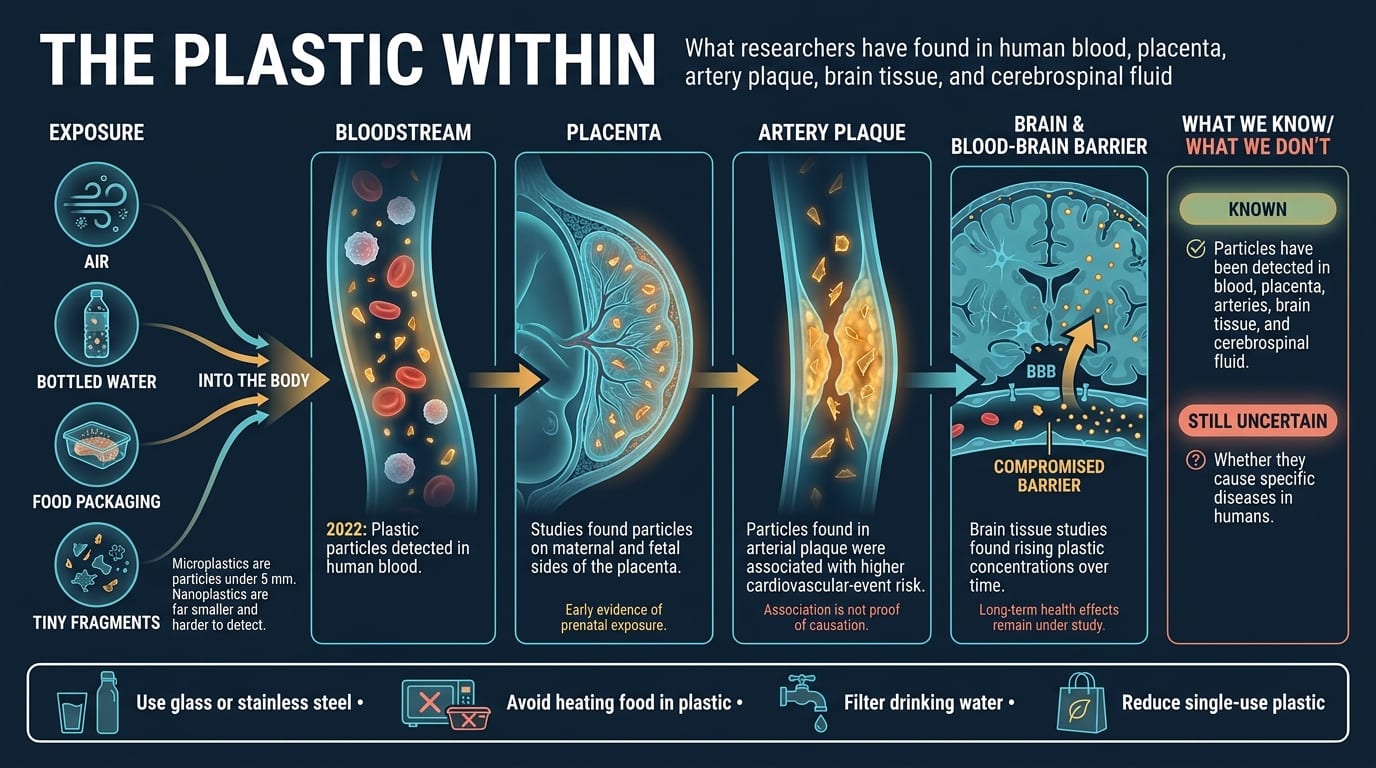
What is established: plastic particles are present in human blood, placenta, arterial plaque, and brain tissue. Their concentrations appear to be increasing over time. Their presence in carotid artery plaque is associated with a significantly higher risk of cardiovascular events. They can cross the placental barrier, exposing the fetus before birth. They can penetrate the blood-brain barrier, especially when that barrier is compromised. And at the cellular level, they are associated with structural changes consistent with oxidative stress and inflammation. [1, 2, 3, 4, 5, 6]
What is not yet established: whether microplastics and nanoplastics cause specific diseases in humans. The NEJM study shows a strong association - a hazard ratio of 4.53 - but association is not causation. The brain study is cross-sectional, examining tissue at a single point in time. The cellular changes observed in placental tissue are suggestive but not definitive proof of harm. [3, 4, 5]
The evidence points in a consistent direction, and the biological plausibility is strong. But the science is still in its early stages. The first study detecting plastic in human blood was published only three years ago. The first study detecting plastic in the human brain was published last year. We are, in a very real sense, only beginning to understand what it means to have plastic inside us.
What Can Be Done
While the research continues, there are practical steps that can reduce exposure. Activated carbon water filters have been shown to reduce microplastic content in tap water. Choosing glass or stainless steel containers over plastic ones reduces leaching, especially with hot or acidic foods. Avoiding plastic food storage and microwave-safe plastic containers - the "microwave-safe" label means the plastic will not melt, not that it will not shed particles - can meaningfully reduce daily intake.
These measures are not a solution to the broader problem of plastic pollution. But they are a starting point for you if you want to reduce your personal burden while the scientific and policy communities work to address the crisis at its source, as if they are even trying to.
References
|
 |



7 Comments
Join the conversation
Honestly at 50,000 particles a year just from food and drink, and that's the LOW estimate, I'm not sure a stainless steel bottle is going to move the needle much. The whole system needs to change not just individual choices.
The placenta findings are what get me. These babies are being born already exposed before they even take a breath. That should be the headline everywhere.
I appreciate that they're honest about what's proven vs what's just associated so far. Too many of these articles skip that part and just go full panic mode.
Switched to a glass water bottle two years ago and honestly feel better about it even if I can't prove anything. Small changes are still something.
deb_mSame here. Made the switch about a year ago and also ditched the plastic containers for leftovers. Can't say I notice a physical difference but it just feels like the right call given everything coming out. Glass is a pain when it breaks though lol.
4.5 times higher risk of heart attack or stroke in people with plastics in their artery plaque. And yet here we are still wrapping everything in single use packaging like it's nothing.
The part about microwave-safe plastic meaning it won't melt but will still shed particles blew my mind. Been microwaving leftovers in plastic containers for years thinking it was fine.